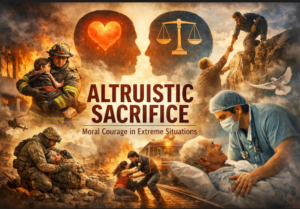
Altruistic Sacrifice: The Psychology of Moral Courage in Extreme Situations

(National Supreme Sacrifice Day Special 18/02)

History is full of examples of people who made other people a priority, heroes who ran into burning homes, military representatives who risked their lives to protect civilians, parents who risked their life to save their children, and even strangers who appeared when needed. These acts which can be termed as supreme sacrifice transcend a normal helping behaviour. They are the ultimate altruism, which is based on profound psychological, moral, and evolutionary processes.

But why would one risk or even sacrifice his life to save others? Is it an instinct, a morality or social conditioning or something deeper within the psychology of man? This paper discusses psychological theory of the origins of altruistic sacrifice, based on prosocial behaviour, moral courage and collective survival instincts.

Understanding Altruism: Beyond Self-Interest

Altruism is essentially a term used to describe the act where a person performs a behaviour that solely aims at benefiting others at a personal sacrifice. The classical psychological theories used to believe that human beings are self-centred, but social psychological studies and evolutionary psychological studies indicate otherwise.

There is the spectrum of altruism:

  • Low-cost altruism– assisting someone with bare minimum effort (e.g. giving directions)
  • High-cost altruism – putting life/resource in danger.
  • Extreme altruism (sacrifice) – taking or giving up one life in order to save others.

Supreme sacrifice is classified under the last category thus making it one of the most complicated human behaviours to explain.

Prosocial Behaviour: The Foundation of Sacrifice

Prosocial behaviour involves activities such as assistance, sharing, protection and cooperation. It is determined both by biology and culture.

Key Psychological Theories:
1. Empathy-Altruism Hypothesis (Batson)

According to this theory, empathy, which allows one to imagine what other person is undergoing, can result in truly altruistic actions.

  • Empathy leads to individuals assisting at the expense of themselves when it is high.
  • Emotional affinity supersedes sound self-preservation.

In very severe cases, like disasters, people tend to claim that they acted without thinking, being emotionally touched by the distress of other people.

2. Social Responsibility Norm

The society makes the society believe that they have a responsibility to assist the vulnerable or needy.

  • Helping behaviour is supported by cultural values.
  • Caregivers, soldiers, and doctors are some of the roles that are associated with moral expectations.

These norms when deep rooted can then encourage people to do things even under situations that are life-threatening.

3. Reciprocal and Kin Altruism

Evolutionarily, there are two possible scenarios that have not been explored:

Kin selection: We are more willing to make sacrifices on behalf of the family since this guarantees the survival of our genes.

Reciprocal altruism: Altruism benefits an individual by enhancing the chances of future altruism.

But even extreme altruism tends to extend beyond these explanations particularly when individuals do sacrifice strangers.

Moral Psychology: The Roots of Moral Courage

Moral courage refers to the readiness to be an advocate of ethical values under any circumstances even at the risk of social rejection, injury, or death.

1. Moral Identity

Individuals that perceive themselves as moral persons tend to perform bravely.

  • The values such as justice, compassion, and duty are included in their self concept.
  • These values are broken, and this leads to internal conflict.

In a severe case scenario, doing nothing can even be more psychologically difficult than losing life.

2. Cognitive Dissonance

People feel uncomfortable when they are in a scenario whereby their moral values are contravened by the action that they fail to take.

  • Assistance alleviates mental anxiety.
  • Sacrifice is an alternative of self-integrity.

3. Moral Elevation

It is possible to feel inspired to do the same things by watching an act of bravery or sacrifice.

  • Heroism exposes individuals to prosocial tendencies.
  • Leaves a wave of change in the society.

This is the reason why tales of sacrifice remain inspirational to generations.

Heroism: The Psychology of Extraordinary Action

Some individuals view heroism as something uncommon but the psychologists believe that given the right circumstances, all human beings can be heroes.

Characteristics of Heroes:

  • High empathy
  • Strong moral values
  • Sense of responsibility
  • The capability of responding to pressure.

Interestingly, most heroes do not consider themselves as extraordinary. They tend to say that they do what everyone would do implying that heroism is not as rare as we believe it to be.

The Role of Situational Factors

Not every sacrifice is done intentionally. A number of them take place in tense, stress-filled settings.

1. The Bystander vs Action Effect.

Although the effect of the bystander implies the smaller propensity to assist in groups, there are extreme cases that turn the opposite:

  • Existence outweighs indecision.
  • People assume responsibility voluntarily.

2. Time Pressure

People use instinct and internalised values when they have no time to think over the matter.

  • Moral conditioning is usually manifested in quick decisions.
  • Rational analysis is surpassed by emotional brain (limbic system).

3. Perceived Responsibility

Human beings tend to do things in a more responsible manner when they perceive personal responsibility.

  • Role responsibility (e.g. police, military).
  • Personal relationship with victims.

Collective Survival Instincts: Evolutionary Perspective

On the evolutionary perspective, a human being is a social animal whose survival is necessitated by cooperation.

1. Group Selection Theory

The groups that are cooperative and altruistic in nature, have bigger chances of survival.

  • To get long-term survival, the group needs to be sacrificed.
  • Promotes unity and trust

2. Emotional Wiring

It is biologically programmed in human beings to react when others are in distress.

  • Mirror neurons are authenticated when we observe suffering.
  • Gives rise to a self-motivated desire to assist.

3. Attachment and Bonding

  • Good social ties enhance readiness to make sacrifices.
  • The role is played by family, community and national identity.
  • “We” overtakes the significance of “I”.

Psychological Traits Linked to Altruistic Sacrifice

Studies have determined that there are a number of characteristics that correlate with extreme prosocial behaviour:

  • Compassion – the feeling of emotion toward others.
  • Compassion- wish to reduce suffering.
  • Self-efficacy- an opinion that one can help.
  • Risk-taking ability- the readiness to take a risk.
  • Moral conviction- high ethical beliefs.

Such characteristics are not in a vacuum, they are combined with situational and cultural factors.

Influences of Culture and Society.

Culture contributes a lot in determining the altruistic behaviour.

1. Collectivist Cultures

  • In cultures which promote group harmony:
  • People tend to put others higher in order of priority.
  • Sacrifice is regarded as noble.

2. Narratives and Role Models

  • Hero tales, martyr tales, and founder of caregivers build expectations in the society.
  • Venerate the power of sacrifice.
  • Offer behavioural prototypes.

3. Religious and Ethical Teachings.

  • A lot of belief systems focus on selflessness, compassion and service.
  • Enhance ethical incentives.
  • Give meaning to sacrifice.

The Paradox of Self-Sacrifice

The most interesting feature of altruistic sacrifice is that it seems to be selfless but it can be accompanied with emotional compensation:

  • Sense of purpose
  • Emotional fulfillment
  • Compliant with personal values.

This puts one in a paradox that, in fact, sacrificing oneself can be a very significant one to the individual.

What is the Time When Sacrifice is Risky?

Although altruism is mostly a good principle, there is moral and psychological concern when one goes too far in sacrificing:

  • Action on impulse vs. thoughtful action.
  • Social demands.
  • Burnout of helping professions.

It is important to learn about these boundaries, particularly among such professionals as healthcare workers, counsellors, and emergency responders.

Mental Health and Society Implications.

The benefits of the promotion of prosocial behaviour are far-reaching:

1. Enhances Social Cohesion

  • Develops loyalty and collaboration.
  • Reduces conflict

2. Improves Mental Well-being

  • Serving others makes one happier.
  • Lowers stress and depression.

3. Encourages Resilience

Societies, which have high altruism, recuperate more quickly than crises.

Is it Teachable to Perform Altruistic Sacrifice?

Even though there are things that a person is born with, most can be fostered:

  • The Guidance of empathy at an early age.
  • Encouraging perspective-taking
  • Promoting moral reasoning
  • Providing role models

Families and educational systems are significant in producing the future generations who will be morally courageous.

Conclusion: The Human Capacity for Selflessness

Altruistic sacrifice is the greatest manifestation of the human potential. It is the place of emotion, morality, and evolution where people are forced to do what is not in their own best interest.

When there is no chance of survival, and fear and survival instincts prevail, others follow another route, which is based on empathy, courage, and a strong sense of responsibility. Such performances are not only good to recall that human beings are not simply motivated by self-preservation but also that they can be very selfless.

When we consider these psychological aspects on the occasion of National Supreme Sacrifice Day, we can see that heroes are not born, but they are made through experiences and values and the unseen strands of human relationship.

After all, sacrifice ability is in all of us. It is not a question whether man is capable of being altruistic or not, but it is a question when that altruism becomes so exceptional.

FAQs on Altruistic Sacrifice & Moral Courage

1. What is altruistic sacrifice in psychology?

Altruistic sacrifice can be defined as extreme prosocial action in which a person voluntarily jeopardises or sacrifices his own safety, well-being, or life to other people. It transcends ordinary helping and is more of moral dedication and action benefit of empathy.

2. What is the difference between altruism and prosocial behaviour?

  • Prosocial behaviour: This can be any behaviour that aims at benefiting others (e.g., sharing, comforting).
  • Altruism: A prosocial behaviour that is a subset, the motivation of which is selfless, and does not presuppose reward.

Any prosocial is altruism, but not all the prosocial acts are altruistic in nature.

3. What is the psychological motivation to extreme sacrifice?

Key factors include:

  • Empathy (feeling others’ pain)
  • Moral identity (identifying oneself as ethical)
  • Sense of responsibility
  • Emotional arousal in crises
  • Internalized social norms

4. What is moral courage?

Moral courage is the skill to perform in line with personal values, even when this risks something, e.g. danger, censure, or loss. Sacrifice is the core of any sacrifice since each person values the morally right rather than the morally secure.

5. Is biological altruistic sacrifice?

Yes, partially. According to evolutionary psychology, it implies:

  • Kin selection (defending family)
  • Helping community survival (group survival instincts).
  • Such brain processes as mirror neurons foster empathy.

Nevertheless, there is no way that science of biology can explain sacrifice to strangers.

6. Why do individuals make sacrifices to strangers?

This is explained by:

  • Batson empathy-altruism hypothesis
  • Moral principles and values
  • Role models and social learning.
  • Immediate emotional crisis psychology over personal interest.

7. What role then does the bystander effect play in such cases?

In general, the bystander effect decreases the helping behaviour among groups.
But in extreme situations:

  • Urgency increases action
  • A single person can affect the action of the group.

8. Is it possible to teach altruistic behaviour?

Yes. It can be developed through:

  • Empathy training
  • Moral education
  • Perspective-taking exercises

Contact with role models and real life storeys of bravery.

9. Are selfless acts psychologically advantageous?

Even in the context of sacrifice:

  • Increased sense of purpose
  • Emotional fulfillment
  • However, congruence to personal values.
  • Increased psychological health.

10. Are there any possible instances of extreme altruism being bad?

Yes, if:

  • It turns reckless and forms without risk evaluation.
  • There is the social pressure on people to make sacrifices.
  • Causes burnout in the helping professions.
  • In prosocial roles, healthy boundaries are significant.
  • Written by Baishakhi Das

    Counselor | Mental Health Practitioner
    B.Sc, M.Sc, PG Diploma in Counseling

Reference Links (Credible Sources)

Here are some useful academic and psychological resources for deeper understanding:

  1. Batson, C. D. (1991). The Altruism Question: Toward a Social-Psychological Answer
    https://psycnet.apa.org/record/1991-97320-000

  2. American Psychological Association – Prosocial Behavior
    https://www.apa.org/monitor/2015/09/prosocial

  3. Greater Good Science Center (UC Berkeley) – Altruism & Compassion
    https://greatergood.berkeley.edu/topic/altruism

  4. Zimbardo, P. – The Heroic Imagination Project
    https://www.heroicimagination.org

  5. Evolutionary Basis of Altruism (Stanford Encyclopedia of Philosophy)
    https://plato.stanford.edu/entries/altruism-biological/

  6. The Psychology of Healthy Eating: How Habits and Self-Regulation Shape Our Nutritional Choices

This article is written for knowledge purposes, aiming to help readers understand the topic better and gain useful insights for learning and awareness.
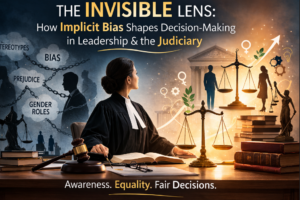
The Invisible Lens: How Implicit Bias Shapes Decision-Making in Leadership and the Judiciary

In modern societies, we often believe that decision-making—especially in leadership and judicial systems—is purely rational and objective. Judges evaluate evidence, leaders analyze facts, and decisions are expected to be impartial. However, psychology reveals a deeper truth: human decisions are rarely free from cognitive influences. One of the most powerful yet subtle influences is implicit bias.

Implicit bias refers to the unconscious attitudes or stereotypes that affect our understanding, actions, and judgments without conscious awareness. Unlike explicit prejudice, implicit biases operate silently, often contradicting our conscious beliefs about fairness and equality.

The Psychological Mechanism of Implicit Bias

From a cognitive psychology perspective, the human brain continuously relies on mental shortcuts known as heuristics to process the vast amount of information it encounters every day. Because our cognitive resources are limited, the brain cannot carefully analyze every situation in detail. Instead, heuristics allow individuals to make rapid judgments and decisions with minimal cognitive effort. These shortcuts are often useful and adaptive, helping us respond quickly in complex environments. However, they can also lead to systematic cognitive biases, especially when decisions are influenced by stereotypes, past experiences, cultural narratives, and social conditioning.

Over time, people internalize societal messages about gender roles, authority, and competence. These internalized patterns become part of our implicit cognitive schemas, which automatically shape perceptions and expectations. For instance, research in social and organizational psychology has shown that many individuals unconsciously associate leadership traits such as assertiveness, dominance, and authority with masculinity, while associating nurturing, caregiving, and emotional sensitivity with femininity. Importantly, these associations can operate even among individuals who consciously endorse gender equality and strongly believe in fairness.

This phenomenon can be better understood through the dual-process theory of cognition, which proposes that human thinking operates through two interacting systems.

  • System 1 thinking is fast, intuitive, automatic, and largely unconscious. It relies heavily on heuristics and learned associations, enabling people to make quick judgments without deliberate reasoning. Because it operates automatically, System 1 can easily activate implicit stereotypes and biases without the individual being aware of it.
  • In contrast, System 2 thinking is slow, deliberate, analytical, and effortful. It involves conscious reasoning, critical evaluation of evidence, and reflective decision-making. System 2 has the capacity to monitor and override automatic responses generated by System 1, but it requires attention and cognitive effort.

Implicit bias primarily operates through System 1 processing, influencing perceptions, evaluations, and judgments before conscious reasoning has the opportunity to intervene. As a result, individuals may unknowingly interpret behaviors, competence, or credibility through the lens of unconscious associations. Understanding this cognitive mechanism is crucial for recognizing how implicit bias can shape decision-making processes in areas such as leadership selection, workplace evaluation, and judicial reasoning, even when individuals strive to act fairly and objectively.

Implicit Bias in Leadership and Judicial Decision-Making

In leadership contexts, implicit bias can subtly influence a wide range of professional decisions, including hiring practices, promotion opportunities, performance evaluations, and perceptions of competence or authority. Even when organizations aim to promote fairness and merit-based evaluation, unconscious stereotypes may shape how leadership qualities are interpreted.

Women leaders, for example, often face what psychologists describe as the “double bind dilemma.” Leadership is traditionally associated with traits such as assertiveness, decisiveness, and dominance—qualities that are culturally coded as masculine. When women demonstrate these traits, they may be perceived as overly aggressive, unlikable, or difficult. Conversely, when they exhibit warmth, empathy, or cooperation—traits socially associated with femininity—they may be judged as less authoritative or less capable of leading effectively. This tension creates a psychological and social challenge where women leaders are evaluated through conflicting expectations.

Within judicial systems, implicit bias can also influence how information is perceived and interpreted. Judges, lawyers, and jurors are expected to make objective decisions based on evidence and legal reasoning; however, psychological research suggests that unconscious cognitive processes can still shape interpretations of evidence, credibility of witnesses, and behavioral judgments. For instance, stereotypes related to gender, race, social class, or cultural background may unconsciously affect how individuals interpret a person’s reliability, honesty, or responsibility. Studies in legal psychology have shown that subtle cues—such as appearance, speech patterns, or emotional expression—can sometimes influence perceptions of guilt, innocence, or moral accountability, even among highly trained professionals who consciously strive for neutrality.

It is important to emphasize that implicit bias does not necessarily reflect deliberate prejudice or intentional discrimination. Instead, it highlights how deeply embedded social stereotypes and automatic cognitive processes interact with institutional structures and professional decision-making. These unconscious influences illustrate the complex relationship between individual cognition and broader social norms, reminding us that achieving true fairness requires not only ethical commitment but also awareness of the psychological mechanisms that shape judgment and behavior.

Gender Dynamics and the Importance of Representation

The presence of women in leadership and judiciary roles plays a crucial role in promoting gender-sensitive perspectives and reducing systemic bias. From the perspective of social role theory, representation helps challenge traditional stereotypes about authority and competence.

Moreover, diverse leadership teams encourage cognitive diversity, which improves decision-making quality by incorporating multiple perspectives and reducing groupthink.

Psychological Strategies to Reduce Implicit Bias

Psychology also offers evidence-based approaches to minimize implicit bias in decision-making:

  1. Awareness Training
    Recognizing that everyone possesses implicit biases is the first step toward reducing their influence.

  2. Structured Decision-Making
    Using standardized evaluation criteria can reduce reliance on subjective judgments.

  3. Perspective-Taking
    Research shows that actively considering another person’s viewpoint can reduce stereotypical thinking.

  4. Diverse Environments
    Regular interaction with diverse groups helps weaken automatic stereotypes over time.

Toward More Conscious Leadership

Implicit bias reminds us that fairness is not only a moral commitment but also a psychological challenge. By understanding how unconscious processes influence judgment, institutions can design systems that promote equity, transparency, and accountability.

As more women step into leadership and judicial roles, they not only break structural barriers but also contribute to reshaping the psychological landscape of authority and decision-making.

Ultimately, the goal is not to eliminate human cognition—an impossible task—but to ensure that our decisions are guided more by awareness than by invisible biases.

Reference 

1. Implicit Bias and Social Cognition


Greenwald, A. G., & Banaji, M. R. (1995).
Implicit Social Cognition: Attitudes, Self-Esteem, and Stereotypes.
Journal Psychological Review.

🔗 https://doi.org/10.1037/0033-295X.102.1.4

2. Dual-Process Theory of Thinking

Kahneman, D. (2011).
Thinking, Fast and Slow.

🔗 https://us.macmillan.com/books/9780374533557/thinkingfastandslow

3. Gender Bias in Leadership Evaluation

Heilman, M. E. (2001).
Description and Prescription: How Gender Stereotypes Prevent Women’s Ascent Up the Organizational Ladder.
Journal of Social Issues.

🔗 https://doi.org/10.1111/0022-4537.00234

5. The Psychology of Protest: How Crowds Think, Feel, and Act Together

Written by Baishakhi Das

Counselor | Mental Health Practitioner
B.Sc, M.Sc, PG Diploma in Counseling

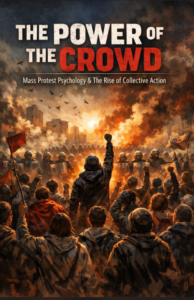
The Psychology of Protest: How Crowds Think, Feel, and Act Together

Mass protests are among the most powerful expressions of human collective behavior. From independence movements to civil rights campaigns, from student uprisings to digital-era demonstrations, protests reveal something profound about the psychology of groups. They show how individual emotions transform into shared purpose, how moral conviction overcomes fear, and how crowds become agents of social change.

Understanding protests through psychology helps us move beyond seeing them as chaos or politics. Instead, they become windows into human identity, motivation, morality, and social influence.

This article explores four key psychological dimensions of protests: mass protest psychology, collective action, moral courage, and crowd behavior. 

1. Mass Protest Psychology: When Individual Minds Become a Shared Mind

At the core of any protest lies a psychological shift: people stop thinking only as individuals and begin thinking as part of a group.

Social psychology calls this process social identity activation. According to Social Identity Theory (Tajfel & Turner), individuals define themselves partly through group membership. During protests, identity shifts from “I am one person” to “I am part of us.”

This shift produces several psychological effects:

a. Emotional Contagion

In crowds, emotions spread rapidly. Anger, hope, grief, and solidarity become amplified. Neuroscience suggests mirror neuron systems help people automatically synchronize emotional states with others.

A person who might remain quiet alone may feel empowered when surrounded by hundreds chanting the same message.

b. Perceived Collective Power

Psychologist Albert Bandura’s idea of collective efficacy is crucial here. People protest when they believe the group can create change. Even if one individual feels powerless, a crowd creates the sense:

“Together, we matter.”

This perception often predicts whether protests escalate, sustain, or dissolve.

c. Legitimacy and Shared Narrative

Protests become psychologically stronger when participants share a moral story:

  • “We are oppressed”
  • “We deserve justice”
  • “This system is unfair”

This narrative builds cognitive unity, turning scattered frustrations into a common cause.

2. Collective Action: Why People Decide to Join Protests

Not everyone who feels injustice joins a protest. Psychology explains this through collective action models, especially the SIMCA Model (Social Identity Model of Collective Action).

It suggests three main factors drive participation:

1. Perceived Injustice

People must feel something is wrong. But injustice alone is not enough.

They must also feel:

  • The situation is unfair
  • Someone is responsible
  • Change is possible

This produces moral outrage, one of the strongest motivators for protest.

2. Group Identity

People protest when they feel psychologically connected to a group affected by the issue.

For example:

  • Students protest education policy
  • Workers protest labor rights
  • Women protest gender violence
  • Citizens protest corruption

Even allies join protests when they develop empathic identification with affected groups.

3. Belief in Effectiveness

If people believe protest is useless, they stay home. When they believe it can work, participation rises dramatically.

This explains why:

  • A small protest can suddenly become huge
  • One viral incident can mobilize thousands
  • Symbolic acts trigger mass response

Psychology calls this threshold activation: once enough people join, others feel safer joining too.

3. Moral Courage: The Psychological Engine Behind Protest

Perhaps the most fascinating part of protest psychology is moral courage — the willingness to stand for values despite fear, risk, or punishment.

Moral courage differs from physical bravery. It involves:

  • Social risk
  • Legal risk
  • Reputation risk
  • Emotional risk

a. Moral Conviction

Psychologist Linda Skitka describes moral conviction as beliefs tied to a person’s core values. When an issue becomes moralized, compromise feels impossible.

People then act not because they want to win, but because:

“It is the right thing to do.”

This explains why some protesters persist even when success seems unlikely.

b. Identity Fusion

Some individuals experience identity fusion — a deep psychological merging between personal identity and group cause.

In such cases:

  • Personal sacrifice feels meaningful
  • Fear reduces
  • Loyalty increases
  • Collective goals feel personal

This phenomenon is seen in freedom movements, resistance struggles, and humanitarian activism.

c. The Role of Witnessing Injustice

Research shows people are more likely to act when:

  • They directly witness injustice
  • Someone from their group is harmed
  • The event feels morally shocking

These moments create moral awakening, transforming passive observers into active participants.


4. Crowd Behavior: Are Crowds Irrational or Highly Structured?

Older theories, like Gustave Le Bon’s crowd psychology, described crowds as irrational and dangerous. Modern psychology challenges this.

Today, the Social Identity Model of Crowd Behavior (Reicher) suggests crowds are not chaotic — they are structured by shared norms and identity.

a. Norms Inside Crowds

Crowds do not behave randomly. They follow implicit rules such as:

  • Protect fellow protesters
  • Follow leaders or symbols
  • Stay united in messaging
  • Respond collectively to threat

Violence, when it occurs, often emerges not from irrationality but from perceived injustice or repression.

b. Deindividuation Revisited

Earlier psychology claimed anonymity in crowds causes loss of self-control (deindividuation theory). Modern research shows something different.

Instead of losing identity, people shift identity:

From personal self → social self

They don’t become mindless.
They become group-minded.

c. Interaction with Authorities

Crowd behavior changes dramatically depending on how authorities respond.

When authorities are perceived as:

  • Legitimate → crowds remain cooperative
  • Unfair → crowds become resistant
  • Aggressive → crowds unite defensively

This dynamic explains why some protests stay peaceful while others escalate.

5. The Psychological Functions of Protest

Beyond politics, protests serve important psychological roles for individuals and societies.

1. Restoring Agency

When people feel unheard, protest restores a sense of control over their lives.

2. Building Solidarity

Protests create social bonds. Participants often report feeling:

  • Less alone
  • More hopeful
  • More connected

3. Emotional Release

Protests act as collective emotional expression:

  • grief
  • anger
  • hope
  • pride

This emotional sharing strengthens group identity.

4. Shaping Social Memory

Protests become historical markers. They redefine what society considers acceptable or unjust.

6. The Double Edge of Crowd Psychology

While protests can empower, psychology also reminds us they carry risks.

Positive Outcomes

Social reform
 Empowerment
 Identity strengthening
 Democratic participation

Potential Risks

Polarization
 Rumor spread
 Group radicalization
 Us-vs-them thinking

The same psychological forces that build unity can also deepen divisions.

7. Protest in the Digital Age: A New Psychological Landscape

Social media has transformed protest psychology.

Now movements spread through:

  • Hashtags
  • Viral videos
  • Online outrage
  • Digital solidarity

Psychologists call this networked collective action.

It has two major effects:

1. Lower Entry Barrier

People can join movements with:

  • a post
  • a share
  • a digital signature

This increases participation but sometimes reduces long-term commitment.

2. Rapid Emotional Mobilization

Online platforms accelerate emotional contagion. Outrage spreads faster than ever before, sometimes mobilizing crowds within hours.

Conclusion: Protest as a Mirror of Human Social Nature

Mass protests are not simply political events — they are psychological phenomena that reveal that deeply humans are social beings.

  • how identity shapes action
  • morality fuels courage
  • how emotions spread across groups
  • collective belief creates power

At their best, protests represent humanity’s drive for justice, dignity, and voice. They remind us that individuals may feel small, but together people can reshape societies.

Understanding protest psychology does not tell us which protests are right or wrong. Instead, it helps us understand why people rise, unite, and act when they believe something must change.

FAQ

1. What does mass protest psychology mean?

The psychology of mass protest involves the examination of the way thoughts, feelings, and behaviours of people evolve when they participate in large scale protests. It is concerned with identity, feelings, group pressure and common morality.

2. Why normal citizens attend demonstrations?

According to research, individuals object when these three aspects are together:
perceived injustice
strong group identity
expectation that sharing power will lead to change.

This can be explained through the Social Identity Model of Collective Action (SIMCA).

3. Are multitudes non-intellectual or sentimental?

Modern psychology declares that crowds are not irrational. They abide by collective group norms, values and objectives. Behaviour is usually organised, intentional and identity based.

4. What does collective efficacy mean when protesting?

Collective efficacy refers to the fact that individuals are convinced that the group can bring about a change. This belief becomes so high that the participation in protests is increased manifold.

5. To what extent is emotions in protests important?

  • Emotions are central.
  • Anger motivates action
  • Hope sustains movements
  • Fear can put off participation.
  • Commitment is enhanced by solidarity.
  • Emotions are transferred in emotional contagion within crowds.

6. What is the moral courage in protest behaviour?

Moral courage is a readiness to defend values regardless of the danger or penalty. It is based on high moral conviction and identity motivation.

7. Why are there violent protests?

Violence can be a frequent occurrence when protesters believe that:

  • injustice from authorities
  • illegitimate force
  • suppressed expression of peace.

The research on the crowd psychology suggests that escalation is not spontaneous chaos but rather interaction-based.

8. What is identity fusion of protest movements?

Identity fusion happens when one is strongly integrated into a group or cause. This can be induced to make the willingness to sacrifice and long-term activism.

9. What is the effect of social media on protest psychology?

Social media accelerates:
emotional mobilization
information spread
group identity formation
rapid participation

Psychologists refer to this collective action networked.

  • 10. Are protests effective in transforming the society?

Mass protest has traditionally been a part of many significant reforms, such as the civil rights and labour regulations overhaul, the independence movements, and so on. Psychology demonstrates that protests influence the opinion of the population, social rules, political pressure.

11. Why are there those who offer support to protests and yet they do not even attend?

Barriers include:

  • fear of punishment
  • low perceived impact
  • deficit of group identification.
  • logistical constraints
  • Participation threshold theory explains this.

12. What are the psychological benefits of those participating?

Participants often report:
empowerment
belonging
emotional release
hope
increased civic identity

Psychological agency can be enhanced by protests.

13. Will protests make social polarisation go up?

Yes. Good group identity might at times lead to the inclination of us vs them thinking which can widen ideological differences in the absence of dialogue.

14. What goes psychologically well with a protest?

It has been proposed that success is determined by:

  • shared identity
  • clear narrative
  • perceived legitimacy
  • sustained participation
  • strategic leadership

15. What are the disciplines of the study of protest psychology?

  • The behaviour of mass protests is analysed in:
  • Social Psychology
  • Political Psychology
  • Sociology
  • Peace & Conflict Studies
  • Group behaviour Research.

Written by Baishakhi Das

Counselor | Mental Health Practitioner
B.Sc, M.Sc, PG Diploma in Counseling


Reference

  1. Social Identity Theory (Tajfel & Turner)
    https://www.simplypsychology.org/social-identity-theory.html

  2. Social Identity Model of Collective Action (SIMCA)
    https://doi.org/10.1037/a0021235

  3. Collective Efficacy – Albert Bandura
    https://psycnet.apa.org/record/2000-13324-003

  4. Crowd Behaviour – Stephen Reicher Research
    https://www.bbcprisonstudy.org/resources

  5. Moral Conviction – Linda Skitka
    https://doi.org/10.1177/0146167208316690

  6. The Language of the Heart: How Mother Tongue Shapes Identity, Memory, and Emotion

This topic performs well due to rising searches around men’s mental health, workplace stress, and burnout recovery. Combining emotional insight with practical steps increases engagement and trust.