
When a protest gathers, private grief and private hope become a single, loud heartbeat — and history listens.
Introduction
Mass protests are among the most powerful expressions of human collective behavior. From independence movements to civil rights campaigns, from student uprisings to digital-era demonstrations, protests reveal something profound about the psychology of groups. They show how individual emotions transform into shared purpose, how moral conviction overcomes fear, and how crowds become agents of social change.
Understanding protests through psychology helps us move beyond seeing them as chaos or politics. Instead, they become windows into human identity, motivation, morality, and social influence.
This article explores four key psychological dimensions of protests: mass protest psychology, collective action, moral courage, and crowd behavior.
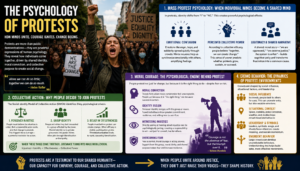
Mass Protest Psychology: When Individual Minds Become a Shared Mind
At the core of any protest lies a psychological shift: people stop thinking only as individuals and begin thinking as part of a group. Social psychology calls this process social identity activation. According to Social Identity Theory (Tajfel & Turner), individuals define themselves partly through group membership. During protests, identity shifts from “I am one person” to “I am part of us.”
This shift produces several psychological effects:
a. Emotional Contagion
In crowds, emotions spread rapidly. Anger, hope, grief, and solidarity become amplified. Neuroscience suggests mirror neuron systems help people automatically synchronize emotional states with others.
A person who might remain quiet alone may feel empowered when surrounded by hundreds chanting the same message.
b. Perceived Collective Power
Psychologist Albert Bandura’s idea of collective efficacy is crucial here. People protest when they believe the group can create change. Even if one individual feels powerless, a crowd creates the sense: “Together, we matter.”
This perception often predicts whether protests escalate, sustain, or dissolve.
c. Legitimacy and Shared Narrative
Protests become psychologically stronger when participants share a moral story:
- “We are oppressed”
- “Deserve justice”
- “This system is unfair”
This narrative builds cognitive unity, turning scattered frustrations into a common cause.
Collective Action: Why People Decide to Join Protests
Not everyone who feels injustice joins a protest. The Social Identity Model of Collective Action (SIMCA) helps explain why by identifying three essential psychological drivers of participation.
1. Perceived injustice
Feeling that something is wrong is necessary but not sufficient. For protest to become likely, people must also believe:
- The situation is unfair, not merely unfortunate.
- A specific actor (a government, institution, employer) is responsible.
- Change is possible—there is a realistic path to make things better.
When these conditions hold, moral outrage is triggered: a powerful, value-driven emotion that motivates people to act rather than passively complain.
2.Group identity
People are more likely to protest when they feel psychologically connected to a group affected by the issue. Shared identity turns private grievances into public claims. Examples:
- Students protesting education policy changes.
- Workers organizing for better labor rights.
- Women mobilizing against gender-based violence.
- Citizens rallying against corruption.
Allies may also join once they empathically identify with the affected group; identification, not just demographic membership, predicts who will step forward.
3.Belief in effectiveness
A core driver is the belief that collective action will achieve results. If protest seems futile, people stay home. When people believe protest can succeed, participation increases sharply.
This belief explains several common patterns:
- Small demonstrations can rapidly grow if initial participants signal that change is possible.
- A high-profile incident or viral video can activate thousands by demonstrating both injustice and impact.
- Symbolic acts (e.g., sit-ins, marches, strikes) can lower others’ thresholds to join.
Psychologists call this threshold activation: once enough people participate and signal safety or efficacy, others feel safer joining, producing cascading growth.
Together, perceived injustice, group identification, and belief in effectiveness create the psychological conditions for collective action. All three usually need to be present for a protest to move from grievance to mass mobilization.
Moral Courage: The Psychological Engine Behind Protest
Perhaps the most fascinating part of protest psychology is moral courage — the willingness to act on values despite fear, risk, or punishment. Unlike physical bravery (which responds to immediate bodily danger), moral courage is about taking social, legal, reputational, or emotional risks to defend principles.
Moral courage involves several related processes:
1. Moral conviction
Moral conviction describes beliefs experienced as grounded in a person’s core values. When an issue is moralized, compromise often feels unacceptable. People with strong moral convictions act not to win a debate but because “it is the right thing to do.” That explains why some protesters persist even when success is unlikely or costly.
Example: Someone repeatedly speaks at public meetings against a policy because it conflicts with their ethical beliefs, even if change is slow.
2.Identity fusion
Identity fusion occurs when personal identity deeply merges with a group or cause. Fused individuals treat the group’s fate as their own. Consequences include:
- Greater willingness to sacrifice personal safety or resources.
- Reduced fear in confrontational settings.
- Stronger loyalty and long-term commitment.
This intense bond appears in liberation movements, resistance struggles, and high-commitment activism where people accept major personal costs for collective goals.
3.Witnessing injustice (moral awakening)
Directly witnessing harm, seeing a member of one’s group victimized, or encountering a morally shocking event often triggers immediate action. These vivid experiences break through apathy and create emotional clarity: the injustice feels personal and urgent.
Example: Bystanders who see police violence toward someone from their community may move from sympathy to active protest or organizing.
How these processes interact
- Moral conviction supplies the “rightness” that legitimizes risk-taking.
- Identity fusion makes that moral claim feel personal and non-negotiable.
- Witnessing injustice provides the immediate catalyst that converts belief into action.
Practical note for organizers and supporters
- Moral courage can be fostered by clear moral framing, narratives that personalize the issue, and opportunities for meaningful participation that build fusion and commitment.
- At the same time, care is needed: high moralization and fusion can lead to uncompromising stances or burnout; supportive networks and risk-awareness training help sustain ethical, resilient movements.
Crowd Behavior: Are Crowds Irrational or Highly Structured?
Older theories (e.g., Gustave Le Bon) portrayed crowds as irrational, contagious masses prone to violence. Contemporary research, especially the Social Identity Model of Crowd Behavior (Reicher), rejects that view. Crowds are organized by shared social identity and norms; their behaviour is purposeful and context-sensitive.
a. Norms inside crowds
Crowds typically follow implicit group rules that guide action, for example:
- Protect fellow protesters (help injured or shield those targeted).
- Follow leaders, symbols, or agreed tactics (chants, banners, routes).
- Maintain a common message or framing.
- Coordinate responses to perceived threats (retreat, form human chains, or hold ground).
When violence occurs, it is often a strategic or reactive response to perceived injustice or repression, not mindless chaos.
Example: During many demonstrations, marshals or trusted organizers direct movement and de-escalation, showing internal structure rather than disorder.
b. Deindividuation revisited
Classic deindividuation theory argued that anonymity in crowds causes a loss of self and impulse control. Modern evidence reframes this: people in crowds shift from their private identity to a social identity tied to the group’s norms. They do not become mindless; they become group-minded. Behavior aligns with shared values—peaceful or confrontational—depending on what the group endorses.
c. Interaction with authorities
The crowd–authority dynamic powerfully shapes outcomes:
- When authorities are perceived as legitimate and proportionate, crowds tend to cooperate and negotiate.
- Perceived unfairness or injustice prompts resistance and noncompliance.
- Aggressive or indiscriminate policing often unites otherwise diverse participants defensively, increasing escalation risk.
This explains why the same march can stay peaceful in one city yet escalate in another: responses from police, officials, and media change the crowd’s perceived identity and permissible norms.
Takeaway: Crowd behaviour is structured, meaningful, and sensitive to social identity and context. Understanding the norms inside crowds and the interaction with authorities helps explain when protests remain peaceful, when they escalate, and how organizers or officials can influence outcomes.
The Psychological Functions of Protest
Beyond politics, protests serve crucial psychological roles for individuals and societies.
1.Restoring agency
Protesting gives people a way to act when they feel ignored or powerless. Taking part—even symbolically—reduces helplessness and restores a sense of influence over public life. Example: signing a petition or joining a march can turn private frustration into visible civic voice.
2.Building solidarity
Shared struggle forges social bonds. Participants commonly report feeling less isolated, more hopeful, and more connected to others who share their values. These new relationships often outlast the event and fuel ongoing activism, mutual aid, or community networks.
3. Emotional release
Protests provide a safe, collective space for emotional expression—grief, anger, hope, pride. This emotional catharsis validates participants’ feelings, reduces stress for some, and strengthens group cohesion by signalling common values and commitments.
4.Shaping social memory
Protests mark public attention and shape collective memory. Iconic demonstrations rewrite social norms and public narratives about what is acceptable or intolerable, influencing laws, culture, and future activism.
Closing link: Taken together, these functions explain why people risk time, reputation, and safety: protests do more than push policy—they restore dignity, create lasting communities, process shared emotions, and change how societies remember and judge their past.
The Double Edge of Crowd Psychology
While protests can be powerful engines of social change and individual growth, their psychological dynamics carry both benefits and risks.
Positive outcomes
- Social reform: Protests can shift policies, laws, and institutional practices.
- Empowerment: Participation increases feelings of agency and political efficacy.
- Identity strengthening: Shared struggle builds collective identity and sustained commitment.
- Democratic participation: Protests broaden civic engagement and public debate.
Potential risks
- Polarization: Strong group identity can harden into “us vs them” thinking, reducing willingness to compromise or listen.
- Rumor and misinformation: Fast emotional spread and limited verification can amplify falsehoods and escalate tensions.
- Group radicalization: Echo chambers and moralization can push movements toward more extreme tactics or beliefs.
- Social exclusion: Movements that emphasize one identity may marginalize allies or dissenting views within the group.
Examples
- Polarization: A protest that frames an issue purely as moral absolutes may alienate potential supporters and deepen societal divides.
- Rumor spread: Viral videos or unverified reports can mobilize crowds quickly but also provoke overreactions when later disproven.
- Radicalization: Insular organizing without external accountability can normalize increasingly risky tactics.
Practical ways to reduce risks
- Encourage inclusive framing: Emphasize shared values and practical goals to broaden support and reduce binary thinking.
- Promote internal accountability: Clear codes of conduct, nonviolence training, and designated marshals limit escalation and keep norms visible.
- Fact-check and transparent communication: Centralized, trusted channels for updates reduce misinformation and panic.
- Foster dialogue channels: Maintain pathways for negotiation with opponents or authorities to avoid permanent polarization.
- Support participant wellbeing: Prepare participants for legal and emotional risks; provide debriefs and mental-health resources to reduce burnout and impulsive escalation.
Takeaway: The same psychological mechanisms that create cohesion and courage in protests also create vulnerability to division and harm. Thoughtful leadership, clear norms, and responsible communication help maximize positive outcomes while limiting risks.
Protest in the Digital Age: A New Psychological Landscape
Social media has reshaped protest psychology by creating rapid, networked collective action. Movements now spread through hashtags, viral videos, online outrage, and digital solidarity—channels that change who participates, how quickly, and why.
Key effects:
1.Lowered entry barrier
Joining a movement often requires only a post, a share, or an online signature. This makes activism more inclusive and scalable: people who cannot attend in person (due to distance, caregiving, disability, or fear) can still contribute and feel connected. However, low-cost participation can produce weaker long-term commitment—“slacktivism”—unless social ties and offline actions follow.
Example: A hashtag campaign can draw millions of supporters worldwide but may convert only a fraction into sustained organizers or local volunteers.
2.Rapid emotional mobilization
Digital networks accelerate emotional contagion. Outrage, grief, or solidarity can spread within hours via video clips, livestreams, and memes, mobilizing people far faster than traditional organizing. This speed can be a strength—prompting immediate action and drawing attention—but it also risks impulsive escalation, misinformation, and poorly coordinated responses.
Example: A viral video of an incident can trigger immediate protests in multiple cities before full facts are available, creating both solidarity and confusion.
Additional dynamics to note
- Visibility and framing: Social media shapes which narratives go viral. Visuals and simple frames (e.g., a slogan or image) travel fastest, often simplifying complex issues.
- Network effects and influencers: Activists, journalists, and public figures can amplify messages exponentially, lowering thresholds for participation.
- Surveillance and countermeasures: Authorities and opposing actors also use digital tools for monitoring, disinformation, and infiltration, raising safety and ethical concerns.
- Hybrid activism: The most resilient movements combine online mobilization with local organizing, sustained relationships, and clear tactics that translate digital momentum into real-world pressure.
Practical implications
- Convert online support into durable engagement by offering clear next steps: local meetings, training, donation links, or volunteer roles.
- Use trusted channels for verified information to counter misinformation.
- Balance rapid mobilization with safety planning and coordination to reduce the risk of unintended escalation.
Takeaway: Networked collective action expands who can join and how fast movements can form, but its power depends on translating digital energy into grounded, strategic, and safe collective action.
Conclusion: Protest as a Mirror of Human Social Nature
Mass protests are not simply political events — they are psychological phenomena that reveal that deeply humans are social beings.
- how identity shapes action
- morality fuels courage
- how emotions spread across groups
- collective belief creates power
At their best, protests represent humanity’s drive for justice, dignity, and voice. They remind us that individuals may feel small, but together people can reshape societies.
Understanding protest psychology does not tell us which protests are right or wrong. Instead, it helps us understand why people rise, unite, and act when they believe something must change.
FAQ
1. What does mass protest psychology mean?
The psychology of mass protest involves the examination of the way thoughts, feelings, and behaviours of people evolve when they participate in large scale protests. It is concerned with identity, feelings, group pressure and common morality.
2. Why normal citizens attend demonstrations?
According to research, individuals object when these three aspects are together:
perceived injustice
strong group identity
expectation that sharing power will lead to change.
This can be explained through the Social Identity Model of Collective Action (SIMCA).
3. Are multitudes non-intellectual or sentimental?
Modern psychology declares that crowds are not irrational. They abide by collective group norms, values and objectives. Behaviour is usually organised, intentional and identity based.
4. What does collective efficacy mean when protesting?
Collective efficacy refers to the fact that individuals are convinced that the group can bring about a change. This belief becomes so high that the participation in protests is increased manifold.
5. To what extent is emotions in protests important?
- Emotions are central.
- Anger motivates action
- Hope sustains movements
- Fear can put off participation.
- Commitment is enhanced by solidarity.
- Emotions are transferred in emotional contagion within crowds.
6. What is the moral courage in protest behaviour?
Moral courage is a readiness to defend values regardless of the danger or penalty. It is based on high moral conviction and identity motivation.
7. Why are there violent protests?
Violence can be a frequent occurrence when protesters believe that:
- injustice from authorities
- illegitimate force
- suppressed expression of peace.
The research on the crowd psychology suggests that escalation is not spontaneous chaos but rather interaction-based.
8. What is identity fusion of protest movements?
Identity fusion happens when one is strongly integrated into a group or cause. This can be induced to make the willingness to sacrifice and long-term activism.
9. What is the effect of social media on protest psychology?
Social media accelerates:
emotional mobilization
information spread
group identity formation
rapid participation
Psychologists refer to this collective action networked.
-
10. Are protests effective in transforming the society?
Mass protest has traditionally been a part of many significant reforms, such as the civil rights and labour regulations overhaul, the independence movements, and so on. Psychology demonstrates that protests influence the opinion of the population, social rules, political pressure.
11. Why are there those who offer support to protests and yet they do not even attend?
Barriers include:
- fear of punishment
- low perceived impact
- deficit of group identification.
- logistical constraints
- Participation threshold theory explains this.
12. What are the psychological benefits of those participating?
Participants often report:
empowerment
belonging
emotional release
hope
increased civic identity
Psychological agency can be enhanced by protests.
13. Will protests make social polarisation go up?
Yes. Good group identity might at times lead to the inclination of us vs them thinking which can widen ideological differences in the absence of dialogue.
14. What goes psychologically well with a protest?
It has been proposed that success is determined by:
- shared identity
- clear narrative
- perceived legitimacy
- sustained participation
- strategic leadership
15. What are the disciplines of the study of protest psychology?
- The behaviour of mass protests is analysed in:
- Social Psychology
- Political Psychology
- Sociology
- Peace & Conflict Studies
- Group behaviour Research.
Reference
-
Social Identity Theory (Tajfel & Turner)
https://www.simplypsychology.org/social-identity-theory.html -
Social Identity Model of Collective Action (SIMCA)
https://doi.org/10.1037/a0021235 -
Collective Efficacy – Albert Bandura
https://psycnet.apa.org/record/2000-13324-003 -
Crowd Behaviour – Stephen Reicher Research
https://www.bbcprisonstudy.org/resources -
Moral Conviction – Linda Skitka
https://doi.org/10.1177/0146167208316690 - The Language of the Heart: How Mother Tongue Shapes Identity, Memory, and Emotion
This topic performs well due to rising searches around men’s mental health, workplace stress, and burnout recovery. Combining emotional insight with practical steps increases engagement and trust.
Pingback: The Invisible Lens: How Implicit Bias Influences Leadership
What I appreciate about this topic is that it looks beyond symptoms and explores the psychological processes underneath them. Understanding the “why” can often be the beginning of meaningful change.