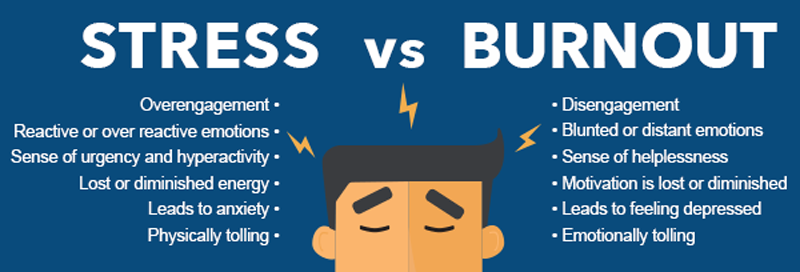
Stress vs Burnout: How to Tell the Difference

https://doctorondemand.com/wp-content/uploads/2022/04/stress-vs-burnout.png

In today’s fast-paced world, feeling overwhelmed has become almost a normal part of daily life. Long work hours, constant digital connectivity, financial pressures, and growing personal responsibilities have blurred the line between productivity and exhaustion. As a result, many people use the terms stress and burnout interchangeably—but psychologically, they are not the same experience.

Understanding the difference between stress and burnout is crucial because they affect the mind and body in very different ways and require different responses. Stress is often a short-term reaction to pressure and can sometimes be managed with rest or problem-solving. Burnout, however, develops gradually from prolonged, unmanaged stress and leads to deep emotional, mental, and physical exhaustion.

When burnout is mistaken for ordinary stress and addressed only with quick fixes—such as taking a short break or pushing harder—it can silently worsen. Over time, this may contribute to anxiety, depression, physical illness, emotional numbness, and a loss of meaning or motivation.

What Is Stress?

Stress is the body’s natural response to pressure, challenge, or perceived demand. It arises when external situations or internal expectations feel greater than one’s current coping capacity. From a psychological perspective, stress is not inherently harmful—it is a signal, alerting the mind and body to mobilize resources for adaptation.

Stress is usually:

  • Situational – tied to a specific circumstance or phase of life

  • Short- to medium-term – it rises and falls as demands change

  • Demand-linked – connected to identifiable tasks, responsibilities, or pressures

Common stressors include work deadlines, academic exams, financial strain, caregiving roles, relationship conflicts, health concerns, or major life transitions. These stressors activate the body’s stress response system (sympathetic nervous system), preparing a person to respond, solve, or endure.

Psychological Experience of Stress

Psychologically, stress is often experienced as:

  • Feeling overwhelmed but still mentally engaged

  • Persistent worry, tension, or irritability

  • Racing or repetitive thoughts, especially about “what needs to be done”

  • Heightened alertness and a strong sense of urgency

  • Difficulty relaxing, even during rest periods

Despite discomfort, motivation is usually still present. The person may feel exhausted yet continues to push forward, believing effort will resolve the situation.

A key cognitive belief commonly seen in stress is:

“Once this situation improves, I’ll feel better.”

This belief reflects an important distinction:
Under stress, people generally retain hope and purpose. They expect relief once the pressure eases, which is why stress—though uncomfortable—often remains psychologically manageable in the short term.

When stress becomes chronic or unrelenting, however, this belief can begin to fade, increasing the risk of emotional exhaustion and burnout.

What Is Burnout?

Burnout is a state of chronic emotional, mental, and physical exhaustion that develops after prolonged exposure to stress that has not been adequately managed or relieved. It is most commonly associated with work, caregiving, and helping professions, where demands are continuous and recovery is limited or absent.

Unlike stress—which involves overactivation—burnout reflects depletion. The system no longer has enough emotional or psychological resources to respond.

The World Health Organization defines burnout as an occupational phenomenon characterized by three core dimensions:

  • Emotional exhaustion – feeling completely drained, depleted, and unable to give more

  • Mental distance, cynicism, or depersonalization – emotional withdrawal from work or responsibilities, often expressed as negativity or indifference

  • Reduced sense of effectiveness – feeling incompetent, unproductive, or that one’s efforts no longer matter

Burnout does not occur suddenly. It develops gradually, often disguised as “just being tired” or “having a bad phase,” and frequently goes unrecognized until daily functioning, relationships, or physical health are significantly affected.

Psychological Experience of Burnout

Psychologically, burnout is experienced very differently from stress:

  • Emotional numbness or emptiness, rather than anxiety

  • Detachment and cynicism, especially toward work, people, or responsibilities once cared about

  • Profound loss of motivation, meaning, and purpose

  • Feeling trapped, helpless, or stuck, with no sense of agency

  • Reduced emotional reactivity—both positive and negative feelings feel muted

While stressed individuals are often still striving and hoping for relief, burned-out individuals feel psychologically disconnected. Tasks that once felt manageable now feel pointless or unbearable.

A defining cognitive belief in burnout is:

“Nothing will change—even if the pressure stops.”

This belief reflects learned helplessness and emotional shutdown. Even rest or time off may not bring relief, because the nervous system and sense of meaning are already depleted.

Key Psychological Difference from Stress

  • Stress → “Too much to handle, but I must keep going.”

  • Burnout → “I have nothing left to give, and it doesn’t matter anymore.”

Burnout is not a personal failure or lack of resilience—it is a systemic response to prolonged overload without recovery, support, or control. Recovery therefore requires more than rest; it involves restoring meaning, boundaries, autonomy, and emotional safety.

Stress vs Burnout: Key Differences

Aspect Stress Burnout
Duration Short-term or episodic Long-term, chronic
Energy Overactive, tense Depleted, exhausted
Emotions Anxiety, irritability Hopelessness, numbness
Motivation Still present Significantly reduced
Engagement Over-engaged Disengaged
Recovery Improves with rest Persists despite rest

Emotional Signs: How They Feel Different

Stress Feels Like

  • “Everything feels urgent.”
  • “There’s no space to pause.”
  • “If I rest, I’ll fall behind.”

Burnout Feels Like

  • “I don’t care anymore”

  • “I’m empty”

  • “I’m done, but I can’t leave”

Stress pushes you to keep going.
Burnout makes you want to stop altogether.

Behavioral Differences

Under Stress

  • Overworking

  • Difficulty relaxing

  • Short temper

  • Sleep problems

Under Burnout

  • Procrastination or withdrawal

  • Reduced performance

  • Emotional detachment

  • Avoidance of responsibility

Burnout often looks like laziness from the outside—but psychologically, it is exhaustion, not lack of effort.

Physical Symptoms

Both stress and burnout affect the body, but differently:

Stress

  • Headaches

  • Muscle tension

  • Rapid heartbeat

  • Digestive issues

Burnout

  • Chronic fatigue

  • Frequent illness

  • Sleep disturbances

  • Body aches with no clear cause

Burnout weakens the immune system due to prolonged nervous system overload.

Why Stress Turns Into Burnout

Stress becomes burnout when:

  • Recovery time is insufficient

  • Emotional needs are ignored

  • Boundaries are consistently crossed

  • Effort is high but control or reward is low

Caregiving professionals, healthcare workers, counselors, parents, and corporate employees are especially vulnerable.

Can You Be Stressed and Burned Out at the Same Time?

Yes. Many people experience high stress on top of burnout. This feels like:

  • Emotional emptiness + anxiety

  • Exhaustion + pressure to perform

  • Detachment + guilt

This combination significantly increases the risk of depression and anxiety disorders.

How to Respond: Stress vs Burnout

If It’s Stress

  • Time management

  • Short breaks

  • Relaxation techniques

  • Problem-solving

  • Temporary rest

If It’s Burnout

  • Reducing demands (not just resting)

  • Emotional support or therapy

  • Re-evaluating roles and boundaries

  • Restoring meaning and autonomy

  • Long-term lifestyle changes

Burnout cannot be healed by a weekend break.

When to Seek Professional Help

Consider professional support if:

  • Emotional numbness lasts weeks or months

  • You feel detached from people or work

  • Motivation does not return after rest

  • Physical symptoms persist without cause

The American Psychological Association emphasizes early intervention to prevent long-term mental health consequences.

Key Takeaways

  • Stress is about too much

  • Burnout is about nothing left

  • Stress responds to rest

  • Burnout requires deeper change

  • Recognizing the difference protects mental health

Final Reflection

Stress says:
“I can’t slow down.”

Burnout says:
“I can’t go on.”

Stress reflects pressure within capacity—painful, but still fueled by urgency and hope. Burnout reflects depletion beyond capacity—where motivation, meaning, and emotional energy are exhausted.

Listening carefully to this internal shift is critical. When “pushing through” turns into emotional numbness, detachment, or hopelessness, the body and mind are signaling the need for deeper intervention—not just rest.

Recognizing this difference early can prevent long-term emotional collapse, protect mental health, and create space for recovery before functioning is severely compromised.

Frequently Asked Questions (FAQ)

1. Is stress always harmful?

No. Stress is a normal psychological and physiological response to challenges. Short-term stress can improve focus and performance. It becomes harmful when it is chronic, intense, and unmanaged, increasing the risk of anxiety, depression, and burnout.


2. How is burnout different from stress?

Stress involves over-engagement—too much pressure and urgency. Burnout involves disengagement—emotional exhaustion, cynicism, and loss of meaning. Stress says “I must keep going,” while burnout says “I have nothing left.”


3. Can stress turn into burnout?

Yes. Prolonged stress without adequate rest, control, emotional support, or recovery can gradually develop into burnout. Burnout is often the result of long-term stress that feels unavoidable.


4. Is burnout a mental illness?

Burnout is not classified as a mental disorder. According to the World Health Organization, it is an occupational phenomenon. However, burnout can increase vulnerability to depression, anxiety disorders, and physical health problems.


5. Can taking a break cure burnout?

Short breaks may help stress, but burnout usually requires deeper changes, such as:

  • Reducing ongoing demands

  • Restoring boundaries and autonomy

  • Reconnecting with meaning and values

  • Psychological support or counseling

Without these, symptoms often return quickly.


6. Who is most at risk of burnout?

People in high-responsibility or caregiving roles, such as healthcare workers, counselors, teachers, parents, corporate employees, and caregivers—especially when there is high demand and low support.


7. When should someone seek professional help?

Professional support is recommended when symptoms include:

  • Persistent emotional numbness or hopelessness

  • Loss of motivation lasting weeks or months

  • Withdrawal from work or relationships

  • Physical symptoms (sleep issues, fatigue, frequent illness)

  • Feeling trapped or helpless

Early intervention can prevent long-term psychological and occupational damage.


Written by Baishakhi Das

Counselor | Mental Health Practitioner
B.Sc, M.Sc , PG Diploma in Counseling

Reference 

  1. World Health Organization (WHO)
    Burn-out an occupational phenomenon
    https://www.who.int/news/item/28-05-2019-burn-out-an-occupational-phenomenon

  2. American Psychological Association (APA)
    Stress effects on the body
    https://www.apa.org/topics/stress/body

  3. National Institute for Occupational Safety and Health (NIOSH)
    Stress at work
    https://www.cdc.gov/niosh/topics/stress

  4. Maslach, C., & Leiter, M. P. (2016).
    Understanding the burnout experience. World Psychiatry
    https://onlinelibrary.wiley.com/doi/10.1002/wps.20311

  5. Harvard Health Publishing
    Burnout: Symptoms and prevention
    https://www.health.harvard.edu/blog/burnout-modern-affliction-or-human-condition-2017071912199

  6. Why You Feel Emotionally Numb: When You Can’t Feel What You Know You Should  
  7. Emotional Burnout: Symptoms You Shouldn’t Ignore

 

Emotional Burnout: Symptoms You Shouldn’t Ignore

Introduction: When Exhaustion Goes Beyond Tiredness

Everyone feels tired sometimes. Long days, responsibilities, emotional demands, and stress are part of modern life. But emotional burnout is different. It is not solved by a weekend off, a good night’s sleep, or a short break.

Emotional burnout is a state of chronic emotional, mental, and physical exhaustion caused by prolonged stress—especially stress that feels inescapable, unrecognized, or unsupported. It slowly drains motivation, empathy, and a sense of meaning, often without dramatic warning signs.

Many people ignore burnout because they believe:

  • “This is just stress.”

  • “I should be able to handle this.”

  • “Others have it worse.”

  • “Once things settle down, I’ll feel better.”

But burnout does not suddenly appear—it builds quietly. And the longer it goes unnoticed, the deeper its impact on mental health, relationships, and physical well-being.

This article explores what emotional burnout really is, how it develops, the symptoms you should never ignore, and how recovery is possible.

What Is Emotional Burnout?

Emotional burnout is a condition marked by persistent emotional depletion, reduced capacity to cope, and a sense of detachment or hopelessness. It occurs when emotional demands consistently exceed a person’s internal and external resources.

Burnout commonly affects:

  • Caregivers

  • Parents

  • Healthcare professionals

  • Counselors and teachers

  • Corporate employees

  • Homemakers

  • Individuals in emotionally demanding relationships

However, burnout is not limited to work—it can arise from chronic family conflict, financial stress, caregiving roles, trauma, or prolonged emotional suppression.

Burnout vs Stress: Understanding the Difference

Stress involves too much pressure.
Burnout involves nothing left to give.

Stress Burnout
Over-engagement Emotional disengagement
Anxiety and urgency Hopelessness and numbness
Feeling overwhelmed Feeling empty
Still motivated Loss of motivation
Temporary Chronic

Stress says, “I can’t keep up.”
Burnout says, “I don’t care anymore.”

How Emotional Burnout Develops

Burnout is rarely sudden. It develops in stages, often unnoticed.

Stage 1: Chronic Overload

  • High expectations

  • Constant responsibility

  • Lack of rest

  • Emotional overextension

Stage 2: Emotional Suppression

  • Ignoring needs

  • “Pushing through”

  • Minimizing feelings

  • Avoiding vulnerability

Stage 3: Depletion

  • Reduced energy

  • Emotional exhaustion

  • Loss of enthusiasm

Stage 4: Detachment

  • Numbness

  • Cynicism

  • Withdrawal from people

Stage 5: Breakdown

  • Anxiety or depressive symptoms

  • Physical illness

  • Emotional shutdown

Recognizing burnout earlier prevents deeper psychological harm.

Emotional Burnout Symptoms You Shouldn’t Ignore

1. Persistent Emotional Exhaustion

You feel drained even after rest. Emotional tasks—listening, caring, responding—feel overwhelming. You may think:

  • “I have nothing left.”

  • “I can’t handle one more thing.”

This exhaustion is emotional, not just physical.

2. Loss of Motivation and Meaning

Tasks that once mattered now feel pointless. You may continue functioning out of obligation, not interest.

Common thoughts:

  • “What’s the point?”

  • “Nothing excites me anymore.”

  • “I’m just going through the motions.”

This loss of meaning is a core burnout signal.

3. Emotional Numbness

Instead of intense feelings, you feel nothing. Happiness, sadness, excitement, and empathy feel distant.

Numbness is not strength—it is a protective shutdown when the nervous system is overwhelmed.

4. Increased Irritability or Detachment

Small things trigger anger or frustration. Alternatively, you may feel emotionally detached and indifferent.

You might:

  • Withdraw from loved ones

  • Avoid conversations

  • Feel guilty for being unavailable

5. Chronic Fatigue

You feel tired all the time, regardless of sleep. Getting through the day feels like an effort.

Burnout fatigue is deep and persistent, not relieved by rest alone.

6. Cognitive Difficulties

Burnout affects thinking:

  • Poor concentration

  • Forgetfulness

  • Indecisiveness

  • Mental fog

You may feel mentally “slow” or ineffective, which further lowers confidence.

7. Physical Symptoms Without Clear Cause

Emotional burnout often manifests physically:

  • Headaches

  • Digestive issues

  • Body aches

  • Weakened immunity

  • Sleep disturbances

The body expresses what the mind has been suppressing.

8. Increased Anxiety or Hopelessness

Burnout can coexist with:

  • Anxiety

  • Low mood

  • Feelings of helplessness

  • Fear of the future

Unchecked burnout may evolve into clinical anxiety or depression.

Emotional Burnout in Different Life Roles

Burnout in the Workplace

  • Feeling undervalued

  • Constant pressure without control

  • Emotional labor without recognition

  • Fear of failure or replacement

High performers are especially vulnerable.

Burnout in Caregivers and Parents

  • Emotional over-responsibility

  • Lack of support

  • No personal time

  • Guilt for needing rest

Caregivers often normalize burnout until collapse occurs.

Burnout in Relationships

  • Constant emotional giving

  • One-sided dynamics

  • Suppressed resentment

  • Fear of conflict

Love does not protect against burnout—lack of boundaries does.

Why Emotional Burnout Is Often Ignored

  • It develops gradually

  • Productivity may remain intact

  • Society rewards overwork

  • Emotional pain is minimized

  • Many confuse burnout with weakness

Ignoring burnout does not make it disappear—it deepens it.

The Psychological Cost of Ignoring Burnout

Untreated burnout can lead to:

  • Anxiety disorders

  • Depression

  • Emotional disconnection

  • Relationship breakdown

  • Identity confusion

  • Loss of self-worth

Burnout does not mean failure—it means you’ve been strong for too long without support.

How Emotional Burnout Affects Identity

Many people tie self-worth to:

  • Productivity

  • Caregiving

  • Achievement

  • Responsibility

Burnout disrupts identity:

“If I can’t function like before, who am I?”

Healing requires redefining worth beyond output.

Recovery from Emotional Burnout: What Actually Helps

1. Acknowledge the Burnout

Naming burnout reduces shame. You are not lazy, weak, or ungrateful—you are exhausted.

2. Reduce Emotional Load (Not Just Tasks)

Burnout is not solved by time management alone. Emotional labor must be addressed.

Ask:

  • What am I emotionally carrying?

  • Where am I over-giving?

  • What boundaries are missing?

3. Rest Without Guilt

True rest is non-productive rest—without self-judgment.

Burnout recovery requires permission to pause.

4. Reconnect with Emotions Safely

Burnout suppresses feelings. Gentle emotional reconnection—through journaling, therapy, or quiet reflection—is essential.

5. Seek Professional Support

Therapy helps:

  • Identify burnout patterns

  • Process suppressed emotions

  • Rebuild boundaries

  • Restore emotional regulation

You do not need to reach crisis to seek help.

When to Seek Help Immediately

Seek professional support if:

  • Burnout lasts more than a few months

  • You feel emotionally numb or hopeless

  • Anxiety or depression symptoms increase

  • Physical health is affected

  • You feel disconnected from yourself or loved ones

Burnout is treatable, especially when addressed early.

Preventing Emotional Burnout Long-Term

  • Set emotional boundaries

  • Normalize asking for help

  • Separate worth from productivity

  • Schedule rest like responsibility

  • Check in with emotions regularly

Prevention is not selfish—it is sustainable care.

Final Thoughts: Burnout Is a Signal, Not a Failure

Emotional burnout is your mind and body asking for care, balance, and recognition. It does not mean you are incapable—it means you have exceeded your emotional capacity without adequate support.

Listening to burnout symptoms early is an act of self-respect.

You deserve rest before collapse.
Support before exhaustion.
Care before breakdown.

Frequently Asked Questions (FAQ): Emotional Burnout


1. What is emotional burnout?

Emotional burnout is a state of chronic emotional, mental, and physical exhaustion caused by prolonged stress and emotional overload. It develops when demands consistently exceed a person’s capacity to cope, leading to exhaustion, detachment, and loss of motivation.


2. How is emotional burnout different from stress?

Stress involves feeling overwhelmed but still engaged and motivated. Burnout, on the other hand, is marked by emotional depletion, numbness, and disengagement. Stress says, “I have too much to do,” while burnout says, “I have nothing left to give.”


3. What are the early symptoms of emotional burnout?

Early signs include persistent fatigue, irritability, lack of motivation, emotional exhaustion, difficulty concentrating, sleep problems, and feeling detached from work or relationships. Ignoring these signs can lead to more serious mental health concerns.


4. Can emotional burnout affect physical health?

Yes. Emotional burnout often manifests physically through headaches, digestive issues, weakened immunity, muscle pain, sleep disturbances, and chronic fatigue. The body reflects prolonged emotional and psychological stress.


5. Who is most at risk of emotional burnout?

Burnout commonly affects caregivers, parents, healthcare professionals, teachers, counselors, corporate employees, and individuals in emotionally demanding roles or relationships. However, anyone experiencing prolonged stress without adequate support can develop burnout.


6. Is emotional burnout the same as depression?

No, but they can overlap. Burnout is primarily related to chronic stress and emotional overload, while depression is a clinical mood disorder. Untreated burnout can increase the risk of anxiety or depressive disorders over time.


7. Can emotional burnout be prevented?

Yes. Prevention includes setting emotional boundaries, balancing responsibilities, prioritizing rest, seeking social support, and addressing stress early. Regular emotional check-ins and self-care practices reduce the risk significantly.


8. How does therapy help with emotional burnout?

Therapy helps individuals identify burnout patterns, process suppressed emotions, rebuild boundaries, and develop healthier coping strategies. Approaches such as Cognitive Behavioral Therapy (CBT) and stress-management interventions are especially effective.


9. When should someone seek professional help for burnout?

You should seek professional help if burnout symptoms persist for weeks or months, interfere with daily functioning, cause emotional numbness or hopelessness, or are accompanied by anxiety, depression, or physical health problems.

Written by Baishakhi Das

Counselor | Mental Health Practitioner
Qualifications: B.Sc in Psychology | M.Sc  | PG Diploma in Counseling

Reference 


Fatherhood and Mental Health: What Every Dad Should Know

Fatherhood is often described as one of life’s most meaningful roles—but it is also one of the least emotionally discussed. While much attention is rightly given to mothers’ mental health, fathers’ emotional experiences are frequently minimized, overlooked, or dismissed with phrases like “men are strong” or “fathers just need to provide.”

In reality, fatherhood brings profound psychological, emotional, relational, and identity changes. When these changes go unsupported, many fathers struggle silently—with stress, anxiety, depression, anger, emotional distance, or burnout.

This article explores fatherhood and mental health in depth, addressing the emotional challenges fathers face, why many struggle in silence, and what every dad should know to protect his mental well-being.

Fatherhood Is a Major Psychological Transition

Becoming a father is not just a role change—it is an identity shift.

Men often experience:

  • Increased responsibility and pressure

  • Fear of failure as a provider or protector

  • Changes in self-identity and priorities

  • Reduced personal freedom

  • Emotional reactivation of their own childhood experiences

Unlike women, men are rarely prepared emotionally for this transition. Many enter fatherhood with high expectations but little guidance, leading to internal stress and self-doubt.

Common Mental Health Challenges in Fathers

1. Paternal Depression (Yes, Fathers Get Depressed Too)

Depression in fathers often looks different from stereotypical sadness.

Common signs include:

  • Irritability or anger

  • Emotional numbness

  • Withdrawal from family

  • Overworking or avoiding home

  • Increased substance use

  • Physical complaints (headaches, fatigue)

Many fathers do not recognize these signs as depression, delaying help-seeking.

2. Anxiety and Constant Worry

Fathers frequently experience anxiety related to:

  • Financial responsibility

  • Child’s safety and future

  • Relationship changes with partner

  • Work–life balance

This anxiety may remain unspoken, manifesting instead as restlessness, control, or emotional distance.

3. Anger and Emotional Dysregulation

For many men, anger becomes the default emotion, especially when sadness, fear, or overwhelm feel unacceptable.

Unaddressed anger can:

  • Damage partner relationships

  • Create fear in children

  • Increase guilt and shame

  • Lead to emotional disconnection

Anger in fathers is often a signal of unmet emotional needs, not moral failure.

4. Loneliness and Emotional Isolation

Even in families, many fathers feel deeply alone.

Reasons include:

  • Reduced social connections

  • Emotional focus shifting primarily to the mother–child bond

  • Lack of spaces where men can speak openly

  • Belief that they must “handle it alone”

Loneliness in fathers is strongly linked to depression and burnout.

Postpartum Mental Health in Fathers

Postpartum mental health is not exclusive to mothers. Fathers can experience:

  • Postnatal depression

  • Anxiety

  • Identity confusion

  • Feelings of invisibility

Risk factors include:

  • Partner’s postpartum depression

  • Sleep deprivation

  • Relationship strain

  • Prior mental health history

Yet paternal postpartum mental health remains severely under-recognized.

How Fatherhood Reactivates Childhood Wounds

Fatherhood often brings unresolved childhood experiences to the surface.

Fathers may find themselves thinking:

  • “I don’t want to become my father”

  • “I don’t know how to show affection”

  • “I never learned how to be emotionally present”

Unhealed childhood emotional neglect, abuse, or absence can affect:

  • Emotional availability

  • Attachment with children

  • Parenting style

  • Self-criticism and guilt

Awareness of these patterns is the first step toward breaking generational cycles.

Impact of a Father’s Mental Health on Children

A father’s mental health significantly affects a child’s:

  • Emotional regulation

  • Sense of safety

  • Self-esteem

  • Social development

Children don’t need perfect fathers—they need emotionally present and regulated ones.

When fathers model:

  • Emotional awareness

  • Healthy coping

  • Repair after mistakes

children learn resilience and emotional security.

Why Fathers Often Don’t Seek Help

Common barriers include:

  • Stigma around male vulnerability

  • Fear of being seen as weak

  • Belief that others’ needs matter more

  • Lack of male-focused mental health spaces

Many fathers seek help only when:

  • Relationships break down

  • Anger becomes unmanageable

  • Physical symptoms appear

Early support can prevent long-term harm.

Healthy Ways Fathers Can Support Their Mental Health

1. Normalize Emotional Struggle

Feeling overwhelmed does not mean you are failing as a father. It means you are human.

2. Build Emotional Language

Learning to name emotions reduces anger, stress, and emotional shutdown.

3. Prioritize Sleep and Physical Health

Sleep deprivation alone can severely impact mood, patience, and decision-making.

4. Create Support Systems

This may include:

  • Trusted friends

  • Support groups

  • Therapy or counseling

Isolation intensifies distress.

5. Seek Professional Support Early

Therapy is not about weakness—it is about responsibility and self-awareness.

A Message to Fathers

You are allowed to:

  • Feel overwhelmed

  • Ask for help

  • Rest

  • Talk about fear and doubt

  • Take care of your mental health

Strong fathers are not those who suffer silently—but those who choose awareness, support, and growth.

Final Reflection

Fatherhood is not just about providing—it is about presence. A father’s mental health shapes not only his own well-being, but the emotional climate of his family and the future emotional health of his children.

By acknowledging the emotional realities of fatherhood, breaking silence around men’s mental health, and encouraging support-seeking, we create healthier fathers, stronger families, and more emotionally secure children.

FREQUENTLY ASKED QUESTIONS (FAQ)


1. Is it normal for fathers to struggle with mental health?

Yes. Fatherhood brings major emotional, identity, and lifestyle changes. Stress, anxiety, sadness, anger, or emotional numbness are common and valid experiences, not signs of weakness.


2. What does depression look like in fathers?

Depression in fathers often appears as:

  • Irritability or anger

  • Emotional withdrawal

  • Overworking or avoidance

  • Fatigue and sleep problems

  • Substance use

Many fathers don’t feel “sad,” which is why paternal depression often goes unnoticed.


3. Can fathers experience postpartum depression?

Yes. Paternal postpartum depression affects many men, especially during the first year after childbirth. Risk increases if:

  • The partner has postpartum depression

  • Sleep deprivation is severe

  • There is relationship stress

  • The father has a history of mental health issues


4. How does a father’s mental health affect children?

A father’s mental health influences a child’s:

  • Emotional security

  • Stress regulation

  • Self-esteem

  • Behavioral development

Emotionally present fathers support healthier psychological outcomes in children.


5. Why do many fathers avoid seeking help?

Common reasons include:

  • Social stigma around male vulnerability

  • Pressure to “be strong”

  • Fear of being judged as weak

  • Lack of father-focused mental health resources


6. Is anger in fathers a mental health issue?

Anger is often a secondary emotion masking stress, fear, sadness, or burnout. Persistent anger may signal unmet emotional needs or emotional overload and deserves attention, not shame.


7. When should a father seek professional help?

Support is strongly recommended if emotional distress:

  • Is harming relationships

  • Leads to aggression or emotional shutdown

  • Interferes with work or parenting

  • Coexists with trauma, anxiety, or depression

Early help prevents long-term impact.


8. Does therapy really help fathers?

Yes. Therapy helps fathers:

  • Regulate emotions

  • Process stress and trauma

  • Improve relationships

  • Build emotional confidence

  • Break intergenerational patterns

Therapy is a strength-based choice, not a failure.


9. How can fathers support their mental health daily?

  • Get adequate sleep where possible

  • Share emotional load with trusted people

  • Limit overworking

  • Practice emotional awareness

  • Seek professional support early


10. What is the most important message for fathers?

You don’t have to suffer silently.
Caring for your mental health is part of caring for your family.

Written by Baishakhi Das

Counselor | Mental Health Practitioner
Qualifications: B.Sc in Psychology | M.Sc  | PG Diploma in Counseling

Reference 

  1. World Health Organization (WHO) – Mental Health
    https://www.who.int/teams/mental-health-and-substance-use
    (Global mental health framework and family wellbeing)

  2. American Psychological Association – Fathers & Mental Health
    https://www.apa.org/monitor/2013/02/fatherhood
    (Psychological impact of fatherhood on men)

  3. National Institute of Mental Health (NIMH) – Men and Mental Health
    https://www.nimh.nih.gov/health/topics/men-and-mental-health
    (Male depression, anxiety, help-seeking barriers)

  4. Postpartum Support International – Paternal Mental Health
    https://www.postpartum.net/get-help/help-for-dads/
    (Postpartum depression and anxiety in fathers)

  5. Psychology Today – Fathers and Emotional Health
    https://www.psychologytoday.com/us/basics/fatherhood
    (Fatherhood, stress, identity, and emotional wellbeing)

  6. NHS (UK) – Men’s Mental Health
    https://www.nhs.uk/mental-health/conditions/
    (Accessible public mental health guidance)

  7. Harvard Center on the Developing Child – Parents & Mental Health
    https://developingchild.harvard.edu

  8. 7 Signs You Need to Talk to a Therapist — Don’t Ignore These