
Introduction: The Anxiety No One Notices
High-functioning anxiety can be difficult to recognize because it often hides behind achievement, responsibility, and outward competence.
- You meet deadlines.
- Perform well at work.
- You’re dependable, organized, and always “on top of things.”
From the outside, your life looks controlled, successful—even admirable. However, inside, your mind rarely rests.
This is high-functioning anxiety—a hidden form of anxiety where a person appears capable and composed, yet internally struggles with constant worry, self-doubt, and mental exhaustion. Unlike anxiety disorders that visibly disrupt daily functioning, high-functioning anxiety often goes unrecognized, both by others and by the individual experiencing it.
Moreover, because society rewards productivity, perfectionism, and emotional restraint, high-functioning anxiety is frequently praised rather than treated.
What Is High-Functioning Anxiety?
High-functioning anxiety is not an official diagnostic category in clinical manuals. Instead, it is a descriptive term used to explain a pattern where anxiety coexists with high achievement and outward competence.
People with high-functioning anxiety:
- Meet responsibilities
- Maintain relationships
- Appear calm and confident
- Rarely “break down” publicly
Yet, beneath this outward appearance, they may experience:
- Persistent worry
- Overthinking
- Fear of failure
- Emotional tension
- Chronic stress
For example, someone may finish a major project successfully but immediately start worrying about whether they made a mistake. Similarly, they may receive praise for their performance while internally thinking, “What if I’m not actually good enough?”
Because of this, their anxiety can sometimes fuel performance rather than stop it. They may over-prepare, work longer hours, check things repeatedly, or push themselves beyond their limits because being productive temporarily reduces their fear.
In the short term, this can look like ambition, dedication, or perfectionism. Over time, however, constantly relying on anxiety to stay productive can become exhausting. The person may find it increasingly difficult to relax, delegate tasks, ask for help, or accept anything that feels less than perfect.
Eventually, this anxiety-driven pattern can contribute to burnout, chronic stress, physical symptoms, emotional exhaustion, or even a sense of losing motivation.
Most importantly, appearing functional does not mean that a person is emotionally well. High achievement can coexist with significant psychological distress, which is why high-functioning anxiety can remain hidden for so long.
How High-Functioning Anxiety Feels from the Inside
High-functioning anxiety is often misunderstood because it doesn’t always look like typical anxiety. Instead of panic attacks or obvious avoidance, a person may continue working, meeting responsibilities, and appearing completely fine. Yet internally, their mind may rarely slow down.
It can feel like:
- A mind that never switches off
- Constantly imagining worst-case scenarios
- Feeling responsible for everything and everyone
- An inner voice saying, “Don’t mess this up”
- Replaying conversations and decisions
- Difficulty relaxing, even during rest
- Feeling guilty when doing nothing
- Constantly needing to plan, prepare, or stay in control
For example, you may finish your work and finally sit down to relax, but instead of feeling peaceful, your mind starts asking, “Did I forget something? What if I made a mistake?” As a result, even when the body is resting, the mind remains active.
Many people describe it as living in a state of permanent alertness—always anticipating what could go wrong while appearing calm on the outside.
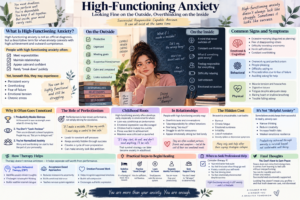
Why High-Functioning Anxiety Often Goes Unnoticed
High-functioning anxiety can be difficult to recognize because the person may continue to appear successful, responsible, and in control. As a result, their internal distress often remains hidden.
1. Productivity Masks Distress
In many cultures, productivity is equated with mental strength. Therefore, when someone consistently achieves their goals, their anxiety may be overlooked. Their constant effort may be praised as ambition or dedication, even when it is driven by fear and internal pressure.
2. You Don’t “Look Anxious”
High-functioning anxiety often lacks dramatic outward symptoms. Because of this, people may hear:
- “But you’re doing so well.”
- “You don’t seem anxious.”
- “Everyone feels stressed.”
Although these comments may seem reassuring, they can unintentionally invalidate what the person is experiencing internally.
3. You’ve Normalized Anxiety
Over time, many individuals become so accustomed to worrying, overthinking, and staying constantly alert that anxiety starts to feel like part of their personality rather than a mental health concern.
When anxiety becomes your normal, you may not even realize that you’re struggling.
High-Functioning Anxiety vs Generalized Anxiety Disorder (GAD)
| Aspect | High-Functioning Anxiety | Generalized Anxiety Disorder |
|---|---|---|
| Daily Functioning | Appears intact | Often impaired |
| Work Performance | High or excessive | May decline |
| Visibility | Hidden | More noticeable |
| Help-Seeking | Rare | More likely |
| Risk | Burnout, chronic stress | Functional impairment |
A person can have both—but not all high-functioning anxiety meets diagnostic criteria for GAD.
The Role of Perfectionism
Perfectionism is not simply about striving for excellence—it can become fear-driven performance, where mistakes feel threatening rather than normal. For someone with high-functioning anxiety, being “good enough” may feel unsafe because their sense of security can become tied to achievement and control.
At its core, perfectionism may sound like:
- “If I make a mistake, I’ll lose my worth.”
- “I must stay in control to feel safe.”
- “If I don’t do this perfectly, something will go wrong.”
Because of these beliefs, a person may constantly push themselves, over-prepare, check their work repeatedly, or struggle to delegate tasks. Even when they achieve something, they may focus more on what could have been better than on what they accomplished. Moreover, perfectionism can create a difficult cycle: anxiety creates pressure to perform perfectly, success temporarily reduces that anxiety, and the relief reinforces the need to perform perfectly again.
Perfectionism also keeps anxiety hidden because success becomes evidence that “nothing is wrong.” Others may see someone who is hardworking, reliable, and highly accomplished, while internally that person may be exhausted and afraid of making mistakes. In this way, perfectionism can make anxiety look like ambition—even when the person is paying a significant emotional cost for their success.
Childhood Roots of High-Functioning Anxiety
High-functioning anxiety can develop early in life, particularly when children learn that being successful, responsible, or emotionally controlled is necessary to feel safe, accepted, or valued. However, childhood experiences are not the only possible cause, and not everyone who grows up in these environments develops anxiety.
It may be more likely to develop in environments where:
- Love or approval felt conditional on performance
- Emotional expression was discouraged or dismissed
- Children were expected to mature too quickly
- Praise was strongly tied to achievement
- Mistakes were frequently criticized or punished
Over time, the child may begin to believe that staying prepared, avoiding mistakes, and meeting expectations is the best way to prevent rejection or conflict.
The underlying belief can become: “If I stay alert, do well, and don’t need anything, I’ll be safe.”
As the child grows older, this way of coping can become deeply ingrained. What once helped them manage their environment may later appear as perfectionism, people-pleasing, excessive responsibility, overthinking, or a constant need for control.
In adulthood, the person may no longer consciously remember why they feel this pressure. They simply know that slowing down feels uncomfortable and that making mistakes feels much more threatening than it should.
In this way, a coping strategy learned in childhood can continue into adulthood, even when the original environment is no longer present.
High-Functioning Anxiety in Relationships
High-functioning anxiety can also affect relationships, even when a person appears to be a caring, reliable, and emotionally strong partner, friend, or caregiver.
They may:
- Overthink texts, conversations, and other people’s reactions
- Take responsibility for others’ emotions
- Fear being “too much” or becoming a burden
- Struggle to ask for reassurance or express their needs
- Appear emotionally strong while feeling lonely internally
Because they are often focused on keeping everyone else comfortable, they may ignore their own emotional needs. They can become excellent supporters of others while finding it difficult to accept support themselves.
The Hidden Cost: Burnout and Emotional Exhaustion
Although anxiety may help someone stay productive in the short term, constantly operating under pressure is not sustainable. Over time, the body and mind can become exhausted from being in a continuous state of alertness.
This may contribute to:
- Burnout and chronic fatigue
- Emotional numbness or irritability
- Loss of motivation
- Increased anxiety
- Depressive symptoms
Unfortunately, many people seek help only after their usual coping strategies stop working. They may think, “I was managing before, so why can’t I manage now?” The problem is that coping through constant overwork and self-pressure eventually has a cost.
Why High-Functioning Anxiety Is Not “Helpful Anxiety”
Some people believe their anxiety is the reason they are successful. After all, worrying may push them to prepare more, work harder, and avoid mistakes.
However, anxiety-driven productivity comes at a cost. Constant anxiety can:
- Narrow thinking and increase mental rigidity
- Reduce creativity and flexibility
- Increase physical and emotional stress
- Weaken emotional resilience
Healthy motivation can encourage achievement without requiring constant fear. Productivity driven by anxiety may produce results, but it does not necessarily create sustainable well-being.
How Therapy Helps High-Functioning Anxiety
Therapy does not aim to remove a person’s ambition, responsibility, or desire to succeed. Instead, it helps them develop healthier ways of managing anxiety while separating self-worth from performance.
Cognitive Behavioral Therapy (CBT)
CBT can help identify anxiety-driven thought patterns, challenge catastrophic thinking, and develop a healthier internal dialogue.
Acceptance-Based Approaches
These approaches can help a person become more comfortable with uncertainty, build emotional tolerance, and learn healthier ways to regulate stress and anxiety.
Emotion-Focused Work
This can help individuals recognize emotions they may have learned to suppress, develop self-compassion, and express their needs more authentically.
Over time, therapy can help a person move from “I have to perform to be okay” toward “I can be okay even when everything isn’t perfect.”
Practical Steps to Begin Healing
1. Redefine Rest
Rest is not a reward for finishing everything. It is a biological need that supports both physical and emotional functioning.
2. Practice “Good Enough”
Perfection can keep the anxiety cycle going. Instead of asking, “Is this perfect?” try asking, “Is this good enough for what is needed?”
3. Learn to Pause
Small pauses throughout the day can interrupt the cycle of constant pressure and give your mind an opportunity to slow down.
4. Separate Identity from Output
Your achievements matter, but they do not determine your worth. You are more than your productivity.
5. Seek Support Early
You do not have to “fall apart” before asking for help. Recognizing the pattern early can make it easier to develop healthier coping strategies.
When to Seek Professional Help
Consider professional support if:
- Your mind rarely feels quiet
- You feel exhausted even when things are going well
- Anxiety has become closely tied to your self-worth
- You feel afraid to slow down
- You feel emotionally disconnected despite being successful
Most importantly, you do not need to wait for a crisis to seek support. High-functioning anxiety is not an official diagnosis, but the anxiety and distress behind the pattern can still be significant and treatable.
Final Thoughts
High-functioning anxiety can convince people that safety comes from vigilance, control, achievement, and constant effort. However, living in a permanent state of pressure is not the same as being well.
Peace does not come from constantly doing more. It comes from learning that you can slow down, make mistakes, ask for help, and still be worthy and safe.
You can be capable and calm.
Driven and rested.
Successful and emotionally supported.
Looking fine doesn’t always mean you are fine—and that truth deserves care, not dismissal.
Frequently Asked Questions (FAQ): High-Functioning Anxiety
1. What is high-functioning anxiety?
High-functioning anxiety is a non-clinical descriptive term used to explain a pattern where a person appears successful, productive, and emotionally stable, yet experiences chronic internal anxiety, excessive worry, and mental strain. It often goes unnoticed because daily functioning remains intact.
2. Is high-functioning anxiety a diagnosable disorder?
No. High-functioning anxiety is not an official diagnosis in diagnostic manuals like the DSM-5. However, many people with high-functioning anxiety may meet criteria for anxiety-related conditions such as generalized anxiety disorder (GAD) or experience clinically significant distress that benefits from professional support.
3. How is high-functioning anxiety different from regular anxiety?
The key difference lies in external functioning. People with high-functioning anxiety continue to perform well at work and in relationships, while internally feeling tense, overwhelmed, and constantly on edge. In contrast, more visible anxiety disorders often interfere with daily responsibilities.
4. What are common signs of high-functioning anxiety?
Common signs include:
- Constant overthinking and worry
- Perfectionism and fear of failure
- Difficulty relaxing or resting
- People-pleasing behaviors
- Physical symptoms like fatigue, muscle tension, or headaches
- Feeling guilty when not being productive
5. Can high-functioning anxiety lead to burnout?
Yes. Because anxiety is often masked by productivity, individuals may ignore early warning signs. Over time, this can lead to burnout, emotional exhaustion, sleep problems, irritability, or depressive symptoms.
6. What causes high-functioning anxiety?
High-functioning anxiety often develops due to:
- Childhood environments with high expectations
- Conditional approval based on performance
- Emotional neglect or pressure to “stay strong”
- Long-term stress and responsibility
- Personality traits like perfectionism and high conscientiousness
7. Is high-functioning anxiety harmful if it helps me succeed?
While it may appear helpful in the short term, anxiety-driven success is not sustainable. Chronic anxiety increases the risk of physical illness, emotional burnout, and reduced quality of life. Healthy motivation does not require constant fear or self-pressure.
8. How can therapy help with high-functioning anxiety?
Therapy helps individuals:
- Identify anxiety-driven thought patterns
- Separate self-worth from productivity
- Learn emotional regulation and nervous system calming
- Develop self-compassion and realistic standards
Approaches like Cognitive Behavioral Therapy (CBT) and acceptance-based therapies are particularly effective.
9. When should someone seek professional help?
You should consider professional support if:
- Your mind rarely feels calm
- You feel exhausted despite success
- Anxiety controls your decisions
- You fear slowing down
- Feel emotionally disconnected or overwhelmed
You do not need to “break down” to deserve help.
Reference
-
American Psychological Association – Understanding Anxiety
https://www.apa.org/topics/anxiety -
National Institute of Mental Health – Anxiety Disorders
https://www.nimh.nih.gov/health/topics/anxiety-disorders -
World Health Organization – Mental Health & Anxiety
https://www.who.int/news-room/fact-sheets/detail/mental-disorders -
Beck, J. S. (2011). Cognitive Behavior Therapy: Basics and Beyond. Guilford Press
https://www.guilford.com/books/Cognitive-Behavior-Therapy/Judith-Beck/9781609185046 -
Barlow, D. H. (2002). Anxiety and Its Disorders. Guilford Press
https://www.guilford.com/books/Anxiety-and-Its-Disorders/David-Barlow/9781572306880 - Anger Management: Understanding, Regulating, and Transforming Anger in Healthy Ways