Why Your Brain Won’t Stop Replaying Past Conversations

Have you ever lay in bed or sitting there when suddenly you hear yourself conversing with someone in the past like your previous conversation? Something you said. Something that you wish you could have said. A tone you’re now questioning. The act recurs over and over, but it is not always comfortable, regrettable, or nervous. This is aggravated by the fact that these thoughts normally come when all the other things are silent at night, when you are taking a rest, or when you are supposed to be having a peaceful moment and you find yourself alone with your inner talk.

Such an experience is so widespread–and it does not mean that something is wrong with you. It is an indication that the brain attempts to defend, process and meaning making around social experiences. These moments come back into your mind to find meaning, closure, or reassurance, particularly when a conversation had been emotionally charged or unresolved. Instead of it being a weakness, this replay shows a very human desire to fit in, to be heard, and to feel emotionally secure in all our relationships with other people.
1. The Brain Is Wired for Social Survival

Humans are social beings. Thousands of years ago, being part of a group was the guarantee of protection, safety and existence. Due to this evolutionary output, the brain allocates additional significance to the social engagement, particularly to the ones, which are awkward, emotionally significant, or unbroken. We are in a state of constant scanning of signals to do with approval, denial, and relationship.

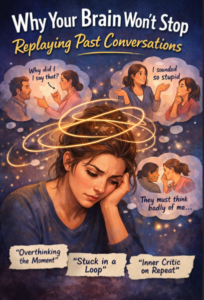
The brain is stressed when a conversation is confusing or uncomfortable, which is why it is important. The replaying of it is the manner in which the brain engages in an effort to comprehend and avoid pain in the future in a social context. The questions under the loop are silent, such as:
“Did I say something wrong?”
“Was I misunderstood?”
Will this alter the perception they have of me or change our relationship?

2. Unfinished Emotional Processing

Most of the discussions are cut short before feelings are well worked out. At the moment, you can suppress your emotions to be polite, calm, or emotionally restrained, particularly when you feel you are not safe, inconvenienced or inappropriate to express them. Those emotions are repressed by your body so that you can get through the interaction.

With time when the nervous system ultimately lets go, the emotions that have been repressed start to appear. That is the reason why the mind re-plays the dialogue in the silent times. The replay is not of the words spoken but of the unspoken emotions which were there, linked to the words, ready to be recognized, comprehended, and discharged.

3. Rumination: When Thinking Turns into a Loop

Rereading conversations could slowly degenerate into rumination a mental cycle in which the brain is continually processing the same incident without having a conclusion or a relief. This repetitive thinking can be a cause of more emotional distress instead of relief. Rumination usually presents itself in association with:

Anxiety
Low self-esteem
A history of trauma
Perfectionism

The mind continues to spin around the same thoughts appearing to replay details and imagine different solutions and events, hoping that at some point the explanation or relief will suddenly come. Sadly enough, this loop is not always answered, the loop only extends the emotional distress.

4. The Inner Critic Takes Over

In these mental acting games, most individuals become cruel and critical to themselves:

“Why did I say that?”
“I sounded stupid.”
“They must think badly of me.”

There is nothing true about this inner critic the criticism is based on the fear. It is attempting to shield you against rejection or embarrassment that might come later, although it is a painful way. This voice frequently expresses historical experiences in which a person was probably criticized, shamed, or punished instead of being patient and understanding. In the course of time, the mind gets to condition itself to pre-erect self, with the hope that the self-criticism will help to stop the external criticism, although it does not necessarily do good.

5. The Nervous System and the “Threat Response”

Psychologically, it is common to relate the re-enactment of conversations to the nervous system being in a high level of alertness. Your system, when subjected to any kind of emotional threat (rejection, conflict, embarrassment, or disapproval), finds it hard to settle down and achieve a relaxed, controlled state. The body and mind remains alert even after the scenario has been experienced.

In reaction the brain re-plays the situation, trying to theorize it and avoid such an emotional injury in future. This circularity is not meant to happen–this is survival by default because the human mind needs to feel safe and secure.

6. Trauma and Emotional Memory

In the case of persons who suffered emotional or relationship trauma, the replays may run deeper. The previous experiences of misunderstanding, being criticized, dismissed, or feeling unsafe may be triggered by old conversations. When this happens it does not mean the mind is reacting to the current interaction alone it is reacting to past emotional records.

It is not really a replay of this conversation. It is a question of what the moment will be embodying in its emotional aspect echoing old wounds that are not yet completely healed or recognized.

What Actually Helps

  • Name what you’re feeling, not just what you said
    (e.g., embarrassment, hurt, fear of rejection)
  • Gently interrupt the loop
    Try grounding techniques like slow breathing or noticing physical sensations.
  • Practice self-compassion
    Ask yourself: “What would I say to a friend in this situation?”
  • Accept imperfection
    No conversation is ever flawless. Human connection doesn’t require perfection—only presence.
  • If it’s persistent, therapeutic support can help uncover deeper patterns behind rumination and emotional looping.

A Reframe Worth Remembering

Your mind is not repeating some old discussions to torment or torment you. It is attempting – in many cases clumsy and unsuccessful – to keep you safe, to make sense out of what has occurred, to get you to feel secure and to belong. These emotional circles are the result of a profound human desire to fit in, to be comprehended and not to be hurt emotionally.

When you receive these thoughts with curiosity, not criticism, that is, by asking yourself questions like “What was I feeling?” and not What is wrong with me? the loop starts getting unstuck. Not instantly. Not completely. But gradually, gradually enough to make breathing room in your head.

And in some cases, that pity suffices to allow that dialogue to finally subside and does not have to be repeated to be listened to.

Frequently Asked Questions (FAQ)

1. Why do old conversations replay in my mind?
Because the brain tries to process unresolved emotions, social uncertainty, or perceived threats related to connection and belonging.

2. Is replaying conversations a sign of anxiety?
It can be associated with anxiety, but not everyone who replays conversations has an anxiety disorder.

3. Why does this happen more at night?
At night, distractions reduce and the nervous system slows down, allowing suppressed thoughts and emotions to surface.

4. Is this the same as overthinking?


Yes, it’s a form of overthinking, often linked specifically to social interactions and emotional safety.

5. What is rumination?
Rumination is repetitive thinking about past events without reaching resolution or relief.

6. Can trauma cause conversation replaying?
Yes. Emotional or relational trauma can make the brain more sensitive to social cues and perceived rejection.

7. Why am I so self-critical during these replays?
The inner critic often develops from past experiences where mistakes were judged harshly rather than met with understanding.

8. Do perfectionists replay conversations more?
Yes. Perfectionism increases fear of mistakes and social evaluation, fueling mental loops.

9. Is my brain trying to fix something?
Yes. The brain is attempting to prevent future emotional harm by analyzing past interactions.

10. Does replaying conversations mean I did something wrong?


Not necessarily. Often, it reflects emotional sensitivity rather than actual mistakes.

11. How can I stop replaying conversations?
Gentle grounding, naming emotions, self-compassion, and nervous system regulation help reduce the loop.

12. Should I distract myself when this happens?
Temporary distraction can help, but emotional acknowledgment leads to longer-term relief.

13. Can mindfulness help?
Yes. Mindfulness helps you observe thoughts without getting pulled into them.

14. When should I seek therapy?
If replaying conversations interferes with sleep, work, or emotional well-being, therapy can be helpful.

15. Will this ever stop completely?
The goal isn’t complete elimination but reducing intensity and responding with compassion instead of fear.

Written by Baishakhi Das

Counselor | Mental Health Practitioner
B.Sc, M.Sc, PG Diploma in Counseling


Reference 

This topic performs well due to rising searches around men’s mental health, workplace stress, and burnout recovery. Combining emotional insight with practical steps increases engagement and trust.

Why You Shut Down Instead of Crying: A Trauma Response

Many people believe that emotional pain should be obvious and visible—expressed through tears, emotional outbursts, breaking down, or openly seeking comfort. Society often equates real suffering with how loudly it is shown. So when someone experiences pain in a quieter way—feeling numb, detached, frozen, or emotionally blank—they begin to question themselves.

They may wonder why they aren’t crying, why they don’t feel angry, or why there is no sense of release. This absence of visible emotion can create deep self-doubt, shame, and the belief that something is “wrong” with them or that their pain isn’t valid enough.

But shutting down is not a failure of emotion. It is the nervous system’s way of protecting itself when feelings once felt unsafe, overwhelming, or useless to express. When the body learns that showing pain doesn’t bring comfort—or might even bring harm—it adapts by turning inward and going quiet. In that sense, shutting down is not a weakness at all. It is a trauma response, shaped by past experiences where survival mattered more than expression.

The Body Chooses Survival Over Expression

When emotional pain feels too intense, unpredictable, or unsafe to show, the nervous system automatically steps in to protect you. Rather than moving into the fight or flight response—where emotions come out through crying, arguing, or panic—the body may choose a quieter survival strategy. It shifts into freeze or collapse mode, slowing everything down to reduce emotional overload.

In this state, the mind may go blank, the body may feel heavy or disconnected, and emotions seem distant or muted. This isn’t a conscious choice—it’s an automatic response designed to keep you functioning when expressing pain feels risky.

This response is especially common when:

  • You learned early in life that crying didn’t bring comfort, understanding, or support
  • Showing emotions led to punishment, ridicule, minimization, or emotional abandonment
  • You had to remain “strong,” mature, or composed in order to survive your environment

In these situations, your system learned that expressing pain didn’t lead to safety—it led to more hurt. Over time, shutting down became the safest option. It allowed you to endure, stay in control, and protect yourself when vulnerability wasn’t an option.

Emotional Numbness Is Not Emotional Absence

When you shut down, it may feel like emptiness, heaviness, or a kind of emotional flatness—as if your feelings have gone silent or distant. You might know intellectually that something hurts, yet feel unable to access the emotion itself. This doesn’t happen because you don’t care or because you are emotionally detached by nature.

It happens because your nervous system is trying to protect you by creating distance from feelings that once felt overwhelming, unsafe, or impossible to process. By turning down emotional intensity, your system gives you space to keep going when fully feeling everything might have been too much. This temporary disconnection is not a lack of emotion—it’s a protective pause, allowing you to survive when experiencing those feelings all at once would have felt unbearable.

This is often linked to:

  • Dissociation – mentally distancing yourself from distress
  • Emotional suppression – unconsciously blocking feelings to function
  • Learned helplessness – believing expression won’t change the outcome

Your body is saying: “Feeling this fully might be too much right now.”

Why Crying Feels Impossible

Crying requires a sense of safety—both emotional and physical. Your nervous system needs to believe that releasing emotions won’t lead to punishment, rejection, shame, or abandonment. When that sense of safety is present, the body allows feelings to rise and move through naturally.

But if your past experiences taught you that vulnerability led to harm, your nervous system remains guarded. Even when your mind knows you are safe now, your body may not fully believe it yet. It operates based on learned survival patterns, not logic alone. As a result, emotions stay contained, tears feel stuck, and shutting down becomes the default response—not because you don’t want to feel, but because your system is still protecting you from what once hurt.

That’s why you might:

  • Go numb during emotional conversations
  • Feel detached during loss or conflict
  • Shut down instead of reacting

This is not emotional coldness. It’s self-protection.

The Cost of Long-Term Shutdown

While shutting down once helped you survive, staying in this state for too long can lead to:

  • Chronic emotional exhaustion
  • Difficulty identifying your own feelings
  • Feeling disconnected from others and yourself
  • Guilt or shame for “not reacting normally”

Over time, unprocessed emotions don’t disappear—they settle in the body as tension, fatigue, or anxiety.

Healing Begins With Safety, Not Force

You cannot force yourself to cry or “open up” through willpower alone. Emotional expression isn’t something the body obeys on command. When the nervous system is in a protective state, it will resist vulnerability no matter how much you want to feel or release.

Healing begins when your nervous system gradually learns that feeling is no longer dangerous. This happens through repeated experiences of safety—being heard without judgment, allowed to feel without consequences, and supported rather than dismissed. With time, patience, and gentleness, the body starts to loosen its defenses. Emotions may return slowly, quietly, or in unexpected ways, but they return because safety has been restored—not because they were forced.

Helpful steps include:

  • Gentle self-awareness instead of self-judgment
  • Grounding practices that reconnect you to your body
  • Safe relationships where emotions are welcomed, not dismissed
  • Trauma-informed therapy that works with the nervous system

Crying may return gradually—or your healing may look quieter. Both are valid.

A Gentle Reminder

If you shut down instead of crying, it doesn’t mean you are broken, heartless, or emotionally unavailable. It doesn’t mean you lack depth or that your pain is somehow less real. It simply means your body learned—often very early on—that protecting yourself was more important than expressing what you felt.

Your nervous system adapted in the only way it could to keep you safe. That response helped you survive moments when vulnerability wasn’t met with care.

And now, with patience, compassion, and a growing sense of safety, your body can learn a new way. One that allows room for softness, for expression, for rest. There is no rush, no “right” way to heal—only a gradual return to feeling, at a pace that honors everything you’ve been through.

FAQ

1. Is shutting down an emotional weakness?
No. Shutting down is a nervous system survival response, not a character flaw or weakness.

2. Why do I feel numb instead of sad?
Emotional numbness often occurs when feelings feel too overwhelming or unsafe to process fully.

3. Is shutting down the same as dissociation?
It can include dissociation, but shutdown also involves emotional freezing and reduced responsiveness.

4. Why can’t I cry even when I want to?


Crying requires safety. If your body doesn’t feel safe, it may block emotional release.

5. Can trauma make emotions disappear?
Trauma doesn’t erase emotions—it suppresses access to them temporarily as protection.

6. Does this mean I’m emotionally unavailable?
No. It means your nervous system learned to guard emotions, not that you lack them.

7. Is shutdown linked to childhood experiences?
Yes. Emotional neglect, criticism, or punishment in childhood often condition shutdown responses.

8. Why do I go blank during emotional conversations?
Your nervous system may enter freeze mode to avoid perceived emotional threat.

9. Is shutting down the same as being calm?


No. Calm involves regulation; shutdown involves disconnection.

10. Can forcing myself to open up help?
Forcing vulnerability can backfire. Safety and patience are more effective.

11. How long does shutdown last?
It varies. For some it’s situational; for others it becomes a long-term pattern.

12. Does therapy help with shutdown responses?
Yes—especially trauma-informed and nervous-system-based therapies.

13. Will I ever feel emotions normally again?
Yes. With safety and support, emotional access often returns gradually.

14. Is shutdown related to depression?


It can overlap, but shutdown is primarily a trauma response, not a mood disorder.

15. What helps the most in healing shutdown?
Safety, self-compassion, body-based regulation, and supportive relationships.

Written by Baishakhi Das

Counselor | Mental Health Practitioner
B.Sc, M.Sc, PG Diploma in Counseling


Reference 

This topic performs well due to rising searches around men’s mental health, workplace stress, and burnout recovery. Combining emotional insight with practical steps increases engagement and trust.

Why You Feel Emotionally Numb: When You Can’t Feel What You Know You Should

Introduction: The Quiet Absence of Feeling

You’re not sad.
You’re not happy.
You’re not angry or excited.

You just… feel nothing.

Emotional numbness is one of the most misunderstood and unsettling psychological experiences. People often describe it as feeling empty, flat, or disconnected from themselves and the world. You may still function—go to work, talk to people, fulfill responsibilities—but internally, something feels switched off.

What makes emotional numbness particularly distressing is that:

  • There may be no obvious reason for it

  • Others may say, “At least you’re not upset”

  • You may wonder if something is “wrong” with you

This article explores why emotional numbness happens, what it means psychologically, how it relates to stress, trauma, anxiety, and burnout, and how feeling can gradually return.

What Is Emotional Numbness?

Emotional numbness is a state in which a person experiences a reduced ability to feel emotions, both positive and negative. It is not the absence of emotions entirely, but rather a dampening or disconnection from them.

People experiencing emotional numbness often report:

  • Feeling detached from their emotions

  • Difficulty crying or feeling joy

  • Feeling “on autopilot”

  • Going through life without emotional engagement

  • Knowing they should feel something, but don’t

Importantly, emotional numbness is not a personality flaw. It is usually a protective psychological response.

Emotional Numbness Is Not the Same as Calm

Calmness is peaceful and grounded.
Numbness is hollow and disconnected.

When you are calm:

  • You feel present

  • You can access emotions if needed

  • There is inner clarity

When you are numb:

  • You feel distant from yourself

  • Emotions feel blocked or unreachable

  • There is a sense of inner emptiness

Many people mistake numbness for emotional strength—but numbness often signals overwhelm, not resilience.

Common Signs of Emotional Numbness

Emotional numbness can show up in subtle ways:

  • Feeling indifferent toward things that once mattered

  • Lack of emotional reaction to good or bad news

  • Difficulty feeling love, excitement, or empathy

  • Reduced emotional expression

  • Feeling disconnected from memories or experiences

  • Loss of pleasure (anhedonia)

  • Sense of being “behind glass” while life happens

You may still think clearly and behave normally—yet feel emotionally absent.

Why Emotional Numbness Happens: The Psychology Behind It

1. Emotional Overload and Burnout

One of the most common causes of emotional numbness is prolonged emotional overload.

When you’ve been:

  • Constantly stressed

  • Emotionally responsible for others

  • Overstimulated

  • Under-rested

  • Emotionally unsupported

…the nervous system may respond by shutting down emotional intensity.

This is not a failure—it is a survival response.

Your mind essentially says:

“Feeling everything right now is too much. Let’s reduce sensation.”

2. Trauma and the Freeze Response

Emotional numbness is closely linked to trauma.

When fight or flight isn’t possible, the nervous system may enter freeze mode, which includes:

  • Emotional shutdown

  • Dissociation

  • Detachment from feelings and body sensations

Trauma doesn’t have to be dramatic or violent. Emotional trauma can include:

  • Chronic emotional neglect

  • Long-term criticism

  • Feeling unsafe expressing emotions

  • Living in unpredictable environments

Numbness protects you from pain—but also from pleasure.

3. Suppressed Emotions Over Time

Many people are taught (directly or indirectly) to:

  • “Stay strong”

  • “Don’t overreact”

  • “Be practical”

  • “Control your emotions”

Over time, repeated emotional suppression can lead to disconnection from feelings altogether.

If emotions are consistently invalidated or unsafe to express, the brain learns:

“It’s better not to feel.”

4. Anxiety and Emotional Avoidance

Anxiety doesn’t always look like panic.

Chronic anxiety can lead to emotional numbness because:

  • Feeling emotions may trigger worry

  • Emotional intensity feels unsafe

  • The mind stays in constant vigilance mode

To avoid discomfort, the brain dampens emotional signals.

Ironically, emotional numbness can be an anxiety symptom, not the absence of anxiety.

5. Depression and Anhedonia

In depression, emotional numbness often appears as anhedonia—the inability to feel pleasure.

This can include:

  • No excitement about achievements

  • No enjoyment in hobbies

  • Emotional flatness in relationships

Unlike sadness, anhedonia feels empty and lifeless, which is often more frightening for individuals.

6. Grief and Emotional Protection

After loss, the psyche may temporarily numb emotions to prevent overwhelm.

Grief-related numbness can feel like:

  • “I know something terrible happened, but I don’t feel it”

  • Delayed emotional reactions

  • Feeling detached from the loss

This does not mean you don’t care—it means your mind is pacing your pain.

7. Dissociation: Feeling Disconnected from Yourself

Emotional numbness is often part of dissociation, a psychological response where:

  • You feel detached from your body or emotions

  • The world feels unreal or distant

  • You feel like an observer of your life

Dissociation develops when emotional intensity exceeds coping capacity.

Emotional Numbness in Daily Life

In Relationships

  • Difficulty feeling close

  • Reduced emotional responsiveness

  • Guilt for not feeling “enough”

  • Fear of hurting loved ones emotionally

Partners may misinterpret numbness as lack of care, which increases isolation.

At Work

  • Loss of motivation

  • Indifference to success or failure

  • Functioning without emotional engagement

  • Feeling drained but detached

High-functioning individuals often experience numbness silently.

In Parenthood or Caregiving

  • Feeling robotic

  • Guilt for lack of emotional warmth

  • Emotional exhaustion

  • Difficulty feeling joy or connection

Caregivers are especially vulnerable due to chronic emotional output.

Why Emotional Numbness Is So Disturbing

Emotional numbness creates identity confusion.

People often ask:

  • “Who am I if I don’t feel?”

  • “Am I broken?”

  • “Will I ever feel normal again?”

Because emotions are central to meaning, numbness can feel like losing yourself.

Emotional Numbness Is Not Permanent

This is crucial to understand:

Emotional numbness is a state, not a life sentence.

It is reversible when the underlying causes are addressed.

What Not to Do When You Feel Numb

  • Don’t force emotions

  • Don’t shame yourself

  • Don’t compare yourself to others

  • Don’t numb further with substances or overwork

  • Don’t assume it means you’re incapable of feeling

Numbness responds to gentle attention, not pressure.

How to Begin Reconnecting with Emotions

1. Focus on Safety, Not Feeling

Your nervous system needs safety before emotions can return.

Ask:

  • Where do I feel safest?

  • What reduces my tension?

2. Reconnect with the Body First

Emotions live in the body.

Helpful practices:

  • Gentle movement

  • Breathing exercises

  • Grounding techniques

  • Warmth (showers, blankets)

3. Allow Small Emotional Signals

Emotions often return subtly:

  • Mild irritation

  • Gentle sadness

  • Brief enjoyment

These are signs of reawakening, not setbacks.

4. Express Without Judgment

Journaling, art, or quiet reflection helps emotions surface without pressure.

5. Seek Therapeutic Support

Therapy helps by:

  • Creating emotional safety

  • Processing suppressed emotions

  • Regulating the nervous system

  • Understanding trauma or burnout patterns

You don’t need to know why you’re numb to seek help.

When to Seek Professional Help

Seek support if numbness:

  • Persists for months

  • Interferes with relationships

  • Is accompanied by hopelessness

  • Follows trauma or loss

  • Feels frightening or worsening

Emotional numbness deserves care—not dismissal.

Healing Is Not About “Feeling More” Immediately

Healing means:

  • Feeling safely

  • Feeling gradually

  • Feeling without overwhelm

Your nervous system will open when it no longer feels threatened.

Final Thoughts: Numbness Is a Message, Not a Failure

Emotional numbness is your mind and body saying:

“I’ve been carrying too much, for too long.”

It is not weakness.
It is not indifference.
It is not permanent.

Feeling will return—not by force, but by compassion, safety, and support.

You are not broken.
You are protecting yourself.
And you can heal.

FAQ


1. What does it mean to feel emotionally numb?

Emotional numbness means feeling disconnected from emotions, both positive and negative. A person may function normally but feel empty, detached, or unable to feel joy, sadness, or emotional connection.


2. Is emotional numbness a mental illness?

No. Emotional numbness is not a diagnosis but a symptom. It commonly appears in anxiety, depression, burnout, trauma responses, or prolonged emotional stress.


3. Can stress or burnout cause emotional numbness?

Yes. Long-term stress and emotional burnout can overwhelm the nervous system, leading it to reduce emotional intensity as a protective mechanism.


4. Is emotional numbness a trauma response?

Often, yes. Emotional numbness can be part of the freeze or dissociation response, especially after emotional neglect, chronic stress, or unresolved trauma.


5. How long does emotional numbness last?

It varies. For some, it lasts weeks; for others, months. Numbness usually improves when underlying stress, trauma, or emotional overload is addressed with support.


6. Can anxiety cause emotional numbness?

Yes. Chronic anxiety can lead to emotional shutdown because feeling emotions may increase fear or overwhelm. Numbness can coexist with anxiety.


7. Is emotional numbness the same as depression?

Not exactly. Depression may include sadness, hopelessness, or loss of pleasure (anhedonia). Emotional numbness can occur with or without depression.


8. How can I start feeling emotions again?

Healing involves:

  • Creating emotional safety

  • Reducing chronic stress

  • Reconnecting with the body

  • Allowing emotions gradually

  • Seeking professional support when needed

Forcing emotions often worsens numbness.


9. When should I seek professional help?

Seek help if numbness:

  • Lasts for months

  • Affects relationships or daily life

  • Is accompanied by anxiety, hopelessness, or trauma history

  • Feels frightening or worsening

Written by Baishakhi Das

Counselor | Mental Health Practitioner
Qualifications: B.Sc in Psychology | M.Sc  | PG Diploma in Counseling

REFERENCE