


Introduction
In today’s fast-moving world, stress, anxiety, and emotional struggles often feel unavoidable. Many people want practical ways to manage their thoughts and emotions without feeling overwhelmed. One of the most widely used and evidence-based psychological therapies in the world is Cognitive Behavioral Therapy (CBT).
CBT is simple, structured, and highly effective. It helps people understand how their thoughts, feelings, and behaviors influence one another. Instead of focusing only on the past, CBT teaches skills to handle current problems and build healthier thinking patterns for the future.
This article offers a clear, easy-to-understand guide to CBT—its meaning, benefits, techniques, and how it works in real life.
What Is CBT?
Cognitive Behavioral Therapy (CBT) is a type of psychological therapy that helps people change unhelpful thoughts and behaviors.
It is based on a simple idea:
“What you think affects how you feel, and how you feel affects how you behave.”
CBT teaches that thoughts are not always facts. Sometimes our minds exaggerate, misinterpret, or assume things that are not true. These distorted thoughts create emotional distress and unhealthy habits. When we learn to challenge these thoughts, our emotions and actions start to improve.
CBT is practical, structured, and focused on helping you build new skills—not just talking about your problems.
The Core Principles of CBT
CBT is grounded in several important principles:
1. Thoughts influence feelings
If you think “I’m a failure,” you will feel hopeless.
If you think “I can try again,” you feel motivated.
2. Feelings influence behavior
When you feel anxious, you might avoid situations.
When you feel confident, you take action.
3. Behavior influences thoughts
Avoiding a problem makes you feel more afraid.
Facing a problem builds confidence.
4. Problems come from patterns—not one single event
CBT focuses on patterns you repeat:
• negative thinking
• avoidance
• self-criticism
• unhelpful coping (overthinking, anger, withdrawal)
5. You can learn to change
CBT believes that psychological problems are treatable when people learn new skills and healthy coping mechanisms.
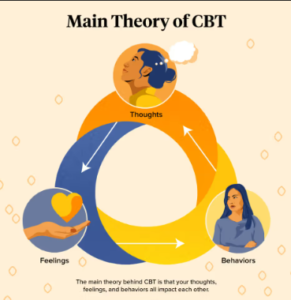
How CBT Works: The CBT Triangle
The core model of CBT is the Cognitive Behavioral Triangle, which shows the connection between:
• Thoughts
What we think
Example: “People will judge me.”
• Feelings
What we feel
Example: anxious, embarrassed.
• Behaviors
What we do
Example: avoid speaking in public.
Even if only one part changes—thought, feeling, or behavior—the others change too.
This is why CBT works so effectively.
Common Problems CBT Helps With
CBT is scientifically proven to work for many mental health conditions:
✔ Anxiety Disorders
Social anxiety, generalized anxiety, panic disorder, phobias.
✔ Depression
Helps reduce negative thinking and increase motivation.
✔ Stress Management
Develops problem-solving and coping skills.
✔ Anger Issues
Teaches emotional regulation and impulse control.
✔ Relationship Problems
Improves communication and reduces assumptions.
✔ OCD
Supports exposure therapy and reduces compulsive behaviors.
✔ Trauma & PTSD
Helps reduce intrusive thoughts and fear responses.
✔ Eating Disorders
Breaks rigid thinking patterns.
✔ Physical Health Conditions
Chronic pain, insomnia, IBS.
CBT is flexible, practical, and suitable for all age groups—children, adolescents, adults, and the elderly.
The Most Common Cognitive Distortions
CBT identifies thinking errors that create unnecessary emotional pain. These are called cognitive distortions.
1. All-or-Nothing Thinking
Seeing things as either perfect or terrible.
Example: “If I don’t succeed completely, I’m a failure.”
2. Catastrophizing
Expecting the worst-case scenario.
Example: “If I make a mistake, everyone will hate me.”
3. Overgeneralization
Drawing broad conclusions from one event.
Example: “One rejection means I’ll always be rejected.”
4. Mind Reading
Assuming you know what others think.
Example: “She didn’t smile; she must dislike me.”
5. Emotional Reasoning
Believing feelings are facts.
Example: “I feel scared, so the situation must be dangerous.”
6. Personalization
Blaming yourself for things you didn’t cause.
Example: “My friend is upset—it must be my fault.”
7. Labeling
Using harsh labels on yourself or others.
Example: “I’m stupid.”
8. Should Statements
Rigid rules for yourself or others.
Example: “I should never feel anxious.”
Recognizing these distortions is the first step in changing them.

Key Techniques Used in CBT
CBT has many practical tools. Here are the most commonly used techniques:
1. Cognitive Restructuring
This means identifying negative thoughts and replacing them with balanced, realistic ones.
Steps:
-
Identify the automatic thought.
-
Ask: “Is this 100% true?”
-
Look for evidence.
-
Replace it with a healthier thought.
Example:
Automatic thought: “I will embarrass myself at work.”
Balanced thought: “I might feel nervous, but I can prepare and do my best.”
2. Behavioral Activation
Used mainly for depression, this method increases meaningful activities to elevate mood.
Examples:
• daily walk
• talking to a friend
• doing small tasks
• practicing hobbies
3. Exposure Therapy
Used for anxiety and phobias.
You gradually face things you fear in a controlled, safe way.
Example:
Social anxiety → Start by greeting a stranger → then join small talk → then speak in a group.
4. Thought Records
A structured worksheet where you write:
• situation
• automatic thought
• emotion
• evidence
• new balanced thought
It helps break the cycle of overthinking.
5. Problem-Solving Skills
CBT teaches step-by-step solutions:
-
Define the problem
-
Brainstorm options
-
Evaluate pros/cons
-
Choose a solution
-
Test it
-
Review results
6. Relaxation Techniques
To manage anxiety and stress:
• deep breathing
• grounding exercises
• progressive muscle relaxation
• mindfulness
7. Habit Reversal
Used for behaviors like nail-biting, hair-pulling, or anger reactions.

What Happens in a CBT Session?
A typical CBT session is structured and collaborative.
Here’s what usually happens:
1. Goal Setting
Therapist and client decide what to work on (e.g., anxiety, anger, low self-esteem).
2. Agenda for the Session
Clear outline:
• review homework
• discuss problem
• learn skills
• plan next steps
3. Identifying Thoughts
Therapist helps you notice patterns you may not recognize.
4. Practicing Skills
Examples: reframing thoughts, breathing techniques, role-playing, worksheets.
5. Homework Assignment
CBT includes activities outside the session to speed progress.
6. Reviewing Progress
Track changes in mood, thoughts, and behaviors.
CBT is active—not passive.
You learn tools that you can use lifelong.
Benefits of CBT
✔ 1. Evidence-Based
CBT is supported by decades of scientific research.
✔ 2. Short-Term
Usually 8–20 sessions.
Not endless talk therapy.
✔ 3. Practical Skills
You learn tools you can use every day.
✔ 4. Helps Many Conditions
From stress to trauma to depression.
✔ 5. Empowers You
You learn how to think, not what to think.
✔ 6. Improves Self-Awareness
You understand your patterns clearly.
✔ 7. Works for All Ages
Children, adults, couples, families.
✔ 8. Can Be Used Alone or With Medication
CBT + medication is often more effective than medication alone.
✔ 9. Prevents Relapse
Long-term changes, not temporary relief.
CBT in Everyday Life: Real Examples
Example 1: Anxiety Before a Presentation
Thought: “I will make a mistake.”
Feeling: Fear
Behavior: Avoid speaking
Using CBT:
Challenge thought → “Everyone makes mistakes. I can practice.”
New behavior → Prepare well and speak.
New feeling → Confidence.
Example 2: Overthinking in Relationships
Thought: “If they take time to reply, they are losing interest.”
Feeling: Insecurity
Behavior: Repeated texting
Using CBT:
Realistic thought → “They may be busy; it doesn’t mean they don’t care.”
New behavior → Give space.
New feeling → Security.
Example 3: Low Motivation in Depression
Thought: “Nothing will change.”
Feeling: Hopeless
Behavior: Staying in bed
Using CBT:
Start with small tasks → “I’ll just take a 5-minute walk.”
Behavioral activation.
Mood improves gradually.
CBT vs Other Therapies
1. CBT vs Psychoanalysis
-
Psychoanalysis explores childhood and unconscious conflicts.
-
CBT is present-focused and skill-based.
2. CBT vs Humanistic Therapy
-
Humanistic therapy focuses on self-growth and unconditional acceptance.
-
CBT focuses on practical problem-solving.
3. CBT vs Mindfulness-Based Therapy
-
Mindfulness teaches awareness without judgment.
-
CBT teaches restructuring thoughts.
-
Many modern therapies combine both.
Limitations of CBT
Though powerful, CBT has limitations:
• It requires homework and active participation
Passive clients may struggle.
• It may not suit very deep trauma alone
Sometimes needs additional therapies.
• It focuses heavily on thoughts
Some people need more emotional or body-oriented work.
• It may seem structured
Not everyone likes worksheets or techniques.
Still, CBT remains one of the most effective therapies worldwide.
How to Know If CBT Is Right for You
You may benefit from CBT if you:
✔ overthink
✔ feel anxious
✔ struggle with low confidence
✔ face relationship conflicts
✔ want practical tools
✔ like structured sessions
✔ want short-term therapy
✔ prefer skill-based learning
CBT is suitable for individuals, couples, and families.
Basic CBT Techniques You Can Start Today
1. The “STOP” Technique
S – Stop
T – Take a breath
O – Observe your thoughts
P – Proceed with a balanced action
2. Thought Replacement
Notice: “I can’t do this.”
Replace: “I can try step by step.”
3. Journaling
Write your thoughts, feelings, and behaviors daily.
4. Worry Time
Schedule 15 minutes per day for worrying.
This reduces overthinking throughout the day.
5. Gratitude List
Write 3 things you are grateful for every day.
CBT for Children and Teens
CBT is highly effective for young people.
Therapists use games, stories, drawings, and role-play.
It helps with:
• exam stress
• bullying
• fear of failure
• anger issues
• emotional regulation
• family conflict

CBT for Couples
CBT teaches couples to break negative cycles:
Examples:
• stopping blame
• improving communication
• replacing assumptions with evidence
• managing anger and expectations
Couples learn healthier ways to express emotions.
CBT and the Brain
CBT changes neural pathways in the brain through a process called neuroplasticity.
When you think differently repeatedly:
• old negative pathways weaken
• new positive pathways strengthen
This creates long-lasting emotional change.
How Long Does CBT Take?
Most treatment plans last:
✔ 8 to 20 sessions
However, duration depends on the condition:
• mild anxiety → 6–10 sessions
• depression → 10–20 sessions
• trauma or OCD → 20+ sessions
How to Get Started with CBT
1. Find a trained therapist
Clinical psychologists, counseling psychologists, mental health practitioners.
2. Choose your format
• in-person
• online
• group therapy
• self-help books + sessions
3. Set your goals
What do you want to change?
4. Be consistent
Practice skills regularly.
5. Track progress
Use journals, apps, or worksheets.
Misconceptions About CBT
Myth 1: CBT is only positive thinking
CBT teaches realistic thinking—not forced positivity.
Myth 2: CBT ignores emotions
CBT deeply explores how thoughts trigger emotions.
Myth 3: CBT works instantly
It needs practice and consistency.
Myth 4: CBT is only for mental illness
CBT helps anyone who wants personal growth.
Why CBT Is So Popular
CBT is widely used because:
• it is evidence-based
• easy to learn
• effective for many problems
• focused on results
• empowers individuals
• teaches lifelong coping skills
Conclusion
Cognitive Behavioral Therapy (CBT) is one of the most powerful, practical, and scientifically proven approaches to improving mental health. It teaches people to understand the connection between thoughts, feelings, and behaviors—and to break negative patterns that cause distress.
CBT equips individuals with tools they can use in daily life, helps them manage stress, anxiety, depression, anger, and relationship issues, and builds long-term emotional resilience. Whether you are a student, professional, parent, or senior citizen, CBT can help you think better, feel better, and live better.
If you are looking for a structured, solution-focused, and skill-building therapy, CBT may be the right choice for you.
Reference
-
American Psychological Association – CBT Overview
https://www.apa.org -
National Institute of Mental Health – Psychotherapies
https://www.nimh.nih.gov -
NHS UK – Cognitive Behavioral Therapy
https://www.nhs.uk -
Verywell Mind – CBT Techniques
https://www.verywellmind.com -
Signs of a Toxic Relationship
/signs-of-toxic-relationship -
How Childhood Trauma Affects Relationships
/childhood-trauma-and-relationships -
Emotional Abuse Signs Many People Miss
/emotional-abuse-subtle-signs - Contact US
6 Replies to “What Is CBT? A Simple Guide for Everyone”