
Childhood is a period of rapid emotional, cognitive, and social development. Every child needs not only food, shelter, and education but also emotional presence, validation, affection, and guidance. When these emotional needs are not met consistently, it creates a silent form of trauma known as Childhood Emotional Neglect (CEN).
Unlike physical abuse or verbal abuse—where something happens to the child—emotional neglect is about what fails to happen. A child might grow up in a stable home, even in a seemingly “good family,” yet silently suffer lifelong emotional consequences because their feelings were ignored, invalidated, or dismissed.
This article explores the psychological roots, science, symptoms, and long-term impact of childhood emotional neglect in adults—and how healing is possible.
1. What Is Childhood Emotional Neglect?
Childhood Emotional Neglect (CEN) refers to the consistent failure of caregivers to respond adequately to a child’s emotional needs.
Examples include:
- Parents not comforting a crying child
- Caregivers saying “Stop crying, it’s nothing”
- Parents being physically present but emotionally unavailable
- A child being punished for expressing feelings
- A home where emotions are not discussed
- Parents too busy, stressed, or self-absorbed to nurture the child emotionally
CEN is often unintentional. Most parents who emotionally neglect their children do not realize the impact. They may themselves be victims of neglect, cultural conditioning, generational trauma, or chronic stress.
But the child learns a dangerous message: “My feelings don’t matter.”
This belief follows them into adulthood, shaping their identity, relationships, mental health, and coping patterns.
Why Childhood Emotional Neglect Is Often Invisible
Childhood Emotional Neglect (CEN) can be difficult to recognize because it is defined by what was missing rather than what happened. Unlike physical or verbal abuse, it may leave no visible scars, dramatic memories, or obvious evidence.
CEN often:
- Leaves no visible scars
- Is rarely discussed openly
- Is normalized as ordinary parenting or discipline
- Occurs in families that appear loving or stable from the outside
- Is dismissed as simply a “parenting style”
A child may have food, education, clothing, and a safe home while still lacking emotional attunement. A parent may be physically present but emotionally unavailable, responding to a crying child with “Stop crying” rather than “Tell me what happened.”
Because children depend on caregivers, they often cannot recognize that their emotional needs are being neglected. Instead, they adapt. They may learn that their feelings are inconvenient, excessive, or unimportant—and gradually stop expressing them or asking for comfort.
The child adapts to the emotional environment rather than questioning it.
Why Adults May Recognize It Later
The effects of CEN may become clearer in adulthood. Someone may be successful and highly independent yet struggle to identify emotions, ask for help, express vulnerability, or understand what they need in relationships.
They may think: “My childhood was normal. My parents did everything for me.”
This is why CEN can remain hidden for years. Physical care and emotional care are not the same. Recognizing emotional neglect also does not automatically mean that parents were intentionally cruel; stress, emotional limitations, or their own upbringing may have affected their ability to respond to a child’s emotional needs.
Sometimes the first clue is simply the feeling:
“Something is missing, but I don’t know what.”
That uncertainty is part of what makes Childhood Emotional Neglect one of the most misunderstood and overlooked forms of childhood adversity.

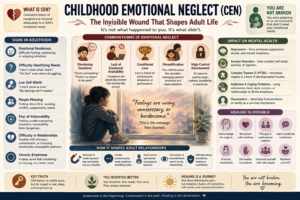
Common Forms of Childhood Emotional Neglect
CEN does not always look like obvious mistreatment. It can appear through repeated patterns in which a child’s emotional needs are dismissed, overlooked, or made secondary.
1. Dismissing Emotions
Children may hear:
- “You’re overreacting.”
- “There’s no reason to be upset.”
- “Only weak people cry.”
Over time, they may learn to distrust or suppress their own emotions.
2. Lack of Emotional Availability
This can involve parents who are:
- Constantly busy or emotionally unavailable
- Consumed by work or other responsibilities
- Emotionally withdrawn
- Struggling with their own mental health and unable to respond consistently
The parent may be physically present while remaining emotionally disconnected.
3. Conditional Love
When affection or approval depends heavily on achievement or obedience, children may learn that they must earn love.
Examples include:
- “Be first in class, then I’ll be proud.”
- “Good children don’t talk back.”
4. Parentification
The child takes on emotional or practical responsibilities that are not developmentally appropriate, such as:
- Managing family conflicts
- Supporting a parent emotionally
- Becoming the “strong one” who never needs help
5. High-Control Environments
In some families, children have little room to express:
- Anger or sadness
- Personal boundaries
- Independent opinions or choices
When these patterns occur repeatedly, the child may internalize a powerful message:
“My feelings are wrong, unnecessary, or burdensome.”
The Psychology Behind Childhood Emotional Neglect
Human beings are wired for emotional connection. From an attachment perspective, children need responsiveness, emotional attunement, affection, safety, and co-regulation to develop a healthy sense of self and emotional security.
When these needs are repeatedly unmet, children may develop coping patterns that protect them in the short term but create difficulties later in life.
1. Emotional Suppression
Children may stop expressing emotions when doing so repeatedly leads to rejection, dismissal, or tension. They learn to hide feelings rather than process them.
2. Shame
When a child’s emotions are consistently invalidated, they may begin to turn the problem inward:
- “Something must be wrong with me.”
- “Why doesn’t anyone care how I feel?”
Over time, normal emotional needs can become associated with shame or guilt.
3. Disconnection From Self
Repeated emotional suppression can make it difficult to recognize:
- Needs
- Emotions
- Preferences
- Personal values and identity
The person may become so accustomed to adapting to others that they struggle to know what they genuinely want.
4. Hyper-Independence
When children learn that emotional support is unreliable, they may develop beliefs such as:
- “No one will help me.”
- “I must handle everything alone.”
As adults, this can appear as extreme self-reliance, difficulty asking for help, or discomfort with depending on others.
These patterns are not signs of weakness. They are often adaptations to an emotional environment in which the child’s needs were not consistently met—but they can continue to influence relationships, self-worth, and emotional functioning in adulthood.
Signs of Childhood Emotional Neglect in Adults
People who experienced CEN may sense that “something is missing” without knowing why. The signs can vary, but several patterns commonly appear in emotional functioning, self-worth, and relationships.
1. Feeling Emotionally Numb
They may struggle to:
- Identify or access emotions
- Express what they feel
- Experience joy or excitement fully
Emotional numbness can develop when disconnecting from feelings became a learned way of coping.
2. Difficulty Identifying Needs
They may frequently say:
- “I don’t know what I want.”
- “I’m fine,” even when struggling
- “I don’t need help.”
When a person is disconnected from their needs, self-care and relationships can become difficult.
3. Low Self-Worth
Repeated emotional invalidation may contribute to beliefs such as:
- “I don’t deserve love.”
- “My feelings don’t matter.”
- “I’m a burden.”
4. Overthinking and Anxiety
Some adults may overanalyze situations because they have learned to doubt their own emotional responses, fear rejection, or struggle with emotional regulation.
5. People-Pleasing Tendencies
They may learn to:
- Keep others happy
- Avoid conflict
- Avoid causing trouble
- Suppress their own needs
This can make approval from others feel more important than personal well-being.
6. Fear of Being Vulnerable
If emotions were repeatedly ignored, punished, or shamed, emotional openness may begin to feel unsafe. Vulnerability can feel threatening rather than natural.
7. Difficulty Forming Close Relationships
Some adults may:
- Struggle with intimacy or commitment
- Feel uncomfortable depending on others
- Become drawn to emotionally unavailable partners
- Show patterns associated with insecure attachment
These patterns are not inevitable, but they can reflect learned expectations about emotional closeness.
8. Feeling Empty or “Not Enough”
A persistent sense of emptiness, inadequacy, or emotional disconnection may occur when a person has spent years suppressing their needs and feelings.
9. Self-Doubt and Impostor Feelings
Some adults may repeatedly question their:
- Achievements
- Abilities
- Worth
This can be especially strong when childhood experiences provided little emotional affirmation.
10. Emotional Outbursts
When emotions are repeatedly suppressed rather than processed, they may eventually emerge as:
- Sudden anger
- Intense crying
- Emotional breakdowns
The pattern can become “bottle everything up, then eventually break down.”
These signs do not prove that someone experienced CEN. They can have many causes, and the broader childhood and adult context matters. However, when several of these patterns consistently appear together, they may be worth exploring with greater self-awareness or professional support.
How Childhood Emotional Neglect Shapes Adult Relationships
Relationships can become a powerful mirror of unresolved emotional patterns from childhood. When a person learned early that their feelings or needs were unsafe, unimportant, or burdensome, those lessons may influence how they connect with others as adults.
1. Attraction to Familiar Dynamics
Some adults may feel drawn to partners who are:
- Emotionally distant
- Self-focused
- Uncomfortable with emotional intimacy
Not because they consciously want unhealthy relationships, but because familiar patterns can feel more predictable than healthy ones.
2. Trouble Communicating Needs
They may say:
- “It’s okay, I don’t need anything.”
- “I don’t want to bother you.”
When needs remain unspoken, resentment and emotional distance can gradually develop.
3. Avoidance of Conflict
If conflict was associated with rejection or emotional danger in childhood, adults may fear:
- Anger
- Rejection
- Abandonment
As a result, they may suppress concerns or tolerate unhealthy behavior to keep the relationship stable.
4. Feeling Unseen or Misunderstood
Even within a loving relationship, they may sometimes feel:
- Disconnected
- Invisible
- Emotionally alone
This can happen when they struggle to communicate their inner emotional world.
5. Difficulty Setting Boundaries
When a child’s boundaries or emotional needs were repeatedly ignored, saying “no,” expressing discomfort, or asking for space may later feel selfish or unsafe.
Learning that healthy relationships can include both closeness and boundaries is therefore an important part of healing.
Impact of Childhood Emotional Neglect on Mental Health
Childhood Emotional Neglect is associated with a higher risk of several psychological difficulties. However, CEN does not automatically cause a specific mental disorder; outcomes depend on many individual and environmental factors.
1. Depression
Emotional suppression, chronic loneliness, low self-worth, and internalized shame may contribute to depressive symptoms.
2. Anxiety
Some adults may experience persistent self-doubt, fear of rejection, heightened sensitivity to relationships, or difficulty regulating emotions, which can contribute to anxiety.
3. Trauma-Related Symptoms
Chronic emotional neglect can be associated with developmental and trauma-related difficulties, including emotional dysregulation, negative self-beliefs, and problems with relationships. It is important not to assume that everyone who experiences CEN develops PTSD or complex PTSD.
4. Unhelpful Coping Behaviors
Some people may turn to behaviors such as excessive work, food, screens, substances, or relationships to avoid difficult emotions or cope with feelings of emptiness. These behaviors can provide temporary relief without addressing the underlying emotional needs.
5. Dissociation
Some individuals may cope by becoming detached from their emotions, surroundings, or sense of self, particularly when emotional experiences feel overwhelming.
The Neurobiology of Emotional Neglect
Emotional experiences during childhood can influence brain development and stress-regulation systems. However, the science is more complex than saying that CEN simply “damages” particular brain regions.
1. Stress and Emotional Regulation
Chronic or unpredictable stress during development may affect systems involved in:
- Emotional regulation
- Attention and decision-making
- Stress responses
2. The Amygdala and Threat Processing
Research on childhood adversity suggests that early stress can be associated with differences in how the brain processes threat and emotional information. These changes may contribute to increased sensitivity to stress in some individuals.
3. Emotional and Social Processing
Repeatedly lacking emotional attunement may also influence how a person learns to interpret emotions, relationships, and social cues. These effects are not fixed or inevitable, and the brain remains capable of adaptation and change throughout life.
Therefore, CEN is not “just psychological.” Emotional experiences and biological processes are deeply interconnected—but claims about specific brain abnormalities should be made cautiously and based on the strength of available evidence.
Why People Don’t Realize They Were Emotionally Neglected
Many adults struggle to identify CEN because they remember having their basic needs met:
- “My parents gave me everything.”
- “I had a normal childhood.”
- “They didn’t beat me. So what’s the problem?”
Emotional neglect can remain hidden because it is often:
- Silent
- Unintentional
- Normalized within families or cultures
- Difficult to remember or describe as a specific event
Children often adapt to their environment rather than question it. As a result, they may grow up believing that emotional suppression or extreme self-reliance is simply part of who they are.
The absence of obvious abuse does not mean the absence of emotional needs. A childhood can look “normal” externally while still leaving important emotional needs unmet.
The Cultural Role of Emotional Neglect
Culture can influence how families understand and express emotions. In some Asian and Indian families, for example, children may be taught to prioritize obedience, academic achievement, family responsibilities, or emotional restraint.
Common messages may include:
- “Don’t talk back.”
- “Be strong.”
- “What will people say?”
- “Family comes first.”
These values are not inherently neglectful. The concern arises when cultural expectations consistently leave little room for emotional expression, validation, autonomy, or psychological support.
It is also important to recognize that love can be expressed through practical care—such as food, education, protection, and financial support—while emotional needs may still go unspoken. Cultural context can therefore help explain why CEN may remain hidden, but it should not be used to label an entire culture or family system as emotionally neglectful.
Healing Childhood Emotional Neglect
Healing is not about blaming parents or rewriting the past. It is about understanding learned patterns and developing a healthier relationship with your emotions, needs, and relationships.
1. Acknowledge the Experience
Begin by:
- Naming what was missing
- Understanding how it affected you
- Recognizing that your emotional needs matter
2. Reconnect With Emotions
Try:
- Naming emotions
- Journaling
- Asking, “What am I feeling right now?”
- Allowing emotions without immediately judging or suppressing them
3. Consider Therapy
Depending on the person’s needs, approaches such as CBT, DBT, Schema Therapy, and attachment-focused therapy may help with emotional regulation, negative beliefs, interpersonal patterns, and unmet emotional needs. “Inner child” or reparenting work may also be useful for some people when used thoughtfully within therapy.
4. Expand Emotional Vocabulary
Someone who grew up suppressing emotions may rely on words such as “fine,” “sad,” or “angry.” Learning to distinguish emotions such as disappointment, loneliness, shame, frustration, fear, guilt, and longing can improve emotional awareness.
5. Practice Vulnerability Gradually
Start small:
- Share a feeling with a trusted person
- Ask for help
- Express a need
- Admit when something has hurt you
Vulnerability does not require telling everyone everything. It is about learning that appropriate emotional openness can be safe.
6. Build Healthy Boundaries
Practice statements such as:
- “No, I’m not comfortable with that.”
- “This is not okay for me.”
- “I need some time.”
Boundaries are not rejection; they help create healthier relationships.
7. Build Emotionally Safe Relationships
Spend time with people who listen, respect boundaries, validate feelings, and allow emotional honesty without humiliation or punishment.
8. Practice Self-Reparenting
This can involve:
- Responding to yourself with compassion
- Recognizing your needs
- Celebrating progress rather than only achievement
- Speaking to yourself with the kindness you needed growing up
What Healing Looks Like
Healing from CEN is gradual. It does not mean becoming emotional all the time or forgetting the past. It means developing greater freedom in how you experience and respond to emotions.
Over time, a person may begin to:
- Recognize and express emotions more clearly
- Understand and communicate needs
- Build stronger relationships
- Develop healthier boundaries
- Reduce self-blame
- Strengthen self-worth and emotional resilience
Healing is not about fixing the past. It is about creating a present in which your emotional life has room to exist.
Final Thoughts
Childhood Emotional Neglect can be difficult to see, especially when there was no obvious abuse or dramatic event. But what was missing can still matter.
- Your emotions matter.
- Needs matter.
- Your experiences matter.
Understanding CEN can be a first step toward breaking unhealthy patterns, building more authentic relationships, and developing greater self-worth.
You are not broken. Some of your patterns may have developed as ways of adapting to what you experienced. With awareness, supportive relationships, and appropriate help when needed, those patterns can change.
Reference
1. American Psychological Association (APA)
https://www.apa.org/topics/childhood-trauma
2. National Institute of Mental Health (NIMH)
3. Verywell Mind – Emotional Neglect
https://www.verywellmind.com/what-is-emotional-neglect-4174665
4. Psychology Today – Attachment Theory
https://www.psychologytoday.com/us/basics/attachment-theory
5. Harvard Health Publishing – Early Childhood & the Brain
6.What Is CBT? A Simple Guide for Everyone
7.DBT Skills for Emotional Regulation
8.Anxious vs Avoidant Partners: The Push–Pull Pattern
9.How Childhood Trauma Affects Romantic Relationships
Pingback: Situationship Red Flags People Often Ignore
Pingback: Breakup Anxiety: Why It Happens & How to Heal