
“I don’t just ask ‘What’s your type?’ — I ask ‘What’s your attachment styles ?’ because chemistry without emotional safety is just chaos.”
Introduction
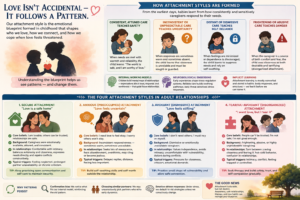
Love isn’t accidental — it follows a pattern. The people we’re drawn to, how we show love, how we argue and forgive, and even how fiercely we expect to be cared for often trace back to a blueprint laid down long before adult romance: our attachment style. Attachment theory shows that the ways caregivers responded to our needs as children create deep, mostly unconscious expectations about safety, trust, and worthiness. Those expectations quietly shape who we choose, how we connect, and how we cope when love feels threatened. Understanding this blueprint helps us see patterns in our relationships and opens the door to changing them.
How attachment styles are formed
Human infants are biologically dependent: their survival relies on caregivers for food, safety, and emotional regulation. From the earliest days, babies learn not only from what caregivers do, but from how consistently and sensitively they respond.
What children observe and learn
- Consistent, attuned care teaches safety. When a caregiver soothes a baby’s cry promptly, holds them when they’re scared, and reads signals accurately (for example, distinguishing hunger from tiredness), the child learns: “The world is safe, and I am worthy of love.”
- Inconsistent or unpredictable caregiving teaches uncertainty. If responses are sometimes warm and sometimes absent, the child learns that closeness is unreliable and must be sought or guarded.
- Distant or dismissive caregiving teaches self-reliance. If a caregiver minimizes feelings or discourages dependence, the child learns to suppress emotional needs and rely on self‑soothing.
- Frightening or abusive caregiving teaches danger. When the caregiver is both a source of comfort and threat (for example, due to anger, neglect, or trauma), the child forms a disorganized attachment, seeing closeness as both desirable and terrifying.
How these patterns become internalized
- Internal working models: Children build mental maps of relationships — expectations about whether people are trustworthy, whether they will respond, and whether the child is lovable. These “internal working models” guide attention, memory, and behavior in later relationships.
- Neurobiological embedding: Repeated early experiences shape stress‑regulation systems. Reliable caregiving helps the developing brain regulate cortisol and build effective soothing pathways. Chronic unpredictability or threat can sensitize stress responses, making adults more reactive to perceived rejection or closeness.
- Implicit learning: Much of attachment learning is nonverbal and procedural — it’s stored in habits, bodily responses, and emotional reactions, rather than explicit beliefs. Adults may “feel” patterns before they can name them.
Developmental stages and sensitive periods
- Infancy (0–2 years): Core attachment bonds form through feeding, soothing, and face‑to‑face interaction.
- Toddlerhood (2–4 years): Exploration and the “secure base” concept develop; the child tests whether the caregiver will return after brief separations.
- Early childhood (4–7 years): Relationships with peers and teachers expand the attachment network, but primary caregiver patterns remain influential.
Examples that show the process
- A child whose parent sometimes comforts and sometimes ignores may grow up anxious in relationships, constantly checking for signs of love.
- Child whose caregiver dismissed emotions may learn to hide vulnerability and later prefer independence over closeness.
- A child exposed to frightening parental behavior may alternate between seeking comfort and fleeing from intimacy.
Why attachment patterns persist
- Confirmation bias: People tend to notice information that fits their internal working model, reinforcing the original pattern.
- Choosing similar partners: Adults often select partners who unconsciously echo early relationship dynamics (for example, an anxious person may pair with a less available partner).
- Emotion‑driven responses: Under stress, the brain defaults to habitual attachment strategies, making early patterns likely to reappear unless actively changed.
Pathways for change
Awareness, consistent relationships, therapeutic interventions, and deliberate practice of new emotional responses can reshape internal models and stress biology over time. Attachment is durable but not destiny — early patterns explain tendencies, not fixed outcomes.
The Four Attachment Styles in Detail
Our early caregiving experiences shape predictable patterns of relating that persist into adult love. These patterns—called attachment styles—explain why some people move toward closeness, others pull away, and some feel torn between the two. Below are the four core styles, what they look like in relationships, common childhood roots, typical triggers, and one practical tip to help each style move toward greater security.
1. Secure attachment — “Love is a safe home”
Core beliefs: I am lovable; others can be trusted; relationships are safe.
Background: Caregivers were emotionally available, attuned, and consistent.
In relationships: Comfortable with intimacy, balances autonomy and closeness, expresses needs directly, and repairs conflicts constructively.
Typical triggers: Feeling neglected, prolonged partner unavailability, or chronic criticism.
Emotion regulation: Uses self‑soothing and partner support; cortisol response clears quickly after stress.
Practical tip: Keep practicing clear requests and boundaries; model consistent responsiveness for partners.
Example: After a fight, a secure partner says, “I felt hurt when you said X — can we talk about it tonight?” and follows through.
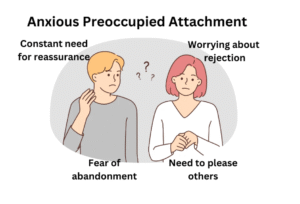
2. Anxious / preoccupied attachment — “Love must be protected or it will disappear”
Core beliefs: I need reassurance; I might not be enough; fear of abandonment.
Background: Caregivers were inconsistently available; emotional needs were hit-or-miss.
In relationships: Intense desire for closeness, frequent worry about partner’s feelings, tendency to read negative intent into neutral events.
Typical triggers: Delays in communication, perceived withdrawal, ambiguous emotional signals.
Emotion regulation: High arousal (racing thoughts, cortisol spikes); seeks external soothing from partner.
Practical tip: Build internal soothing tools — pause, breathe, journal before reacting; set a communication plan with partner.
Example: When a partner is quiet after work, an anxious person might feel rejected and either send multiple messages or ruminate for hours.
3. Avoidant / dismissive attachment — “Love threatens independence”
Core beliefs: Emotions are unsafe; depending on others leads to disappointment; self-reliance is prized.
Background: Caregivers minimized feelings, encouraged independence, or withheld emotional support.
In relationships: Maintains distance to protect autonomy, struggles to disclose vulnerability, may value competence and activity over emotional exchange.
Typical triggers: Requests for emotional depth, prolonged dependency, perceived loss of freedom.
Emotion regulation: Low expressed affect but internal stress may rise (narrowed attention, shutdown); uses distraction or withdrawal to downregulate.
Practical tip: Practice brief vulnerability (share one small feeling per day), and agree on predictable check-ins to reduce perceived threats.
Example: After an emotional conversation, an avoidant partner may withdraw to work or hobbies rather than talk, making the other partner feel abandoned.
4. Fearful–avoidant / disorganized attachment — “I want love, but love terrifies me”
Core beliefs: I crave closeness but expect it to cause harm; people who love me may also hurt me.
Background: Caregivers were frightening, chaotic, abusive, or unpredictable — comfort and threat were intertwined.
In relationships: Oscillates between intense pursuit and abrupt withdrawal, may test partners, struggles with trust and emotional regulation.
Typical triggers: Intense intimacy, reminders of past betrayal or trauma, perceived inconsistency in a partner.
Emotion regulation: Rapid shifts between hyperactivation (panic, clinginess) and hypoactivation (shutting down, dissociation); higher risk for trauma reenactment.
Practical tip: Build a safety plan with trusted supports and a therapist; use short grounding practices during overwhelm and commit to small, steady steps toward trust.
Example: After several loving weeks, a fearful–avoidant partner might initiate a breakup impulsively when closeness feels unsafe, then return seeking reconciliation.
Quick comparison and pairing note
- Secure: flexible, balanced, repair‑oriented.
- Anxious: seeks closeness, fears abandonment, ruminates.
- Avoidant: prioritizes independence, avoids vulnerability.
- Fearful–avoidant: wants intimacy but is frightened; often trauma‑driven.
Pairing effects
- Anxious + Avoidant often creates a chase–distance loop: the more one pursues, the more the other withdraws.
- Secure partners can buffer insecure partners by offering predictable responsiveness.
- Fearful patterns respond best to trauma‑informed therapy and steady, predictable relationship experiences.
How Attachment Styles Combine in Relationships
| Combination | Relationship Outcome |
| Secure + Secure | Supportive, growth-oriented, emotionally fulfilling |
| Secure + Anxious | Heals anxious partner over time |
| Secure + Avoidant | Avoidant gradually learns emotional safety |
| Anxious + Avoidant | Most unstable — triggers each other’s fears |
| Anxious + Fearful | Passionate but unpredictable and exhausting |
| Avoidant + Fearful | High walls, unresolved trauma |
| Fearful + Fearful | Intense but chaotic and rarely long-term |
The most challenging and common trauma bond:
Anxious + Avoidant → chasing vs withdrawing dyad
Psychological Mechanisms Behind Attachment
Neurochemistry of Attachment
Love activates chemicals in the brain:
| Hormone | Function |
| Oxytocin | Bonding, trust |
| Dopamine | Pleasure, attraction |
| Cortisol | Stress and insecurity |
| Serotonin | Emotional balance |
- Anxious partners produce high cortisol during separation.
- Avoidants produce cortisol during too much closeness.
- Secure partners maintain hormonal balance through trust.
Attachment and Core Wounds
Each insecure attachment carries a deep core wound:
| Style | Core Wound |
| Anxious | “I am not enough.” |
| Avoidant | “I can rely only on myself.” |
| Fearful | “Love is danger.” |
Awareness of the wound is the first step toward healing.
Healing: Moving Toward Secure Attachment
Attachment style is changeable, not permanent.
General Healing Principles
- Recognize triggers instead of reacting impulsively
- Communicate needs rather than testing or assuming
- Build emotional regulation skills
- Choose partners who respect emotional safety
- Study childhood patterns without judgment
- Receive therapy / trauma-informed counselling if possible
Healing Exercises for Each Style
For Anxious Attachment
- Practice delayed response before reacting to fear.
- Journal thoughts instead of acting on them instantly.
- Ask directly for reassurance instead of testing love.
- Build self-worth from within, not from validation.
Helpful sentence to express needs:
“When messages stop suddenly, I feel anxious. Can we agree on a communication rhythm that feels safe for both of us?”
For Avoidant Attachment
- Label emotions instead of suppressing them.
- Practice vulnerability in small doses.
- Allow closeness without assuming loss of freedom.
- Learn to take emotional responsibility without shutting down.
Helpful sentence to express needs: “I need some space right now, but I care about you and I’m not leaving.”
For Fearful–Avoidant Attachment
- Identify triggers that cause sudden withdrawal.
- Practice grounding techniques during emotional overwhelm.
- Challenge the belief that love = danger.
- Build trust slowly with consistent partners.
Helpful sentence to express needs: “I want closeness, but sometimes it feels scary. Can we go slowly and check in emotionally?”
For Secure Attachment
- Maintain boundaries with insecure partners.
- Avoid becoming the “fixer” or emotional caretaker.
- Balance empathy with self-respect.
Becoming Secure Starts with One Core Truth
Love is not earned by fear, chasing, perfection, or self-sacrifice.
Love becomes secure when there is:
- Consistency
- Communication
- Emotional safety
- Trust Repair after rupture
Attachment style is not about blame — it is about understanding your emotional map so you can build healthier relationships.
Conclusion
You don’t need a perfect childhood to find healthy love. You don’t have to fix everything before you deserve connection. Healing isn’t about becoming someone new — it’s about reclaiming who you were before fear rewired your heart.
When you heal your attachment wounds:
- Love stops feeling like survival
- Connection becomes comfort instead of fear
- Intimacy becomes freedom instead of danger
- You become your own safe place — and love begins to thrive
Frequently Asked Questions (FAQs)
1. What are attachment styles in relationships?
Attachment styles are patterns of emotional bonding formed in childhood that affect adult relationships.
2. What are the four attachment styles?
Secure, anxious, avoidant, and fearful (disorganized).
3. Can attachment styles change over time?
Yes, with awareness, effort, and therapy, attachment styles can become more secure.
4. Which attachment style is the healthiest?
Secure attachment is considered the healthiest and most balanced.
5. Why do anxious and avoidant partners attract each other?
They trigger each other’s emotional patterns—one seeks closeness while the other seeks distance.
6. How does childhood affect adult relationships (Attachment Styles)?
Early caregiver experiences shape beliefs about love, trust, and emotional safety.
7. What is anxious attachment (Attachment Styles)?
It involves fear of abandonment, need for reassurance, and emotional dependency.
8. What is avoidant attachment (Attachment Styles)?
It involves emotional distance, fear of intimacy, and strong independence.
9. What is fearful-avoidant attachment (Attachment Styles)?
It is a mix of desire for closeness and fear of getting hurt.
10. How can I become securely attached (Attachment Styles)?
Through self-awareness, emotional regulation, communication, and healthy relationships.
References
- Psychology Today
https://www.psychologytoday.com/us/basics/attachment - PositivePsychology
https://positivepsychology.com/attachment-theory/ - John Bowlby
https://www.britannica.com/biography/John-Bowlby - Mary Ainsworth
https://www.simplypsychology.org/mary-ainsworth.html - The Psychology of Care: Inside the Minds of Certified Nurses Balancing Empathy, Burnout, and Healing
This article is written for knowledge purposes, aiming to help readers understand the topic better and gain useful insights for learning and awareness.