
Narcissism isn’t just self-love — it’s a mirror that can crack relationships.
Introduction
In today’s world, the term “narcissist” is often used casually to describe someone who seems self-centered or overly confident. However, it is much more complex than simply loving oneself. It is a psychological pattern that exists on a spectrum—from healthy self-esteem to a more extreme and harmful personality style known as Narcissistic Personality Disorder (NPD).
Understanding narcissism is important not only for identifying it in others but also for recognizing subtle traits within ourselves. This awareness can improve relationships, emotional well-being, and decision-making in everyday life.
What is Narcissism?
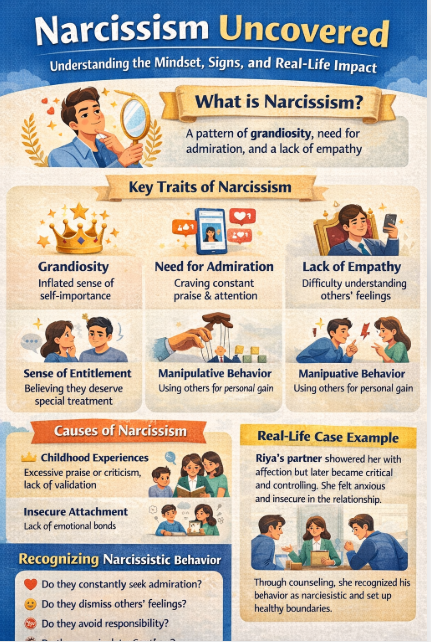
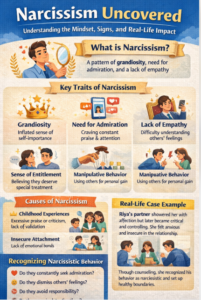
It refers to a pattern of grandiosity, a constant need for admiration, and a lack of empathy for others. It originates from the Greek myth of Narcissus, a young man who fell in love with his own reflection.
In psychology, narcissism exists on a spectrum:
- Healthy Narcissism: Confidence, self-worth, and ambition
- Unhealthy Narcissism: Arrogance, entitlement, and manipulation
- Narcissistic Personality Disorder (NPD): A clinical condition involving persistent and severe narcissistic traits
Key Characteristics of Narcissism
1. Grandiosity
Narcissistic individuals often have an inflated sense of self-importance. They may believe they are superior to others and deserve special treatment.
Example: A person constantly exaggerates their achievements and expects recognition even when it is not warranted.
2. Need for Admiration
They crave attention, praise, and validation from others.
Example: Someone who frequently posts on social media and becomes upset when they don’t receive enough likes or comments.
3. Lack of Empathy
One of the most defining traits of narcissism is difficulty understanding or caring about others’ feelings.
Example: Ignoring a friend’s emotional pain and shifting the conversation back to themselves.
4. Sense of Entitlement
Narcissists often believe they deserve special privileges.
Example: Expecting preferential treatment at work without putting in extra effort.
5. Manipulative Behavior
They may use others to achieve their own goals.
Example: Flattering someone only to gain favors or opportunities.
Types of Narcissism
1. Grandiose Narcissism
- Confident, dominant, and attention-seeking
- Often appears charismatic
- May hide insecurity beneath confidence
Example: A leader who constantly seeks praise and dismisses others’ contributions.
2. Vulnerable Narcissism
- Sensitive, insecure, and defensive
- Easily hurt by criticism
- May appear shy but internally seeks validation
Example: Someone who feels deeply offended by minor feedback and withdraws emotionally.
3. Malignant Narcissism
- Combines narcissism with aggression and lack of morality
- Can be controlling or abusive
Example: A person who manipulates and harms others without guilt.
Causes of Narcissism
It can develops due to a combination of psychological, environmental, and biological factors.
1. Childhood Experiences
- Excessive praise or criticism
- Lack of emotional validation
- Overprotective or neglectful parenting
Example: A child constantly told they are superior may develop unrealistic self-importance.
2. Insecure Attachment
Children who do not form secure emotional bonds may develop narcissistic traits as a defense mechanism.
3. Cultural Influence
Modern society, especially social media, often promotes self-image, comparison, and validation.
Example: The pressure to appear perfect online can reinforce narcissistic tendencies.
Narcissism in Relationships
Narcissistic individuals often struggle with maintaining healthy relationships.
Common Patterns:
- Love bombing in the beginning
- Gradual emotional withdrawal
- Control and manipulation
- Lack of accountability
Example: A partner may initially shower someone with affection, then later become critical and distant.
Emotional Impact on Others
Being in a relationship with a narcissist can lead to:
- Low self-esteem
- Confusion and self-doubt
- Emotional exhaustion
- Anxiety and depression
Workplace Narcissism
It is also common in professional environments.
Traits in the Workplace:
- Taking credit for others’ work
- Lack of teamwork
- Sensitivity to criticism
- Desire for power and recognition
Example: A manager who ignores team contributions but highlights their own role in success.
Social Media and Narcissism
Social media platforms have amplified narcissistic behaviors.
Why?
- Instant validation (likes, comments)
- Comparison with others
- Focus on appearance and image
Example: Constantly seeking approval through posts and feeling anxious when engagement is low.
Healthy vs Unhealthy Narcissism
It is important to differentiate between healthy self-esteem and harmful narcissism.
| Healthy Traits | Unhealthy Traits |
|---|---|
| Confidence | Arrogance |
| Self-respect | Entitlement |
| Ambition | Exploitation |
| Emotional awareness | Lack of empathy |
Healthy narcissism helps individuals grow, while unhealthy narcissism damages relationships.
How to Identify Narcissistic Behavior
Ask yourself:
- Does this person always need attention?
- They dismiss others’ feelings?
- Do they avoid responsibility?
- They manipulate situations?
If these patterns are consistent, it may indicate narcissistic tendencies.
Coping with a Narcissist
1. Set Boundaries: Clearly define what behavior you will and will not accept.
2. Avoid Emotional Engagement: Narcissists often thrive on emotional reactions.
3. Stay Grounded in Reality: Do not let manipulation distort your perception.
4. Seek Support: Talk to friends, family, or a mental health professional.
Can Narcissism Be Treated?
Yes, but it is challenging.
Treatment usually involves:
- Psychotherapy
- Self-awareness development
- Emotional regulation training
However, many narcissistic individuals do not seek help because they do not see their behavior as problematic.
Case Example
Consider a young professional named Riya.
Riya’s partner initially appeared charming and supportive. Over time, he began criticizing her achievements, controlling her decisions, and demanding constant attention. Whenever Riya expressed her feelings, he dismissed them or blamed her.
Eventually, Riya experienced anxiety and self-doubt. Through counseling, she recognized these patterns as narcissistic behavior and began setting boundaries.
This example highlights how it can subtly impact mental health and relationships.
The Psychological Perspective
From a psychological viewpoint, narcissism is often linked to:
- Fragile self-esteem
- Defense mechanisms
- Need for external validation
Interestingly, beneath the surface, many narcissistic individuals struggle with insecurity and fear of rejection.
How to Build Healthy Self-Esteem Instead
Instead of falling into narcissistic patterns, individuals can:
- Practice self-awareness
- Develop empathy
- Accept constructive criticism
- Focus on internal validation
Conclusion
It is a complex psychological phenomenon that influences behavior, relationships, and emotional well-being. While a certain level of self-confidence is healthy, excessive narcissism can lead to significant personal and social challenges.
By understanding the signs, causes, and impact of narcissism, we can better navigate our relationships and protect our mental health. Awareness is the first step toward change—both in ourselves and in how we interact with others.
Frequently Asked Questions (FAQs)
1. What is narcissism in psychology?
It is a personality pattern involving self-importance, need for admiration, and lack of empathy.
2. Is narcissism a disorder?
In extreme cases, it is diagnosed as Narcissistic Personality Disorder (NPD).
3. What are signs of a narcissist?
Grandiosity, lack of empathy, manipulation, entitlement, and constant need for validation.
4. Can narcissism be treated?
Yes, through psychotherapy, but it requires self-awareness and willingness to change.
5. What causes narcissism?
Childhood experiences, insecure attachment, and social/environmental factors.
6. How do narcissists behave in relationships?
They may love-bomb initially, then become controlling, critical, and emotionally distant.
7. What is the difference between healthy and unhealthy?
Healthy = confidence and self-worth
Unhealthy = arrogance and lack of empathy
8. How can I deal with a narcissist?
Set boundaries, avoid emotional reactions, and seek support.
9. Are narcissists insecure inside?
Often yes. Many have fragile self-esteem beneath their behavior.
10. How does social media affect?
It increases validation-seeking behavior and comparison.
References
American Psychiatric Association. (n.d.). Narcissistic personality disorder.
https://www.psychiatry.org/patients-families/personality-disorders/what-are-personality-disorders
Verywell Mind. (n.d.). narcissistic personality disorder.
https://www.verywellmind.com/what-is-narcissistic-personality-disorder-2795446
Monoprova Counselling, (2026), “About Us”,
Monoprova Counselling, (2026), “Contact Us”,
This article is written for knowledge purposes, aiming to help readers understand the topic better and gain useful insights for learning and awareness.