
Neurodiversity in Adults: 20 Hidden Signs That Could Change How You Understand Yourself
Introduction
For decades, words like ADHD, Autism, Dyslexia, or Dyspraxia were mostly associated with children. Adults were rarely assessed unless their challenges were severe. As a result, thousands of adults grew up undiagnosed, adapting to life by masking, overworking, or hiding their struggles.
Now, neuroscience and psychology recognize something important: Neurodiversity is not a disability—it’s a natural variation in how the brain functions.
Adults who are neurodivergent often possess strengths such as creativity, hyperfocus, problem-solving, and deep empathy. But without understanding their own brain, they often feel “different,” “lazy,” “too sensitive,” or “not good enough.”
This article explains:
- What neurodiversity means
- Why adults often remain undiagnosed
- 20 psychological signs you might be neurodivergent
- How masking hides symptoms
- The benefits of discovering your neurotype
- When to seek assessment
If you’ve ever felt misunderstood, overwhelmed, or “out of sync,” this may help you see yourself with clarity—not judgment.
What Does Neurodiversity Mean?
Neurodiversity is a concept that recognizes natural variation in how human brains develop, process information, learn, communicate, and interact with the world. Coined by sociologist Judy Singer in the late 1990s, the neurodiversity in adults movement emphasizes that neurological differences are a normal part of human diversity—not simply deficits or disorders.
Rather than viewing every difference through a purely medical lens, neurodiversity in adults encourages a more balanced perspective: neurological differences can present both challenges and strengths, depending on the individual and their environment.
This does not mean that neurodevelopmental conditions cannot cause significant difficulties. Many neurodivergent individuals experience real challenges that may require support, accommodations, or treatment. Instead, the neurodiversity framework recognizes that differences in brain functioning are a natural part of human variation and deserve understanding rather than stigma.
Human Brains Naturally Differ In (Neurodiversity in Adults)
Every brain processes information differently. Neurodiversity reflects natural differences in areas such as:
- Attention and concentration
- Sensory processing
- Language and communication
- Learning and information processing
- Emotional regulation
- Social interaction and social communication
- Executive functioning (planning, organization, working memory, and self-regulation)
- Motor coordination and movement
No two brains function in exactly the same way, and these differences exist along a continuum.
What Conditions Are Included Under Neurodiversity in Adults?
The term neurodivergent is commonly used to describe individuals whose neurological development differs from what is considered typical. While definitions vary slightly across researchers and advocacy groups, the neurodiversity umbrella commonly includes:
- Attention-Deficit/Hyperactivity Disorder (ADHD)
- Autism Spectrum Disorder (ASD)
- Dyslexia
- Developmental Coordination Disorder (Dyspraxia/DCD)
- Dyscalculia
- Tourette Syndrome
- Specific learning disorders
- Sensory processing differences, which may occur alongside other neurodevelopmental conditions
Some discussions of neurodiversity also include giftedness, particularly Twice-Exceptional (2e) individuals—people who are both gifted and have a neurodevelopmental condition such as ADHD, autism, or dyslexia. However, whether giftedness itself should be considered part of neurodiversity remains an area of ongoing discussion among researchers and clinicians.
Neurodivergence Looks Different in Every Person (Neurodiversity in Adults)
Neurodivergence is not one-size-fits-all. Two people with the same diagnosis may have very different experiences, strengths, challenges, and support needs.
For example:
- One adult with ADHD may struggle primarily with organization and time management, while another excels in fast-paced environments but finds routine tasks exhausting.
- One autistic adult may prefer limited social interaction, while another enjoys friendships but experiences sensory overload or difficulty interpreting social cues.
- A person with dyslexia may struggle with reading accuracy yet demonstrate exceptional creativity, problem-solving, or spatial reasoning.
Many adults also display characteristics associated with more than one neurodevelopmental condition. Research shows that co-occurring conditions—such as ADHD alongside autism or dyslexia—are relatively common. This overlap means that each individual’s neurocognitive profile is unique.
Understanding neurodiversity is not about placing people into rigid categories. It is about recognizing that different brains process the world in different ways and that these differences deserve both scientific understanding and compassionate support.
Why Many Adults Remain Undiagnosed (Neurodiversity in Adults)
For many years, neurodevelopmental conditions such as ADHD and autism were viewed primarily as childhood conditions. As a result, countless adults reached adulthood without ever receiving an assessment or understanding why everyday life felt more challenging for them than it seemed to be for others.
Today, growing research shows that many adults are only identified later in life—sometimes in their 30s, 40s, or even later. This delay is rarely due to a lack of symptoms. Instead, it often reflects historical limitations in diagnosis, differences in presentation, and years of adapting to social expectations.
Here are some of the most common reasons why neurodivergent adults remain undiagnosed.
1. Diagnostic Criteria Were Historically Based on Children
For decades, diagnostic criteria for conditions such as ADHD and autism were developed primarily from research involving young children—especially boys.
Because of this, many adults whose symptoms looked different from these early descriptions were overlooked. Adult presentations often involve difficulties with executive functioning, emotional regulation, organization, relationships, or maintaining employment rather than the overt behaviours commonly seen in childhood.
As research has expanded, clinicians have gained a better understanding of how neurodevelopmental conditions can present differently across the lifespan.
2. Women and Many AFAB Individuals May Mask Their Difficulties
Research suggests that many women and people assigned female at birth (AFAB) develop sophisticated coping strategies from an early age.
This process, often called masking or social camouflaging, involves consciously or unconsciously hiding neurodivergent traits in order to fit social expectations.
Examples include:
- Forcing eye contact
- Rehearsing conversations in advance
- Copying other people’s social behaviour
- Suppressing stimming behaviours
- Closely monitoring facial expressions and tone of voice
While masking may help individuals navigate social situations, it often comes at a significant psychological cost, including chronic exhaustion, anxiety, identity confusion, and burnout.
3. High Intelligence and Strong Coping Strategies Can Hide Difficulties
Some neurodivergent adults develop exceptional compensatory strategies that allow them to perform well academically or professionally despite significant underlying challenges.
For example, they may:
- Spend far longer on tasks than others
- Rely heavily on reminders and organizational systems
- Work late into the night to compensate for executive functioning difficulties
- Memorize information instead of processing it naturally
In some cases, individuals are Twice Exceptional (2e), meaning they are both intellectually gifted and have a neurodevelopmental condition such as ADHD, autism, or dyslexia. Their strengths may mask areas of difficulty, delaying recognition and diagnosis.
4. Cultural Beliefs and Stigma Can Delay Assessment
Many adults grew up in environments where neurodevelopmental differences were poorly understood or dismissed.
Instead of receiving support, they may have repeatedly heard messages such as:
- “You’re just not trying hard enough.”
- “Stop being lazy.”
- “Everyone struggles sometimes.”
- “You’re too sensitive.”
- “Overreacting.”
- “You just need more discipline.”
Over time, these messages can lead individuals to internalize shame and blame themselves rather than recognizing that their brain may simply process the world differently.
Fear of stigma, discrimination, or misunderstanding may also discourage adults from seeking professional assessment later in life.
5. Neurodivergence Can Be Mistaken for Other Mental Health Conditions
Many characteristics of ADHD, autism, and other neurodevelopmental conditions overlap with symptoms seen in mental health disorders. As a result, some adults initially receive diagnoses such as:
- Anxiety disorders
- Depressive disorders
- Obsessive-Compulsive Disorder (OCD)
- Borderline Personality Disorder (BPD)
- Bipolar disorder
This does not necessarily mean that these diagnoses are incorrect. Many neurodivergent individuals also experience co-occurring mental health conditions.
However, when the underlying neurodevelopmental profile is not recognized, treatment may address only part of the person’s difficulties.
Years of struggling to meet expectations, coping with chronic stress, experiencing social rejection, or constantly masking neurodivergent traits can also contribute to anxiety, depression, low self-esteem, and burnout.
Why Late Diagnosis Matters
Receiving a diagnosis in adulthood is often described not as receiving a label, but as finally receiving an explanation.
For many adults, understanding their neurotype helps them reinterpret years of confusion and self-criticism with greater compassion. Rather than asking, “What’s wrong with me?”, they begin asking, “How does my brain work, and what support helps me thrive?”
This shift in perspective can be an important first step toward improved mental health, self-acceptance, and access to appropriate support.
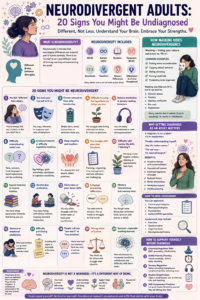
20 Signs That May Suggest You Could Be a Neurodivergent Adult
There is no single sign that confirms someone is neurodivergent. Many of the characteristics below can also occur in people without a neurodevelopmental condition or overlap with mental health conditions such as anxiety, depression, trauma-related disorders, or sleep difficulties.
However, if several of these experiences have been present since childhood, occur across different areas of life (such as work, education, and relationships), and significantly affect daily functioning, they may warrant a professional assessment.
Many neurodivergent adults identify with multiple characteristics rather than just one.
1. You’ve Always Felt “Different” From Other People
Many adults describe feeling different long before they understood why.
Common thoughts include:
- “I always felt out of place.”
- “Everyone else seemed to understand social rules that I had to learn.”
- “I always felt like I was pretending to fit in.”
Although this experience is not unique to neurodivergence, it is frequently reported by adults later diagnosed with ADHD, autism, or other neurodevelopmental conditions.
2. You Frequently Mask Your Natural Behaviour
Masking (also called social camouflaging) refers to consciously or unconsciously hiding neurodivergent traits to fit social expectations.
Examples include:
- Forcing eye contact despite discomfort
- Rehearsing conversations beforehand
- Carefully copying facial expressions or body language
- Mimicking other people’s humour, tone, or communication style
- Suppressing stimming behaviours such as fidgeting or rocking
Masking has been widely studied in autism and is also reported by many adults with ADHD.
While masking can improve social acceptance, maintaining it over long periods may contribute to anxiety, exhaustion, identity confusion, and burnout.
3. Everyday Life Feels Surprisingly Exhausting
Many neurodivergent adults describe feeling mentally drained by activities that others appear to manage more easily.
Examples include:
- Social interactions
- Decision-making
- Managing multiple responsibilities
- Sensory environments
- Planning and organizing daily activities
This exhaustion often reflects the additional cognitive effort required to compensate for executive functioning or sensory differences rather than a lack of motivation.
4. You Struggle to Focus—Yet Can Hyperfocus for Hours
One of the best-known characteristics of ADHD is inconsistent attention rather than an inability to focus.
You may struggle with:
- Administrative tasks
- Paperwork
- Long meetings
- Household chores
- Planning ahead
Yet become completely absorbed in topics that genuinely interest you, sometimes:
- Working for hours without noticing time
- Forgetting to eat or rest
- Becoming deeply immersed in hobbies or research
This phenomenon, often called hyperfocus, is commonly reported in ADHD and may also occur in autistic individuals.
5. You Experience Sensory Differences
Many neurodivergent individuals experience the world more intensely—or actively seek additional sensory input.
Sensory sensitivities may include:
- Loud sounds feeling overwhelming
- Bright lights causing discomfort
- Clothing textures or labels becoming distracting
- Strong smells or certain food textures being difficult to tolerate
Sensory-seeking behaviours may include:
- Enjoying deep pressure or weighted blankets
- Preferring strong flavours or textures
- Frequently tapping, rocking, or fidgeting (stimming)
Sensory experiences vary greatly between individuals and are especially common in autism, though they may also occur in ADHD and other neurodevelopmental conditions.
6. Social Communication Often Feels Effortful
Some adults find it difficult to interpret social information that others seem to understand automatically.
Examples include:
- Misinterpreting tone of voice
- Missing sarcasm or indirect communication
- Difficulty reading facial expressions
- Overanalyzing conversations afterwards
- Uncertainty about unspoken social expectations
These experiences can increase social anxiety and contribute to feelings of isolation.
7. Your Emotions Feel Intense or Difficult to Regulate
Many neurodivergent adults describe emotions as arriving quickly and intensely.
Common experiences include:
- Becoming emotionally overwhelmed
- Difficulty calming down after conflict
- Frustration building rapidly
- Emotional shutdowns or meltdowns
- Strong sensitivity to perceived criticism or rejection
Some individuals with ADHD report Rejection Sensitive Dysphoria (RSD), although it is not currently an official diagnostic criterion and continues to be studied.
Research suggests that differences in brain networks involved in emotional regulation may contribute to these experiences.
8. You Experience Strong Emotional Empathy
Contrary to outdated stereotypes, many neurodivergent adults report experiencing deep emotional empathy.
Some individuals describe:
- Absorbing other people’s emotions
- Becoming distressed by injustice
- Feeling emotionally overwhelmed by others’ suffering
- Strong emotional intuition in close relationships
Research on empathy in autism is complex. Many autistic individuals experience strong affective (emotional) empathy, while differences may exist in aspects of social cognition or interpreting social information.
9. Executive Functioning Is a Daily Challenge
Executive functioning refers to the mental processes that help us organize, plan, initiate, and complete tasks.
Common difficulties include:
- Time management
- Organization
- Working memory
- Prioritizing tasks
- Beginning tasks
- Completing ongoing projects
You may notice yourself:
- Procrastinating despite wanting to start
- Losing important items
- Missing deadlines
- Forgetting appointments
- Becoming overwhelmed by multi-step tasks
Executive functioning differences are central features of ADHD and may also occur in autism and other neurodevelopmental conditions.
10. Everyday Adult Responsibilities Feel Harder Than Expected
Many neurodivergent adults describe struggling with tasks often referred to as “adulting.”
Examples include:
- Managing finances
- Keeping living spaces organized
- Maintaining routines
- Cooking regularly
- Remembering appointments
- Completing household chores consistently
These challenges reflect differences in executive functioning—not laziness or a lack of responsibility.
11. You Develop Deep, Focused Interests
Many autistic individuals develop special interests, while ADHD is often associated with hyperfixations.
These interests may involve: Psychology, Technology, Science, Art, Music, History, Gaming, Social justice. These passions often provide enjoyment, emotional regulation, creativity, and a sense of identity.
12. You Prefer Parallel Activities
Some neurodivergent adults enjoy spending time with others without continuous conversation.
For example:
- Reading together
- Working quietly in the same room
- Watching separate activities while sharing the same space
This style of connection, often called parallel play or parallel presence, allows closeness without overwhelming social demands.
13. Coordination or Motor Skills Have Always Been Challenging
Some individuals experience:
- Frequent tripping
- Poor balance
- Difficulty with handwriting
- Clumsiness
- Trouble with fine motor tasks
These characteristics may occur in Developmental Coordination Disorder (Dyspraxia) and are also reported more frequently in ADHD.
14. Processing Spoken Language Takes Extra Time
Some adults process spoken information more slowly.
You may notice:
- Asking people to repeat themselves
- Needing extra time to formulate responses
- Mixing up words
- Difficulty finding the right word under pressure
These experiences may occur in autism, language disorders, auditory processing differences, or other neurodevelopmental conditions.
15. Your Memory Is Uneven Rather Than Poor
Many neurodivergent adults describe having highly selective memory.
For example, you may forget:
- Appointments
- Birthdays
- Daily tasks
- Names
Yet remember:
- Song lyrics
- Historical facts
- Childhood experiences
- Detailed conversations
- Topics related to your interests
This reflects differences in attention and working memory rather than global memory impairment.
16. Overwhelm Leads to Shutdown Rather Than Anger
When cognitive or sensory demands become overwhelming, some people experience shutdowns.
This may involve:
- Becoming unusually quiet
- Difficulty speaking
- Withdrawing socially
- Feeling mentally “frozen”
- Needing time alone to recover
Shutdowns differ from intentional avoidance—they represent a nervous system response to overload.
17. Prioritizing Tasks Feels Surprisingly Difficult
Some adults describe every task as feeling either: Extremely urgent or Impossible to begin. This difficulty often reflects executive functioning differences rather than poor motivation.
18. Others Have Described You as “Too Sensitive”
Many neurodivergent adults recall hearing statements such as:
- “You’re overreacting.”
- “Too emotional.”
- “You’re too blunt.”
- “Why can’t you sit still?”
- “You’re thinking too much.”
Repeated criticism can contribute to shame, masking, and reduced self-confidence over time.
19. You Have a Strong Sense of Fairness
Some neurodivergent individuals report:
- Deep concern about injustice
- Strong honesty
- Difficulty accepting unfair treatment
- Passion for advocacy or protecting vulnerable people
While this characteristic is common in many autistic and ADHD communities, it is not universal and should not be considered diagnostic.
20. You Experience Burnout That Goes Beyond Ordinary Stress
Many adults seek assessment after experiencing prolonged burnout.
Neurodivergent burnout may involve:
- Extreme mental exhaustion
- Increased sensory sensitivity
- Reduced ability to complete everyday tasks
- Emotional withdrawal
- Difficulty recovering after social interaction
- Feeling overwhelmed by responsibilities that were previously manageable
Burnout often develops after years of chronic masking, stress, and attempting to meet expectations without adequate support.
A Final Note
Recognizing yourself in several of these characteristics does not necessarily mean you are neurodivergent. Many of these experiences can occur for different reasons.
However, if these patterns have been present since childhood, significantly affect your daily life, and resonate strongly with your experiences, discussing them with a qualified clinical psychologist, neuropsychologist, psychiatrist, or other clinician experienced in adult neurodevelopmental assessment may help provide clarity and appropriate support.
How Masking Can Hide Neurodiversity in Adults
Many neurodivergent adults spend years—or even decades—masking their natural behaviours without realizing they are doing it. Masking, also known as social camouflaging, involves consciously or unconsciously suppressing neurodivergent traits and adopting behaviours that appear more socially acceptable.
For some individuals, masking begins in childhood after receiving repeated messages that their natural way of communicating, learning, or behaving is “wrong,” “too much,” or “not normal.” Over time, these coping strategies can become so automatic that people no longer recognize where the mask ends and their authentic self begins.
While masking may help someone navigate school, work, or social situations, it often comes with significant psychological and emotional costs.
The Psychological Costs of Masking
Long-term masking has been associated with:
- Chronic mental and emotional exhaustion
- Increased anxiety and stress
- Low self-esteem and self-doubt
- Identity confusion
- Depression
- Social burnout
- Reduced quality of life
Research suggests that prolonged masking, particularly in autistic adults, is associated with increased psychological distress and may contribute to autistic burnout.
Common Examples of Masking
Masking looks different for everyone, but common examples include:
- Smiling or laughing despite feeling uncomfortable
- Forcing eye contact even when it feels distressing
- Copying other people’s behaviour, facial expressions, or communication style
- Hiding stimming behaviours such as rocking, fidgeting, or hand movements
- Forcing yourself to make small talk despite feeling overwhelmed
- Pretending to be more organized or socially confident than you feel
- Constantly monitoring what you say to avoid appearing “different”
Because these behaviours often develop gradually, many adults do not realize they have been masking since childhood until they begin learning about neurodiversity.
Why Receiving a Diagnosis in Adulthood Can Be Life-Changing for Neurodiversity in Adults
For many adults, receiving a diagnosis is not about receiving a label—it is about finally receiving an explanation.
After years of believing they were lazy, disorganized, overly emotional, or “not trying hard enough,” many people describe diagnosis as a turning point in understanding themselves with greater compassion.
Common reactions include:
- “Everything finally makes sense.”
- “I spent years blaming myself for something I couldn’t explain.”
- “I’m not broken—my brain simply works differently.”
Although every person’s experience is unique, many adults report feeling relief, validation, and greater self-acceptance after receiving an accurate assessment.
Potential Benefits of Assessment and Diagnosis (Neurodiversity in Adults)
An accurate diagnosis may provide access to:
- Evidence-based therapy and psychological support
- Educational or workplace accommodations, where appropriate
- Better understanding of personal strengths and challenges
- Improved emotional regulation strategies
- Reduced shame and self-blame
- Stronger relationships through increased self-awareness
- Appropriate medication evaluation (when indicated and prescribed)
- Parenting strategies that better support neurodivergent children and families
A diagnosis does not define who you are—it can provide a framework for understanding how your brain processes the world and what supports help you thrive.
How to Seek a Professional Assessment for Neurodiversity in Adults
If you recognize many of the characteristics discussed throughout this article and they have affected your life since childhood, speaking with a qualified healthcare professional may be helpful.
Depending on your country and healthcare system, assessment may be conducted by:
- Clinical psychologists
- Neuropsychologists
- Psychiatrists
- Psychologists or physicians with expertise in adult ADHD or autism assessments
- Multidisciplinary neurodevelopmental assessment teams
A comprehensive evaluation typically considers your entire developmental history rather than relying on a single questionnaire.
What an Assessment May Include for Neurodiversity in Adults
Although assessment procedures vary, they commonly involve:
- A detailed clinical interview
- Standardized questionnaires and rating scales
- Cognitive or neuropsychological testing (when appropriate)
- Review of developmental and educational history
- Information from family members or caregivers (when available and appropriate)
- Evaluation of current strengths, challenges, and daily functioning
The goal is not simply to assign a diagnosis, but to understand the individual’s unique cognitive and behavioural profile.
How to Support Yourself Before Receiving a Diagnosis in case of Neurodiversity in Adults
You do not need to wait for a formal diagnosis to begin building supportive habits. Many evidence-based strategies can improve daily functioning regardless of diagnostic status.
1. Practice Emotional Regulation Skills (Neurodiversity in Adults)
Techniques drawn from Dialectical Behavior Therapy (DBT), mindfulness, grounding exercises, and breathing practices can help reduce emotional overwhelm and improve self-regulation.
(You can also explore my related resources on emotional regulation and DBT skills.)
2. Use ADHD-Friendly Planning Strategies (Neurodiversity in Adults)
External supports often work better than relying on memory alone.
Helpful tools include:
- Visual planners
- Digital reminders
- Timers
- Task chunking
- Body doubling
- Checklists
Working with your brain rather than against it is often more effective.
3. Support Your Sensory Needs (Neurodiversity in Adults)
If sensory overload is a challenge, consider:
- Noise-cancelling headphones
- Sunglasses or softer lighting
- Weighted blankets
- Comfortable clothing
- Sensory tools or fidget items
- Planned sensory breaks throughout the day
Meeting sensory needs is a form of self-care—not avoidance.
4. Simplify Daily Routines (Neurodiversity in Adults)
Reducing cognitive load can make everyday tasks more manageable.
Strategies include:
- Cleaning in short time blocks
- Task batching
- Keeping frequently used items visible
- Breaking large tasks into smaller steps
- Establishing predictable routines
Small environmental changes often reduce executive functioning demands.
5. Practice Self-Compassion (Neurodiversity in Adults)
Perhaps the most important strategy is replacing self-criticism with curiosity.
- Instead of asking: “Why can’t I do this?”
- Try asking: “What support would help my brain succeed?”
Learning to let go of years of shame can be one of the most powerful parts of the Neurodiversity in Adults journey.
Conclusion (Neurodiversity in Adults)
Neurodiversity is not a new phenomenon—our understanding of it has evolved.
For generations, many neurodivergent adults grew up believing that their challenges reflected personal weakness, laziness, or a lack of effort. Today, research offers a different perspective: human brains naturally vary, and these differences can influence how we think, learn, communicate, regulate emotions, and experience the world.
If you recognize yourself in many of the characteristics described throughout this article, consider this an invitation to explore—not to self-diagnose. Learning more about Neurodiversity in Adults can help you better understand your experiences and identify whether a professional assessment may be appropriate.
Receiving a diagnosis is not about placing yourself in a box. For many people, it is about stepping out of the wrong one.
Understanding your neurotype can replace years of self-criticism with self-awareness, self-acceptance, and practical strategies that support long-term well-being.
Ultimately, the goal is not to become someone else’s version of “normal.” The goal is to understand how your brain works and create a life in which you can thrive.
Reference
American Psychological Association (APA)
Autism Research Institute
National Institute of Mental Health — ADHD
https://www.nimh.nih.gov/health/topics/attention-deficit-hyperactivity-disorder
ADDitude Magazine (Evidence-Based ADHD Resource)
Childhood Trauma & Adult Relationships
Relationship Red Flags Backed by Psychology