
Why Relationships Fail: The Hidden Psychology of Attachment Styles That Nobody Talks About
Introduction
We live in an age where people are more connected than ever—but relationships fail faster than before. Ghosting, sudden breakups, emotional distance, communication issues, and commitment fears are becoming the norm for many couples.
People often blame technology, dating apps, or “lack of loyalty,” but modern relationship breakdown is far more psychological than cultural. Beneath most conflicts, misunderstandings, and emotional wounds lies one core concept: Our attachment style shapes how we love, fight, connect, and break apart.
Attachment theory, developed by John Bowlby and expanded by Mary Ainsworth, explains why some people seek closeness, others push away, and some feel torn between the two. When attachment needs are unmet or mismatched, relationships struggle—even when both partners love each other deeply.
This article explores:
- Why modern relationships fail
- How attachment styles develop
- The role of anxious, avoidant, and disorganized attachment
- The “anxious-avoidant trap”
- Why secure attachment is rare today
- How to build healthier relationships
What Is Attachment Theory?
Attachment theory is one of the most influential frameworks in developmental and relationship psychology. Originally developed by British psychiatrist and psychoanalyst John Bowlby and later expanded through the research of psychologist Mary Ainsworth, the theory explains how our earliest emotional bonds with caregivers shape the way we relate to others throughout life.
During infancy and childhood, caregivers provide more than food, shelter, and protection—they also create a child’s first experience of emotional safety. Through repeated interactions, children gradually develop internal working models: deeply held beliefs about themselves, other people, and relationships.
These internal working models answer fundamental psychological questions such as:
- Am I worthy of love and care?
- Can I trust others to support me when I need them?
- Is emotional closeness safe, or should I protect myself from it?
Although these patterns begin in childhood, they are not fixed. They continue to influence friendships, family relationships, and especially romantic partnerships throughout adulthood. Importantly, attachment styles are not personality traits or diagnoses. Instead, they represent learned patterns of thinking, feeling, and behaving in close relationships, and they can change over time through healthy relationships, self-awareness, and therapy.
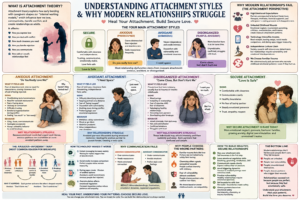
How Attachment Influences Adult Relationships
Your attachment style can influence many aspects of your romantic relationships, including:
- How you express love and affection
- Comfortable you feel with emotional intimacy
- How you respond to conflict or disagreements
- Much closeness or independence you prefer
- How you cope with rejection, separation, or uncertainty
- Easily you trust others
- How you communicate your emotional needs
- Whether relationships generally feel safe, secure, or threatening
These patterns often operate automatically, influencing reactions before we are even consciously aware of them.
The Four Main Attachment Styles
Researchers generally describe four primary attachment styles in adulthood.
1. Secure Attachment
People with a secure attachment style are generally comfortable with both intimacy and independence. They trust others, communicate openly, and are able to regulate their emotions effectively during relationship challenges.
2. Anxious (Preoccupied) Attachment
Individuals with an anxious attachment style strongly value closeness but often worry about rejection, abandonment, or not being “enough.” They may seek frequent reassurance and become highly sensitive to changes in their partner’s behaviour.
3. Avoidant (Dismissive) Attachment
People with an avoidant attachment style tend to prioritize independence and self-reliance. Emotional closeness may feel uncomfortable or overwhelming, leading them to withdraw, suppress emotions, or avoid vulnerability.
4. Disorganized (Fearful-Avoidant) Attachment
Disorganized attachment combines both anxious and avoidant tendencies. Individuals often desire deep emotional connection while simultaneously fearing intimacy or rejection. This pattern is commonly associated with inconsistent, frightening, or traumatic early caregiving experiences.
Why Attachment Styles Matter
Research suggests that individuals with insecure attachment styles—anxious, avoidant, or disorganized—may experience greater challenges with trust, emotional regulation, communication, and relationship satisfaction. However, attachment style alone does not determine whether a relationship succeeds or relationships fail.
Healthy relationships are influenced by many interacting factors, including emotional regulation, communication skills, compatibility, mutual respect, life circumstances, mental health, and each partner’s willingness to grow. Understanding your attachment style is not about placing labels on yourself or others—it is about recognizing patterns that can be changed.
The encouraging news is that attachment is flexible rather than permanent. Through self-awareness, emotionally supportive relationships, and evidence-based therapies such as Cognitive Behavioral Therapy (CBT), Emotionally Focused Therapy (EFT), or attachment-focused psychotherapy, many people gradually develop a more secure way of relating to others.
Why Modern Relationships Fail: An Attachment Perspective
Modern relationships exist in a world that is more connected than ever before, yet many people report feeling increasingly lonely, misunderstood, and emotionally disconnected. While technology, changing social norms, and busy lifestyles certainly play a role, relationship psychologists suggest that many recurring relationship problems are rooted in attachment patterns—the ways people seek closeness, manage conflict, and respond to emotional needs.
Attachment theory does not suggest that every relationship ends because of attachment style alone. Rather, it provides a powerful framework for understanding why certain relationship patterns repeatedly emerge, even when both partners genuinely care about each other.
Several modern factors can amplify attachment insecurities and make healthy relationships more difficult to maintain.
1. Emotional Expectations Are Higher Than Ever
In previous generations, romantic relationships were often centred around practical roles such as financial stability, family responsibilities, or social expectations. Today, many people expect a romantic partner to fulfil numerous emotional and psychological needs simultaneously.
Many individuals hope their partner will be their:
- Best friend
- Romantic partner
- Emotional support system
- Trusted confidant
- Motivator and encourager
- Companion
- Co-parent or future family partner
- Financial teammate
- Safe space during times of stress
These expectations are not inherently unhealthy. In fact, emotional intimacy is an important feature of satisfying relationships. However, expecting one person to meet every emotional, social, and psychological need can create unrealistic pressure. When these expectations are not met, disappointment, resentment, and conflict often follow.
Individuals with insecure attachment styles may experience these disappointments even more intensely because unmet emotional needs can activate deep fears of rejection, abandonment, or emotional distance.
2. Childhood Trauma Is Better Recognized—but Often Remains Unresolved
Growing awareness of mental health has encouraged more people to recognize the impact of adverse childhood experiences. However, recognition does not always lead to healing.
Many adults enter relationships carrying unresolved emotional wounds from childhood, including experiences such as:
- Emotionally unavailable or inconsistent caregivers
- Emotional neglect
- Chronic criticism or rejection
- Overprotective or controlling parenting
- Family conflict, instability, or abuse
- Loss, separation, or other traumatic experiences
These early experiences can influence how individuals perceive trust, intimacy, and emotional safety in adulthood. Rather than responding only to their current partner, they may unknowingly react to fears that originated much earlier in life.
Unresolved attachment wounds can contribute to heightened sensitivity to rejection, difficulties with vulnerability, fear of intimacy, or challenges regulating emotions during relationship conflict.
3. Technology Can Intensify Attachment Anxiety (Relationships Fail)
Digital communication has transformed the way couples connect, but it has also introduced new sources of uncertainty and emotional stress.
Features such as:
- Read receipts
- Delayed text responses
- Online activity indicators
- Social media comparisons
- Dating applications with seemingly endless options
can unintentionally activate attachment-related fears.
For someone with an anxious attachment style, an unanswered message may trigger worries about abandonment or rejection. Someone with an avoidant attachment style may experience constant digital communication as intrusive or emotionally overwhelming, leading them to withdraw further.
Technology itself does not create insecure attachment, but it can magnify existing attachment patterns and misunderstandings between partners.
4. A Culture of Independence Can Conflict with Human Attachment Needs
Modern society often celebrates independence, productivity, and self-sufficiency. Messages encouraging people to “never depend on anyone” or “always put yourself first” can be empowering in some contexts, particularly after unhealthy relationships.
However, attachment research consistently shows that healthy relationships are built on secure interdependence rather than complete independence or emotional dependence.
Humans are biologically wired for connection. Healthy partnerships involve balancing autonomy with emotional closeness—allowing each person to maintain their individuality while also feeling supported, understood, and emotionally safe.
When independence becomes emotional avoidance, or when dependence becomes emotional overreliance, relationship satisfaction often declines.
5. Familiar Emotional Patterns Can Feel Like Love
One of the most fascinating findings in relationship psychology is that people are often drawn to what feels familiar, even when those patterns are unhealthy.
Individuals may unconsciously gravitate toward partners whose behaviours resemble the emotional dynamics they experienced during childhood. This does not mean people intentionally seek painful relationships. Instead, the brain often interprets familiarity as safety because it reflects experiences it has known before.
For example:
- Someone raised by emotionally inconsistent caregivers may feel unusually attracted to unpredictable partners.
- A person who learned that love had to be earned may repeatedly choose emotionally unavailable partners.
- Someone who grew up in chaotic environments may mistake emotional intensity for genuine intimacy.
These familiar dynamics can create powerful emotional chemistry, even when they are incompatible with long-term relationship health.
Recognizing these unconscious patterns is an important step toward developing healthier relationships based on emotional safety, mutual respect, and genuine compatibility rather than unresolved attachment wounds.
The Role of Childhood in Adult Attachment
Our earliest relationships lay the foundation for how we understand love, trust, and emotional safety. According to attachment theory, repeated interactions with caregivers shape our internal working models—deeply held beliefs about ourselves, other people, and relationships.
These beliefs often answer questions such as:
- Am I worthy of love?
- Can I rely on others when I need them?
- Is it safe to be emotionally vulnerable?
Although these patterns begin in childhood, they are not permanent. Life experiences, supportive relationships, and psychotherapy can gradually reshape attachment patterns throughout adulthood.
Secure Attachment Develops When Emotional Needs Are Consistently Met
Children are more likely to develop secure attachment when caregivers are consistently responsive, emotionally available, and supportive. They learn that expressing emotions is safe and that trusted people will usually respond with comfort and care.
As a result, many securely attached adults develop beliefs such as:
- “I am worthy of love.”
- “My feelings matter.”
- “People can be trusted.”
- “Healthy relationships are safe.”
These beliefs often contribute to:
- Greater emotional resilience
- Healthy communication
- Secure intimacy
- Balanced independence
- Constructive conflict resolution
Insecure Attachment Can Develop When Emotional Needs Are Inconsistently Met
Insecure attachment may develop when caregiving is unpredictable, emotionally unavailable, highly critical, frightening, or inconsistent.
Examples include:
- Emotional neglect
- Inconsistent caregiving
- Frequent criticism or rejection
- Lack of warmth and affection
- Overprotective or controlling parenting
- Exposure to chronic family conflict or trauma
These experiences can make relationships feel uncertain or emotionally unsafe, increasing vulnerability to difficulties with trust, intimacy, emotional regulation, and communication later in life.
Anxious Attachment: “Do You Really Love Me?” (Relationships Fail)
People with an anxious (preoccupied) attachment style deeply value emotional closeness but often fear losing it. Because relationships feel closely tied to their sense of safety, even small signs of distance may be interpreted as rejection.
What It Feels Like
Individuals with anxious attachment often experience:
- Persistent fear of abandonment
- Heightened sensitivity to rejection
- Strong need for emotional reassurance
- Worry about being replaced or unloved
- Difficulty tolerating uncertainty in relationships
Their attachment system becomes hyperactivated, meaning they become especially alert to anything that might threaten the relationship.
Common Signs
Some common characteristics include:
- Overthinking conversations or text messages
- Frequently seeking reassurance
- Difficulty being alone after conflict
- Jealousy or frequent comparison with others
- Difficulty trusting despite wanting closeness
- Intense emotional reactions during disagreements
- Feeling “too much” or “too needy”
Not everyone with anxious attachment displays all of these traits, and the intensity varies from person to person.
Relationship Behaviours
When anxious attachment is activated, people may:
- Pursue their partner after conflict
- Send repeated messages or seek immediate responses
- Apologize excessively
- Prioritize the relationship over their own needs
- Tolerate unhealthy behaviour to avoid abandonment
These behaviours are usually attempts to restore emotional security rather than intentional manipulation.
Why Relationships Become Challenging
Anxious attachment does not automatically lead to relationship failure. However, when paired with a partner who struggles with emotional closeness—particularly someone with avoidant attachment—the anxious partner’s attempts to seek reassurance may unintentionally increase the other person’s desire for distance, creating a cycle of misunderstanding and emotional frustration.
Avoidant Attachment: “I Need Space” (Relationships Fail)
Individuals with an avoidant (dismissive) attachment style often value independence and self-reliance. Emotional closeness may feel uncomfortable because vulnerability has historically been associated with disappointment, criticism, or loss of autonomy.
What It Feels Like
People with avoidant attachment may experience:
- Discomfort with excessive emotional dependence
- Fear of losing independence
- Difficulty relying on others
- Preference for emotional distance during stress
Rather than activating their attachment system, they often deactivate it by minimizing emotional needs.
Common Signs
Typical characteristics include:
- Difficulty identifying or expressing emotions
- Keeping emotional distance
- Fear of feeling trapped
- Discomfort with vulnerability
- Withdrawing during conflict
- Focusing on logic instead of emotional discussion
Relationship Behaviours
They may:
- Withdraw after emotional disagreements
- Delay commitment
- Avoid emotionally intense conversations
- Minimize relationship problems
- Need significant personal space
- Sometimes become emotionally unavailable or inconsistent
Not every avoidantly attached person ghosts partners or avoids commitment entirely, but many find prolonged emotional vulnerability challenging.
Why Relationships Become Challenging
When one partner withdraws during conflict, the other partner may pursue reassurance more intensely. Without awareness of these attachment dynamics, both individuals may feel misunderstood, despite wanting the relationship to succeed.
Disorganized Attachment: “Come Close… But Don’t Hurt Me” (Relationships Fail)
Disorganized attachment, also called fearful-avoidant attachment, combines both anxious and avoidant tendencies. It is often associated with childhood environments where caregivers were simultaneously a source of comfort and fear.
What It Feels Like
Individuals may experience an internal conflict:
- They deeply desire intimacy.
- Fear being hurt.
- They long for connection.
- Struggle to trust it.
This creates a confusing push-pull pattern within the same relationship.
Common Signs
Possible characteristics include:
- Rapid shifts between closeness and withdrawal
- Fear of both rejection and intimacy
- Emotional instability during relationships
- Difficulty trusting others
- Self-sabotaging healthy relationships
- Strong attraction to unpredictable partners
- Longer emotional recovery after breakups
These experiences vary considerably and should not be viewed as diagnostic criteria.
Why Relationships Become Challenging
Because conflicting attachment needs are activated simultaneously, relationships can become unpredictable. Partners may struggle to understand sudden changes in emotional availability, creating confusion and insecurity on both sides.
Secure Attachment: “Love Feels Safe”
Secure attachment does not mean someone is perfect or never experiences conflict. Instead, it reflects confidence that relationships can remain stable even during difficult moments.
Characteristics of Secure Attachment
Securely attached individuals typically:
- Feel comfortable with emotional closeness
- Respect both intimacy and independence
- Communicate openly and honestly
- Maintain healthy personal boundaries
- Trust their partners while addressing concerns directly
- Recover from conflict through repair and communication
Research consistently shows that secure attachment is associated with greater relationship satisfaction, emotional well-being, and effective conflict resolution.
Why Secure Attachment Can Be Difficult to Develop
Several modern factors may make secure attachment more difficult for some individuals, including:
- Childhood emotional neglect
- Family instability
- Chronic stress
- Mental health challenges
- Limited opportunities to learn healthy emotional regulation
- Constant digital distraction and overstimulation
However, secure attachment remains achievable throughout adulthood through supportive relationships and therapeutic growth.
The Anxious–Avoidant Trap (Relationships Fail)
One of the best-known relationship patterns in attachment research is the anxious–avoidant cycle, sometimes called the pursuer–distancer dynamic.
The Cycle
- The anxious partner seeks reassurance and closeness.
- Avoidant partner feels overwhelmed and withdraws.
- The anxious partner experiences greater fear of abandonment.
- They pursue connection even more intensely.
- The avoidant partner distances themselves further.
- Both partners feel misunderstood and emotionally unsafe.
Without awareness and healthier communication, this cycle can repeat over time.
Why It Happens
Each partner unintentionally activates the other’s attachment fears.
- The anxious partner’s internal belief becomes: “Please don’t leave me.”
- Avoidant partner’s internal belief becomes: “Please don’t overwhelm or control me.”
Neither partner is intentionally trying to hurt the other. Instead, both are attempting to protect themselves using attachment strategies learned earlier in life.
Why Technology Can Intensify Attachment Insecurity (Relationships Fail)
Technology has transformed communication, but it can also amplify existing attachment patterns.
Examples include:
- Delayed replies increasing uncertainty
- Read receipts triggering rejection sensitivity
- Social media encouraging unrealistic relationship comparisons
- Dating apps creating the perception of endless alternatives
- Constant digital stimulation reducing emotional presence and patience
Importantly, technology does not create insecure attachment. Rather, it often magnifies existing emotional patterns.
Emotional Unavailability: A Growing Relationship Challenge (Relationships Fail)
Emotional unavailability refers to persistent difficulty engaging in emotional intimacy or responding consistently to a partner’s emotional needs.
Contributing factors may include:
- Chronic stress
- Burnout
- Unresolved trauma
- Depression or anxiety
- Fear of vulnerability
- Insecure attachment patterns
Common signs include:
- Avoiding emotionally important conversations
- Shutting down during conflict
- Inconsistent affection
- Difficulty expressing feelings
- Hesitation about commitment
Emotional unavailability is usually a protective strategy rather than a lack of caring.
Why Communication Breaks Down (Relationships Fail)
Partners with different attachment styles often communicate from different emotional needs.
Individuals with anxious attachment often:
- Seek reassurance
- Express emotions openly
- Desire frequent connection
- Discuss problems immediately
Individuals with avoidant attachment often:
- Need time and space before discussing conflict
- Communicate less during stress
- Feel uncomfortable with emotional intensity
- Focus on practical solutions rather than feelings
Neither style is inherently “wrong.” Problems arise when each partner misinterprets the other’s behaviour instead of understanding the underlying attachment needs.
Why We Sometimes Choose Emotionally Unhealthy Partners (Relationships Fail)
Research suggests people are often drawn to relationships that feel psychologically familiar.
Several processes may contribute:
- Familiar childhood dynamics can feel emotionally comfortable, even when unhealthy.
- Intense chemistry is sometimes confused with genuine compatibility.
- Unresolved emotional wounds can influence attraction.
- Attachment needs may outweigh objective compatibility during partner selection.
Awareness of these patterns allows individuals to make healthier relationship choices.
The Psychology Behind Modern Breakups (Relationships Fail)
Relationships fail rarely occur because of a single cause. Instead, breakups often reflect the interaction of multiple factors, including:
- Unresolved attachment insecurity
- Poor emotional regulation
- Unrealistic expectations
- Ineffective communication
- Chronic stress
- Lack of vulnerability
- Unresolved trauma
- Incompatibility in values or life goals
Attachment theory helps explain why many couples become trapped in recurring conflict, but it represents one important piece of a much larger picture.
How to Build More Secure Relationships (Relationships Fail)
Although attachment patterns develop early, they can change throughout adulthood.
Research suggests several practices promote greater relationship security:
- Increase Self-Awareness: Recognize your attachment style, emotional triggers, and recurring relationship patterns.
- Develop Emotional Regulation Skills: Practice evidence-based techniques such as mindfulness, diaphragmatic breathing, grounding exercises, Cognitive Behavioral Therapy (CBT), or Dialectical Behavior Therapy (DBT) skills.
- Communicate Needs Clearly: Express emotions directly using respectful, non-blaming language rather than expecting partners to read your mind.
- Recognize Trigger Cycles: Learn to identify anxious–avoidant dynamics before they escalate into repeated conflict.
- Practice Healthy Vulnerability: Allow yourself to express fears, needs, and emotions gradually within emotionally safe relationships.
- Establish Healthy Boundaries: Boundaries are not emotional walls—they create predictability, mutual respect, and psychological safety.
- Choose Emotional Safety Over Emotional Intensity: Healthy relationships are built on trust, consistency, respect, and emotional responsiveness rather than uncertainty or dramatic highs and lows.
Conclusion
Modern relationships fail simply because people care less than previous generations. More often, they struggle because individuals bring different attachment histories, emotional needs, and coping strategies into the relationship.
When these patterns remain unrecognized, couples may become trapped in cycles of misunderstanding, withdrawal, or emotional pursuit.
Attachment theory reminds us that lasting relationships are not built on perfection. They are built on emotional safety, secure communication, mutual responsiveness, and a willingness to understand both ourselves and our partners.
The encouraging message is that attachment patterns are not fixed. With self-awareness, supportive relationships, and evidence-based therapeutic approaches, people can move toward greater emotional security and create healthier, more fulfilling relationships.
Reference
American Psychological Association (APA)
National Institute of Mental Health — Attachment & Trauma
The Gottman Institute (Leading Relationship Research)
Relationship Red Flags Backed by Psychology
Anxious vs Avoidant Partners: The Push–Pull Pattern

Pingback: Psychology of Jealousy: Why You Feel Insecure