

Introduction: When Bonding Doesn’t Feel Natural
When postpartum depression enters the picture, bonding can feel delayed, fragile, or confusing. Mothers may worry: Why don’t I feel connected? Why does caring for my baby feel mechanical? What if this damages my child forever?
Attachment theory offers a compassionate framework to understand what truly happens to the mother–baby bond when postpartum depression is present—and why healing and secure attachment are still very much possible.
Understanding Attachment Theory in Simple Terms
Attachment theory explains how early emotional bonds between a caregiver and infant shape the child’s sense of safety, trust, and emotional regulation. The attachment relationship develops through consistent, responsive caregiving—meeting a baby’s needs for comfort, protection, and connection.
Importantly, attachment is not about perfection. It is about repair and responsiveness over time.
Core Attachment Patterns
Attachment theory describes several broad patterns:
- Secure attachment: The caregiver is generally responsive, emotionally available, and predictable.
- Insecure attachment: Caregiving may be inconsistent, emotionally unavailable, or intrusive.
- Disorganized attachment: The caregiver appears frightened, frightening, or emotionally overwhelmed in ways that confuse the infant.
These patterns do not form overnight. They develop gradually through thousands of small interactions—not a single emotional moment after birth.
What Is Postpartum Depression?
Postpartum depression (PPD) is a mood disorder that can develop after childbirth. It affects emotional regulation, energy, cognition, motivation, and self-worth.
Common symptoms include:
- Persistent low mood or emotional numbness
- Anxiety or intrusive thoughts
- Loss of pleasure or interest
- Feelings of inadequacy or guilt
- Fatigue and sleep disturbances
- Difficulty concentrating
- Emotional withdrawal
When depression affects a mother’s emotional availability, it can understandably influence early bonding experiences—but not in the irreversible way many fear.
The Myth of “Instant Bonding”
One of the most damaging myths surrounding motherhood is that bonding must be immediate. This belief creates unrealistic expectations and deep shame for mothers who don’t feel an instant connection.
In reality:
- Bonding is a process, not an event
- Many healthy attachments form gradually over weeks or months
- Emotional connection can grow through routine care
- Attachment develops through repeated interactions, not emotional intensity
Postpartum depression often interferes with emotional feeling, not emotional capacity.
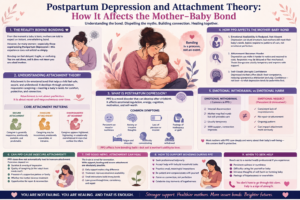
How Postpartum Depression Affects the Mother–Baby Bond
Postpartum depression does not eliminate a mother’s ability to bond. Instead, it alters how bonding feels and how emotions are accessed.
1. Emotional Availability Is Reduced, Not Absent
Depression can blunt emotions, making it difficult for a mother to feel joy, warmth, or excitement. However, she may still respond to her baby’s needs—feeding, holding, soothing—even if she feels emotionally flat.
Babies respond to patterns of care, not emotional perfection.
2. Attunement Becomes Harder
Attunement refers to a caregiver’s ability to notice, interpret, and respond to a baby’s emotional cues. Depression can slow responsiveness or make cues feel overwhelming.
This may look like:
- Delayed responses
- Less eye contact
- Reduced vocal engagement
- Mechanical caregiving
These changes are usually temporary and improve with support.
3. Self-Doubt Disrupts Confidence
Depressed mothers often doubt their competence. This self-doubt can reduce spontaneous interaction and play, not because of lack of love, but because of fear of “doing it wrong.”
Confidence is a key ingredient in attachment—and depression undermines confidence before it undermines love.
Emotional Withdrawal vs Emotional Harm
It is crucial to distinguish emotional withdrawal from emotional neglect.
- Emotional withdrawal during postpartum depression is often internal.
- The mother may feel disconnected but still provide care.
- Emotional neglect involves consistent lack of responsiveness without repair.
Most mothers with postpartum depression care deeply and worry intensely about their baby’s well-being—this concern itself is protective.
Can Postpartum Depression Cause Insecure Attachment?
Postpartum depression alone does not automatically lead to insecure attachment.
Attachment outcomes depend on:
- Duration and severity of depression
- Presence of support (partner, family, caregivers)
- Whether the depression is treated
- Opportunities for emotional repair
Even when early interactions are strained, attachment can reorganize toward security once maternal mental health improves.
The Power of “Good Enough” Parenting
Attachment theory emphasizes good enough caregiving—not flawless caregiving.
Secure attachment does not require:
- Constant emotional availability
- Always responding immediately
- Never feeling overwhelmed
It requires:
- Consistency over time
- Willingness to repair after disconnection
- Emotional presence often enough
Mothers with postpartum depression can still provide good-enough care, especially with support.
Repair: The Most Important Attachment Skill
No caregiver is emotionally available all the time. What matters is repair—returning to connection after moments of emotional distance.
Repair can look like:
- Picking up the baby after feeling distant
- Talking softly even when tired
- Comforting after irritation
- Showing up again the next moment
These moments teach the baby that relationships are safe—even when emotions fluctuate.
The Baby’s Perspective
Babies are highly adaptive. They are sensitive to caregiving patterns but not fragile in the way many parents fear.
A baby benefits from:
- Predictable care
- Physical comfort
- Consistent routines
- Presence of any emotionally regulated caregiver
When a mother is depressed, additional caregivers can buffer attachment development until she recovers.
Role of Fathers and Other Caregivers
Attachment is not limited to mothers. Babies can form secure attachments with multiple caregivers.
Partners, grandparents, and caregivers can:
- Provide emotional availability when the mother is depleted
- Support bonding by reducing maternal stress
- Offer the baby relational safety
This shared caregiving protects both mother and child.

When Mothers Fear They’ve “Damaged” the Bond
One of the most painful beliefs in postpartum depression is the fear of irreversible harm.
Common thoughts include:
- “My baby deserves better”
- “I’ve ruined our bond”
- “They would be better without me”
These thoughts are symptoms of depression—not evidence.
Attachment is flexible. Healing in the mother heals the relationship.
Healing the Mother–Baby Bond After Depression
Bonding does not close after infancy. It evolves through everyday moments.
Ways bonding can grow:
- Skin-to-skin contact
- Feeding interactions
- Eye contact during care
- Talking, singing, and soothing
- Play as energy returns
As depression lifts, emotional connection often emerges naturally.
Therapy and Attachment Repair
Mental health support plays a crucial role in restoring attachment security.
Therapy can help mothers:
- Process guilt and shame
- Understand attachment realistically
- Rebuild emotional confidence
- Regulate the nervous system
- Strengthen reflective parenting
Treatment supports both mother and baby simultaneously.
Intergenerational Attachment Patterns
A mother’s own attachment history can influence how postpartum depression affects bonding. If a woman experienced emotional neglect or insecure attachment growing up, depression may reactivate old wounds. Awareness—not blame—allows healing across generations.
Cultural Pressure and Attachment Anxiety
Cultural narratives that idealize motherhood intensify attachment fears.
Messages like:
- “A mother’s love must be instinctive”
- “Babies sense everything”
- “The first year determines everything”
…create unnecessary panic. Attachment science does not support these rigid beliefs.
When to Seek Help for Attachment Concerns
Professional support is important when:
- Emotional detachment persists for months
- Mother avoids interacting with the baby
- Depression remains untreated
- There are thoughts of harm or disappearance
- Bonding anxiety becomes overwhelming
Early support strengthens outcomes—not weakens them.
Reframing Attachment With Compassion
Attachment is not about emotional performance. It is about relationship. A depressed mother who keeps showing up—even imperfectly—is still building attachment.
- Love can exist beneath numbness.
- Care can exist beneath exhaustion.
- Bonding can exist beneath fear.
What This Means for Mothers
If you are struggling with postpartum depression:
- You have not failed your baby
- Have not missed your chance
- Your bond is not broken
- Healing is still unfolding
Attachment grows with presence, not perfection.
What This Means for Professionals
Professionals must:
- Normalize delayed bonding
- Address shame and fear
- Screen for depression early
- Include attachment psychoeducation
- Support repair, not blame
Protecting maternal mental health protects attachment.
Conclusion: Bonds Can Heal
Postpartum depression can temporarily cloud emotional connection, but it does not erase a mother’s capacity to bond. Attachment is resilient, flexible, and deeply forgiving.
The mother–baby bond is not destroyed by depression—it is challenged by it. And with support, understanding, and time, it can grow strong again. Motherhood is not measured by constant emotional presence, but by returning—again and again—to care.
And that return is enough.
Reference
-
World Health Organization – Maternal Mental Health
https://www.who.int/teams/mental-health-and-substance-use/promotion-prevention/maternal-mental-health -
Postpartum Support International (Mother–Baby Mental Health)
https://www.postpartum.net -
UNICEF – Early Childhood Development & Attachment
https://www.unicef.org/early-childhood-development -
National Institute of Mental Health – Postpartum Depression
https://www.nimh.nih.gov/health/publications/postpartum-depression -
NHS – Postnatal Depression & Bonding
https://www.nhs.uk/mental-health/conditions/post-natal-depression/ -
How Long Does Postpartum Depression Last? What Every Mother Needs to Know
Pingback: Postpartum Depression in Indian Mothers: Cultural Pressure