
Introduction: When Depression Doesn’t Look Like Sadness
When people think of postpartum depression, they often imagine a new mother crying endlessly, overwhelmed with sadness and despair. But what if there are no tears? What if instead of sadness, there is nothing—no joy, no sorrow, no emotional response at all?
Many women experiencing postpartum depression do not cry. They feel emotionally numb, disconnected, empty, or “flat.” This version of depression is often misunderstood, misdiagnosed, or dismissed—both by others and by the mothers themselves.
Emotional numbness after childbirth can be just as serious as visible sadness. It quietly affects bonding, self-identity, relationships, and mental health, often without drawing attention or support.
This article explores postpartum depression without crying—why emotional numbness happens, how it feels, how it differs from typical sadness, and what healing looks like.
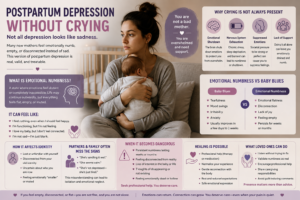
What Is Emotional Numbness?
Emotional numbness is a state in which a person feels disconnected from their emotions. Rather than experiencing sadness, happiness, excitement, or love, they often feel a profound sense of emptiness or emotional “shutdown.” As a result, life may continue outwardly, while emotional experiences feel distant or inaccessible.
A mother experiencing emotional numbness may say:
- “I feel nothing, even when I should feel happy.”
- “I’m functioning, but I’m not feeling.”
- “I love my baby, but I don’t feel connected.”
- “I’m not sad—I’m just blank.”
Importantly, this emotional flatness is not a sign of a lack of love, care, or maternal instinct. Instead, it is a psychological response that is often linked to depression, trauma, chronic stress, or nervous system overload. Consequently, many mothers may appear capable and functional on the outside while silently struggling with profound emotional disconnection.
Postpartum Depression Is Not One-Size-Fits-All
Postpartum depression exists on a spectrum. While some mothers experience intense sadness, others may instead experience anxiety, anger, intrusive thoughts, or emotional numbness. Therefore, the absence of visible sadness does not necessarily mean that postpartum depression is absent.
Depression without crying often includes:
- Emotional detachment
- Loss of pleasure (anhedonia)
- Feeling robotic or on autopilot
- Lack of emotional reaction to events
- Difficulty bonding with the baby
- Low motivation without visible sadness
However, because these symptoms do not match the “classic” image of depression, many women may not recognize that they are experiencing depression. As a result, they may continue functioning without seeking the emotional support or professional help they need.

Why Crying Is Not Always Present in Depression
Crying is one way the nervous system may express or release emotional distress; however, it is not the only way distress can manifest. In some cases, when the system becomes overwhelmed, it may instead respond by shutting emotions down. As a result, a person may experience emotional numbness rather than visible sadness or tears.
Several factors may explain why postpartum depression can appear without crying:
1. Emotional Shutdown as a Survival Response
After childbirth, a woman’s body and mind experience intense changes. These may include hormonal shifts, sleep deprivation, physical pain, increased responsibility, and a significant transformation in identity.
When emotional pain becomes too difficult to process, the brain may respond with numbness as a form of protection. Therefore, emotional shutdown should not be viewed as weakness; instead, it can function as a survival response to overwhelming emotional demands.
2. Chronic Stress and Nervous System Exhaustion
Similarly, persistent stress can activate the fight-or-flight response. Over time, prolonged stress and exhaustion may contribute to a freeze or shutdown state, in which emotional responses become muted.
This may be more likely when:
- Sleep deprivation is severe
- Emotional or practical support is lacking
- Expectations feel overwhelming
- The mother feels she must “hold it together”
Consequently, when a mother continuously suppresses her distress while managing overwhelming demands, she may gradually feel emotionally disconnected rather than openly distressed.
3. Suppressed Emotions and Social Conditioning
Furthermore, many women are taught to be strong, responsible, and self-sacrificing, particularly after becoming mothers. Because of these expectations, they may feel that expressing emotional difficulties is inappropriate or selfish.
For example, thoughts such as:
- “I shouldn’t complain”
- “Other mothers handle this”
- “I should be grateful”
can gradually contribute to emotional suppression. Over time, these emotions may not simply disappear; instead, the person may begin to experience them as numbness, emptiness, or emotional disconnection.
Emotional Numbness vs Baby Blues
Baby blues typically involve:
- Tearfulness
- Mood swings
- Emotional sensitivity
- Symptoms that usually resolve within two weeks
In contrast, emotional numbness linked to postpartum depression may present differently:
- Lasts for weeks or months
- Feels emotionally flat rather than sad
- Does not improve on its own
- Interferes with bonding and sense of identity
Therefore, it is important to recognize that postpartum emotional difficulties do not always involve crying or obvious sadness. While baby blues are generally temporary, persistent emotional numbness may indicate a deeper concern. Because numbness is quieter and less visible than crying, it can easily go unnoticed by both the mother and those around her. As a result, some women may struggle for a long time before realizing that they need support.
How Emotional Numbness Feels in Daily Life
A mother experiencing postpartum emotional numbness may continue caring for her baby and managing daily responsibilities; however, she may feel emotionally disconnected while doing so.
She may:
- Care for the baby efficiently but feel disconnected
- Go through daily routines on autopilot
- Feel indifferent toward things she once enjoyed
- Struggle to feel love, excitement, or pride
- Feel guilty for not feeling “happy enough”
- Experience an internal emptiness that is difficult to describe
Although she may continue functioning normally on the outside, her internal experience can be very different. She may appear calm, capable, and responsible; however, this outward functioning does not necessarily reflect her emotional well-being. As a result, family members, partners, or even the mother herself may struggle to recognize that she is experiencing significant emotional distress.
Impact on Mother–Baby Bonding
One of the most painful aspects of emotional numbness is its impact on the mother–baby bond. When a mother feels emotionally disconnected, she may begin to question her ability to love, connect with, or care for her baby, even when she continues to meet the baby’s needs.
As a result, many mothers may experience fears such as:
- “Something is wrong with me.”
- “I’m a bad mother.”
- “I don’t feel the connection everyone talks about.”
However, bonding is not always immediate or effortless. Emotional numbness does not mean that a secure attachment will never develop. Instead, it may indicate that the mother’s emotional system is currently overwhelmed, making it difficult for her to access or express feelings of connection.
Importantly, struggling to feel an immediate bond does not make a mother uncaring or incapable of loving her child. With appropriate support and treatment, emotional connection can gradually develop and strengthen over time.
Guilt, Shame, and Silent Suffering
Emotional numbness can often be accompanied by intense feelings of guilt and shame. Instead of recognizing numbness as a possible response to emotional overwhelm, mothers may blame themselves for not experiencing motherhood in the way they expected.
They may experience:
- Guilt for not feeling joyful
- For wanting space or time for themselves
- Guilt for feeling emotionally disconnected from their baby
Moreover, because society often idealizes motherhood as a naturally blissful and fulfilling experience, mothers experiencing emotional numbness may feel that their reality is abnormal or unacceptable. As a result, they may hide their struggles, fearing judgment from family members, partners, or even from themselves.
Over time, this shame can prevent help-seeking and deepen emotional isolation. Consequently, a mother may continue suffering silently while appearing capable and functional on the outside.
Who Is More Likely to Experience Postpartum Emotional Numbness?
Certain factors may increase a mother’s vulnerability to experiencing postpartum emotional numbness. However, experiencing one or more of these factors does not necessarily mean that a mother will develop emotional numbness.
These factors may include:
- A history of depression, anxiety, or trauma
- An emotional suppression coping style
- High levels of responsibility and perfectionism
- Limited emotional or practical support
- Difficult or distressing childbirth experiences
- Unplanned or complicated pregnancies
- Significant sleep deprivation and burnout
Additionally, emotional numbness may be particularly difficult to recognize in mothers who are “high-functioning” and accustomed to being strong for others. Because they may continue managing household responsibilities, caring for their baby, and meeting daily demands, their emotional struggles can remain hidden.
As a result, their distress may be overlooked not because it is less significant, but because they have become skilled at functioning despite it.
Emotional Numbness vs Detachment
It is important to distinguish emotional numbness from intentional emotional distancing, as they may appear similar on the surface but involve different psychological processes.
Emotional numbness is involuntary. The mother may genuinely want to feel love, joy, or emotional connection, but finds herself unable to access those feelings. In contrast, emotional detachment is often a conscious or unconscious coping strategy in which a person creates emotional distance as a way of protecting themselves from distress or overwhelming situations.
Therefore, in postpartum depression, emotional numbness should not be interpreted as a choice or a deliberate rejection of the baby. Instead, it is a symptom that may reflect significant emotional distress and psychological overwhelm. Recognizing this distinction can help reduce self-blame and encourage mothers to seek appropriate support.
Postpartum Depression: How Emotional Numbness Affects Identity
Motherhood brings a profound shift in identity. As a woman adjusts to new responsibilities, relationships, and expectations, she may begin to experience changes in how she understands herself. When emotional numbness is present, this transition can become even more difficult, leaving her feeling disconnected not only from her emotions but also from her sense of identity.
She may feel:
- Lost or unfamiliar with herself
- Disconnected from her previous identity
- Uncertain about who she is now
- Emotionally “smaller” or muted
Moreover, when a mother no longer experiences emotions in the way she once did, she may struggle to recognize the person she has become. This identity confusion can be particularly distressing for women who were emotionally expressive, energetic, or strongly connected to their sense of self before childbirth. As a result, emotional numbness may affect not only how a mother experiences motherhood but also how she understands and relates to herself.
Postpartum Depression: Partners and Family Often Miss the Signs
Because emotional numbness may not involve visible signs of distress, partners and family members may mistakenly assume that the mother is coping well. For example, they may think:
- “She’s handling it well.”
- “Seems she calm.”
- “She’s not depressed—she’s just tired.”
However, appearing calm or continuing to manage daily responsibilities does not necessarily mean that a mother is emotionally well. In fact, emotional numbness can make significant distress difficult to recognize, particularly when there are no obvious signs such as frequent crying or emotional outbursts.
As a result, family members may unintentionally overlook the mother’s emotional needs. Over time, this misunderstanding can contribute to emotional neglect and further increase her sense of isolation, making it even harder for her to communicate what she is experiencing or seek support.
Postpartum Depression: When Emotional Numbness Becomes Dangerous
While emotional numbness may feel less alarming than visible sadness, it can still be a serious sign of psychological distress. Because numbness may appear quiet or outwardly manageable, its severity can sometimes be underestimated.
Warning signs that require professional help include:
- Persistent numbness lasting for weeks or months
- Feeling disconnected from reality
- Losing interest in the baby or in life more generally
- Having thoughts of disappearing or not existing
- Feeling emotionally dead, hollow, or completely empty
- Continuing to function without a sense of meaning or emotional presence
Importantly, emotional numbness does not protect someone from experiencing severe depressive symptoms. In some cases, it can coexist with suicidal thoughts, even when there is no crying or other visible expression of distress. Therefore, the absence of tears should never be taken as evidence that a mother is emotionally safe or that her suffering is not serious.
Healing Emotional Numbness in Postpartum Depression
Recovery is possible, and emotional numbness does not have to be permanent. With appropriate support, many mothers can gradually reconnect with their emotions, rebuild their sense of self, and develop a stronger sense of emotional connection.
1. Professional Mental Health Support
Professional support can provide a safe and non-judgmental space where mothers can gradually reconnect with their emotions. Depending on the individual’s needs, therapy may focus on:
- Developing emotional awareness
- Supporting nervous system regulation
- Processing suppressed or difficult emotions
- Adjusting to changes in identity and motherhood
Additionally, medication may be helpful when emotional numbness occurs as part of clinical depression. A qualified healthcare professional can assess the symptoms and determine whether medication may be appropriate.
2. Normalizing the Experience
Another important step is recognizing that emotional numbness can occur in response to overwhelming emotional and psychological demands. Understanding this can reduce shame and help mothers become more compassionate toward themselves.
Instead of judging themselves for not feeling “enough,” mothers can begin to recognize numbness as a signal that they may need care and support. Over time, reducing self-judgment can make it easier to reconnect with emotional experiences.
3. Gentle Reconnection With the Body
Emotional experiences are often accompanied by physical sensations. Therefore, gentle body-based practices may help a mother gradually reconnect with herself and develop a greater sense of safety.
These may include:
- Mindful breathing
- Gentle stretching or walking
- Warm showers
- Body-based grounding exercises
Importantly, the goal is not to force emotions to return immediately. Instead, the focus is on creating a sense of safety and gradually becoming more aware of what the body and mind are experiencing.
4. Rest and Reduced Expectations
Furthermore, emotional recovery requires adequate rest and realistic expectations. The postpartum period can already involve significant physical and emotional demands; therefore, placing additional pressure on oneself to be a “perfect” mother can increase emotional exhaustion.
By reducing unrealistic expectations and allowing space for rest, support, and recovery, mothers may gradually move away from a constant state of emotional survival.
5. Safe Emotional Expression
Finally, having opportunities to express emotions without being judged, criticized, or immediately “fixed” can be an important part of recovery. For some mothers, writing, therapy, or talking with a trusted person can create a safe space for emotions to gradually resurface.
Ultimately, healing does not require forcing yourself to feel happy. Instead, it begins with creating enough safety, support, and self-compassion to allow emotions to return naturally.
Postpartum Depression: What Loved Ones Can Do
Partners and family members can play an important role in supporting a mother experiencing emotional numbness. Rather than assuming that she is simply tired or adjusting to motherhood, loved ones can offer patience, understanding, and practical support.
They can help by:
- Listening without immediately trying to solve the problem
- Validating emotional numbness as a real form of distress
- Gently encouraging professional mental health support when needed
- Sharing caregiving and household responsibilities
- Avoiding guilt-inducing, dismissive, or judgmental comments
Most importantly, loved ones do not always need to have the right answers. Sometimes, simply being present, listening without judgment, and reminding the mother that she does not have to manage everything alone can be deeply supportive.
In moments of emotional numbness, presence often matters more than advice.
You Are Not a Bad Mother
Emotional numbness does not mean:
- You don’t love your baby
- Incapable of bonding
- You are broken
- You have failed as a mother
Instead, it may mean that your emotional system is overwhelmed and is asking for care, support, and recovery. Therefore, experiencing numbness should not become another reason to blame or judge yourself.
Remember, motherhood does not require you to feel constant joy or an immediate, effortless connection. Emotional connection can develop gradually, particularly when you have the support and care you need.
Postpartum Depression: When to Seek Immediate Help
Although emotional numbness can sometimes be difficult to recognize, certain symptoms require urgent professional support. Seek immediate help if:
- You feel disconnected from reality
- Have thoughts of harming yourself
- You feel emotionally dead, hopeless, or completely empty
- Daily functioning becomes impossible
Importantly, you do not need to wait until your symptoms become unbearable before asking for help. Reaching out early can provide an opportunity for appropriate assessment, support, and treatment.
Help is not a weakness—it is a form of protection and self-care.
Reference
-
World Health Organization – Maternal Mental Health
https://www.who.int/teams/mental-health-and-substance-use/promotion-prevention/maternal-mental-health -
Postpartum Support International (PPD Help & Helpline)
https://www.postpartum.net -
National Institute of Mental Health – Postpartum Depression
https://www.nimh.nih.gov/health/publications/postpartum-depression -
UNICEF – Mental Health After Childbirth
https://www.unicef.org/parenting/mental-health -
NHS – Postnatal Depression Overview
https://www.nhs.uk/mental-health/conditions/post-natal-depression/overview/ - How Long Does Postpartum Depression Last? What Every Mother Needs to Know
Pingback: Postpartum Depression in Indian Mothers: Cultural Pressure
Pingback: Signs of Parentification Trauma: When Childhood Ends Early