
What Does “Tracking Mental Wellness” Really Mean?
Mental wellness tracking means regularly paying attention to and recording different aspects of your emotional and psychological well-being. For example, you can track:
- Mood changes
- Stress levels
- Sleep patterns
- Energy and motivation
- Emotional triggers
- Coping behaviors
Unlike physical fitness tracking, which often relies on measurable metrics such as steps, heart rate, or calories, mental wellness tracking is more subjective, reflective, and pattern-based. Instead of focusing on a single number, you look for changes and connections over time.
For instance, you may notice that poor sleep increases irritability, work-related stress reduces motivation, or certain situations consistently trigger anger. By reviewing these patterns regularly, you can better understand how your thoughts, emotions, behaviors, and lifestyle factors interact.
Most importantly, mental wellness tracking is not about judging yourself or achieving a “perfect” mental health score. Rather, it helps you become more aware of what is happening internally so you can respond to problems earlier and make more informed choices.
How to Combine These Tools Effectively
You don’t need to use all seven tools to support your mental wellness. Instead, choose the tools that match your current needs, lifestyle, and level of stress. Starting with two simple tools is often more sustainable than trying to track everything at once.
Beginner Combo
If you are just starting to pay attention to your mental wellness, keep it simple:
- Mood tracker — helps you recognize emotional patterns
- Sleep tracker — helps you understand how rest may affect your mood and energy
Together, these tools can give you a basic picture of your emotional state and daily recovery.
Moderate Stress Combo
If you are experiencing ongoing stress but can still manage your daily responsibilities, consider combining:
- Mood tracker — identify changes in mood and emotional triggers
- Journaling — explore thoughts, feelings, and stressful experiences
- Mindfulness — develop greater awareness and reduce automatic reactions
This combination works particularly well because it combines tracking, reflection, and active emotional regulation.
High Burnout Combo
If you notice persistent exhaustion, detachment, reduced motivation, or significant difficulty functioning, consider a stronger support system:
- Sleep tracking — identify patterns in sleep and recovery
- Stress or burnout assessment — understand the severity and pattern of your stress
- Therapy or professional mental health support — address underlying difficulties and develop an individualized plan
Most importantly, when burnout symptoms significantly affect your daily functioning, self-tracking should support—not delay—professional help.
Common Mistakes Men Make When Tracking Mental Health
Mental wellness tracking can be useful, but the way you use these tools matters just as much as the tools themselves. Avoid these common mistakes:
- Obsessing over numbers instead of looking at overall patterns
- Expecting quick fixes from tracking alone
- Ignoring emotional information because physical data feels easier to understand
- Tracking without reflection, which turns the process into data collection without meaningful insight
- Avoiding professional help despite persistent or concerning signs
Remember: tracking is a guide, not a judgment. The purpose is to understand yourself better—not to give yourself a daily score or criticize yourself for having difficult days.
Privacy & Confidentiality Concerns
When using digital mental wellness tools, privacy deserves careful attention. Men may hesitate to use these platforms because they worry about personal data, judgment, or appearing weak. However, protecting your information should be a practical consideration rather than an afterthought.
When choosing a mental wellness tool, look for options that:
- Use appropriate data encryption
- Provide anonymous or privacy-focused options when available
- Clearly explain how they collect, store, and use your data
- Give you meaningful control over data sharing
- Provide clear privacy policies and account-security settings
Before entering sensitive information, read the tool’s privacy policy and check its data-sharing settings. Convenience should not come at the expense of understanding how your personal information is handled.
Mental Wellness Tracking Is Not Self-Diagnosis
Mental wellness tracking can help you become more aware of changes in your emotions, behaviors, sleep, stress, and overall functioning. However, tracking data alone cannot tell you whether you have a mental health disorder.
These tools can:
- Support self-awareness
- Complement therapy or counseling
- Help identify patterns that may encourage early intervention
- Provide useful information to discuss with a mental health professional
At the same time, they do not replace professional diagnosis or treatment.
The goal is not to diagnose yourself—it is to notice, understand, and respond to changes before they become harder to manage.
The Psychology Behind Why Tracking Works
Mental wellness tracking can be effective because it turns vague internal experiences into observable patterns. Instead of simply thinking, “I’ve been feeling off lately,” you can begin to identify what you are feeling, when it happens, and what may be influencing it.
Tracking can support psychological awareness in several ways:
- Activates self-observation — encourages you to notice thoughts, emotions, behaviors, and physical sensations rather than moving through them automatically.
- Reduces emotional avoidance — putting feelings into words can make it easier to acknowledge experiences that you might otherwise ignore or suppress.
- Builds accountability — regular tracking creates a clearer picture of your habits and encourages you to take an active role in your well-being.
- Enhances insight — reviewing patterns over time can reveal connections between sleep, stress, relationships, behavior, physical activity, and mood.
For example, you may initially notice only that you feel irritable. After several weeks of tracking, you might recognize that the irritability consistently appears after poor sleep or periods of excessive work stress. That awareness gives you something concrete to respond to.
Awareness precedes change. You cannot effectively change a pattern that you have not yet noticed.
Conclusion: Strength Is Awareness, Not Silence
Tracking mental wellness is not about constantly analyzing yourself or becoming hyper-focused on every negative thought, emotion, or fluctuation. Instead, it is about developing enough self-awareness to recognize what is happening within you and respond intentionally rather than reacting automatically.
For men who have learned to push through stress, suppress difficult emotions, or handle problems alone, these tools can provide a practical starting point for paying attention to mental well-being without turning it into another source of pressure.
When used thoughtfully, mental wellness tools can offer:
- Privacy — a personal space to reflect and recognize patterns
- Control — greater understanding of your emotional and behavioral responses
- Practicality — simple methods that can fit into everyday routines
- Empowerment — the confidence to recognize when something needs attention and take appropriate action
However, strength does not mean handling everything alone. Sometimes the strongest response is recognizing that you need support and reaching out for it.
Mental strength is not the absence of struggle—it is the ability to notice, understand, and address it.
FAQ Section
1. Why should men track their mental wellness?
Tracking mental wellness helps men identify stress patterns, emotional triggers, and early warning signs of burnout, anxiety, or depression before they become severe.
2. What are the best mental wellness tools for men?
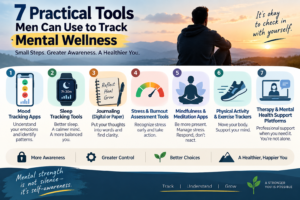
Mood tracking apps, sleep trackers, journaling tools, stress assessments, mindfulness apps, fitness trackers, and therapy platforms are among the most effective tools.
3. Can mental wellness tracking replace therapy?
No. Tracking tools support self-awareness and early intervention but cannot replace professional mental health diagnosis or therapy.
4. How often should men track their mental health?
Tracking once or twice daily—or reviewing weekly patterns—is sufficient. Consistency matters more than frequency.
5. Are mental health tracking apps private and safe?
Most reputable tools offer encryption and privacy controls, but users should always review privacy policies and data-sharing settings.
6. What is the link between sleep tracking and mental health?
Sleep quality directly affects mood, stress tolerance, focus, and emotional regulation, making sleep tracking crucial for mental wellness.
7. Do mindfulness apps really help men?
Yes. Mindfulness tools improve emotional regulation, reduce anxiety and anger, and increase awareness without requiring long sessions or prior experience.
8. Which tool is best for work-related burnout?
A combination of sleep tracking, stress assessments, mood tracking, and therapy support works best for identifying and managing burnout.
9. Can physical activity trackers improve mental health?
Yes. Regular physical activity improves mood, reduces stress hormones, and enhances overall emotional wellbeing.
10. What is the first mental wellness tool men should start with?
Mood tracking is often the best starting point because it builds emotional awareness and helps identify patterns with minimal effort.
Reference
Mood tracking & mental health
https://www.verywellmind.com/mood-tracking-for-mental-health-4801171
Sleep and emotional wellbeing
https://www.sleepfoundation.org/how-sleep-affects-your-emotional-well-being
Journaling for mental health
https://www.psychologytoday.com/us/blog/mindful-anger/202306/the-therapeutic-power-journaling
Burnout & stress assessment tools
https://www.mindgarden.com/products/burnout-measure
Mindfulness and mental health benefits
https://www.apa.org/monitor/2019/01/mindfulness-practice
Physical activity & mental health
https://www.cdc.gov/physicalactivity/basics/pa-health/index.htm
10 Common Mental Health Challenges in Men—and How to Address Them