
Introduction: From Freud to the Neo-Freudians
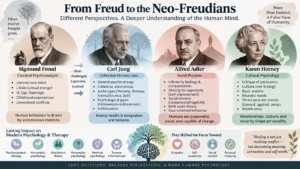
The foundation of modern psychology cannot be discussed without acknowledging Sigmund Freud, the pioneer who introduced psychoanalysis and fundamentally changed how we understand the human mind. His ideas, particularly those concerning the unconscious mind, childhood experiences, and instinctual drives, were revolutionary and strongly influenced the development of Neo-Freudians and later psychological theories. However, Freud’s approach was also controversial and rigid, with a strong emphasis on sexuality and biological instincts.
As psychoanalysis evolved, several of Freud’s closest followers began to question, reinterpret, and expand his theories. Although these thinkers respected Freud’s core insights, they believed his framework did not fully explain the complexity of human behavior. Consequently, they developed new perspectives that placed greater emphasis on social relationships, cultural influences, personal goals, and human growth.
Among the most influential Neo-Freudians were:
- Carl Jung
- Alfred Adler
- Karen Horney
Together, they broadened the scope of psychoanalytic thought by shifting the focus:
- From sexual drives → social and cultural influences
- Determinism → personal growth and choice
- From pathology → human potential and development
Moreover, their theories helped move psychology toward a more comprehensive understanding of personality, relationships, identity, and personal meaning.
Who Are the Neo-Freudians?
Neo-Freudians were psychologists who built upon Freud’s psychoanalytic ideas while challenging some of his assumptions. Although they recognized the importance of the unconscious mind, they believed that human behavior could not be explained by biological instincts and sexuality alone.
In particular, Neo-Freudian theorists:
- Accepted the importance of the unconscious
- Rejected Freud’s biological determinism
- Emphasized social relationships, culture, and conscious motivation
- Highlighted personal growth, choice, and human potential
Furthermore, they viewed individuals as active participants in their own development rather than simply being controlled by unconscious instincts. In other words, humans are not prisoners of instinct; they are capable of growth, creativity, meaningful relationships, and change.
Therefore, the Neo-Freudian movement represented an important shift in psychology—from explaining behavior primarily through instinct and unconscious conflict toward understanding the influence of social context, culture, personal goals, and human development.
Carl Jung: From Libido to the Collective Unconscious
Jung’s Break from Freud
Carl Jung was initially one of Freud’s closest collaborators and was even regarded as a potential successor within the psychoanalytic movement. However, their relationship eventually broke down because of significant theoretical disagreements. At the center of their conflict was their fundamentally different understanding of libido and human motivation.
Major Point of Conflict
- Freud: Libido = primarily sexual energy
- Jung: Libido = general psychic energy
Unlike Freud, Jung believed that human motivation extended beyond sexuality. He argued that psychic energy could influence a much broader range of experiences, including creativity, spirituality, intellectual activity, relationships, and the pursuit of personal meaning. In this way, Jung considered Freud’s explanation of human motivation too narrow.
Key Contributions of Carl Jung
1. The Collective Unconscious
One of Jung’s most influential contributions was his concept of the collective unconscious. He proposed that, beyond the personal unconscious formed through individual experiences, there is a deeper psychological layer shared by humanity.
According to Jung, the collective unconscious contains archetypes—universal patterns or symbolic structures that influence how people perceive and experience the world.
Major Archetypes
Some of Jung’s most well-known archetypes include:
- Persona – the social mask or identity we present to others
- Shadow – the repressed or less-acknowledged aspects of the personality
- Anima/Animus – Jung’s concepts concerning unconscious feminine and masculine aspects of the psyche
- Self – the integrated and unified whole of the personality
These archetypal patterns can appear in dreams, myths, art, stories, and human behavior, helping explain why certain themes and symbols recur across different cultures.
2. Psychological Types
Jung also developed a theory of psychological types to explain differences in how individuals perceive and interact with the world.
His framework included:
- Introversion vs. Extraversion
- Four psychological functions:
- Thinking
- Feeling
- Sensation
- Intuition
Together, these concepts provided a framework for understanding individual differences in personality. Jung’s ideas later influenced the development of personality assessments, including the Myers-Briggs Type Indicator (MBTI).
3. Individuation
Another central concept in Jungian psychology is individuation, the lifelong process through which a person integrates different aspects of the conscious and unconscious self.
Rather than simply suppressing unwanted thoughts, emotions, or impulses, individuation involves recognizing, understanding, and integrating them into a more complete sense of self. Consequently, psychological development becomes a process of becoming more aware of who we are rather than merely eliminating inner conflict.
Mental health involves integration and balance, rather than simply repression.
How Jung Modified Freud
| Freud | Jung |
|---|---|
| Sexual libido | General psychic energy |
| Personal unconscious | Collective unconscious |
| Pathology-focused | Growth and wholeness |
| Past-oriented | Past + future goals |
Alfred Adler: From Sexual Conflict to Social Purpose
Adler’s Rejection of Freud
Alfred Adler disagreed with Freud’s psychoanalytic approach more fundamentally than Jung did. Although he recognized the importance of psychological processes, Adler rejected the idea that sexual instincts and unconscious conflicts were the primary forces shaping human behavior.
In particular, Adler challenged:
- Sexual motivation as the primary drive
- Deterministic control by unconscious processes
- An excessive emphasis on psychological pathology
Instead, Adler viewed human beings as goal-oriented, purposeful, and socially embedded. He emphasized that people actively respond to their circumstances and strive toward goals rather than simply being driven by past experiences or unconscious instincts.
Key Contributions of Alfred Adler
1. Inferiority Feelings and Compensation
One of Adler’s most important concepts was inferiority feelings. He proposed that people naturally experience feelings of inadequacy or limitation, particularly when they compare themselves with others or recognize areas in which they feel less capable.
However, these feelings are not necessarily unhealthy. In fact, they can motivate individuals to develop their abilities, overcome limitations, and improve themselves.
Healthy compensation may occur through:
- Skill-building
- Achievement
- Contribution to others
When compensation becomes excessive or unhealthy, however, it may contribute to patterns such as:
- Inferiority complex – persistent feelings of inadequacy and worthlessness
- Superiority complex – an exaggerated need to appear superior as a way of compensating for underlying insecurity
2. Striving for Superiority
Adler proposed that human beings are motivated to overcome limitations and move toward greater competence, significance, and fulfillment.
Importantly, his concept of striving for superiority does not simply mean dominating or being better than others. Rather, it refers to the individual’s ongoing effort toward self-improvement, mastery, and personal development.
Thus, Adler shifted the focus from Freud’s emphasis on unconscious sexual conflict toward a more purposeful and future-oriented understanding of human motivation.
3. Social Interest (Gemeinschaftsgefühl)
Another central concept in Adlerian psychology is social interest, or Gemeinschaftsgefühl. Adler believed that psychological well-being is closely connected to a person’s ability to develop social connectedness, empathy, cooperation, and a sense of contribution.
From this perspective, mental health is not simply an individual matter. Instead, it also involves how effectively a person participates in relationships and contributes to the wider community.
A psychologically healthy person feels connected to humanity and contributes to the well-being of others.
4. Birth Order Theory
Adler also emphasized the influence of family dynamics and birth order on personality development. He suggested that a child’s position within the family can shape their experiences, expectations, and patterns of interaction.
Traditionally, Adler associated different birth positions with tendencies such as:
- Firstborn: Often associated with responsibility and greater concern about expectations
- Middle child: Often associated with competition and comparison
- Youngest: Often associated with being more pampered or protected
- Only child: Often associated with maturity as well as greater sensitivity to attention and expectations
However, birth order should not be treated as a fixed predictor of personality. Family environment, parenting, relationships, and individual interpretation of experiences also play important roles.
How Adler Modified Freud
| Freud | Adler |
|---|---|
| Sexual instincts | Social motivation |
| Past trauma | Future goals |
| Individual conflict | Social interest |
| Determinism | Choice and responsibility |
Karen Horney: From Penis Envy to Cultural Psychology
Horney’s Feminist Critique of Freud
Karen Horney was one of the most prominent critics of Freud’s male-centered approach to personality and psychosexual development. She particularly challenged Freud’s concepts of penis envy and female inferiority, arguing that women’s psychological experiences could not be adequately understood through a framework developed primarily around male development.
Rather than attributing psychological differences between men and women mainly to biology, Horney emphasized the powerful influence of culture, social expectations, and interpersonal relationships on personality development. In this way, her work helped move psychoanalytic thinking toward a more culturally informed understanding of human behavior.
Key Contributions of Karen Horney
1. Basic Anxiety
One of Horney’s central concepts was basic anxiety, which refers to a deep sense of insecurity and helplessness that can develop when a child does not experience sufficient safety, warmth, or emotional support.
According to Horney, basic anxiety may arise from experiences such as:
- Lack of warmth and affection
- Rejection
- Inconsistent or unpredictable parenting
As a result, children may develop feelings of insecurity and adopt different coping strategies to manage their anxiety. Over time, these patterns can influence how they approach relationships and respond to the challenges of life.
2. Neurotic Needs
Horney identified 10 neurotic needs that can develop as individuals attempt to cope with basic anxiety. These needs may become problematic when they are rigid, excessive, or driven primarily by insecurity.
Examples include:
- Need for affection and approval
- For power and control
- Need for perfection
- For independence
Although these needs can appear normal in moderation, Horney argued that they become neurotic when a person depends on them excessively to feel safe or valued.
3. Three Neurotic Trends
Horney later organized these coping patterns into three major neurotic trends, describing how individuals may respond to anxiety in relationships:
- Moving Toward People – seeking approval, affection, and security through compliance and dependence
- Against People – attempting to gain security through aggression, control, or competition
- Moving Away from People – protecting oneself from anxiety through withdrawal, emotional distance, or excessive independence
These three trends demonstrate Horney’s emphasis on interpersonal relationships and the ways people adapt to feelings of insecurity.
4. Womb Envy
Horney also proposed the concept of womb envy as a counterpoint to Freud’s concept of penis envy. She suggested that men may experience envy toward women’s reproductive capacities, particularly the ability to give birth and nurture new life.
By introducing this concept, Horney challenged the assumption that women’s psychological development should be understood primarily in relation to male anatomy. Her broader argument was that cultural expectations and gender roles can significantly influence psychological experiences, rather than those experiences being determined solely by biology.
How Horney Modified Freud
| Freud | Horney |
|---|---|
| Biology-based | Culture-based |
| Penis envy | Womb envy |
| Female inferiority | Gender equality |
| Instinct-driven | Relationship-driven |
Comparative Summary: Freud vs Neo-Freudians
| Aspect | Freud | Jung | Adler | Horney |
|---|---|---|---|---|
| Motivation | Sexual instincts | Psychic energy | Social goals | Security |
| View of self | Conflict-driven | Growth-oriented | Purposeful | Relational |
| Role of culture | Minimal | Moderate | Important | Central |
| Gender view | Male-centric | Balanced | Neutral | Feminist |
Impact on Modern Psychology and Therapy
The ideas developed by the Neo-Freudians extended psychoanalytic thinking beyond Freud’s emphasis on instinctual drives and unconscious conflict. By placing greater importance on relationships, social context, personal meaning, and human development, their work influenced several areas of modern psychology and psychotherapy.
Neo-Freudian ideas have influenced:
- Psychodynamic therapy
- Humanistic psychology
- Attachment theory
- Personality psychology
- Feminist psychology
- Trauma-informed care
More importantly, these perspectives helped shift therapeutic attention toward:
- Empathy and the therapeutic relationship
- Self-awareness and insight
- Social and cultural context
- Personal meaning and individual experience
As a result, psychological difficulties began to be understood not only as symptoms of internal conflict but also in relation to a person’s relationships, environment, identity, and developmental experiences.
Relevance in Daily Life and Counseling
The ideas of Jung, Adler, and Horney remain useful for counselors and psychology students because they provide different ways of understanding how people develop patterns of thinking, feeling, and behaving.
For example, Neo-Freudian perspectives can help professionals:
- Understand relationship patterns and recurring interpersonal difficulties
- Address self-esteem issues and feelings of inadequacy
- Explore identity, purpose, and personal meaning
- Reduce shame-based approaches to psychological difficulties
- Promote personal growth rather than focusing exclusively on diagnosis
In counseling, these perspectives can therefore encourage practitioners to look beyond the presenting problem and consider the person’s relationships, social environment, developmental history, goals, and sense of self.
Criticisms of Neo-Freudian Theories
Despite their influence, Neo-Freudian theories have important limitations. Many of their concepts are difficult to test objectively, and some claims have limited empirical support.
Major criticisms include:
- Limited empirical support for some theoretical concepts
- Abstract and difficult-to-operationalize concepts
- Potential cultural and historical biases
- Concepts that can be difficult to measure scientifically
For this reason, Neo-Freudian theories are generally more valuable as conceptual and clinical frameworks than as empirically established explanations of human behavior.
Nevertheless, their historical, clinical, and philosophical contributions remain significant. They helped broaden psychological thinking by emphasizing that human beings are influenced not only by instinct and unconscious conflict but also by relationships, culture, goals, meaning, and the desire for personal growth.
Conclusion: From Instinct to Insight
The Neo-Freudians did not simply reject Freud; they reinterpreted and expanded his ideas. Jung, Adler, and Horney each challenged important aspects of classical psychoanalysis while retaining the broader insight that unconscious processes can influence human behavior.
Together, their theories helped transform the emphasis of psychoanalytic thought:
- Sexual determinism → Human potential
- Pathology → Growth and development
- Individual conflict → Social connection
- Biological explanations → Psychological, social, and cultural influences
Ultimately, Jung, Adler, and Horney contributed to a broader and more nuanced understanding of personality and psychological development. Their work reminds us that understanding the human mind involves more than identifying conflict or symptoms; it also requires exploring meaning, relationships, identity, self-worth, and the possibility of growth.
Healing is not only about resolving inner conflict; it is also about developing meaning, connection, self-awareness, and a stronger sense of self.
FAQ Section
1. Who are Neo-Freudians in psychology?
Neo-Freudians are psychologists who accepted Freud’s idea of the unconscious but rejected his emphasis on sexual instincts, focusing instead on social, cultural, and interpersonal factors.
2. How did Carl Jung modify Freud’s theory?
Carl Jung expanded Freud’s concept of libido beyond sexuality, introduced the collective unconscious, archetypes, psychological types, and emphasized self-realization through individuation.
3. What is Alfred Adler’s main contribution to psychology?
Alfred Adler introduced Individual Psychology, focusing on inferiority feelings, striving for superiority, social interest, and goal-directed behavior rather than unconscious sexual conflict.
4. How did Karen Horney disagree with Freud?
Karen Horney rejected Freud’s concept of penis envy and argued that personality development is shaped by culture, social relationships, and basic anxiety rather than biology.
5. What is the main difference between Freud and Neo-Freudians?
Freud emphasized biological instincts and unconscious conflict, while Neo-Freudians emphasized social relationships, culture, conscious motivation, and personal growth.
6. What is the concept of basic anxiety according to Horney?
Basic anxiety refers to a child’s feeling of insecurity and helplessness arising from lack of warmth, safety, or consistent parenting, which shapes neurotic personality patterns.
7. What is Jung’s collective unconscious?
The collective unconscious is a shared, inherited layer of the unconscious mind containing universal archetypes that influence behavior, dreams, and myths.
8. Why are Neo-Freudians important in modern psychology?
Neo-Freudians broadened psychoanalysis by including social, cultural, and humanistic perspectives, influencing modern psychotherapy, personality theory, and counseling practices.
9. Are Neo-Freudian theories still relevant today?
Yes. Their ideas are widely used in psychodynamic therapy, personality assessment, trauma work, relationship counseling, and self-development approaches.
10. Is Neo-Freudian theory important for psychology exams?
Yes. Neo-Freudians are a core topic in undergraduate and postgraduate psychology syllabi, especially in personality theories and history of psychology.
Reference
-
Neo-Freudians — Lumen Learning
An educational overview of Neo-Freudian theorists including Adler, Jung, and Horney and how their views differed from Freud’s.
👉 https://courses.lumenlearning.com/waymaker-psychology/chapter/neo-freudians-adler-erikson-jung-and-horney/ Lumen Learning -
Neo-Freudians: Adler, Erikson, Jung & Horney — OpenStax
OpenStax’s psychology textbook section outlining the basic tenets, disagreements with Freud, and the contributions of key Neo-Freudians.
👉 https://openstax.org/books/psychology-2e/pages/11-3-neo-freudians-adler-erikson-jung-and-horney OpenStax -
Neo-Freudians (General Psychology) — FSCJ Pressbooks
Another educational summary emphasizing reduction in the role of sexuality and greater focus on social and cultural influences.
👉 https://fscj.pressbooks.pub/psychology/chapter/freud-and-neo-freudians/ fscj.pressbooks.pub -
Neo-Freudians Overview — Simply Psychology
A learner-friendly explanation of how Freud’s followers built on and adapted his psychoanalytic theories.
👉 https://www.simplypsychology.org/neo-freudians.html Simply Psychology -
Neo-Freudianism — Wikipedia
Encyclopedic entry describing the broader Neo-Freudian school and its emphasis on social and cultural aspects beyond Freud’s work.
👉 https://en.wikipedia.org/wiki/Neo-Freudianism -
Structure of Personality: Id, Ego & Superego Explained Simply
Pingback: Erikson’s Psychosocial Stages Explained Across the Lifespan
Pingback: Structure of Personality: Id Ego & Superego Explained Simply