
Why Men’s Mental Health Often Goes Unnoticed
Men are often conditioned by social expectations to:
- Hide vulnerability
- Avoid emotional expression
- View help-seeking as a weakness
- Prioritize responsibility over self-care
As a result, emotional difficulties may remain unnoticed or unaddressed for long periods. Rather than openly discussing sadness, fear, or emotional pain, some men may express distress through other behaviors.
For example, mental health symptoms may present differently in men than in women, often appearing as irritability, aggression, risk-taking, workaholism, or emotional shutdown rather than sadness or tearfulness. Consequently, these signs can sometimes be overlooked or misunderstood, particularly when they are viewed only as behavioral or personality problems.
Furthermore, when emotional distress is repeatedly suppressed, it can become more difficult for men to recognize when they need support. Therefore, learning to recognize these patterns is an important first step toward greater awareness, earlier support, and meaningful change.
Breaking the Stigma Around Men’s Mental Health
Breaking the stigma around men’s mental health begins with changing how we understand emotional strength. Instead of viewing vulnerability as a weakness, it can be recognized as an important part of emotional awareness and resilience. True strength lies in:
- Emotional awareness
- Asking for help when needed
- Setting healthy boundaries
- Choosing healing over silence
Furthermore, when men feel safe expressing emotions without fear of judgment, they are more likely to recognize difficulties and seek support. In turn, this can create healthier ways of coping and strengthen relationships. Ultimately, allowing men to be emotionally human is an important step toward better mental health outcomes.
How Families and Society Can Support Men
Creating supportive environments requires both individual and collective effort. For example, families, partners, workplaces, and communities can help by:
- Encouraging open emotional conversations
- Avoiding shame or criticism around vulnerability
- Modeling healthy coping strategies
- Promoting mental health education
- Normalizing therapy and counseling
In addition, support should not begin only when a crisis occurs. Regular communication, emotional validation, and early encouragement can make it easier for men to speak about what they are experiencing.
Most importantly, supportive environments can reduce isolation and make help-seeking feel safer. In situations involving serious emotional distress or suicide risk, timely support can be especially important and potentially lifesaving.
Conclusion
Men experience mental health challenges just as deeply as anyone else—although these difficulties may sometimes appear in quieter or less visible ways. Depression, anxiety, anger, burnout, addiction, and loneliness are not personal failures. Instead, they can reflect human responses to stress, social expectations, difficult experiences, and unmet emotional needs.
Therefore, addressing men’s mental health requires awareness, compassion, early support, and cultural change. Furthermore, when men have access to appropriate tools, supportive relationships, and professional care when needed, they can develop healthier coping strategies and greater emotional resilience.
Ultimately, mental health care is not a weakness. Rather, it is an act of responsibility toward oneself and the people who depend on us. Breaking the silence does not make men less strong; instead, it creates space for healthier, more connected, and emotionally resilient lives.
Frequently Asked Questions (FAQ)
1. Why are mental health issues in men often overlooked (Mental Health Challenges)?
Men are often socialized to suppress emotions and appear strong or self-reliant. As a result, distress may show up as anger, withdrawal, substance use, or overworking rather than openly expressed sadness or anxiety—making it easier to miss.
2. What are the most common mental health challenges men face (Mental Health Challenges)?
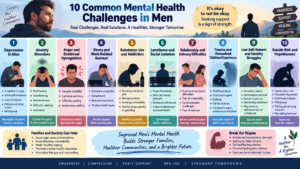
Common challenges include depression, anxiety, anger and emotional dysregulation, work-related burnout, substance use, loneliness, relationship difficulties, unresolved trauma, low self-esteem, and increased suicide risk.
3. How does depression look different in men (Mental Health Challenges)?
Depression in men may appear as irritability, emotional numbness, fatigue, sleep problems, withdrawal, or loss of interest in work or relationships rather than visible sadness or crying.
4. Is anger a sign of poor mental health in men (Mental Health Challenges)?
Anger can be a sign of underlying emotional distress. Many men were taught to express anger instead of sadness or fear, so unresolved pain may surface as irritability or outbursts.
5. Why do many men avoid seeking mental health support (Mental Health Challenges)?
Common barriers include stigma, fear of being judged, beliefs that asking for help is a weakness, lack of emotional language, and limited awareness of mental health resources.
6. How does work stress affect men’s mental health (Mental Health Challenges)?
Men often tie self-worth to productivity and financial responsibility. Chronic work stress can lead to burnout, emotional exhaustion, irritability, physical health issues, and reduced motivation.
7. Are substance use and addiction linked to men’s mental health (Mental Health Challenges)?
Yes. Many men use substances such as alcohol or drugs to cope with stress, emotional pain, or unresolved trauma. Addressing the underlying emotional issues is essential for recovery.
8. How does loneliness impact men psychologically (Mental Health Challenges)?
Loneliness increases the risk of depression, anxiety, substance use, and poor physical health. As men age, social connections may decrease, making isolation a significant mental health risk.
9. What role does childhood trauma play in men’s mental health (Mental Health Challenges)?
Unresolved childhood trauma—such as abuse, neglect, or emotional invalidation—can affect emotional regulation, relationships, self-esteem, and coping strategies in adulthood.
10. Why is suicide risk higher in men (Mental Health Challenges)?
Men are less likely to seek help and more likely to use lethal means. Untreated depression, emotional isolation, and social pressure contribute significantly to increased suicide risk.
11. How can men start improving their mental health (Mental Health Challenges)?
Small steps help, such as:
-
Acknowledging emotions
-
Talking to someone trusted
-
Reducing harmful coping behaviors
-
Practicing stress management
-
Seeking professional support when needed
12. Is therapy effective for men (Mental Health Challenges)?
Yes. Therapy provides a safe, confidential space to understand emotions, improve coping skills, address trauma, and build healthier relationships. Many men benefit greatly once they engage.
13. How can families and partners support men’s mental health (Mental Health Challenges)?
Supportive listening, avoiding judgment, encouraging help-seeking, validating emotions, and reducing stigma can make a significant difference.
14. Are mental health struggles a sign of weakness (Mental Health Challenges)?
No. Mental health challenges are human experiences, not personal failures. Seeking help reflects self-awareness, responsibility, and strength.
15. What is the most important message about men’s mental health (Mental Health Challenges)?
Men deserve emotional support, understanding, and care just like anyone else. Breaking silence and stigma is essential for prevention, healing, and long-term well-being.
Reference
-
World Health Organization. (2022). Mental health of men and boys.
https://www.who.int/publications/i/item/9789240044149 -
American Psychological Association. (2023). Men and mental health.
https://www.apa.org/monitor/men-mental-health -
National Institute of Mental Health. (2023). Men and mental health.
https://www.nimh.nih.gov/health/topics/men-and-mental-health -
Courtenay, W. H. (2000). Constructions of masculinity and their influence on men’s well-being. Social Science & Medicine, 50(10), 1385–1401.
https://doi.org/10.1016/S0277-9536(99)00390-1 -
Mahalik, J. R., et al. (2007). Gender role conflict and psychological distress in men. Journal of Counseling Psychology, 54(2), 163–175.
https://doi.org/10.1037/0022-0167.54.2.163 - How to Build Daily Habits for Better Mental Health
Pingback: Top 7 Mental Wellness Tools Every Man Should Use
Pingback: Best Books & Podcasts for Men’s Mental Health Growth
Pingback: 7 Signs You Need to Talk to a Therapist — Don’t Ignore