
Introduction: You Need to Talk to a Therapist
Many people believe therapy is only for those who are “mentally ill,” broken, or unable to function. However, you don’t need to reach a crisis point to Talk to a Therapist. Therapy can offer support, clarity, and practical tools before life starts to feel unmanageable.
People often delay seeking help because:
- “Others have it worse.”
- “I should handle this myself.”
- “It’s just a phase.”
- “I don’t want to be judged.”
- “I don’t even know what I’d say.”
As a result, emotional distress can build quietly and eventually affect different areas of life. You might notice irritability, exhaustion, emotional disconnection, physical symptoms, or ongoing relationship problems.
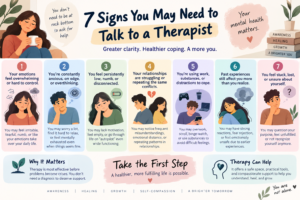
In this article, we’ll explore 7 clear signs you may need to talk to a therapist. Rather than focusing on labels or diagnoses, these signs can help you recognize when professional support could make a meaningful difference.
What Therapy Really Is (and Isn’t)
Before we explore the signs, let’s first clear up a few common myths about therapy. Understanding what therapy actually involves can make it easier to decide whether seeking support is right for you.
Therapy is:
- A confidential space where you can explore your thoughts and feelings openly.
- A way to understand emotional and behavioral patterns without blaming yourself.
- An opportunity to learn practical skills for managing emotions, stress, and difficult situations—not simply talk about problems.
- Helpful even when you “can’t explain” what’s wrong, because a therapist can help you explore what you’re experiencing.
Therapy is not:
- A sign of weakness or failure.
- Something reserved only for severe mental illness.
- A situation where someone simply tells you what to do.
- Endless talking without progress; instead, therapy can involve reflection, skill-building, goal-setting, and meaningful change.
Ultimately, therapy is a collaborative process that can help you better understand yourself, develop healthier coping strategies, and navigate challenges with greater clarity.
Sign 1: Your Emotions Feel Overwhelming or Hard to Control
Everyone experiences emotions. However, when your feelings begin to take over your daily life, it may be a sign that you need additional support. You might find yourself reacting more strongly than you expect, struggling to calm down, or feeling emotionally exhausted without fully understanding why.
What This Can Look Like
You may cry more easily, become suddenly angry or irritable, or experience emotional numbness and emptiness. Sometimes, your mood may change so quickly that you struggle to understand what triggered it. You might even feel like you are experiencing “too much” emotionally—or, at other times, nothing at all.
You may catch yourself thinking:
- “I don’t know why I react like this.”
- “Small things set me off.”
- “I feel emotionally exhausted.”
Why This Matters
Often, emotional overwhelm develops when stress exceeds your usual coping capacity. Suppressed emotions, difficult past experiences, or limited opportunities to learn emotional regulation skills can also make it harder to manage intense feelings.
Therapy can help you understand where these emotional reactions come from and develop healthier ways to regulate and respond to them. Instead of allowing emotions to control your actions, you can gradually learn to recognize, process, and manage them.
Sign 2: You’re Constantly Anxious, On Edge, or Overthinking
Anxiety does not always involve panic attacks. Instead, it can quietly appear as constant mental noise that makes it difficult to switch off, relax, or feel fully present.
You may spend a lot of time worrying about the future, replaying conversations, overanalyzing decisions, or anticipating problems that may never happen. Physical sensations such as a tight chest, racing thoughts, or restlessness can accompany these worries. Even when everything seems fine externally, you may still feel unsafe or unable to relax.
You might tell yourself:
- “This is just how my mind works.”
- “I’m just being responsible.”
- “Once this situation ends, I’ll be fine.”
Why Therapy Helps
Over time, chronic anxiety can become exhausting. Therapy can help you identify the thought patterns that fuel anxiety, understand the emotional roots of fear, and develop practical strategies such as grounding and relaxation techniques. It can also help you gradually reduce avoidance and excessive reassurance-seeking. An anxious mind isn’t a weak mind—it’s a tired one.
Sign 3: You Feel Persistently Low, Numb, or Disconnected
Not all depression looks like sadness. Sometimes, emotional difficulties appear as numbness, low motivation, or a sense of disconnection from yourself and the people around you.
You may continue working, studying, meeting responsibilities, and appearing fine to others while internally feeling as though you are simply moving through life on “autopilot.”
Subtle Warning Signs
You might notice that activities you once enjoyed no longer feel meaningful. You may also feel tired even after resting, struggle to find motivation, or experience a persistent sense of emptiness rather than sadness.
People sometimes dismiss these experiences as “burnout,” “adulthood,” or simply being practical. However, consistently feeling disconnected from yourself or your life deserves attention.
Why You Shouldn’t Ignore This
Emotional numbness can sometimes function as a protective response when the mind feels overwhelmed. However, when that numbness continues for a long time, it can gradually affect your relationships, motivation, sense of meaning, and ability to experience joy.
Therapy can provide a safe space to explore these experiences and gradually reconnect with your emotions, motivation, sense of purpose, and sense of self.
Sign 4: Your Relationships Are Struggling or Repeating the Same Conflicts
If relationship problems keep repeating across romantic relationships, friendships, or family interactions, it may be worth looking beyond the individual conflict and examining the pattern itself.
You might experience frequent misunderstandings, emotional withdrawal, difficulty trusting others, or fear of intimacy. Similarly, you may notice that you repeatedly choose similar partners, avoid difficult conversations, or shut down whenever conflict arises.
How Therapy Helps
Therapy can help you explore the patterns behind these difficulties, including attachment patterns, emotional triggers, communication styles, and unmet needs.
The goal is not to blame you or someone else. Instead, therapy can help you understand your role in relational patterns and develop healthier ways to communicate, set boundaries, and connect with others.
Sign 5: You’re Using Work, Substances, or Distractions to Cope
Coping itself is not the problem. The concern arises when you consistently use avoidance to escape uncomfortable thoughts or emotions rather than addressing what is underneath them.
For example, you may overwork, constantly scroll through social media, spend excessive time gaming or binge-watching, increase your alcohol or substance use, or keep yourself busy simply because you do not want to sit with your thoughts.
You might tell yourself:
- “I just don’t like sitting idle.”
- “This helps me relax.”
- “At least I’m being productive.”
What’s Really Happening
Avoidance can provide short-term relief, but it often comes with a long-term emotional cost. The uncomfortable feelings may temporarily become quieter, but they usually do not disappear simply because you distract yourself from them.
Therapy can help you understand what you are trying to avoid and gradually develop healthier coping strategies. With the right support, you can learn to face difficult emotions safely instead of relying on distractions to escape them.
Sign 6: Past Experiences Still Affect You More Than You Realize
You do not need to label your past as “trauma” for it to continue affecting you. Sometimes, earlier experiences influence how you respond to situations in the present without you immediately recognizing the connection.
For example, you may experience unusually strong reactions to certain situations, fear abandonment or rejection, struggle to trust people, or feel emotionally unsafe. Old memories may also resurface unexpectedly, particularly when something in the present reminds you of an earlier experience.
You may find yourself thinking:
- “It wasn’t that bad.”
- “Others had it worse.”
- “I should be over it by now.”
An Important Truth
The fact that someone else experienced something worse does not automatically make your experience insignificant. What matters is how that experience continues to affect you today.
Therapy can help you process unresolved experiences, understand emotional triggers, develop a stronger sense of safety, and distinguish between what happened in the past and what is happening in the present.
Sign 7: You Feel Stuck, Lost, or Unsure About Yourself
Sometimes, the biggest sign that you could benefit from therapy is not intense distress but a persistent sense of confusion or disconnection from yourself.
You may question your life direction, feel uncertain about your purpose, or experience a lack of meaning despite achieving things that others consider successful. Might you also feel stuck even though you cannot identify exactly what needs to change.
You may find yourself wondering:
- “Is this all there is?”
- “Why don’t I feel fulfilled?”
- “I don’t recognize myself anymore.”
How Therapy Supports Growth
Therapy is not only about addressing problems. It can also give you space to understand yourself more deeply, clarify your values, and make choices that better reflect the life you want to build.
Through this process, therapy can support self-discovery, personal growth, identity development, and more intentional decision-making.
Why People Delay Therapy (And Why You Don’t Have To)
Even when someone knows they are struggling, taking the first step toward therapy can feel difficult. Several common barriers can make people hesitate, including fear of judgment, the belief that they should “handle it alone,” uncertainty about how to begin, and concerns about cost or time.
However, you don’t have to wait until your problems become a crisis before seeking support. Starting therapy earlier can give you the opportunity to understand what you are experiencing, develop healthier coping strategies, and address concerns before they become more overwhelming.
If you have been thinking, “Maybe I should talk to someone,” that thought itself can be worth exploring. You don’t need to have everything figured out before your first session, and you don’t need a diagnosis to ask for support. You don’t need a diagnosis to deserve support.
Conclusion: Listening Early Changes Everything
Ignoring emotional signs does not make them disappear. Instead, when we repeatedly dismiss what we are feeling, those signs can become harder to manage over time.
Therapy is not about weakness or failure. It is about recognizing when you need support and taking an active role in your well-being. It can help you build:
- Awareness of your thoughts, emotions, and patterns
- Healing from experiences that continue to affect you
- Growth through greater self-understanding and healthier coping
- Self-compassion instead of constantly pushing yourself to “just deal with it”
Most importantly, you do not have to wait until you reach burnout or a crisis before you seek help. Paying attention to the early signs can give you the opportunity to make changes while you still have the capacity to do so. If something inside you is asking for attention, that itself is reason enough to listen.
FAQ Section
1. How do I know if I really need therapy (You Need to Talk to a Therapist)?
If emotional distress, anxiety, relationship problems, or feeling stuck is affecting your daily life, therapy can help—even if you don’t have a diagnosis.
2. Do I need to be depressed or anxious to see a therapist (You Need to Talk to a Therapist)?
No. Therapy is also helpful for stress, burnout, emotional numbness, relationship issues, personal growth, and self-understanding.
3. What are early signs that therapy might help (You Need to Talk to a Therapist)?
Early signs include constant overthinking, emotional overwhelm, sleep problems, irritability, withdrawal from others, and feeling stuck or disconnected.
4. Is it okay to seek therapy even if others seem to have bigger problems (You Need to Talk to a Therapist)?
Yes. Pain is not a competition. If something is affecting you, it deserves attention and care.
5. How long should I wait before seeking professional help (You Need to Talk to a Therapist)?
You don’t need to wait. Therapy is often more effective when started early, before stress or emotional pain becomes overwhelming.
6. What happens in the first therapy session (You Need to Talk to a Therapist)?
The first session usually involves sharing what brought you to therapy, discussing goals, and understanding how therapy can support you—at your own pace.
7. Can therapy help if I don’t know what’s wrong (You Need to Talk to a Therapist)?
Yes. Many people seek therapy because something feels “off” even if they can’t explain it. Therapy helps bring clarity.
8. Is therapy confidential (You Need to Talk to a Therapist)?
Yes. Therapy sessions are confidential, with a few safety-related exceptions explained by the therapist.
9. How do I choose the right therapist (You Need to Talk to a Therapist)?
Look for someone you feel comfortable with. It’s okay to ask questions, and it’s also okay to switch therapists if it doesn’t feel like the right fit.
10. Is seeking therapy a sign of weakness (You Need to Talk to a Therapist)?
No. Seeking therapy is a sign of self-awareness, responsibility, and willingness to take care of your mental health.
Reference
-
Do I Need Therapy? – Talkspace — Lists common signs people may benefit from therapy, including anxiety, sleep issues, and difficulty coping. Do I Need Therapy?
-
7 Signs You Should See a Mental Health Therapist – American Behavioral Clinics — Explains indicators like relationship issues and feeling “off” as valid reasons to seek therapy. 7 Signs It’s Time to Talk to Someone (American Behavioral Clinics)
-
Signs of Needing Mental Health Help – SAMHSA — Lists emotional, thought, behavior, and body changes that could mean it’s time to seek help. Signs You Need Help
- 10 Common Mental Health Challenges in Men—and How to Address Them
Pingback: Real Stories of Men Who Transformed Their Mental Health
Pingback: Anger Management: How to Understand and Control Anger
Pingback: Fatherhood and Mental Health: What Every Dad Should Know