How to Heal Emotional Triggers Using CBT + DBT Skills

Introduction: Why Emotional Triggers Take Over Our Lives

Everyone has emotional triggers—situations, words, or memories that activate intense emotional reactions. A simple comment can feel like rejection. A delay in reply may feel like abandonment. A disagreement might feel like a personal attack.

For many people, these reactions feel automatic, uncontrollable, and overwhelming. Emotional triggers can:

  • Damage relationships

  • Lower self-esteem

  • Cause anxiety and panic

  • Influence decisions

  • Create impulsive behaviors

  • Lead to shame and guilt

But here’s the truth psychology teaches us:

Triggers are not the problem—our unprocessed wounds are.

Two therapy models, Cognitive Behavioral Therapy (CBT) and Dialectical Behavior Therapy (DBT), offer scientifically backed tools to transform these reactions into clarity, calmness, and emotional resilience.

This article explores:

  • What emotional triggers are

  • Why they feel so powerful

  • How the brain reacts under threat

  • How CBT helps you understand triggers

  • How DBT helps you regulate them

  • Step-by-step strategies to heal emotional triggers

  • How to apply skills in relationships and daily life

Let’s begin the journey toward emotional freedom.

Section 1: What Are Emotional Triggers?

An emotional trigger is an intense emotional response caused by something in the present that activates a past wound.

Common triggers include:

  • Feeling ignored

  • Criticism or disagreement

  • Someone raising their voice

  • Silence or withdrawal

  • Social rejection

  • Feeling controlled

  • Seeing others succeed

  • Being compared

  • Feeling misunderstood

  • Discussions about trauma

Triggers are usually connected to deeper unmet needs such as:

  • Safety

  • Love

  • Validation

  • Respect

  • Certainty

  • Autonomy

  • Belonging

When these needs feel threatened, the brain activates old patterns.
Section 2: Why Emotional Triggers Feel So Overwhelming

When triggered, the brain shifts into survival mode.

What happens in the brain:

  • The amygdala (fear center) becomes hyperactive

  • The prefrontal cortex (logic center) shuts down

  • Stress hormones spike

  • The body prepares to fight, flee, freeze, or fawn

This is why you:

  • Say things you regret

  • Feel out of control

  • Shut down emotionally

  • Have panic attacks

  • Cry suddenly

  • Overthink or dissociate

Emotional triggers aren’t signs of weakness. They’re signs of old wounds asking to be healed.

Section 3: The Connection Between Childhood and Triggers

Most emotional triggers come from:

1. Emotional neglect

When your feeling needs were ignored.

2. Criticism or perfectionism

When nothing you did felt good enough.

3. Inconsistent affection

Unpredictable love leads to emotional hypervigilance.

4. Trauma or chaos in childhood

Your brain learns to stay alert for danger.

5. Rejection or bullying

Creating fear of abandonment and sensitivity to disapproval.

6. Controlling caregivers

Triggers around autonomy and freedom develop.

Your present-day reactions often mirror how your emotional needs were handled as a child.

Section 4: How CBT Helps Heal Emotional Triggers

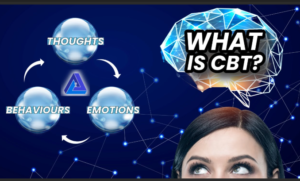
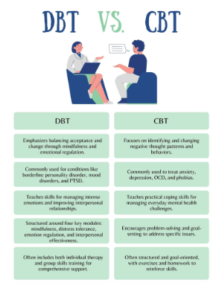
CBT (Cognitive Behavioral Therapy) focuses on the relationship between:

  • Thoughts

  • Emotions

  • Behaviors

Triggers become intense because of distorted thinking patterns and learned beliefs.

CBT teaches you to:

  • Identify the thought causing the reaction

  • Challenge distorted thinking

  • Replace unhealthy beliefs

  • Respond with rational, balanced thinking

The CBT Model for Triggers

Trigger → Automatic Thought → Emotion → Behavior

Example:
Trigger: Partner doesn’t reply for 2 hours
Automatic Thought: “They’re losing interest.”
Emotion: Anxiety, fear
Behavior: Overtexting, anger, withdrawal

CBT helps interrupt and reframe this cycle.

Section 5: Common Cognitive Distortions That Fuel Triggers

1. Mind Reading

“You’re upset with me. I just know it.”

2. Catastrophizing

“If they don’t reply, the relationship is over.”

3. Black-and-White Thinking

“They are perfect or terrible.”

4. Emotional Reasoning

“I feel rejected, so I must be rejected.”

5. Personalization

“They’re quiet because of something I did.”

6. Overgeneralization

“This always happens. No one stays.”

CBT teaches you to challenge these distortions and replace them with realistic thoughts.
Section 6: CBT Step-by-Step: How to Heal a Trigger

Step 1: Identify the trigger

Ask: What triggered me? What happened right before the reaction?

Step 2: Identify the automatic thought

Ask: What did my mind instantly assume?

Step 3: Identify the core belief

Examples:

  • “I’m not lovable.”

  • “People leave me.”

  • “I’m inadequate.”

Step 4: Challenge the thought

Ask:

  • What is the evidence for and against this thought?

  • Is this thought a fact or a feeling?

  • Am I catastrophizing or personalizing?

Step 5: Replace with balanced thinking

Example:
“I feel insecure because of my past, but it doesn’t mean they’re abandoning me.”

Step 6: Choose a healthier response

Take a pause, calm your body, and then communicate calmly.

CBT transforms triggers by changing the meaning you assign to them.

Section 7: How DBT Helps Heal Emotional Triggers

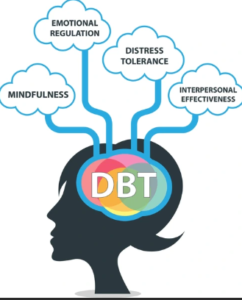
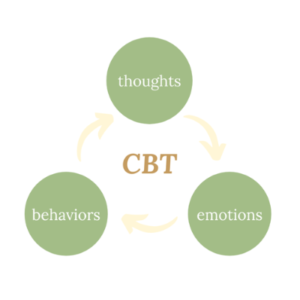
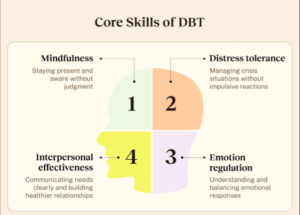
DBT (Dialectical Behavior Therapy) focuses on:

  • Emotional regulation

  • Mindfulness

  • Distress tolerance

  • Interpersonal effectiveness

CBT changes thoughts.
DBT calms emotions.
Together, they become psychological “superpowers.”

Section 8: DBT Skills That Transform Emotional Triggers

1. Mindfulness: Observing without reacting

DBT teaches you to notice:

  • What you feel

  • What you think

  • What your body is doing

Without judgment and without acting immediately.

Mindfulness steps:

  • Pause

  • Breathe

  • Label the feeling (“This is fear,” “This is shame”)

  • Allow the emotion to exist

  • Respond, don’t react

Mindfulness creates emotional distance between the trigger and reaction.

2. TIPP Skill (Immediate calming for intense emotions)

TIPP stands for:

  • Temperature change

  • Intense exercise

  • Paced breathing

  • Paired muscle relaxation

This quickly reduces emotional intensity by activating the parasympathetic system.

3. STOP Skill (Prevent impulsive reactions)

  • Stop

  • Take a breath

  • Observe

  • Proceed mindfully

This helps when triggers lead to impulsive texting, shouting, or shutting down.

4. DEAR MAN (Communicating needs without conflict)

Useful in relationship triggers.

  • Describe

  • Express

  • Assert

  • Reinforce

  • Mindful

  • Appear confident

  • Negotiate

Example:
“Yesterday when you didn’t reply, I felt anxious. I need reassurance when plans change.”
5. Wise Mind (Combining emotion + logic)

There are three states:

  • Emotion Mind (triggered state)

  • Reasonable Mind (logic only)

  • Wise Mind (balanced, grounded)

Wise Mind helps you make healthier choices.

Section 9: Combining CBT + DBT: The Ultimate Trigger-Healing Formula

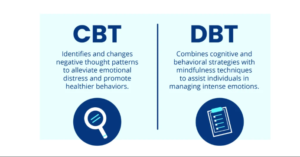
CBT = Understanding the thought behind the trigger
DBT = Regulating the emotion caused by the trigger

Together, they allow you to:

  • Reduce emotional intensity

  • Understand the origin of the trigger

  • Respond rationally

  • Build emotional resilience

  • Heal core wounds

A trigger is healed when the emotional charge decreases and the reaction becomes mild or neutral.

Section 10: Healing Triggers in Relationships

1. Communicate your triggers openly

Use “I feel” statements.

2. Request reassurance when needed

Healthy partners respond with empathy.

3. Avoid assumptions

Use DEAR MAN.

4. Learn your partner’s attachment style

This helps reduce conflicts.

5. Take breaks during heated moments

Use TIPP or grounding.

6. Validate each other’s emotions

Validation reduces reactivity.

Section 11: Healing Triggers from Past Trauma

For trauma-related triggers:

  • Use grounding skills

  • Practice body-based calming

  • Avoid self-judgment

  • Work slowly and gently

  • Seek professional support if needed

CBT helps reframe trauma beliefs.
DBT builds tools to manage overwhelm.

Section 12: Daily Practices to Reduce Trigger Reactivity

  • 10 minutes mindfulness daily

  • Naming emotions throughout the day

  • Challenging cognitive distortions

  • Practicing self-compassion

  • Using STOP when overwhelmed

  • Journaling automatic thoughts

  • Tracking progress

  • Building secure attachments

Emotional healing is a consistent process, not a one-time technique.

Section 13: How to Know You’re Healing Your Emotional Triggers

You will notice:

  • Fewer overreactions

  • Less anxiety

  • More clarity

  • Healthier communication

  • More patience

  • Healthier boundaries

  • Feeling calmer and safer

  • Increased self-awareness

Triggers don’t disappear instantly, but their power decreases dramatically.
Conclusion: You Can Break Free From Emotional Reactivity

Emotional triggers are not signs of weakness—they are signals pointing to deeper wounds that need attention, compassion, and care.

By using CBT to understand your thoughts,
and DBT to regulate your emotions,
you can transform moments of emotional overwhelm into opportunities for healing.

You are not your triggers.
You are the awareness that can heal them.

With consistent practice, support, and self-compassion, emotional stability becomes a skill you can build, strengthen, and master.

Reference

American Psychological Association (APA) – CBT & DBT Resources

https://www.apa.org

National Institute of Mental Health (NIMH)

https://www.nimh.nih.gov

Beck Institute (Founded by Dr. Aaron Beck — CBT Research Institute)

https://beckinstitute.org

What Is CBT? A Simple Guide for Everyone

DBT Skills for Emotional Regulation

Contact Us

Why Modern Relationships Fail: Attachment Theory Explained

Introduction: The Crisis of Modern Love

We live in an age where people are more connected than ever—but relationships are breaking faster than before. Ghosting, sudden breakups, emotional distance, communication issues, and commitment fears are becoming the norm for many couples.

People often blame technology, dating apps, or “lack of loyalty,” but modern relationship breakdown is far more psychological than cultural. Beneath most conflicts, misunderstandings, and emotional wounds lies one core concept:

Our attachment style shapes how we love, fight, connect, and break apart.

Attachment theory, developed by John Bowlby and expanded by Mary Ainsworth, explains why some people seek closeness, others push away, and some feel torn between the two. When attachment needs are unmet or mismatched, relationships struggle—even when both partners love each other deeply.

This article explores:

  • Why modern relationships fail

  • How attachment styles develop

  • The role of anxious, avoidant, and disorganized attachment

  • The “anxious-avoidant trap”

  • Why secure attachment is rare today

  • How to build healthier relationships

Section 1: What Is Attachment Theory?

Attachment theory explains how early bonding with caregivers forms “internal working models,” which shape adult romantic relationships.

Your attachment style determines:

  • How you express love

  • How you deal with conflict

  • How much closeness you need

  • How you handle rejection

  • How you communicate

  • How safe or unsafe relationships feel

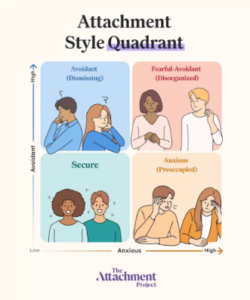
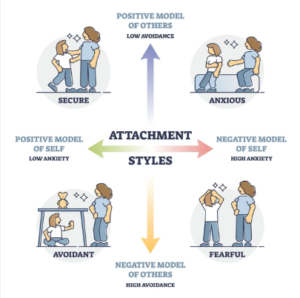
The Four Main Attachment Styles

  1. Secure

  2. Anxious (Preoccupied)

  3. Avoidant (Dismissive)

  4. Disorganized (Fearful-Avoidant)

Most relationship dysfunction stems from insecure attachment: anxious, avoidant, or disorganized.

Section 2: Why Modern Relationships Fail—The Attachment Perspective

Today’s relationships face unique challenges:

1. Emotional Needs Are Higher Than Ever

People expect partners to be:

  • Best friend

  • Lover

  • Therapist

  • Motivator

  • Companion

  • Financial supporter

  • Safe space

These expectations create pressure and disappointment.

2. Childhood Trauma Is More Recognized but Less Healed

Many adults:

  • Grew up with emotionally unavailable parents

  • Had inconsistent caregivers

  • Experienced neglect or overprotection

  • Carry unresolved trauma

Unhealed wounds create insecure attachment patterns.

3. Technology Intensifies Anxiety

Read receipts, texting delays, social media comparison, and online dating can trigger attachment insecurity.

4. Independence Culture Clashes with Emotional Needs

Society rewards:

  • Self-reliance

  • Detachment

  • Hustle culture

But relationships require vulnerability and interdependence.

5. People Choose Partners Based on Familiar Trauma

We subconsciously pick partners who recreate childhood emotional patterns—even if they hurt us.

Section 3: The Role of Childhood in Adult Attachment

Secure Attachments Develop When Childhood Needs Are Met

Children learn:
“I am loved. My feelings matter. People are safe.”

These adults create stable, emotionally fulfilling relationships.

Insecure Attachments Form When Needs Are Inconsistently Met

  • Emotional neglect

  • Unpredictable parenting

  • Criticism

  • Lack of affection

  • Over-controlling parents

These lead to adult struggles in intimacy, boundaries, trust, and communication.

Section 4: Anxious Attachment – “Do You Really Love Me?”

What It Feels Like

Anxiously attached adults fear abandonment.
They crave closeness but are terrified they will be rejected or replaced.

Signs of Anxious Attachment

  • Overthinking texts or conversations

  • Need for constant reassurance

  • Fear of being alone

  • Jealousy or comparison

  • Difficulty trusting

  • Emotional hyperactivation during conflict

  • Feeling “too much” or “too needy”

How They Behave in Relationships

They often:

  • Cling

  • Chase

  • Overcommunicate

  • Apologize excessively

  • Accept unhealthy behavior to avoid breakups

Why Modern Relationships Fail With Anxious Attachment

Because emotional needs feel urgent and intense, anxious partners can overwhelm or scare avoidant partners away.

Section 5: Avoidant Attachment – “I Need Space”

What It Feels Like

Avoidantly attached adults fear intimacy.
Closeness threatens their independence and sense of control.

Signs of Avoidant Attachment

  • Difficulty identifying emotions

  • Keeping partners at a distance

  • Fear of “being trapped”

  • Discomfort with vulnerability

  • Shutting down during conflict

  • Preferring logic over emotional expression

How They Behave in Relationships

They often:

  • Withdraw

  • Delay commitment

  • Ghost or go silent

  • Minimize problems

  • Value independence over closeness

Why Modern Relationships Fail With Avoidant Attachment

Avoidant partners disconnect during emotional moments—leading the anxious partner to pursue harder, creating a toxic cycle.

Section 6: Disorganized Attachment – “Come Close, But Don’t Hurt Me”

Also called fearful-avoidant, this style is the most conflicted and confusing.

What It Feels Like

These individuals crave love but fear intimacy, usually due to trauma or chaotic childhoods.

Signs of Disorganized Attachment

  • Mood swings

  • Instability in relationships

  • Fear of rejection AND fear of closeness

  • Sabotaging healthy relationships

  • Attracting toxic partners

  • Slow healing after breakups

Why Modern Relationships Fail With Disorganized Attachment

These individuals may attach intensely and then suddenly pull away. Both partners feel confused and unsafe.

Section 7: Secure Attachment – “Love Is Safe”

Signs of Secure Attachment

  • Comfortable with closeness

  • Communicate clearly

  • Healthy boundaries

  • No fear of losing partner

  • Steady emotional presence

Why Secure Attachment Is Rare Today

  • More childhood emotional neglect

  • More pressure on individuals

  • More fractured families

  • Growing anxiety culture

  • Digital overstimulation

Modern society produces insecure attachment at a high rate.

Section 8: The Anxious-Avoidant Trap (Most Common Reason for Breakups)

This dynamic explains MOST modern relationship breakdowns.

The Cycle

  1. The anxious partner wants closeness.

  2. The avoidant partner withdraws.

  3. The anxious partner panics and pursues harder.

  4. The avoidant partner distances more.

  5. Both feel misunderstood.

  6. Breakup happens.

  7. They often repeat the same cycle with new partners.

Why This Happens

Each partner activates the other’s deepest wounds:

  • Anxious: “Don’t leave me.”

  • Avoidant: “Don’t control me.”

Modern dating apps actually pair these types frequently, because avoidants are charming at first and anxious partners are expressive.

Section 9: Why Technology Makes Attachment Worse

1. Instant messaging increases anxiety

Waiting for replies triggers fear of abandonment.

2. Social media increases comparison

Perfect couples online worsen insecurity.

3. Dating apps create illusion of endless options

Avoidants avoid commitment; anxious people feel rejected.

4. Overstimulation affects emotional regulation

Constant dopamine crashes reduce patience and empathy.

Section 10: Emotional Unavailability – A Modern Epidemic

People today are:

  • Burnt out

  • Overworked

  • Distracted

  • Overstimulated

This creates emotional numbness and detachment, ruining relationship quality.

Signs your partner is emotionally unavailable

  • Avoiding serious discussions

  • Shutting down during conflict

  • Keeping you at a distance

  • Inconsistent affection

  • Fear of labels or commitment

Attachment wounds trigger unavailability.

Section 11: Why Communication Fails in Modern Relationships

Communication breaks because attachment needs conflict.

Anxious communicator

  • Over-communicates

  • Needs reassurance

  • Wants emotional connection

Avoidant communicator

  • Under-communicates

  • Avoids emotions

  • Prefers logic over feelings

Result:

Misunderstandings, frustration, emotional distance, repeated arguments.

Section 12: Why People Choose the Wrong Partners

1. Familiar trauma feels like love

If chaos was normalized early, safety feels boring.

2. Chemistry often signals unresolved wounds

People confuse intensity with intimacy.

3. Fear of vulnerability attracts avoidants

People choose partners who confirm their fears.

4. People choose based on unmet childhood needs

Not compatibility.

Section 13: The Psychology Behind Modern Breakups

Breakups today are faster because:

  • Emotional tolerance is low

  • Expectations are high

  • Communication is digital, not emotional

  • People fear vulnerability

  • Past trauma remains unresolved

  • Secure attachment is rare

Attachment needs often go unmet because individuals lack tools to understand themselves and each other.

Section 14: How to Build Healthy, Secure Relationships

1. Heal Your Attachment Style

Self-awareness is the first step. Understand your patterns.

2. Learn Emotional Regulation Skills

Breathing, grounding, DBT techniques, mindfulness.

3. Communicate Needs Clearly

Secure partners express needs without fear or pressure.

4. Avoid Triggering Dynamics

Anxious & avoidant pairings require conscious work.

5. Practice Vulnerability

Healthy relationships require emotional openness.

6. Set Boundaries With Love

Not walls—boundaries create safety.

7. Choose Partners Based on Emotional Safety

Not intensity, chemistry, or trauma familiarity.

Conclusion: Love Fails When Attachment Needs Go Unseen

Modern relationships don’t fail because people don’t care.
They fail because:

  • People are unhealed.

  • People fear vulnerability.

  • People misunderstand themselves.

  • People choose partners who trigger their wounds.

Attachment theory reveals one truth:

Relationships succeed not because people are perfect, but because they feel emotionally safe.

Understanding attachment styles can transform not just your love life—but your entire emotional world.

Reference

American Psychological Association (APA)

https://www.apa.org

National Institute of Mental Health — Attachment & Trauma

https://www.nimh.nih.gov

The Gottman Institute (Leading Relationship Research)

https://www.gottman.com

Relationship Red Flags Backed by Psychology

Anxious vs Avoidant Partners: The Push–Pull Pattern

Contact Us

Why Neurodiversity in Adults Is Overlooked

Introduction

For decades, words like ADHD, Autism, Dyslexia, or Dyspraxia were mostly associated with children. Adults were rarely assessed unless their challenges were severe. As a result, thousands of adults grew up undiagnosed, adapting to life by masking, overworking, or hiding their struggles.

Now, neuroscience and psychology recognize something important:

Neurodiversity is not a disability—it’s a natural variation in how the brain functions.

Adults who are neurodivergent often possess strengths such as creativity, hyperfocus, problem-solving, and deep empathy. But without understanding their own brain, they often feel “different,” “lazy,” “too sensitive,” or “not good enough.”

This article explains:

  • What neurodiversity means

  • Why adults often remain undiagnosed

  • 20 psychological signs you might be neurodivergent

  • How masking hides symptoms

  • The benefits of discovering your neurotype

  • When to seek assessment

If you’ve ever felt misunderstood, overwhelmed, or “out of sync,” this may help you see yourself with clarity—not judgment.

What Does Neurodiversity Mean?

Neurodiversity is the concept that there is no “normal” brain. Human brains naturally vary in:

  • Attention

  • Sensory processing

  • Language

  • Learning

  • Emotion regulation

  • Social communication

  • Executive functioning

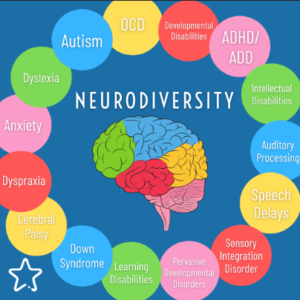
The neurodiversity umbrella includes:

  • ADHD

  • Autism (ASD)

  • Dyslexia

  • Dyspraxia (DCD)

  • Dyscalculia

  • Tourette’s

  • Sensory Processing Differences

  • Giftedness/2e (Twice Exceptional)

Many adults have a mix of traits across these.

Why Many Adults Are Undiagnosed

1. Diagnostic criteria were child-focused.

Earlier manuals described symptoms as they appear in boys, not adults or women.

2. Women and AFAB individuals mask better.

They learn to “socially camouflage” from a young age.

3. Smart adults overcompensate.

High intelligence hides challenges. This is known as twice-exceptionality.

4. Cultural stigma prevents assessment.

Many adults grew up with messages like:

  • “You are not trying hard enough.”

  • “Stop being dramatic.”

  • “Everyone is shy sometimes.”

5. Mental health misdiagnosis is common.

Adults with neurodivergence are often misdiagnosed with:

  • Anxiety

  • Depression

  • BPD

  • Bipolar disorder

These conditions can overlap or develop due to years of feeling misunderstood.

20 Signs You Might Be an Undiagnosed Neurodivergent Adult

Below are the most common signs across ADHD, autism, dyslexia, dyspraxia, and other neurotypes.
People usually identify with multiple categories, not just one.

1. You Feel “Different” From Others Your Whole Life

Many adults say:

  • “I always felt out of place.”

  • “I don’t know why social rules come naturally to others.”

This is often one of the earliest indicators.

2. You Mask Your Real Self to Fit In

Masking means copying behaviors or suppressing your natural traits.
Examples:

  • Forced eye contact

  • Practicing conversations before speaking

  • Rehearsing emotional reactions

  • Copying others’ tone, style, or humor

Masking is common in ADHD and autism.

3. Chronic Exhaustion from Daily Functioning

Neurodivergent adults feel drained after tasks others find simple:

  • Social interactions

  • Decision-making

  • Noise and sensory overload

  • Executive function tasks

Your brain works harder to do the same things.

4. Difficulty Focusing… yet Hyperfocus on Things You Love

This paradox is classic ADHD and also common in autism.
You struggle with:

  • Boring tasks

  • Paperwork

  • Routines

  • Planning

But you can:

  • Work 8 hours straight on a passion

  • Fixate deeply on hobbies

  • Lose track of time

Focus depends on interest, not importance.

5. Sensory Sensitivities or Sensory-Seeking Behaviors

Common examples include:

Sensory-sensitive

  • Loud noises feel painful

  • Bright lights overwhelm

  • Strong smells are intolerable

  • Clothes tags feel irritating

Sensory-seeking

  • Need for deep pressure

  • Love strong flavors

  • Stimming movements (tapping, rocking, foot shaking)

These are hallmark neurodivergent traits.

6. Difficulty Understanding Social Cues

You might misread or overthink:

  • Tone

  • Sarcasm

  • Body language

  • Facial expressions

You may replay conversations repeatedly, worrying about mistakes.

7. Emotional Intensity or Difficulty Regulating Emotions

Neurodivergent adults frequently experience:

  • Emotional overwhelm

  • Quick frustration

  • Difficulty calming down

  • Shutdowns or meltdowns

  • Rejection sensitivity (RSD)

This is linked to differences in the amygdala and prefrontal cortex.

8. Deep Empathy and Intuition

Many autistic and ADHD adults are exceptionally empathetic—even hypersensitive to others’ feelings.
This is called empathic hyperawareness.

9. You Struggle with Executive Functions

Executive function includes:

  • Planning

  • Time management

  • Organization

  • Working memory

  • Task initiation

Common signs:

  • Procrastinating until deadlines

  • Starting but not finishing tasks

  • Forgetting important things

  • Losing items frequently

  • Struggling to follow multi-step instructions

10. Difficulty with Routine Life Skills (“Adulting”)

This includes:

  • Keeping the home organized

  • Managing money

  • Maintaining hygiene consistently

  • Cooking on schedule

  • Remembering appointments

It doesn’t mean you’re irresponsible—your brain works differently.

11. Special Interests or Intense Hobbies

Autistic adults often have “special interests.”
ADHD adults have “hyperfixations.”

These can include:

  • Psychology

  • Tech

  • Art

  • Gaming

  • Science

  • Social issues

These interests provide joy, regulation, and identity.

12. Parallel Play Preference

You may enjoy being with others without interacting directly.
Example:

  • Sitting together and working quietly

  • Doing separate things in the same room

It reduces social pressure.

13. Clumsiness or Poor Motor Skills

Common in dyspraxia and ADHD:

  • Tripping often

  • Difficulty with fine motor tasks

  • Bad handwriting

  • Dropping things

This is caused by coordination and proprioception differences.

14. Language Processing Differences

Signs include:

  • Taking time to process verbal information

  • Saying “What?” many times even when you heard the question

  • Mixing up words

  • Difficulty articulating thoughts quickly

This is common in autism and auditory processing differences.

15. Memory Inconsistency (Not Memory Loss)

You may forget:

  • Birthdays

  • Dates

  • Tasks

  • Names

Yet remember:

  • Lyrics

  • Facts

  • Childhood events in detail

  • Emotional memories vividly

This uneven pattern is typical in ADHD and dyslexia.

16. Sensory or Emotional Shutdowns

When overwhelmed, neurodivergent adults often:

  • Go silent

  • Need to withdraw

  • Become non-reactive

  • Feel mentally frozen

This is a protective mechanism.

17. Difficulty Prioritizing Tasks

Everything feels equally urgent—or equally impossible.
This is due to executive dysfunction.

18. People Call You “Too Much” or “Too Sensitive”

Over years you may have heard:

  • “Stop overreacting.”

  • “You think too much.”

  • “Why can’t you sit still?”

  • “You’re too blunt.”

These statements suppress your natural neurotype.

19. Strong Sense of Justice

Many neurodivergent adults:

  • Stand up for others

  • Hate unfairness

  • Feel deeply upset by injustice

  • Are honest and straightforward

This is linked to high moral reasoning and emotional sensitivity.

20. Burnout—Especially Masking Burnout

Adult autistic/ADHD burnout includes:

  • Mental exhaustion

  • Increased sensitivity

  • Difficulty doing basic tasks

  • Emotional withdrawal

  • Feeling overwhelmed by small things

Burnout often leads adults to seek diagnosis.

How Masking Hides Neurodivergence in Adults

Masking helps you “fit in,” but it has costs:

  • Chronic stress

  • Anxiety

  • Identity confusion

  • Burnout

  • Depression

Common examples:

  • Smiling when uncomfortable

  • Copying others’ behavior

  • Hiding stimming

  • Forcing small talk

  • Pretending to be organized

Many adults don’t realize they’re masking—they’ve done it since childhood.

Why Getting Diagnosed as an Adult Matters

A diagnosis is not a label—it is an explanation.
Adults describe diagnosis as:

  • “Finally understanding myself.”

  • “My life makes sense.”

  • “I’m not lazy—I’m neurodivergent.”

Benefits include:

  • Access to therapy and accommodations

  • Improved self-esteem

  • Emotional regulation strategies

  • Reduced shame

  • Better relationships

  • Workplace support

  • Mindful parenting

How to Seek Assessment

You can approach:

  • Clinical psychologists

  • Neuropsychologists

  • Psychiatrists

  • Autism/ADHD specialists

Assessment may include:

  • Interview

  • Questionnaires

  • Cognitive tests

  • Developmental history

How to Support Yourself Before Diagnosis

Here are psychology-based strategies:

1. Emotional Regulation Skills

(DBT, grounding, mindfulness — link to your video scripts)

2. ADHD-Friendly Planning

  • Visual schedules

  • Timers

  • Body-doubling

3. Sensory Regulation

  • Noise-cancelling headphones

  • Weighted blankets

  • Stimming tools

4. Routine Simplification

  • Cleaning in small bursts

  • One-in-one-out rule

  • Task batching

5. Self-Compassion Practices

Letting go of shame is essential.

Conclusion

Neurodiversity is not new—awareness is.
Many adults grow up believing their struggles are personal failures when, in reality:

Your brain is simply wired differently, not wrongly.

If you resonate with many signs, exploring neurodiversity can help you understand yourself with compassion and evidence-based psychological insight.

Diagnosis is not about putting you in a box—it’s about freeing you from the wrong box.

Reference

American Psychological Association (APA)

https://www.apa.org

Autism Research Institute

https://autism.org

National Institute of Mental Health — ADHD

https://www.nimh.nih.gov/health/topics/attention-deficit-hyperactivity-disorder

ADDitude Magazine (Evidence-Based ADHD Resource)

https://www.additudemag.com

Childhood Trauma & Adult Relationships

Relationship Red Flags Backed by Psychology

Contact Us

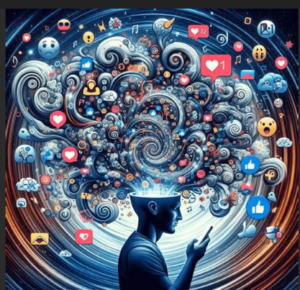
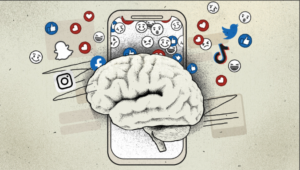
Digital Burnout: How Social Media Affects the Brain

Social media is part of everyday life. It keeps us informed, connected, and entertained. Although it offers many benefits, it also affects the brain in ways that many people do not fully understand. As screen time increases, a new problem has become common: digital burnout.

Digital burnout is a state of mental and emotional exhaustion caused by constant online activity. It develops gradually but affects focus, energy, and mental health in a major way. In this article, we explore how social media shapes the brain, why digital burnout happens, and what you can do to protect your well-being.

What Is Digital Burnout?

Digital burnout is more than simple tiredness. It is a deeper exhaustion linked to overstimulation from screens, notifications, messaging, and endless content. When the brain receives too much information, it becomes overwhelmed. As a result, daily tasks feel harder, motivation decreases, and emotional balance becomes unstable.

Unlike traditional burnout, digital burnout can appear even in people who enjoy using social media. This happens because the brain struggles to process the constant flow of posts, comments, and alerts.

Why Social Media Overloads the Brain

Social media affects the brain on a biological level. It changes reward pathways, emotional processing, stress responses, and attention systems. To understand digital burnout, we must understand these changes.

1. Dopamine Overload

Dopamine is the brain’s “reward chemical.” It increases when we receive:

  • Likes

  • Shares

  • Messages

  • Comments

  • Notifications

Each alert gives a tiny reward. Over time, the brain gets used to it and craves more. As a result, people check their phones more often and scroll without intention.

However, when dopamine spikes too often, the reward system becomes tired. This leads to:

  • Low motivation

  • Emotional dullness

  • Restlessness

  • Difficulty enjoying offline activities

This pattern is one of the first stages of digital burnout.

2. Decision Fatigue

Every swipe presents hundreds of choices:

  • What to watch

  • Whom to follow

  • What to like

  • What to comment

Even small decisions use mental energy. When the brain makes countless micro-decisions every minute, it eventually becomes fatigued. Therefore, people feel mentally drained even after “relaxing” online.

3. Hyperstimulation

Social media platforms are fast, colorful, and nonstop. They overload the senses through:

  • Rapid videos

  • Bright colors

  • Loud audio

  • Flashy transitions

As a result, the brain adapts to high stimulation. However, daily tasks like studying, reading, or working feel boring. This reduces attention span and makes it harder to stay focused.

4. Emotional Contagion

Social media spreads emotions quickly. If we see anger, fear, sadness, or excitement online, our brains mirror those emotions. While this helps with empathy, it also increases stress.

In addition, scrolling exposes us to:

  • Bad news

  • Conflicts

  • Fake perfection

  • Comparison

  • Online pressure

Over time, emotional overload leads to fatigue and anxiety.

Symptoms of Digital Burnout

Digital burnout affects the mind and body. Symptoms can be subtle at first, but they become stronger when ignored.

1. Constant Tiredness

Even after sleeping well, the mind feels heavy. This happens because the brain does not get enough offline rest.

2. Reduced Attention Span

People find it difficult to read long texts or stay focused on a task. Quick, fast-paced content trains the brain to expect instant stimulation.

3. Irritability

Small things feel overwhelming. Mood becomes unstable. Stress responses activate more quickly.

4. Loss of Motivation

Activities that once felt enjoyable may seem boring. The brain becomes less sensitive to normal rewards.

5. Sleep Disturbances

Late-night scrolling delays melatonin release. This makes it harder to fall asleep and lowers sleep quality.

6. Emotional Exhaustion

Exposure to constant news, opinions, arguments, and comparison drains emotional energy.

7. Physical Discomfort

Digital burnout can also cause:

  • Headaches

  • Eye strain

  • Neck pain

  • Body tension

These symptoms develop slowly but worsen over time.

How Social Media Affects Different Parts of the Brain

Social media does not impact one single area. Instead, it influences multiple brain systems.

1. Prefrontal Cortex: Decision-Making

The prefrontal cortex helps with:

  • Focus

  • Self-control

  • Planning

  • Impulse regulation

Excessive scrolling weakens these functions. As a result, people struggle with discipline and get distracted easily.

2. Amygdala: Emotion Processing

The amygdala reacts to emotional content. Exposure to intense videos or negative news triggers it more frequently. Therefore, people feel anxious or stressed even without real danger.

3. Hippocampus: Memory

The hippocampus helps form long-term memories. Because social media offers rapid content, the brain does not store everything properly. This affects memory retention and learning.

4. Reward Circuit: Motivation

Social media designs notifications to trigger dopamine. While this feels good initially, long-term exposure reduces motivation for real-life activities.

Why Digital Burnout Happens Faster Today

Digital burnout has existed for years, but it has become more common recently.

1. Increased Screen Time

Most people spend hours online every day. The more time spent scrolling, the faster the brain becomes overwhelmed.

2. Short-Form Videos

Platforms like TikTok, Instagram Reels, and YouTube Shorts push the brain into rapid stimulation mode. This creates a cycle of constant craving and exhaustion.

3. FOMO (Fear of Missing Out)

People feel pressure to stay updated, respond quickly, and maintain online presence. This increases anxiety.

4. Online Comparison

Seeing others’ achievements, beauty, or success creates insecurity. Consequently, self-worth drops, causing emotional strain.

5. Lack of Digital Boundaries

The phone is always nearby. Notifications interrupt sleep, meals, conversations, and work. Without boundaries, burnout grows quickly.

How to Prevent and Manage Digital Burnout

Fortunately, digital burnout is reversible. With healthy digital habits, the brain can recover and restore balance.

Below are practical, science-backed strategies.

1. Set Screen Time Limits

Reducing exposure is the first step. You can start with:

  • 2-hour daily limit

  • No-phone zones

  • App usage limits

Even small reductions improve mental clarity.

2. Schedule Social Media Breaks

Instead of scrolling throughout the day, choose specific times:

  • Morning

  • Lunch break

  • Evening

This prevents constant dopamine spikes.

3. Create a Nighttime Digital Detox

Sleep improves when screens are avoided at least one hour before bed. Use this time for:

  • Reading

  • Journaling

  • Stretching

  • Meditation

Rest helps the brain recover from overstimulation.

4. Turn Off Non-Essential Notifications

Notifications are one of the biggest triggers of digital burnout. By turning them off, the brain receives fewer interruptions and feels calmer.

5. Practice Mindfulness

Mindfulness reduces stress and improves attention.

Try:

  • Deep breathing

  • Body scanning

  • Grounding exercises

  • Guided meditation

Even 5 minutes a day builds emotional balance.

6. Take Regular Offline Breaks

Spend time doing activities that do not involve screens, such as:

  • Walking

  • Cooking

  • Playing with pets

  • Gardening

These activities recharge the mind and reduce burnout.

7. Reduce Online Comparison

Follow inspiring or educational accounts instead of unrealistic content. If certain profiles make you feel insecure, unfollow or mute them.

8. Engage in Slow Activities

Because the brain gets used to fast content, slow activities help restore focus. Examples include:

  • Painting

  • Knitting

  • Reading books

  • Journaling

  • Listening to calm music

These activities train the mind to slow down.

9. Improve Sleep Hygiene

Good sleep reduces stress and prevents burnout. Try:

  • Keeping a consistent schedule

  • Sleeping in a dark room

  • Avoiding caffeine at night

  • Using blue-light filters

The better the sleep, the stronger the brain.

10. Seek Professional Support

If digital burnout affects mental health, therapy can help. A therapist teaches coping strategies, emotional regulation skills, and healthier screen habits.

Long-Term Effects of Digital Burnout

If ignored, digital burnout can lead to:

  • Chronic anxiety

  • Depression

  • Memory problems

  • Difficulty concentrating

  • Low self-esteem

  • Reduced productivity

  • Emotional numbness

However, with early intervention, recovery is possible.

Healthy Digital Habits for a Balanced Life

Here are habits that support long-term digital wellness:

  • Choose quality content over quantity

  • Spend time with friends offline

  • Keep your phone away during meals

  • Practice hobbies that bring joy

  • Set boundaries with work messages

  • Take weekly digital detox days

These habits protect mental energy and improve overall well-being.

Conclusion

Digital burnout is becoming more common in a world where social media dominates daily life. Social platforms offer connection and entertainment, but they also overwhelm the brain with constant stimulation. By understanding the brain’s limits and adopting healthy digital habits, anyone can protect their mental health.

A balanced approach—not complete disconnection—is the key. With awareness, boundaries, and mindful habits, you can enjoy social media without letting it damage your well-being.

Reference


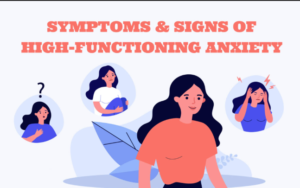
Silent Symptoms of High-Functioning Anxiety: The Hidden Struggles Behind Success

In today’s fast-paced world, many people appear confident, productive, and highly organized—but behind the scenes, they may be silently fighting high-functioning anxiety. Unlike typical anxiety, where symptoms are visible, high-functioning anxiety hides behind perfectionism, overworking, people-pleasing, and constant internal pressure.

These individuals look successful on the outside, but internally they experience worry, tension, fear of failure, and self-doubt. Because they function well, their struggles often go unnoticed—even by themselves.

This article explores the silent symptoms that often stay hidden beneath a calm and composed exterior.

1. Overthinking Everything — Even Small Decisions

People with high-functioning anxiety often feel mentally “busy” all the time. They overthink:

  • Messages they send

  • Mistakes from the past

  • Future possibilities

  • What others think of them

Even simple decisions—like choosing clothes or replying to a text—can become mentally exhausting. This pattern is driven by a constant fear of making the “wrong” choice.

2. Constant Need to Stay Busy

They keep themselves occupied to avoid facing uncomfortable emotions.
If they stop working, thoughts creep in. So they:

  • Take on extra tasks

  • Work beyond office hours

  • Always plan ahead

  • Struggle to sit still

Busyness becomes a coping mechanism, hiding deeper anxiety.

3. Difficulty Saying “No”

High-functioning anxiety often leads to people-pleasing.
These individuals say “yes” to avoid:

  • Disappointing others

  • Conflict or criticism

  • Feeling guilty

  • Being judged

As a result, they overload themselves and silently suffer through burnout.

4. Perfectionism That Feels Like Survival

Perfectionism isn’t just a preference—it feels necessary.
They may think:

  • “If I’m not perfect, I’ll fail.”

  • “I need to prove my worth.”

  • “Mistakes mean I’m not good enough.”

This leads to:

  • Over-preparing

  • Double-checking work

  • Avoiding risks

  • Excessive self-criticism

Perfectionism becomes a masked form of anxiety.

5. Fear of Failure Despite Success

Even when they achieve big milestones, individuals with high-functioning anxiety often doubt themselves.

They may think:

  • “What if I can’t maintain this?”

  • “What if people find out I’m not good enough?”

They experience imposter syndrome, constantly questioning their abilities despite evidence of success.

6. Trouble Relaxing or “Switching Off”

Their mind is always running.
Even during:

  • Vacations

  • Weekends

  • Breaks

  • Downtime

They feel guilty for not being productive. Relaxing feels uncomfortable because it creates space for anxious thoughts.

7. Physical Symptoms That Don’t Look Like Anxiety

Their anxiety shows physically but subtly:

  • Muscle tension

  • Jaw clenching

  • Fatigue

  • Headaches

  • Stomach discomfort

  • Restlessness

Often, they blame lifestyle or stress—not anxiety.

8. Difficulty Sleeping

Because their mind never shuts down, sleep becomes difficult.
Common patterns:

  • Trouble falling asleep

  • Waking up multiple times

  • Early morning anxiety

  • Racing thoughts at night

Despite appearing energetic, many live with chronic sleep deprivation.

9. Being Highly Self-Critical

They may seem confident, but internally they battle:

  • Harsh self-talk

  • Fear of disappointing others

  • Comparing themselves to everyone

  • Believing they are “not enough”

This silent self-criticism drains emotional energy.

10. Hiding Emotions Behind Humor or Positivity

Many mask anxiety with:

  • Sarcasm

  • Humor

  • Smiling

  • Being overly cheerful

They avoid sharing struggles because they don’t want to burden others or seem “weak.”

Why High-Functioning Anxiety Goes Unnoticed

Because these individuals perform well, they often receive praise like:

  • “You’re so disciplined.”

  • “You’re always on top of things.”

  • “You’re such a perfectionist!”

But these “strengths” are actually coping mechanisms for anxiety.
People assume they’re fine, so their struggles stay invisible.


How to Manage High-Functioning Anxiety

Here are evidence-based strategies:

Managing high-functioning anxiety is possible with consistent practice, self-awareness, and the right tools. Below are expanded explanations of each strategy to help readers understand how and why these techniques work.

✔ 1. Cognitive Behavioral Therapy (CBT)

CBT is one of the most effective, research-backed treatments for anxiety disorders. It helps individuals identify negative thought patterns, challenge irrational fears, and replace them with healthier, balanced thinking.

How CBT Helps:

  • Breaks the cycle of overthinking

  • Reduces catastrophizing (“worst-case scenario” thinking)

  • Improves emotional regulation

  • Teaches practical coping strategies

  • Builds long-term resilience

CBT helps you step back from thoughts like:
“People will judge me,” “I might fail,” or “I’m not good enough”
… and replace them with more realistic interpretations.

✔ 2. Mindfulness & Grounding Practices

Mindfulness teaches you to stay in the present moment—reducing worry about the past or future. Grounding techniques help calm the nervous system and reduce physical symptoms of anxiety.

Effective Practices Include:

  • Deep breathing exercises

  • Body scan meditation

  • Sensory grounding (5-4-3-2-1 technique)

  • Mindful walking

  • Progressive muscle relaxation

These methods relax the body, lower cortisol levels, and help break the “fight or flight” response.

✔ 3. Setting Healthy Boundaries

High-functioning anxiety often leads to people-pleasing and overcommitting. Setting boundaries is essential to protect mental energy and reduce emotional burnout.

What Healthy Boundaries Look Like:

  • Saying “no” without guilt

  • Limiting availability outside work hours

  • Delegating tasks instead of doing everything alone

  • Prioritizing your mental health over others’ expectations

  • Speaking up when something feels overwhelming

Boundaries help you conserve energy and maintain emotional balance.

✔ 4. Journaling

Journaling is a powerful tool for processing emotions and reducing anxiety. It helps declutter the mind and provides space to reflect without judgment.

Types of Journaling That Help Anxiety:

  • Thought dump journaling: Writing whatever comes to mind

  • Gratitude journaling: Noting positive moments

  • Cognitive journaling: Challenging negative thoughts

  • Stress journaling: Identifying triggers and patterns

Journaling offers emotional release and creates self-awareness around anxiety triggers.

✔ 5. Limiting Over-Commitment

High-functioning anxiety often pushes people to take on more than they can handle. Limiting commitments allows you to work at your true capacity—not your anxious expectations.

How to Practice This:

  • Prioritize essential tasks

  • Break big tasks into smaller steps

  • Stop striving for perfection in every task

  • Learn to rest without guilt

  • Use digital planners to track workload

Choosing tasks based on capacity, not fear or pressure, prevents burnout and increases productivity.

✔ 6. Therapy or Counseling

Talking to a trained mental health professional provides a safe space to explore fears, learn coping skills, and understand the root cause of anxiety.

Benefits of Therapy for High-Functioning Anxiety:

  • Helps challenge internalized pressure and self-criticism

  • Provides personalized strategies

  • Improves emotional awareness

  • Supports long-term mental well-being

  • Helps break the cycle of perfectionism and avoidance

Therapy offers guidance, validation, and structure—especially for those who appear “strong” but struggle internally.

✔ 7. Lifestyle Changes

Lifestyle influences mental health more than we often realize. Small, consistent habits support nervous system regulation and reduce anxiety symptoms.

🟣 Regular Sleep

Lack of sleep intensifies irritability, overthinking, and stress.
Aim for 7–9 hours with a consistent sleep routine.

🟣 Balanced Diet

Foods rich in omega-3, magnesium, and whole grains support brain health.
Avoid heavy sugar and processed foods that trigger energy crashes.

🟣 Reducing Caffeine

High caffeine increases heart rate and mimics anxiety symptoms.
Limit intake or switch to:

  • Herbal tea

  • Decaffeinated coffee

  • Warm lemon water

🟣 Physical Activity

Exercise releases endorphins and reduces tension.
Even 20–30 minutes of:

  • Walking

  • Yoga

  • Stretching

  • Dancing
    can significantly lower anxiety levels.

These habits strengthen the body’s ability to handle stress and improve overall mental resilience.

When to Seek Help

Seek professional support if:

  • Anxiety affects daily functioning

  • You feel overwhelmed

  • Your relationships suffer

  • You cannot relax

  • Perfectionism controls your life

  • You constantly feel “not enough”

Early intervention helps prevent burnout and emotional exhaustion.

Conclusion

High-functioning anxiety is often invisible, hidden behind success, productivity, and a calm exterior. People experiencing it show up, perform well, and look in control—but internally, they carry constant pressure and worry.

By recognizing the silent symptoms, we can better understand ourselves and support others.
Remember: seeking help is not a sign of weakness—it’s a step toward emotional freedom and healthier wellbeing.

Reference

AI-Powered Productivity Hacks for 2025: The Smart Guide to Working Faster & Better

Artificial Intelligence is no longer a future concept—it’s the engine that powers our daily productivity. In 2025, AI has become more intelligent, context-aware, and integrated into almost every digital workflow. Whether you’re a student, content creator, entrepreneur, therapist, or business owner, AI tools can save hours of repetitive work, boost creativity, and provide lightning-fast solutions.

  1. Why AI Productivity Matters in 2025

The digital world is changing fast. Workloads are increasing, competition is higher, and attention spans are shrinking. In this environment, productivity is not just about working hard—it’s about working smart.

AI unlocks these benefits:

  • Automates repetitive tasks

  • Speeds up decision-making

  • Enhances creativity

  • Reduces mental load

  • Improves workflow accuracy

  • Saves time and money

  • Offers personalized recommendations

  • Helps manage information overload

In 2025, AI is not something “extra.” It has become a necessity to stay relevant and efficient.

  1. AI as Your Personal Assistant: Smart Scheduling & Automation

AI-powered personal assistants have reached a new level. They not only remind you of tasks but also understand priorities, detect patterns, and offer suggestions.

Top AI Scheduling Hacks:

a) AI-Based Calendar Optimization

Tools like Reclaim AI, Motion, and Google Gemini automatically:

  • Place tasks into free calendar slots

  • Prioritize deadlines

  • Adjust schedules dynamically

  • Reduce time conflicts

  • Spread workload evenly

b) Smart Reminders

AI now reminds you based on:

  • Location

  • Behavior

  • Previous habits

  • Project patterns

Example: If you usually answer emails at 10 AM, AI will remind you at the right moment.

c) Automating Routine Workflows

AI assistants can:

  • Send follow-up emails

  • Schedule meetings

  • Summarize discussions

  • Draft responses

  • Update project boards

This removes 20–30% of daily low-level work.

  1. AI-Powered Content Creation: Writing, Editing & Research

For bloggers, psychologists, educators, and digital creators, AI has become the ultimate productivity enhancer.

a) Writing Faster With AI

AI tools help generate:

  • Blog posts

  • Scripts

  • Captions

  • Email newsletters

  • Reports

  • Social media posts

Apps like ChatGPT 5.1, Jasper, Writesonic, and Copy.ai make writing 10× faster.

b) AI-Assisted Editing

AI tools improve your:

  • Grammar

  • Tone

  • Clarity

  • SEO score

  • Structure

  • Readability

Tools: Grammarly, Wordtune, Hemingway AI

c) AI for Research

No more spending hours searching Google.

Now AI can:

  • Summarize long PDFs

  • Extract important points

  • Compare research findings

  • Generate citations

  • Analyze patterns

Tools: ChatGPT Advanced Data Analysis, Perplexity AI, Scholar AI

d) Content Repurposing with AI

Turn one blog into:

  • Reels

  • Carousels

  • Tweets

  • YouTube script

  • Newsletter

  • Infographic

AI reduces content workload by 70%.

  1. AI for Email & Communication Automation

Emails consume too much time. 2025 AI tools write, reply, organize, and prioritize messages automatically.

a) AI Email Drafting

These tools write professional emails in seconds:

  • Superhuman AI

  • Gmail AI Compose

  • Spark AI

You can choose tone:

  • Formal

  • Friendly

  • Short

  • Detailed

b) AI Auto-Replies

AI replies based on previous conversations and patterns.

Example:
If you frequently send onboarding info, AI will respond instantly.

c) Inbox Prioritization

AI filters emails into:

  • Urgent

  • Important

  • Promotional

  • Low priority

This saves 1–2 hours daily.

  1. AI Automation to Replace Manual Work (No Code Needed)

2025 is the era of no-code automation. Anyone—even non-tech users—can automate workflows.

a) Zapier AI & Make.com AI

These tools automate:

  • Lead collection

  • Data entry

  • File organization

  • Social media posting

  • Form responses

  • CRM updates

Example workflow:

  • When a client fills a form, AI:
    → Saves data to Google Sheets
    → Sends welcome email
    → Adds contact to WhatsApp list
    → Schedules consultation

b) AI Document Automation

AI tools create:

  • Invoices

  • Certificates

  • Reports

  • Contracts

Automatically, based on your template.

c) AI Task Automation for Therapists & Counselors

Example (for your field):
When a new client signs up, AI can auto-generate:

  • Case summary

  • Consent forms

  • First-session questionnaire

  • Progress notes

Huge time saver for mental health professionals.

  1. AI for Learning Faster: Micro-Learning & Personalized Study Plans

AI tools personalize learning based on:

  • Pace

  • Strengths

  • Weaknesses

  • Learning style

Top AI Learning Hacks

  • AI flashcards

  • Auto summaries

  • Mind maps

  • Interactive quizzes

  • Practice Q&A

  • Visual explanations

Tools: Khanmigo, Notion AI, Quizlet AI, ChatGPT Learning Mode

AI reduces study time by 40–50%.

  1. AI for Focus & Mental Clarity

Productivity isn’t only about speed—it’s also about mental clarity.

AI helps manage:

  • Distractions

  • Screen time

  • Stress

  • Work overload

Tools like:

  • Freedom AI → Blocks distracting apps

  • Brain.fm AI → Focus music

  • Calm AI Coach → Stress management

  • NotionAI → Organized workspace

  • Motion AI → Task batching for focus time

AI-Based Pomodoro Sessions

AI analyzes your focus rhythm and creates personalized intervals:

  • 25 min work

  • 5 min rest

  • Brain breaks

  • Deep-work blocks

  1. AI Tools for Business Owners & Entrepreneurs

2025 is the best time to run a business with AI assistance.

a) AI for Marketing

AI handles:

  • Keyword research

  • SEO optimization

  • Social media planning

  • Competitor analysis

  • Ad optimization

  • Audience insights

Tools:
Surfer AI, Semrush AI, HubSpot AI, Hootsuite AI, Meta Ads AI

b) AI for Customer Support

AI chatbots can answer:

  • FAQs

  • Payment inquiries

  • Appointment requests

  • Basic counseling queries (screening only)

  • Product info

Example tools: Intercom AI, Tidio AI, Drift AI

c) AI for Business Analytics

AI dashboards show:

  • Traffic trends

  • Sales prediction

  • Customer behavior

  • Retention rate

Tools: Tableau AI, Looker, Power BI AI

  1. AI Tools for Therapists, Counselors & Psychologists (Highly Relevant to You)

Since you are a mental health practitioner, these AI productivity hacks are especially useful:

a) Session Documentation Automation

AI generates:

  • Clinical notes

  • SOAP notes

  • Treatment plans

Tools: Scribe AI, HealthGPT tools

b) AI-Based Psychoeducation Content

Generate:

  • Slides

  • Worksheets

  • Handouts

  • Self-help guides

Perfect for your YouTube channel SelfBloom Counselling Hub and your brand NiramayaSoul.

c) AI Appointment & Follow-Up Automation

AI sends:

  • Reminders

  • Homework tasks

  • Daily check-ins

This increases client engagement.

AI for Financial Productivity

AI tools help track:

  • Expenses

  • Bills

  • Income

  • Taxes

  • Investment patterns

Tools:
Monarch Money AI, Copilot Money, Mint AI 2025

You get automated budgeting and smart suggestions.

  1. AI for Health, Fitness & Wellbeing

Productivity also depends on health.

AI improves:

  • Sleep monitoring

  • Meal planning

  • Exercise design

  • Stress management

Tools:
Fitbit AI Coach, Apple Health AI, Zero AI, MyFitnessPal AI

AI-generated routines keep your energy high.

  1. AI for Project Management & Team Productivity

AI has upgraded platforms like:

  • Trello AI

  • Asana AI

  • Notion AI

  • ClickUp AI

  • Monday.com AI

AI helps by:

  • Auto-assigning tasks

  • Predicting bottlenecks

  • Suggesting deadlines

  • Summarizing meetings

  • Creating project timelines

Teams complete projects 30–40% faster.

  1. AI for File Management & Knowledge Organization

AI automatically organizes:

  • Documents

  • Images

  • Notes

  • Chat logs

  • PDFs

Tools:
Notion AI, Evernote AI, Microsoft 365 AI Copilot

Search becomes instantaneous—no more hunting for lost files.

  1. AI for Creative Work: Design, Video & Audio

Creativity is no longer slow.

AI for Design:

  • Canva AI

  • Adobe Firefly

  • Midjourney

  • DALL·E 4

  • Figma AI

Designs that used to take hours now take minutes.

AI for Video Editing:

Tools auto:

  • Cut clips

  • Add subtitles

  • Remove noise

  • Create reels

  • Add transitions

Apps: Descript AI, Kapwing AI, Runway ML

AI for Audio:

  • Noise removal

  • Voice enhancement

  • Music generation

Perfect for your therapy YouTube content.

15. AI-Powered Personal Knowledge Management (PKM)

2025 PKM systems are powered by AI:

  • Generate summaries

  • Link related notes

  • Build idea maps

  • Detect themes

  • Create outlines

Tools: Obsidian AI, Notion AI, Mem AI

PKM helps store your learning permanently.

16. Building an AI-Optimized Workflow (Step-by-Step)

Here’s how to create a full AI-powered productivity ecosystem:

✔ Step 1: Identify repetitive tasks

Make a list of tasks you do every day or week.

✔ Step 2: Apply automation

Use:

  • Zapier

  • Make.com

  • Google Workspace AI

  • Notion AI

✔ Step 3: Use AI for planning

Let smart calendars schedule your work.

✔ Step 4: Use AI for writing & communication

Draft emails, reports, blogs, and scripts with AI.

✔ Step 5: Use AI for focus

Install distraction blockers, brain-music apps, and Pomodoro tools.

✔ Step 6: Integrate organization tools

Use Notion AI, Evernote AI, and file-auto-taggers.

✔ Step 7: Review weekly

AI will give you productivity insights weekly.

17. Ethical Use of AI (A Must for 2025)

AI is powerful, but must be used responsibly.

Follow these ethical rules:

  • Always verify AI-generated content

  • Avoid sharing confidential client data

  • Use AI only as a helper, not a replacement

  • Maintain human empathy in counseling

  • Follow professional guidelines and privacy laws

18. Future of AI Productivity: What to Expect After 2025

AI will soon:

  • Anticipate needs even before you ask

  • Predict work patterns

  • Offer personalized emotional support

  • Automate entire workflows end-to-end

  • Become fully voice-integrated

AI is becoming the most powerful productivity partner humans have ever had.

Internal Link Suggestions (Use on Your Website):

  • “Benefits of AI in Mental Health Therapy”

  • “How to Use AI Tools for Content Creation in 2025”

  • “Best Productivity Apps for Students & Professionals”

  • “How AI Improves Emotional Regulation Skills”

External Link Suggestions:

  • Zapier → zapier.com

  • Notion → notion.so

  • Reclaim AI → reclaim.ai

  • Motion → usemotion.com

  • Grammarly → grammarly.com

  • Descript → descript.com

Conclusion

2025 is the year where AI becomes your smartest partner in life, work, and creativity. Whether you want to write faster, organize your workload, manage clients, create content, or boost mental clarity—AI tools can transform your productivity.

Implement these hacks, and you will save hours every day, reduce stress, and upgrade your workflow like never before.

Reference

DBT Skills for Emotional Regulation

Introduction

Emotions play a powerful role in our daily lives. They influence how we think, behave, make decisions, and connect with others. But for many people, emotions can sometimes feel overwhelming. Small triggers can turn into big reactions, mood swings may feel uncontrollable, and relationships can suffer because of intense emotional responses.
To help people manage this effectively, psychologist Marsha Linehan developed Dialectical Behavior Therapy (DBT)—a therapy system designed to help individuals regulate emotions, reduce impulsive behaviors, and build healthier coping skills.

This comprehensive guide explores DBT skills for emotional regulation, explaining the concepts in simple language with real-life examples, step-by-step techniques, and actionable strategies. Whether you’re a student, practitioner, parent, or someone wanting to improve your emotional health, this article will give you a deep and useful understanding.

What Is DBT?

Dialectical Behavior Therapy (DBT) is a type of cognitive-behavioral therapy designed to help individuals who experience intense emotions.
The term “dialectical” means bringing together two seemingly opposite ideas—acceptance and change.

DBT teaches that:

  • You can accept your emotions as they are,
    and at the same time

  • You can learn skills to change your reactions to these emotions.

DBT has four major skill modules:

  1. Mindfulness

  2. Distress Tolerance

  3. Emotional Regulation

  4. Interpersonal Effectiveness

This article focuses specifically on Emotional Regulation Skills.

Why Emotional Regulation Is Important

Emotional regulation means the ability to:

  • understand your emotions

  • name them correctly

  • manage them effectively

  • reduce emotional vulnerability

  • respond instead of reacting

When emotional regulation is weak, people often experience:

  • mood swings

  • impulsive decisions

  • anger outbursts

  • anxiety or depression

  • unhealthy coping (self-harm, addiction, withdrawal)

  • relationship conflicts

DBT provides practical tools to manage all of these.

Understanding Emotions Through DBT

Before learning the skills, DBT focuses on understanding why emotions occur and what purpose they serve.

1. Emotions Give Us Information

Fear warns us of danger.
Anger tells us boundaries are crossed.
Sadness signals loss.

2. Emotions Motivate Action

Fear → run or protect
Anger → defend
Love → connect

3. Emotions Connect Us to Others

Shared feelings build empathy, bonding, and communication.

However, emotional problems arise when:

  • emotions are too intense

  • they last too long

  • they lead to harmful behaviors

  • they are misunderstood

This is where DBT emotional regulation skills become important.

Key DBT Skills for Emotional Regulation

DBT offers several practical emotional regulation strategies. Here are the major ones, explained in detail.

1. Identify and Label Emotions

You cannot regulate emotions you cannot identify. Many people use vague terms like “bad,” “stressed,” or “upset.” DBT teaches clear emotional labeling.

Primary Emotions Include:

  • anger

  • fear

  • sadness

  • joy

  • guilt

  • shame

  • disgust

  • love

Steps to Identify Emotions:

  1. Notice physical sensations
    (heart racing, tight chest, sweaty palms)

  2. Observe your thoughts
    (“They don’t care about me,” “I’m in danger”)

  3. Identify the trigger

  4. Name the emotion accurately
    “I feel angry.”
    “I feel hurt.”
    “I feel anxious.”

Why This Helps:

When you name the emotion, the brain becomes calmer. This is known as “name it to tame it.”

2. Reduce Emotional Vulnerability: The ABC PLEASE Skills

DBT teaches that emotional regulation becomes easier when your body and life are in balance.

The acronym ABC PLEASE stands for:

A — Accumulate Positive Experiences

Do small things daily that bring joy:

  • walking

  • listening to music

  • spending time with friends

  • cooking

  • reading

  • hobbies

Small doses of daily positivity make the brain more resilient.

B — Build Mastery

Do something daily that makes you feel competent:

  • completing tasks

  • learning a skill

  • small achievements

This reduces helplessness and increases confidence.

C — Cope Ahead

Prepare yourself mentally for difficult situations.
Ask:
“What challenges might come up?”
“How will I handle them?”

This reduces impulsive reactions.

PLEASE Skills (Taking Care of the Body)

These skills reduce emotional vulnerability by taking care of your physical health.

P — Physical Illness

Treat health issues. Don’t ignore symptoms.

L — Balanced Eating

Avoid overeating, undereating, or emotional eating.

E — Avoid Mood-Altering Substances

Reduce alcohol, drugs, or excessive caffeine.

A — Balanced Sleep

Maintain proper sleep hygiene.

S — Exercise

Movement reduces stress hormones and regulates emotions.

When the body is healthy, emotions become easier to manage.

3. Opposite Action: Changing Emotions by Changing Behavior

This is one of the strongest emotional regulation skills.

When your emotion does not fit the facts or is too intense, you do the opposite of what the emotion urges you to do.

Examples:

Emotion: Fear

Urge: Avoid
Opposite Action: Approach gradually

Emotion: Anger

Urge: Attack or shout
Opposite Action: Speak calmly, walk away

Emotion: Sadness

Urge: Isolate
Opposite Action: Reach out, move, engage in activity

Emotion: Shame

Urge: Hide
Opposite Action: Make eye contact, speak openly

Why This Works:

Behavior sends signals to the brain. When you act differently, emotions change automatically.

4. Check the Facts

Many emotional reactions are based on assumptions, not facts. DBT teaches a structured way to examine whether the emotion fits the situation.

Steps:

  1. Identify the emotion

  2. Identify the trigger

  3. Ask: “What are the facts?”

  4. Check for assumptions or distortions

  5. Ask: “Does my emotion fit the facts?”

If yes, use problem-solving.
If no, use opposite action.

Example:

Emotion: Anger
Thought: “They ignored me purposely.”
Facts: They were busy in a meeting.
Better Response: Calm communication.

5. Mindfulness for Emotional Awareness

Mindfulness is the foundation of DBT. It teaches you to observe your emotions without judging them.

DBT Mindfulness Skills Include:

Observe

Notice emotions without reacting:
“I feel tightness in my chest.”

Describe

Put words to the experience:
“This is anxiety.”

Participate

Engage fully in the moment without avoiding.

Non-Judgmentally

Do not label emotions as “good” or “bad.”

One-Mindfully

Focus on one thing at a time.

Effectively

Do what works, not what feels comfortable.

Mindfulness stops emotional spirals before they intensify.

6. Build Positive Experiences (Short-Term & Long-Term)

Positive emotions balance negative ones.

Short-Term Positive Experiences:

  • watching a movie

  • talking to a friend

  • enjoying food

  • playing with pets

  • listening to music

Long-Term Positive Experiences:

  • building a career

  • maintaining relationships

  • learning long-term skills

  • personal goals

  • self-development

DBT encourages creating a “positive emotional bank.”

7. Reduce Emotional Intensity with the Wave Skill

Also known as “Ride the Wave.”

Emotions are like waves—if you don’t fight them, they rise and fall naturally.

Steps:

  1. Notice the emotion

  2. Allow it to rise

  3. Observe without reacting

  4. Allow it to fall

  5. Let it pass naturally

This helps prevent:

  • suppression

  • impulsive reactions

  • emotional overload

8. Use the PLEASE Skill for Preventing Emotional Spirals

As explained earlier, taking care of physical health reduces vulnerability.

Emotional dysregulation is more likely when you are:

  • tired

  • hungry

  • sick

  • dehydrated

  • stressed

  • not exercising

Simple self-care strengthens emotional resilience.

9. Improve the Moment (IMPROVE Skill)

When emotions are too intense, DBT offers the IMPROVE technique:

I — Imagery

Imagine calming scenes.

M — Meaning

Find purpose in pain.

P — Prayer

Connect to something larger (spiritual or moral).

R — Relaxation

Breathing, meditation, body relaxation.

O — One thing in the moment

Stay grounded.

V — Vacation

Take a short break.

E — Encouragement

Be kind to yourself.

This skill is very effective during emotional surges.

10. Problem Solving

When your emotion fits the facts, solve the problem instead of fighting the emotion.

Steps:

  1. Define the problem clearly

  2. Brainstorm solutions

  3. Evaluate pros and cons

  4. Choose the best option

  5. Apply the solution

  6. Review the outcome

This skill reduces helplessness and increases confidence.

Real-Life Examples of DBT Skills in Emotional Regulation

Example 1: Anger in Relationships

Situation: Partner doesn’t reply for hours.
Emotion: Anger → “They don’t care.”

DBT Skills Used:
✔ Check the facts
✔ Opposite action
✔ Mindfulness

Result: Calm communication instead of impulsive reaction.

Example 2: Anxiety Before Exams

Emotion: Fear → urge to avoid studying
DBT Skill: Opposite action → Start studying for 10 minutes

Outcome: Reduced anxiety, increased control.

Example 3: Depression After a Loss

Emotion: Sadness → urge to isolate
DBT Skills:
✔ Build positive experiences
✔ Wave skill
✔ PLEASE skill

Outcome: Gradual improvement in mood.

Example 4: Emotional Overwhelm

Emotion: Panic
Skills:
✔ IMPROVE technique
✔ Mindfulness
✔ Breathing

Outcome: Emotion reduces instead of escalating.

Benefits of DBT Emotional Regulation Skills

✔ Reduces emotional intensity

✔ Prevents impulsive behaviors

✔ Improves stress tolerance

✔ Strengthens problem-solving

✔ Heals relationship conflicts

✔ Builds long-term resilience

✔ Helps with anxiety, depression, BPD, anger

✔ Enhances mindfulness and self-awareness

✔ Improves communication and self-control

DBT is effective for people of all age groups.

Who Can Benefit from DBT Emotional Regulation?

DBT is especially helpful for individuals who experience:

  • Borderline Personality Disorder (BPD)

  • Emotional dysregulation

  • Anger issues

  • Anxiety and panic

  • Depression

  • Trauma responses

  • Bipolar mood fluctuations

  • Impulse control problems

  • Self-harm tendencies

  • Addiction

But even people without a diagnosis can benefit from DBT.

How DBT Emotional Regulation Works in Therapy

A typical DBT session includes:

  • reviewing weekly diary cards

  • analyzing patterns of emotional behavior

  • learning new skills

  • practicing real-life application

  • building long-term habits

  • role-playing

  • homework assignments

  • ongoing support

Therapists help clients integrate skills in daily life, not only in sessions.

How to Practice DBT Emotional Regulation on Your Own

✔ Keep a daily mood diary

✔ Identify triggers

✔ Practice mindfulness daily

✔ Use opposite action when emotions rise

✔ Observe emotions without reacting

✔ Build positive experiences

✔ Practice PLEASE skills

✔ Learn problem-solving strategies

✔ Take breaks when overwhelmed

Daily small steps create long-term change.

Common Mistakes People Make

✘ Fighting emotions instead of accepting them

✘ Waiting for motivation

✘ Using unhealthy coping (avoidance, anger, addiction)

✘ Skipping mindfulness

✘ Ignoring physical health

Awareness helps improve skill use.

Conclusion

DBT emotional regulation skills provide a powerful, practical framework for understanding and managing emotions. These tools teach us how to stay balanced, reduce emotional intensity, prevent impulsive reactions, and build emotional resilience.

By learning skills such as:

  • identifying emotions

  • opposite action

  • mindfulness

  • ABC PLEASE

  • checking the facts

  • the wave skill

  • improve the moment

  • problem solving

… anyone can transform how they respond to life’s challenges.

DBT doesn’t promise a life free of pain—but it helps us respond skillfully to pain. With consistent practice, these skills bring emotional clarity, stability, confidence, and healthier relationships.

Reference

What Is CBT? A Simple Guide for Everyone

Introduction

In today’s fast-moving world, stress, anxiety, and emotional struggles often feel unavoidable. Many people want practical ways to manage their thoughts and emotions without feeling overwhelmed. One of the most widely used and evidence-based psychological therapies in the world is Cognitive Behavioral Therapy (CBT).

CBT is simple, structured, and highly effective. It helps people understand how their thoughts, feelings, and behaviors influence one another. Instead of focusing only on the past, CBT teaches skills to handle current problems and build healthier thinking patterns for the future.

This article offers a clear, easy-to-understand guide to CBT—its meaning, benefits, techniques, and how it works in real life.

What Is CBT?

Cognitive Behavioral Therapy (CBT) is a type of psychological therapy that helps people change unhelpful thoughts and behaviors.
It is based on a simple idea:

“What you think affects how you feel, and how you feel affects how you behave.”

CBT teaches that thoughts are not always facts. Sometimes our minds exaggerate, misinterpret, or assume things that are not true. These distorted thoughts create emotional distress and unhealthy habits. When we learn to challenge these thoughts, our emotions and actions start to improve.

CBT is practical, structured, and focused on helping you build new skills—not just talking about your problems.

The Core Principles of CBT

CBT is grounded in several important principles:

1. Thoughts influence feelings

If you think “I’m a failure,” you will feel hopeless.
If you think “I can try again,” you feel motivated.

2. Feelings influence behavior

When you feel anxious, you might avoid situations.
When you feel confident, you take action.

3. Behavior influences thoughts

Avoiding a problem makes you feel more afraid.
Facing a problem builds confidence.

4. Problems come from patterns—not one single event

CBT focuses on patterns you repeat:
• negative thinking
• avoidance
• self-criticism
• unhelpful coping (overthinking, anger, withdrawal)

5. You can learn to change

CBT believes that psychological problems are treatable when people learn new skills and healthy coping mechanisms.

How CBT Works: The CBT Triangle

The core model of CBT is the Cognitive Behavioral Triangle, which shows the connection between:

• Thoughts

What we think
Example: “People will judge me.”

• Feelings

What we feel
Example: anxious, embarrassed.

• Behaviors

What we do
Example: avoid speaking in public.

Even if only one part changes—thought, feeling, or behavior—the others change too.
This is why CBT works so effectively.

Common Problems CBT Helps With

CBT is scientifically proven to work for many mental health conditions:

✔ Anxiety Disorders

Social anxiety, generalized anxiety, panic disorder, phobias.

✔ Depression

Helps reduce negative thinking and increase motivation.

✔ Stress Management

Develops problem-solving and coping skills.

✔ Anger Issues

Teaches emotional regulation and impulse control.

✔ Relationship Problems

Improves communication and reduces assumptions.

✔ OCD

Supports exposure therapy and reduces compulsive behaviors.

✔ Trauma & PTSD

Helps reduce intrusive thoughts and fear responses.

✔ Eating Disorders

Breaks rigid thinking patterns.

✔ Physical Health Conditions

Chronic pain, insomnia, IBS.

CBT is flexible, practical, and suitable for all age groups—children, adolescents, adults, and the elderly.

The Most Common Cognitive Distortions

CBT identifies thinking errors that create unnecessary emotional pain. These are called cognitive distortions.

1. All-or-Nothing Thinking

Seeing things as either perfect or terrible.
Example: “If I don’t succeed completely, I’m a failure.”

2. Catastrophizing

Expecting the worst-case scenario.
Example: “If I make a mistake, everyone will hate me.”

3. Overgeneralization

Drawing broad conclusions from one event.
Example: “One rejection means I’ll always be rejected.”

4. Mind Reading

Assuming you know what others think.
Example: “She didn’t smile; she must dislike me.”

5. Emotional Reasoning

Believing feelings are facts.
Example: “I feel scared, so the situation must be dangerous.”

6. Personalization

Blaming yourself for things you didn’t cause.
Example: “My friend is upset—it must be my fault.”

7. Labeling

Using harsh labels on yourself or others.
Example: “I’m stupid.”

8. Should Statements

Rigid rules for yourself or others.
Example: “I should never feel anxious.”

Recognizing these distortions is the first step in changing them.

Key Techniques Used in CBT

CBT has many practical tools. Here are the most commonly used techniques:

1. Cognitive Restructuring

This means identifying negative thoughts and replacing them with balanced, realistic ones.

Steps:

  1. Identify the automatic thought.

  2. Ask: “Is this 100% true?”

  3. Look for evidence.

  4. Replace it with a healthier thought.

Example:

Automatic thought: “I will embarrass myself at work.”
Balanced thought: “I might feel nervous, but I can prepare and do my best.”

2. Behavioral Activation

Used mainly for depression, this method increases meaningful activities to elevate mood.

Examples:

• daily walk
• talking to a friend
• doing small tasks
• practicing hobbies

3. Exposure Therapy

Used for anxiety and phobias.
You gradually face things you fear in a controlled, safe way.

Example:

Social anxiety → Start by greeting a stranger → then join small talk → then speak in a group.

4. Thought Records

A structured worksheet where you write:
• situation
• automatic thought
• emotion
• evidence
• new balanced thought

It helps break the cycle of overthinking.

5. Problem-Solving Skills

CBT teaches step-by-step solutions:

  1. Define the problem

  2. Brainstorm options

  3. Evaluate pros/cons

  4. Choose a solution

  5. Test it

  6. Review results

6. Relaxation Techniques

To manage anxiety and stress:
• deep breathing
• grounding exercises
• progressive muscle relaxation
• mindfulness

7. Habit Reversal

Used for behaviors like nail-biting, hair-pulling, or anger reactions.

What Happens in a CBT Session?

A typical CBT session is structured and collaborative.
Here’s what usually happens:

1. Goal Setting

Therapist and client decide what to work on (e.g., anxiety, anger, low self-esteem).

2. Agenda for the Session

Clear outline:
• review homework
• discuss problem
• learn skills
• plan next steps

3. Identifying Thoughts

Therapist helps you notice patterns you may not recognize.

4. Practicing Skills

Examples: reframing thoughts, breathing techniques, role-playing, worksheets.

5. Homework Assignment

CBT includes activities outside the session to speed progress.

6. Reviewing Progress

Track changes in mood, thoughts, and behaviors.

CBT is active—not passive.
You learn tools that you can use lifelong.

Benefits of CBT

1. Evidence-Based

CBT is supported by decades of scientific research.

2. Short-Term

Usually 8–20 sessions.
Not endless talk therapy.

3. Practical Skills

You learn tools you can use every day.

4. Helps Many Conditions

From stress to trauma to depression.

5. Empowers You

You learn how to think, not what to think.

6. Improves Self-Awareness

You understand your patterns clearly.

7. Works for All Ages

Children, adults, couples, families.

8. Can Be Used Alone or With Medication

CBT + medication is often more effective than medication alone.

9. Prevents Relapse

Long-term changes, not temporary relief.

CBT in Everyday Life: Real Examples

Example 1: Anxiety Before a Presentation

Thought: “I will make a mistake.”
Feeling: Fear
Behavior: Avoid speaking

Using CBT:
Challenge thought → “Everyone makes mistakes. I can practice.”
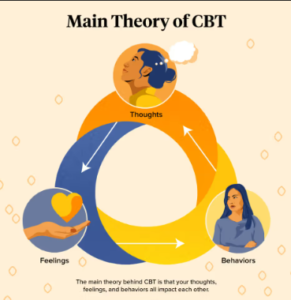
New behavior → Prepare well and speak.
New feeling → Confidence.

Example 2: Overthinking in Relationships

Thought: “If they take time to reply, they are losing interest.”
Feeling: Insecurity
Behavior: Repeated texting

Using CBT:
Realistic thought → “They may be busy; it doesn’t mean they don’t care.”
New behavior → Give space.
New feeling → Security.

Example 3: Low Motivation in Depression

Thought: “Nothing will change.”
Feeling: Hopeless
Behavior: Staying in bed

Using CBT:
Start with small tasks → “I’ll just take a 5-minute walk.”
Behavioral activation.
Mood improves gradually.

CBT vs Other Therapies

1. CBT vs Psychoanalysis

  • Psychoanalysis explores childhood and unconscious conflicts.

  • CBT is present-focused and skill-based.

2. CBT vs Humanistic Therapy

  • Humanistic therapy focuses on self-growth and unconditional acceptance.

  • CBT focuses on practical problem-solving.

3. CBT vs Mindfulness-Based Therapy

  • Mindfulness teaches awareness without judgment.

  • CBT teaches restructuring thoughts.

  • Many modern therapies combine both.

Limitations of CBT

Though powerful, CBT has limitations:

• It requires homework and active participation

Passive clients may struggle.

• It may not suit very deep trauma alone

Sometimes needs additional therapies.

• It focuses heavily on thoughts

Some people need more emotional or body-oriented work.

• It may seem structured

Not everyone likes worksheets or techniques.

Still, CBT remains one of the most effective therapies worldwide.

How to Know If CBT Is Right for You

You may benefit from CBT if you:

✔ overthink
✔ feel anxious
✔ struggle with low confidence
✔ face relationship conflicts
✔ want practical tools
✔ like structured sessions
✔ want short-term therapy
✔ prefer skill-based learning

CBT is suitable for individuals, couples, and families.

Basic CBT Techniques You Can Start Today

1. The “STOP” Technique

S – Stop
T – Take a breath
O – Observe your thoughts
P – Proceed with a balanced action

2. Thought Replacement

Notice: “I can’t do this.”
Replace: “I can try step by step.”

3. Journaling

Write your thoughts, feelings, and behaviors daily.

4. Worry Time

Schedule 15 minutes per day for worrying.
This reduces overthinking throughout the day.

5. Gratitude List

Write 3 things you are grateful for every day.

CBT for Children and Teens

CBT is highly effective for young people.
Therapists use games, stories, drawings, and role-play.

It helps with:
• exam stress
• bullying
• fear of failure
• anger issues
• emotional regulation
• family conflict

CBT for Couples

CBT teaches couples to break negative cycles:

Examples:

• stopping blame
• improving communication
• replacing assumptions with evidence
• managing anger and expectations

Couples learn healthier ways to express emotions.

CBT and the Brain

CBT changes neural pathways in the brain through a process called neuroplasticity.

When you think differently repeatedly:
• old negative pathways weaken
• new positive pathways strengthen

This creates long-lasting emotional change.

How Long Does CBT Take?

Most treatment plans last:

8 to 20 sessions

However, duration depends on the condition:
• mild anxiety → 6–10 sessions
• depression → 10–20 sessions
• trauma or OCD → 20+ sessions

How to Get Started with CBT

1. Find a trained therapist

Clinical psychologists, counseling psychologists, mental health practitioners.

2. Choose your format

• in-person
• online
• group therapy
• self-help books + sessions

3. Set your goals

What do you want to change?

4. Be consistent

Practice skills regularly.

5. Track progress

Use journals, apps, or worksheets.

Misconceptions About CBT

Myth 1: CBT is only positive thinking

CBT teaches realistic thinking—not forced positivity.

Myth 2: CBT ignores emotions

CBT deeply explores how thoughts trigger emotions.

Myth 3: CBT works instantly

It needs practice and consistency.

Myth 4: CBT is only for mental illness

CBT helps anyone who wants personal growth.

Why CBT Is So Popular

CBT is widely used because:
• it is evidence-based
• easy to learn
• effective for many problems
• focused on results
• empowers individuals
• teaches lifelong coping skills

Conclusion

Cognitive Behavioral Therapy (CBT) is one of the most powerful, practical, and scientifically proven approaches to improving mental health. It teaches people to understand the connection between thoughts, feelings, and behaviors—and to break negative patterns that cause distress.

CBT equips individuals with tools they can use in daily life, helps them manage stress, anxiety, depression, anger, and relationship issues, and builds long-term emotional resilience. Whether you are a student, professional, parent, or senior citizen, CBT can help you think better, feel better, and live better.

If you are looking for a structured, solution-focused, and skill-building therapy, CBT may be the right choice for you.

Reference

How to Heal After a Breakup: Therapist Tips

Introduction

A breakup can feel like an emotional earthquake—shaking your sense of stability, identity, and future plans. Whether the relationship was long-term, short-term, healthy, or toxic, the grief is real. Many people experience sadness, anxiety, loneliness, confusion, or even physical pain.

Healing is not about “getting over it” quickly—it’s about processing, understanding, and rebuilding. As therapists often say, “A breakup is not just losing a person. It’s losing a routine, a dream, and a version of yourself.”
This article shares therapist-approved tips to help you move through the pain and come out stronger.

1. Allow Yourself to Grieve

Breakup grief is similar to mourning a loss. Suppressing emotions only delays healing.

Therapist Tips

  • Cry if you need to

  • Journal your emotions

  • Talk to a friend or therapist

  • Acknowledge that the pain is normal

Avoid the pressure to “move on” quickly. Healing takes time.

2. Avoid Contact for Emotional Recovery

This is known as the No-Contact Rule.
It prevents emotional setbacks and helps you gain clarity.

Why It Works

  • Reduces emotional re-triggering

  • Prevents reopening old wounds

  • Gives both people space to heal

  • Stops the cycle of hope → disappointment

Limit:

  • Messaging

  • Checking their social media

  • Looking at old photos

  • Mutual gossip

Distance creates emotional stability.

3. Understand What You’re Really Grieving

You’re not just missing a person. You might be missing:

  • The routine

  • The emotional support

  • The imagined future

  • The comfort of familiarity

Recognizing this helps separate attachment from love.

4. Stop Blaming Yourself

After breakups, people often think:

  • “I wasn’t enough.”

  • “I messed up everything.”

  • “I should have done more.”

Self-blame increases emotional pain and delays recovery.

Therapist Reframe

Relationships end because of:

  • Mismatched needs

  • Emotional unavailability

  • Timing

  • Communication issues

  • Differences in values

It is almost never one person’s fault.

5. Set Healthy Emotional Boundaries

If you must remain in contact (children, work, etc.), set boundaries:

  • Limit emotional conversations

  • Avoid late-night texting

  • Keep conversations neutral

  • Don’t discuss dating or personal life

These boundaries protect your mental health.

6. Process the Relationship Objectively

A breakup distorts how we remember the relationship.
You may idealize the good or exaggerate the bad.

Try This Exercise

Divide a page into two parts:
“Reality of the Relationship” vs “My Fantasy Version.”

This helps you see:

  • Red flags you ignored

  • Patterns that didn’t work

  • Needs that weren’t met

Objective reflection leads to emotional closure.

7. Talk to a Therapist or Counselor

Therapy can help you:

  • Understand attachment patterns

  • Heal emotional wounds

  • Build self-worth

  • Learn healthier relationship skills

  • Address anxiety, depression, or trauma triggered by the breakup

Breakups often reveal deeper unresolved issues—and therapy provides the tools to heal them.

8. Rebuild Your Identity

Many people lose themselves in relationships. A breakup allows you to reconnect with who you are.

Ask Yourself

  • What activities make me happy?

  • What did I stop doing in the relationship?

  • What kind of life do I want now?

Rediscover:

  • Hobbies

  • Friends

  • Career goals

  • Personal dreams

Healing includes rediscovering your individuality.

9. Take Care of Your Physical Health

The mind and body are connected. Heartbreak can affect sleep, appetite, and energy.

Therapist-Recommended Self-Care

  • Consistent sleep

  • Balanced meals

  • Regular exercise

  • Sunlight exposure

  • Relaxation techniques (yoga, meditation, breathing exercises)

Physical care speeds up emotional recovery.

10. Challenge Negative Thoughts

You might think:

  • “I’ll never find someone again.”

  • “All relationships fail.”

  • “Maybe I’m unlovable.”

These are cognitive distortions.

Try This Reframe

  • “This relationship ended, but my future relationships can be healthier.”

  • “I am learning, growing, and healing.”

Shifting your mindset builds resilience.

11. Surround Yourself With Emotional Support

Sharing your feelings helps regulate your nervous system.

Reach Out To

  • Friends

  • Family

  • Support groups

  • Online communities

  • A therapist

Healing is easier when you’re not alone.

12. Avoid Rebounds and Emotional Escapes

Jumping into a new relationship may distract you, but it doesn’t heal you.

Other emotional escapes:

  • Excessive drinking

  • Overworking

  • Avoiding emotions

  • Numbing behaviors

They only delay healing.

13. Reflect on Lessons, Not Regrets

A breakup can teach you about:

  • Your attachment style

  • Your emotional needs

  • Boundaries you must set

  • Red flags to avoid

  • The kind of partner you truly deserve

Healing comes from learning—not blaming.

14. Focus on the Future, Not the Past

Once you process your emotions, shift toward building your new life.

Try This

  • Set new goals

  • Create new routines

  • Explore new places

  • Build habits that nourish you

Your future is not a continuation of your past relationship.

15. Give Yourself Permission to Move On

Healing is not betrayal.
Moving on doesn’t mean:

  • You never loved them

  • You forgot them

  • The relationship meant nothing

It simply means you are choosing your peace.

Conclusion

Breakups are painful, but they also offer powerful opportunities for personal growth. Healing isn’t linear—some days you’ll feel strong, other days you’ll feel emotional. That’s normal.

What matters is that you keep moving forward, honoring your emotions, and rebuilding your self-worth.
Remember:
You are not starting from zero—you are starting from experience.

Reference

5 Love Languages: What They Really Mean
/5-love-languages-meaning

Contact Us

1. American Psychological Association – Coping With Loss & Breakups

https://www.apa.org/topics/grief

2. Verywell Mind – Breakup Recovery Psychology

https://www.verywellmind.com/how-to-get-over-a-breakup-4175414

3. Psychology Today – Healing After Breakups

https://www.psychologytoday.com/us/blog/living-forward/202002/the-psychology-getting-over-breakup

4. Greater Good Science Center – Emotional Healing

https://greatergood.berkeley.edu/topic/emotional_intelligence

Relationship Red Flags Backed by Psychology

Introduction

Every relationship goes through ups and downs, but some behaviors are not just “issues”—they are red flags that indicate deeper emotional, psychological, or behavioral problems. These warning signs often start subtly, but over time they can lead to emotional damage, insecurity, and loss of self-esteem.

Psychology helps us understand these red flags clearly. They are not just signs that a relationship is struggling—they are signs that your emotional well-being may be at risk. Recognizing them early can help protect your mental health and guide you toward healthier relationships.

1. Constant Criticism and Belittling

Constructive feedback is normal. Constant criticism is not.

Signs

  • They judge your choices, abilities, or personality

  • Humiliate you in private or public

  • Make fun of your goals, dreams, or appearance

  • Use sarcasm to undermine you

Psychology Behind It

Chronic criticism is linked to low self-esteem, narcissistic traits, and control issues.
According to John Gottman, criticism is one of the “Four Horsemen of Relationship Doom.”

2. Gaslighting

Gaslighting is psychological manipulation that makes you doubt your memory, feelings, and reality.

Signs

  • “You’re overreacting. I never said that.”

  • “You’re too sensitive.”

  • Denying events even when you have proof

  • Twisting facts to confuse you

Psychology Behind It

Gaslighting is a form of emotional abuse, often used by people with:

  • Narcissistic Personality traits

  • Antisocial tendencies

  • High control needs

Victims often develop self-doubt, anxiety, and emotional confusion.

3. Love Bombing

Love bombing is excessive affection, attention, and future promises early in the relationship.

Signs

  • Intense affection very early

  • Over-the-top praises and gifts

  • Talking about marriage quickly

  • Constant texting or calling

  • “I’ve never felt this with anyone before”

Psychology Behind It

Love bombing creates emotional dependency.
It is often used by:

  • Narcissists

  • People with insecure attachment

  • Manipulative partners

Once the partner gains control, the affection drops—and the real behavior appears.

4. Lack of Accountability

Healthy partners apologize and take responsibility. Toxic partners never do.

Signs

  • Always blaming you

  • Turning every problem into your fault

  • Excuses or victim mentality

  • Denying clear mistakes

Psychology Behind It

Avoiding accountability is linked to:

  • Narcissistic traits (grandiosity, entitlement)

  • Emotional immaturity

  • Low empathy

  • Insecure attachment

This destroys trust and emotional safety.

5. Controlling Behavior

Control is not love—it is a major red flag.

Signs

  • Monitoring your phone, social media, or whereabouts

  • Making decisions for you

  • Jealousy disguised as “care”

  • Trying to isolate you from friends or family

  • Not respecting your personal space

Psychology Behind It

Controlling behavior grows from:

  • Fear of abandonment

  • Need for superiority

  • Unresolved childhood trauma

  • Personality disorders like BPD or NPD

Control can slowly become abusive.

6. Hot-and-Cold Behavior

Some days they’re loving, other days they’re distant.

Signs

  • Emotional unpredictability

  • Mixed signals

  • Affection followed by withdrawal

  • “Push–pull” dynamics

Psychology Behind It

Inconsistent behavior is connected to:

  • Avoidant or anxious attachment styles

  • Fear of intimacy

  • Manipulative behavior

  • Emotional unavailability

This keeps you emotionally confused and insecure.

7. Disrespecting Boundaries

Healthy relationships require clear boundaries.

Signs

  • Ignoring your “no”

  • Pressuring you into decisions

  • Overstepping emotional, physical, or digital boundaries

  • Dismissing your comfort levels

Psychology Behind It

Boundary violations indicate:

  • Poor emotional regulation

  • Lack of empathy

  • Controlling personality

  • Difficulty with accountability

Long-term, this erodes your self-esteem.

8. Minimizing Your Feelings

Also called emotional invalidation.

Signs

  • “You’re too emotional.”

  • “You shouldn’t feel like that.”

  • “It’s not a big deal.”

  • Ignoring your concerns

Psychology Behind It

People who minimize often:

  • Struggle with emotional maturity

  • Fear emotional intimacy

  • Have dismissive-avoidant tendencies

Invalidation leads to suppressed emotional expression and loneliness in the relationship.

9. Jealousy and Possessiveness

A little jealousy is normal. Excessive jealousy is dangerous.

Signs

  • Accusing you without reason

  • Wanting access to your accounts

  • Feeling threatened by your friends

  • Getting angry when you meet others

Psychology Behind It

Possessiveness is rooted in:

  • Insecure attachment

  • Low self-esteem

  • Abandonment fears

  • Past betrayal trauma

Uncontrolled jealousy often escalates into aggression or isolation tactics.

10. Walking on Eggshells

If you’re constantly careful not to “trigger” them, that’s a red flag.

Signs

  • Fear of upsetting them

  • Avoiding topics

  • Changing behavior to prevent conflict

  • Overthinking every reaction

Psychology Behind It

This indicates emotional instability, often seen in:

  • Narcissistic behavior

  • Emotional abuse

  • Mood disorders

Walking on eggshells damages your mental health and identity.

11. Stonewalling and Silent Treatment

Shutting down communication to avoid responsibility or punish you.

Signs

  • Ignoring messages

  • Refusing to talk

  • Leaving arguments halfway

  • Emotional withdrawal

Psychology Behind It

This behavior is linked to:

  • Avoidant attachment

  • Power imbalance

  • Emotional immaturity

  • Manipulation

Silent treatment is a form of passive-aggressive control.

12. Emotional Manipulation

Psychological tactics that make you feel guilty or responsible for their emotions.

Signs

  • Guilt-tripping

  • Playing the victim

  • Emotional blackmail

  • Using your insecurities against you

Psychology Behind It

Manipulation is common in:

  • Narcissistic relationships

  • Codependent relationships

  • Personality disorders

It harms your self-worth and autonomy.

13. Lack of Effort

A relationship requires investment from both partners.

Signs

  • Ignoring emotional needs

  • Not making plans

  • No interest in your life

  • No attempts to resolve conflict

  • You always initiate conversations

Psychology Behind It

Lack of effort often reflects:

  • Emotional unavailability

  • Avoidant attachment

  • Taking the partner for granted

  • Low commitment

Relationships cannot survive with one-sided effort.

14. Constant Lying or Hiding Things

Dishonesty is a direct threat to trust.

Signs

  • White lies

  • Hiding conversations

  • Being secretive about past or present

  • Changing stories

Psychology Behind It

Dishonesty is linked to:

  • Avoidant coping

  • Commitment issues

  • Fear of consequences

  • Habitual or pathological lying

Without trust, emotional closeness cannot exist.

15. You’re Losing Yourself

This is one of the most serious red flags.

Signs

  • You stop expressing your needs

  • You compromise too much

  • You feel anxious or drained

  • You change yourself to keep them happy

Psychology Behind It

Losing yourself is a sign of:

  • Emotional dependency

  • Coercive control

  • Insecure attachment

  • Subtle emotional abuse

Healthy relationships allow both partners to grow—never shrink.

Conclusion

Psychology shows that relationship red flags are not random—they are patterns that indicate deeper emotional problems. Recognizing them early is essential for protecting your mental health, establishing boundaries, and choosing the right partner.

Healthy relationships feel safe, supportive, respectful, and emotionally nourishing.
If a relationship consistently brings fear, confusion, or exhaustion, it may be time to step back and reassess.

Reference

Psychology Today – Toxic Relationships

https://www.psychologytoday.com/us/blog/in-love-and-war/201806/signs-toxic-relationship

American Psychological Association (APA) – Relationship Health

https://www.apa.org/topics/relationships

Verywell Mind – Emotional Abuse & Manipulation

https://www.verywellmind.com/emotional-abuse-4155223

The Gottman Institute – Conflict & Criticism (Four Horsemen)

https://www.gottman.com/blog/category/the-four-horsemen/