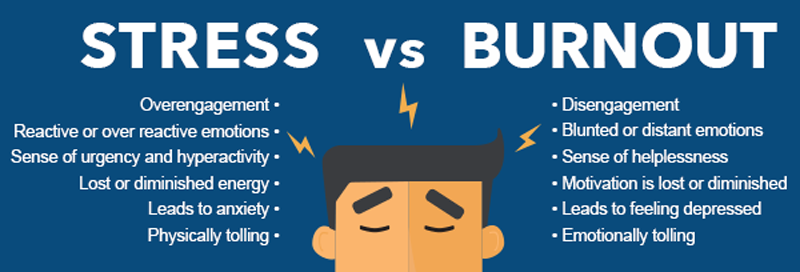
Stress vs Burnout: How to Tell the Difference

https://doctorondemand.com/wp-content/uploads/2022/04/stress-vs-burnout.png

In today’s fast-paced world, feeling overwhelmed has become almost a normal part of daily life. Long work hours, constant digital connectivity, financial pressures, and growing personal responsibilities have blurred the line between productivity and exhaustion. As a result, many people use the terms stress and burnout interchangeably—but psychologically, they are not the same experience.

Understanding the difference between stress and burnout is crucial because they affect the mind and body in very different ways and require different responses. Stress is often a short-term reaction to pressure and can sometimes be managed with rest or problem-solving. Burnout, however, develops gradually from prolonged, unmanaged stress and leads to deep emotional, mental, and physical exhaustion.

When burnout is mistaken for ordinary stress and addressed only with quick fixes—such as taking a short break or pushing harder—it can silently worsen. Over time, this may contribute to anxiety, depression, physical illness, emotional numbness, and a loss of meaning or motivation.

What Is Stress?

Stress is the body’s natural response to pressure, challenge, or perceived demand. It arises when external situations or internal expectations feel greater than one’s current coping capacity. From a psychological perspective, stress is not inherently harmful—it is a signal, alerting the mind and body to mobilize resources for adaptation.

Stress is usually:

  • Situational – tied to a specific circumstance or phase of life

  • Short- to medium-term – it rises and falls as demands change

  • Demand-linked – connected to identifiable tasks, responsibilities, or pressures

Common stressors include work deadlines, academic exams, financial strain, caregiving roles, relationship conflicts, health concerns, or major life transitions. These stressors activate the body’s stress response system (sympathetic nervous system), preparing a person to respond, solve, or endure.

Psychological Experience of Stress

Psychologically, stress is often experienced as:

  • Feeling overwhelmed but still mentally engaged

  • Persistent worry, tension, or irritability

  • Racing or repetitive thoughts, especially about “what needs to be done”

  • Heightened alertness and a strong sense of urgency

  • Difficulty relaxing, even during rest periods

Despite discomfort, motivation is usually still present. The person may feel exhausted yet continues to push forward, believing effort will resolve the situation.

A key cognitive belief commonly seen in stress is:

“Once this situation improves, I’ll feel better.”

This belief reflects an important distinction:
Under stress, people generally retain hope and purpose. They expect relief once the pressure eases, which is why stress—though uncomfortable—often remains psychologically manageable in the short term.

When stress becomes chronic or unrelenting, however, this belief can begin to fade, increasing the risk of emotional exhaustion and burnout.

What Is Burnout?

Burnout is a state of chronic emotional, mental, and physical exhaustion that develops after prolonged exposure to stress that has not been adequately managed or relieved. It is most commonly associated with work, caregiving, and helping professions, where demands are continuous and recovery is limited or absent.

Unlike stress—which involves overactivation—burnout reflects depletion. The system no longer has enough emotional or psychological resources to respond.

The World Health Organization defines burnout as an occupational phenomenon characterized by three core dimensions:

  • Emotional exhaustion – feeling completely drained, depleted, and unable to give more

  • Mental distance, cynicism, or depersonalization – emotional withdrawal from work or responsibilities, often expressed as negativity or indifference

  • Reduced sense of effectiveness – feeling incompetent, unproductive, or that one’s efforts no longer matter

Burnout does not occur suddenly. It develops gradually, often disguised as “just being tired” or “having a bad phase,” and frequently goes unrecognized until daily functioning, relationships, or physical health are significantly affected.

Psychological Experience of Burnout

Psychologically, burnout is experienced very differently from stress:

  • Emotional numbness or emptiness, rather than anxiety

  • Detachment and cynicism, especially toward work, people, or responsibilities once cared about

  • Profound loss of motivation, meaning, and purpose

  • Feeling trapped, helpless, or stuck, with no sense of agency

  • Reduced emotional reactivity—both positive and negative feelings feel muted

While stressed individuals are often still striving and hoping for relief, burned-out individuals feel psychologically disconnected. Tasks that once felt manageable now feel pointless or unbearable.

A defining cognitive belief in burnout is:

“Nothing will change—even if the pressure stops.”

This belief reflects learned helplessness and emotional shutdown. Even rest or time off may not bring relief, because the nervous system and sense of meaning are already depleted.

Key Psychological Difference from Stress

  • Stress → “Too much to handle, but I must keep going.”

  • Burnout → “I have nothing left to give, and it doesn’t matter anymore.”

Burnout is not a personal failure or lack of resilience—it is a systemic response to prolonged overload without recovery, support, or control. Recovery therefore requires more than rest; it involves restoring meaning, boundaries, autonomy, and emotional safety.

Stress vs Burnout: Key Differences

Aspect Stress Burnout
Duration Short-term or episodic Long-term, chronic
Energy Overactive, tense Depleted, exhausted
Emotions Anxiety, irritability Hopelessness, numbness
Motivation Still present Significantly reduced
Engagement Over-engaged Disengaged
Recovery Improves with rest Persists despite rest

Emotional Signs: How They Feel Different

Stress Feels Like

  • “Everything feels urgent.”
  • “There’s no space to pause.”
  • “If I rest, I’ll fall behind.”

Burnout Feels Like

  • “I don’t care anymore”

  • “I’m empty”

  • “I’m done, but I can’t leave”

Stress pushes you to keep going.
Burnout makes you want to stop altogether.

Behavioral Differences

Under Stress

  • Overworking

  • Difficulty relaxing

  • Short temper

  • Sleep problems

Under Burnout

  • Procrastination or withdrawal

  • Reduced performance

  • Emotional detachment

  • Avoidance of responsibility

Burnout often looks like laziness from the outside—but psychologically, it is exhaustion, not lack of effort.

Physical Symptoms

Both stress and burnout affect the body, but differently:

Stress

  • Headaches

  • Muscle tension

  • Rapid heartbeat

  • Digestive issues

Burnout

  • Chronic fatigue

  • Frequent illness

  • Sleep disturbances

  • Body aches with no clear cause

Burnout weakens the immune system due to prolonged nervous system overload.

Why Stress Turns Into Burnout

Stress becomes burnout when:

  • Recovery time is insufficient

  • Emotional needs are ignored

  • Boundaries are consistently crossed

  • Effort is high but control or reward is low

Caregiving professionals, healthcare workers, counselors, parents, and corporate employees are especially vulnerable.

Can You Be Stressed and Burned Out at the Same Time?

Yes. Many people experience high stress on top of burnout. This feels like:

  • Emotional emptiness + anxiety

  • Exhaustion + pressure to perform

  • Detachment + guilt

This combination significantly increases the risk of depression and anxiety disorders.

How to Respond: Stress vs Burnout

If It’s Stress

  • Time management

  • Short breaks

  • Relaxation techniques

  • Problem-solving

  • Temporary rest

If It’s Burnout

  • Reducing demands (not just resting)

  • Emotional support or therapy

  • Re-evaluating roles and boundaries

  • Restoring meaning and autonomy

  • Long-term lifestyle changes

Burnout cannot be healed by a weekend break.

When to Seek Professional Help

Consider professional support if:

  • Emotional numbness lasts weeks or months

  • You feel detached from people or work

  • Motivation does not return after rest

  • Physical symptoms persist without cause

The American Psychological Association emphasizes early intervention to prevent long-term mental health consequences.

Key Takeaways

  • Stress is about too much

  • Burnout is about nothing left

  • Stress responds to rest

  • Burnout requires deeper change

  • Recognizing the difference protects mental health

Final Reflection

Stress says:
“I can’t slow down.”

Burnout says:
“I can’t go on.”

Stress reflects pressure within capacity—painful, but still fueled by urgency and hope. Burnout reflects depletion beyond capacity—where motivation, meaning, and emotional energy are exhausted.

Listening carefully to this internal shift is critical. When “pushing through” turns into emotional numbness, detachment, or hopelessness, the body and mind are signaling the need for deeper intervention—not just rest.

Recognizing this difference early can prevent long-term emotional collapse, protect mental health, and create space for recovery before functioning is severely compromised.

Frequently Asked Questions (FAQ)

1. Is stress always harmful?

No. Stress is a normal psychological and physiological response to challenges. Short-term stress can improve focus and performance. It becomes harmful when it is chronic, intense, and unmanaged, increasing the risk of anxiety, depression, and burnout.


2. How is burnout different from stress?

Stress involves over-engagement—too much pressure and urgency. Burnout involves disengagement—emotional exhaustion, cynicism, and loss of meaning. Stress says “I must keep going,” while burnout says “I have nothing left.”


3. Can stress turn into burnout?

Yes. Prolonged stress without adequate rest, control, emotional support, or recovery can gradually develop into burnout. Burnout is often the result of long-term stress that feels unavoidable.


4. Is burnout a mental illness?

Burnout is not classified as a mental disorder. According to the World Health Organization, it is an occupational phenomenon. However, burnout can increase vulnerability to depression, anxiety disorders, and physical health problems.


5. Can taking a break cure burnout?

Short breaks may help stress, but burnout usually requires deeper changes, such as:

  • Reducing ongoing demands

  • Restoring boundaries and autonomy

  • Reconnecting with meaning and values

  • Psychological support or counseling

Without these, symptoms often return quickly.


6. Who is most at risk of burnout?

People in high-responsibility or caregiving roles, such as healthcare workers, counselors, teachers, parents, corporate employees, and caregivers—especially when there is high demand and low support.


7. When should someone seek professional help?

Professional support is recommended when symptoms include:

  • Persistent emotional numbness or hopelessness

  • Loss of motivation lasting weeks or months

  • Withdrawal from work or relationships

  • Physical symptoms (sleep issues, fatigue, frequent illness)

  • Feeling trapped or helpless

Early intervention can prevent long-term psychological and occupational damage.


Written by Baishakhi Das

Counselor | Mental Health Practitioner
B.Sc, M.Sc , PG Diploma in Counseling

Reference 

  1. World Health Organization (WHO)
    Burn-out an occupational phenomenon
    https://www.who.int/news/item/28-05-2019-burn-out-an-occupational-phenomenon

  2. American Psychological Association (APA)
    Stress effects on the body
    https://www.apa.org/topics/stress/body

  3. National Institute for Occupational Safety and Health (NIOSH)
    Stress at work
    https://www.cdc.gov/niosh/topics/stress

  4. Maslach, C., & Leiter, M. P. (2016).
    Understanding the burnout experience. World Psychiatry
    https://onlinelibrary.wiley.com/doi/10.1002/wps.20311

  5. Harvard Health Publishing
    Burnout: Symptoms and prevention
    https://www.health.harvard.edu/blog/burnout-modern-affliction-or-human-condition-2017071912199

  6. Why You Feel Emotionally Numb: When You Can’t Feel What You Know You Should  
  7. Emotional Burnout: Symptoms You Shouldn’t Ignore

 

How to Handle Work Stress Without Burning Out

https://docsmedicalgroup.com/docsurgentcare/wp-content/uploads/sites/2/2024/05/How-To-Manage-Work-Stress-and-Avoid-Burnout-6-Tips-From-Trusted-Primary-Care-Doctor-in-Fairfield-CT.jpg?utm_source=chatgpt.com

Introduction

In today’s fast-paced, achievement-driven world, work stress has become almost unavoidable. Long working hours, constant deadlines, financial pressure, job insecurity, multitasking, and digital overload have blurred the boundary between professional and personal life.

As a result, many individuals experience mental exhaustion, emotional depletion, and physical fatigue—often without realizing they are gradually moving toward burnout.

Although closely related, stress and burnout are not the same. Stress is characterized by feeling overwhelmed while remaining engaged, whereas burnout involves prolonged emotional, mental, and physical exhaustion accompanied by a gradual loss of motivation, productivity, and sense of purpose.

The good news is that burnout is preventable. With the right awareness, mindset, and practical strategies, work stress can be managed effectively without reaching a breaking point.

This article offers a psychology-based, practical guide on how to handle work stress without burning out—suitable for working professionals, managers, caregivers, freelancers, and anyone struggling to balance work and well-being.

Understanding Work Stress

What Is Work Stress?

Work stress arises when the demands of a job exceed an individual’s capacity to manage them successfully.  It can stem from:

  • Heavy workload

  • Tight deadlines

  • Lack of control or autonomy

  • Poor work-life balance

  • Job insecurity

  • Workplace conflict

  • High expectations or perfectionism

Occasional stress is normal and can even enhance performance. However, chronic unmanaged stress gradually impacts mental health, physical health, and emotional stability.

Stress vs Burnout: Know the Difference

Understanding the difference is crucial for early intervention.

Work Stress

  • You feel pressured and overwhelmed

  • You may still care about your work

  • Energy fluctuates

  • Motivation is present but strained

Burnout

  • Emotional numbness or detachment

  • Feeling hopeless or trapped

  • Constant exhaustion

  • Reduced performance and meaning

  • Cynicism toward work

Recognizing stress early allows you to take action before burnout develops.

Early Warning Signs You Should Not Ignore

Burnout does not happen overnight. It builds gradually through warning signs such as:

Emotional Signs

  • Irritability and frustration

  • Feeling emotionally drained

  • Anxiety or low mood

  • Reduced motivation

Cognitive Signs

  • Difficulty concentrating

  • Overthinking work issues

  • Forgetfulness

  • Negative self-talk

Physical Signs

  • Headaches

  • Muscle tension

  • Sleep disturbances

  • Frequent illness

Behavioral Signs

  • Procrastination

  • Withdrawal from others

  • Increased caffeine or screen use

  • Working excessively without rest

Recognizing these signs early is the first step toward prevention.

Why Burnout Happens (Psychological Perspective)

Burnout often develops when:

  • Effort is high but rewards are low

  • There is a lack of recognition

  • Boundaries are unclear

  • Control is limited

  • Values conflict with work demands

Psychologically, burnout is linked to:

  • Chronic stress activation

  • Emotional suppression

  • Lack of recovery time

  • Identity tied only to productivity

Therefore, managing stress requires both external changes and internal mindset shifts.

1. Set Clear Boundaries Between Work and Personal Life

One of the most effective ways to prevent burnout is by creating clear boundaries.

How to Do This

  • Define work hours and stick to them

  • Avoid checking emails late at night

  • Create a separate workspace at home

  • Communicate availability clearly

Why it works:
Boundaries protect your mental energy and allow your nervous system to recover.

2. Learn to Prioritize, Not Multitask

Multitasking increases mental fatigue and reduces efficiency. Instead, prioritize tasks based on importance and urgency.

Practical Tips

  • Use a daily task list with 3 key priorities

  • Break large tasks into smaller steps

  • Focus on one task at a time

  • Accept that everything cannot be done at once

Psychological benefit:
Prioritization reduces cognitive overload and decision fatigue.

3. Redefine Productivity (Quality Over Quantity)

Many professionals equate productivity with long hours. However, productivity is about effective output, not exhaustion.

Healthy Productivity Means

  • Working with focus, not fear

  • Taking breaks to maintain efficiency

  • Allowing rest without guilt

When productivity is defined realistically, stress naturally reduces.

4. Practice Emotional Regulation at Work

Work stress often intensifies due to unprocessed emotions such as frustration, fear, or anger.

Simple Emotional Regulation Techniques

  • Pause and take 5 deep breaths

  • Label the emotion: “I feel overwhelmed”

  • Ground yourself by noticing your surroundings

  • Avoid reacting immediately during conflict

Result:
Better emotional control prevents impulsive decisions and emotional burnout.

5. Take Micro-Breaks Throughout the Day

Rest does not always mean long holidays. Short, intentional breaks are powerful.

Examples of Micro-Breaks

  • Stretching for 2 minutes

  • Stepping away from the screen

  • Drinking water mindfully

  • Brief breathing exercises

These breaks reset the nervous system and improve focus.

6. Manage Perfectionism and Unrealistic Expectations

Perfectionism is a major contributor to burnout. Constantly trying to meet unrealistic standards drains emotional energy.

Healthy Mindset Shifts

  • Progress is better than perfection

  • Mistakes are part of learning

  • Self-worth is not equal to performance

Letting go of perfectionism allows sustainable growth.

7. Improve Sleep and Physical Health

Stress and sleep are deeply connected. Poor sleep increases stress sensitivity.

Tips for Better Sleep

  • Maintain a consistent sleep schedule

  • Reduce screen exposure before bed

  • Avoid excessive caffeine

  • Practice relaxation techniques

Physical movement, even light exercise, helps regulate stress hormones.

8. Build Supportive Workplace Relationships

Social support acts as a buffer against stress.

How to Strengthen Support

  • Communicate openly with colleagues

  • Ask for help when needed

  • Share workload concerns respectfully

  • Avoid isolation

Feeling understood at work reduces emotional exhaustion.

9. Learn to Say No Without Guilt

Overcommitment is a fast track to burnout.

Assertive Communication Examples

  • “I don’t have the capacity right now.”

  • “Can we prioritize this for later?”

  • “I need to focus on existing deadlines.”

Saying no is not a failure—it is self-respect.

10. Create Meaning Beyond Work

When identity is limited only to work, stress becomes overwhelming.

Protective Factors

  • Hobbies

  • Creative activities

  • Relationships

  • Spiritual or reflective practices

Meaning outside work creates emotional balance and resilience.

11. Use Stress-Reduction Techniques Regularly

Stress management is most effective when practiced consistently, not only during crisis.

Effective Techniques

  • Mindfulness

  • Journaling

  • Progressive muscle relaxation

  • Guided breathing

Even 10 minutes a day can significantly reduce stress levels.

12. Recognize When You Need Professional Help

Sometimes, self-help is not enough—and that is okay.

Consider Professional Support If

  • Stress feels unmanageable

  • Emotional numbness persists

  • Anxiety or depression develops

  • Work impacts daily functioning

Counseling helps identify patterns, strengthen coping skills, and restore emotional balance.

Long-Term Strategies for Burnout Prevention

  • Regular self-check-ins

  • Annual leave without guilt

  • Career alignment with values

  • Ongoing skill development

  • Emotional self-awareness

Burnout prevention is a long-term lifestyle practice, not a one-time solution.

Conclusion

Work stress is a reality of modern life, but burnout does not have to be. By recognizing early warning signs, setting healthy boundaries, regulating emotions, redefining productivity, and prioritizing mental health, it is possible to manage work stress without sacrificing well-being.

Remember, rest is not a reward for exhaustion—it is a requirement for sustainability. Taking care of your mental health is not a weakness; it is the foundation of long-term success and fulfillment.

Frequently Asked Questions (FAQ)

How to Handle Work Stress Without Burning Out


1. What is work stress?

Work stress occurs when job demands exceed a person’s ability to cope. It can be caused by heavy workload, tight deadlines, lack of control, job insecurity, or poor work–life balance.


2. What is burnout and how is it different from stress?

Stress involves feeling overwhelmed but still engaged and motivated. Burnout, on the other hand, is a state of chronic emotional, mental, and physical exhaustion marked by detachment, reduced performance, and loss of meaning at work.


3. What are the early signs of burnout?

Early signs include constant fatigue, irritability, lack of motivation, difficulty concentrating, sleep problems, emotional numbness, and feeling disconnected from work or colleagues.


4. Can work stress be managed without quitting the job?

Yes. Most work stress can be managed through healthy boundaries, prioritization, emotional regulation, realistic expectations, proper rest, and supportive communication—without changing jobs.


5. Why is setting boundaries important for preventing burnout?

Boundaries protect mental and emotional energy. Without clear limits on work hours and availability, the nervous system does not get enough time to recover, increasing the risk of burnout.


6. How does perfectionism contribute to burnout?

Perfectionism creates constant pressure to perform flawlessly, leading to self-criticism, fear of failure, and emotional exhaustion. Over time, this significantly increases burnout risk.


7. Do short breaks really help with work stress?

Yes. Micro-breaks help reset the nervous system, improve focus, and reduce mental fatigue. Even 2–5 minutes of rest can lower stress levels during the workday.


8. How does poor sleep affect work stress?

Lack of sleep increases emotional reactivity, reduces concentration, and weakens stress tolerance. Poor sleep and work stress often reinforce each other, accelerating burnout.


9. Is it okay to say no at work for mental health reasons?

Yes. Saying no respectfully is a form of self-care. Overcommitting may temporarily please others but often leads to long-term stress, reduced performance, and burnout.


10. Can emotional regulation reduce workplace stress?

Absolutely. Skills like pausing, deep breathing, labeling emotions, and responding instead of reacting help manage stress, prevent conflict, and reduce emotional exhaustion.


11. How does social support at work reduce burnout?

Supportive colleagues and supervisors provide emotional validation, shared problem-solving, and a sense of belonging, all of which buffer against stress and burnout.


12. Is burnout only related to workload?

No. Burnout is also linked to lack of recognition, value conflicts, poor control over work, emotional suppression, and identity being tied solely to productivity.


13. When should someone seek professional help for work stress?

Professional support is recommended if stress becomes unmanageable, symptoms persist for weeks, emotional numbness develops, or work stress affects daily functioning and relationships.


14. Can counseling help with burnout recovery?

Yes. Counseling helps identify stress patterns, improve coping strategies, strengthen emotional regulation, rebuild boundaries, and restore balance and motivation.


15. What is the most important step in preventing burnout?

Self-awareness. Regularly checking in with your emotional, mental, and physical state allows early intervention before stress turns into burnout.

About the Author

Baishakhi Das is a Counselor and Mental Health Practitioner with academic training in psychology and human development. She works with individuals experiencing work stress, emotional exhaustion, anxiety, and burnout, focusing on practical coping strategies and emotional resilience.

Reference