
Stress vs Burnout: Know the Difference
Understanding the difference between stress and burnout is crucial for early recognition and intervention. Although they can share some similarities, they represent different experiences and may require different approaches.
Work Stress
With work stress, you may experience:
- Feeling pressured and overwhelmed
- Continuing to care about your work
- Fluctuating energy levels
- Motivation that remains present but feels strained
In many cases, people experiencing work stress are still engaged with their responsibilities, even though they feel under significant pressure.
Burnout
In contrast, burnout may involve:
- Emotional numbness or detachment
- Feeling hopeless or trapped
- Constant exhaustion
- Reduced performance and sense of meaning
- Cynicism toward work
As burnout develops, emotional exhaustion can make it increasingly difficult to remain motivated or connected to work. Therefore, paying attention to these changes is important rather than dismissing them as ordinary workplace stress.
Most importantly, recognizing stress early allows you to take action before burnout develops. By addressing ongoing stress and creating opportunities for recovery, you may reduce the risk of progressing toward more severe exhaustion.
Why Burnout Happens (Psychological Perspective)
Burnout often develops when workplace demands remain high while the resources, support, or recovery needed to manage them are insufficient. For example, burnout may become more likely when:
- Effort is high but rewards are low
- There is a lack of recognition
- Boundaries are unclear
- Control is limited
- Personal values conflict with work demands
In addition, burnout can be influenced by several psychological factors, including:
- Chronic stress activation
- Emotional suppression
- Lack of adequate recovery time
- An identity tied primarily to productivity
Over time, these factors can reinforce one another, making it increasingly difficult to recover from ongoing work-related stress. Consequently, simply reducing workload may not always address every factor contributing to burnout.
Therefore, managing work stress requires both external changes and internal mindset shifts. On the one hand, improving boundaries, workload, recognition, and control can reduce external sources of stress. On the other hand, developing emotional awareness, healthier expectations, and an identity beyond productivity can support psychological recovery and long-term resilience.
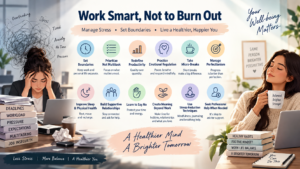
1. Set Clear Boundaries Between Work and Personal Life
One of the most effective ways to prevent burnout is by creating clear boundaries between work and personal life. In particular, consistent boundaries can help protect time for rest and recovery.
How to Do This
- Define work hours and stick to them
- Avoid checking emails late at night
- Create a separate workspace at home
- Communicate availability clearly
Why it works:
As a result, boundaries can help protect your mental energy and give your mind and body adequate time to recover.
2. Learn to Prioritize, Not Multitask
Multitasking can increase mental fatigue and reduce efficiency. Instead, prioritize tasks based on importance and urgency so that your attention is directed toward what matters most.
Practical Tips
- Use a daily task list with 3 key priorities
- Break large tasks into smaller steps
- Focus on one task at a time
- Accept that everything cannot be done at once
Psychological benefit:
Consequently, prioritization can reduce cognitive overload and decision fatigue, making demanding work feel more manageable.
3. Redefine Productivity (Quality Over Quantity)
Many professionals equate productivity with long working hours. However, genuine productivity is better understood as effective output, rather than simply spending more time working.
Healthy Productivity Means
- Working with focus, not fear
- Taking breaks to maintain efficiency
- Allowing rest without guilt
Furthermore, when productivity is defined more realistically, there is less pressure to remain constantly busy. As a result, stress may become easier to manage while sustainable performance becomes more achievable.
4. Practice Emotional Regulation at Work
Work stress can often intensify when emotions such as frustration, fear, or anger remain unprocessed. Therefore, learning to regulate these emotions can help you respond more thoughtfully during challenging situations.
Simple Emotional Regulation Techniques
- Pause and take 5 deep breaths
- Label the emotion: “I feel overwhelmed”
- Ground yourself by noticing your surroundings
- Avoid reacting immediately during conflict
As a result, better emotional regulation can support more thoughtful decision-making and reduce the likelihood of emotional exhaustion.
5. Take Micro-Breaks Throughout the Day
Importantly, rest does not always require a long holiday or an entire day away from work. Instead, short and intentional breaks throughout the day can provide opportunities to pause and reset.
Examples of Micro-Breaks
- Stretching for 2 minutes
- Stepping away from the screen
- Drinking water mindfully
- Brief breathing exercises
For example, even a brief pause between demanding tasks can create space for mental recovery. Consequently, regular breaks may help maintain focus and reduce accumulated mental fatigue.
6. Manage Perfectionism and Unrealistic Expectations
Perfectionism can contribute to burnout because constantly trying to meet unrealistic standards can drain emotional energy. Over time, the pressure to perform flawlessly may increase self-criticism and make ordinary mistakes feel disproportionately difficult.
Healthy Mindset Shifts
- Progress is better than perfection
- Mistakes are part of learning
- Self-worth is not equal to performance
Therefore, developing more realistic expectations can reduce unnecessary pressure. In turn, letting go of perfectionism can support more sustainable growth and a healthier relationship with achievement.
7. Improve Sleep and Physical Health
Similarly, stress and sleep are deeply connected. Poor sleep can increase stress sensitivity, while ongoing stress can make restful sleep more difficult.
Tips for Better Sleep
- Maintain a consistent sleep schedule
- Reduce screen exposure before bed
- Avoid excessive caffeine
- Practice relaxation techniques
In addition, regular physical movement, including light exercise, can support overall stress management. As a result, taking care of physical health can complement psychological strategies for managing work-related stress.
8. Build Supportive Workplace Relationships
Social support can act as an important buffer against stress. For this reason, maintaining healthy workplace relationships can make challenging periods easier to navigate.
How to Strengthen Support
- Communicate openly with colleagues
- Ask for help when needed
- Share workload concerns respectfully
- Avoid isolation
Furthermore, feeling understood and supported at work can reduce emotional exhaustion. Therefore, asking for help should be viewed as a practical strategy rather than a sign of inadequacy.
9. Learn to Say No Without Guilt
Overcommitment can quickly contribute to chronic stress and, eventually, burnout. When too many responsibilities accumulate, there may be little time left for recovery or important existing priorities.
Assertive Communication Examples
- “I don’t have the capacity right now.”
- “Can we prioritize this for later?”
- “I need to focus on existing deadlines.”
However, saying no does not mean refusing every request. Instead, it means communicating your limits clearly and respectfully. Ultimately, healthy boundaries around commitments can protect your time, energy, and well-being.
10. Create Meaning Beyond Work
When a person’s identity becomes limited primarily to work, setbacks and workplace pressure can feel especially overwhelming. Therefore, developing meaningful areas of life outside work can provide greater emotional balance.
Protective Factors
- Hobbies
- Creative activities
- Relationships
- Spiritual or reflective practices
In addition, activities outside work can provide opportunities for connection, enjoyment, and personal meaning. As a result, having multiple sources of purpose can support emotional balance and resilience.
11. Use Stress-Reduction Techniques Regularly
Stress management tends to be more useful when practiced consistently, rather than only during a crisis. For this reason, incorporating simple stress-reduction practices into your regular routine can be more sustainable.
Effective Techniques
- Mindfulness
- Journaling
- Progressive muscle relaxation
- Guided breathing
For example, setting aside a small amount of time each day for one of these practices can create a regular opportunity to slow down and reconnect with yourself. Over time, consistency can make stress-management strategies easier to integrate into everyday life.
12. Recognize When You Need Professional Help
Sometimes, self-help strategies are not enough—and that is okay. When stress becomes persistent or begins interfering with everyday functioning, professional support may be appropriate.
Consider Professional Support If
- Stress feels unmanageable
- Emotional numbness persists
- Anxiety or depression develops
- Work impacts daily functioning
In such situations, counseling can help identify unhelpful patterns, strengthen coping skills, and support emotional balance. Most importantly, seeking professional help early can provide additional support before work-related stress becomes increasingly difficult to manage.
Frequently Asked Questions (FAQ)
How to Handle Work Stress Without Burning Out
1. What is work stress?
Work stress occurs when job demands exceed a person’s ability to cope. It can be caused by heavy workload, tight deadlines, lack of control, job insecurity, or poor work–life balance.
2. What is burnout and how is it different from stress?
Stress involves feeling overwhelmed but still engaged and motivated. Burnout, on the other hand, is a state of chronic emotional, mental, and physical exhaustion marked by detachment, reduced performance, and loss of meaning at work.
3. What are the early signs of burnout?
Early signs include constant fatigue, irritability, lack of motivation, difficulty concentrating, sleep problems, emotional numbness, and feeling disconnected from work or colleagues.
4. Can work stress be managed without quitting the job?
Yes. Most work stress can be managed through healthy boundaries, prioritization, emotional regulation, realistic expectations, proper rest, and supportive communication—without changing jobs.
5. Why is setting boundaries important for preventing burnout?
Boundaries protect mental and emotional energy. Without clear limits on work hours and availability, the nervous system does not get enough time to recover, increasing the risk of burnout.
6. How does perfectionism contribute to burnout?
Perfectionism creates constant pressure to perform flawlessly, leading to self-criticism, fear of failure, and emotional exhaustion. Over time, this significantly increases burnout risk.
7. Do short breaks really help with work stress?
Yes. Micro-breaks help reset the nervous system, improve focus, and reduce mental fatigue. Even 2–5 minutes of rest can lower stress levels during the workday.
8. How does poor sleep affect work stress?
Lack of sleep increases emotional reactivity, reduces concentration, and weakens stress tolerance. Poor sleep and work stress often reinforce each other, accelerating burnout.
9. Is it okay to say no at work for mental health reasons?
Yes. Saying no respectfully is a form of self-care. Overcommitting may temporarily please others but often leads to long-term stress, reduced performance, and burnout.
10. Can emotional regulation reduce workplace stress?
Absolutely. Skills like pausing, deep breathing, labeling emotions, and responding instead of reacting help manage stress, prevent conflict, and reduce emotional exhaustion.
11. How does social support at work reduce burnout?
Supportive colleagues and supervisors provide emotional validation, shared problem-solving, and a sense of belonging, all of which buffer against stress and burnout.
12. Is burnout only related to workload?
No. Burnout is also linked to lack of recognition, value conflicts, poor control over work, emotional suppression, and identity being tied solely to productivity.
13. When should someone seek professional help for work stress?
Professional support is recommended if stress becomes unmanageable, symptoms persist for weeks, emotional numbness develops, or work stress affects daily functioning and relationships.
14. Can counseling help with burnout recovery?
Yes. Counseling helps identify stress patterns, improve coping strategies, strengthen emotional regulation, rebuild boundaries, and restore balance and motivation.
15. What is the most important step in preventing burnout?
Self-awareness. Regularly checking in with your emotional, mental, and physical state allows early intervention before stress turns into burnout.
About the Author
Baishakhi Das is a Counselor and Mental Health Practitioner with academic training in psychology and human development. She works with individuals experiencing work stress, emotional exhaustion, anxiety, and burnout, focusing on practical coping strategies and emotional resilience.
Reference
-
World Health Organization. (2019). Burn-out an “occupational phenomenon”.
https://www.who.int/news/item/28-05-2019-burn-out-an-occupational-phenomenon -
American Psychological Association. (2023). Work stress and burnout.
https://www.apa.org/topics/healthy-workplaces/work-stress -
Maslach, C., & Leiter, M. P. (2016). Understanding the burnout experience: Recent research and its implications. World Psychiatry, 15(2), 103–111.
https://doi.org/10.1002/wps.20311 -
Maslach, C., Schaufeli, W. B., & Leiter, M. P. (2001). Job burnout. Annual Review of Psychology, 52, 397–422.
https://doi.org/10.1146/annurev.psych.52.1.397 -
National Institute of Mental Health. (2023). Caring for your mental health.
https://www.nimh.nih.gov/health/topics/caring-for-your-mental-health