Classical Conditioning: Pavlov’s Theory in Real Life

https://www.simplypsychology.org/wp-content/uploads/Pavlovs-Dogs-Experiment.jpg

A Clear and Detailed Psychological Explanation

Classical conditioning is one of the most foundational concepts in psychology because it explains how learning can occur automatically through association, without conscious intention or deliberate effort. Both humans and animals constantly absorb patterns from their environment, linking events that repeatedly occur together. As a result, many emotional reactions—such as fear, comfort, attraction, or anxiety—are not logical choices, but learned responses that develop over time through repeated experiences. Once formed, these responses can be triggered instantly, often before rational thinking has a chance to intervene.

This theory was introduced by Ivan Pavlov and has had a lasting impact far beyond laboratory experiments. It helps explain everyday behaviors such as emotional triggers, habits, preferences, and aversions. Today, classical conditioning continues to influence modern psychology, education, therapy, marketing, and daily life, offering valuable insight into how past experiences shape present reactions—and how those reactions can be understood, modified, and healed through awareness and intervention.

What Is Classical Conditioning?

Classical conditioning is a form of learning through association, in which a stimulus that initially has no meaning gradually becomes linked to a stimulus that naturally produces a response. Over time, this association causes the previously neutral stimulus to evoke a learned reaction on its own.

In simple terms:
👉 When two events repeatedly occur together, the brain connects them.

Once this connection is established, the neutral stimulus no longer remains neutral. It becomes capable of triggering the response even in the absence of the original stimulus. This is why certain sounds, smells, places, or situations can automatically evoke emotions or physical reactions without conscious thought.

Pavlov’s Original Experiment Explained

The Discovery

While conducting research on digestion, Ivan Pavlov observed an unexpected pattern in his laboratory dogs. His original goal was to measure salivation as a physiological response to food. However, he noticed that the dogs began to salivate even before the food appeared. The response occurred when the dogs heard familiar sounds, such as the footsteps of the lab assistant, or when they saw visual cues that signaled feeding time.

This was a crucial observation because salivation was happening in the absence of food, which meant the response could not be explained by biology alone. The dogs had learned to associate certain environmental cues with feeding. Pavlov realized that learning was taking place through repeated pairing of events, rather than conscious decision-making. This insight shifted the focus of psychology toward observable behavior and measurable learning processes.

The Experiment Setup

To test this learning process under controlled conditions, Pavlov designed a series of structured experiments. Each component of the experiment had a specific role:

  • Food was used as a natural stimulus because it automatically caused salivation without any prior learning.

  • Salivation was measured carefully, as it was a clear, observable, and quantifiable response.

  • A bell sound was introduced as a neutral stimulus, meaning it did not initially trigger salivation or any meaningful response.

Pavlov then followed a precise sequence. The bell was rung immediately before the food was presented. This pairing was repeated many times across different trials. Gradually, the dogs began to anticipate the food as soon as they heard the bell. Their bodies responded automatically, producing saliva even before the food appeared.

Eventually, Pavlov tested the association by ringing the bell without presenting food. Remarkably, the dogs still salivated. This confirmed that the bell had become a meaningful signal through learning.

Why This Experiment Was Revolutionary

Pavlov’s experiment demonstrated that:

  • Learning can occur without conscious thought

  • Neutral stimuli can acquire emotional or physiological meaning

  • Responses can be shaped by experience and repetition

This challenged earlier beliefs that behavior was driven only by instinct or conscious reasoning. Pavlov’s work laid the foundation for behaviorism and influenced later psychological theories related to anxiety, trauma, habit formation, and emotional responses.

Lasting Impact

The significance of Pavlov’s experiment extends far beyond dogs and bells. It helps explain:

  • Why certain sounds, places, or smells trigger strong emotions

  • How fears and phobias develop

  • Why past experiences influence present reactions

Pavlov’s discovery showed that learning is deeply connected to experience, and that understanding these associations is key to understanding human behavior.

Key Components of Classical Conditioning

Classical conditioning is built on a clear sequence of stimuli and responses. Each component plays a specific role in how learning through association occurs.

1. Unconditioned Stimulus (UCS)

The unconditioned stimulus is something that naturally and automatically triggers a response, without any prior learning or conditioning. It has inherent meaning for the organism.

Example:
Food naturally causes salivation.

2. Unconditioned Response (UCR)

The unconditioned response is the automatic, involuntary reaction that occurs in response to the unconditioned stimulus. This response is innate and does not need to be learned.

Example:
Salivation that occurs when food is presented.

3. Neutral Stimulus (NS)

A neutral stimulus is something that initially does not trigger the target response. Before conditioning, it holds no particular significance in relation to the response.

Example:
A bell sound before any learning takes place does not cause salivation.

4. Conditioned Stimulus (CS)

After repeated pairing with the unconditioned stimulus, the neutral stimulus becomes a conditioned stimulus. At this stage, it has acquired meaning through association.

Example:
The bell sound after being repeatedly paired with food.

5. Conditioned Response (CR)

The conditioned response is the learned reaction that occurs when the conditioned stimulus is presented alone. Although it resembles the unconditioned response, it is now produced by learning rather than biology.

Example:
Salivation triggered by the bell sound, even when no food is present.

Together, these components explain how new responses are learned and why previously neutral cues can later evoke strong emotional or physical reactions.

Classical Conditioning in Real Life

https://themarketingagenda.com/wp-content/uploads/2013/11/coca-cola-classical-conditioning.png
Classical conditioning is not limited to laboratories—it operates constantly in daily life. 

Classical Conditioning in Real Life: Detailed Applications

1. Fear and Phobias

Many fears are not learned through logic or reasoning but through direct or indirect associations. When a frightening experience occurs alongside a specific stimulus, the brain links the two.

Example:

  • A child is bitten by a dog, experiencing pain and intense fear

  • The dog becomes associated with danger

  • Later, even seeing or hearing a dog triggers anxiety

This explains why phobias often feel irrational yet emotionally overwhelming. The reaction is not a conscious decision—it is a conditioned response stored in memory and the nervous system.

2. Anxiety and Panic Responses

In anxiety disorders, neutral places or situations can become powerful triggers due to conditioning.

Example:

  • A panic attack occurs in a crowded mall

  • The intense physical sensations pair the mall with danger

  • Future visits to malls trigger anxiety—even when no real threat exists

The body reacts first because the association was formed at a physiological level, bypassing rational thought. This is why reassurance alone often fails to reduce anxiety.

3. Hospital and Medical Anxiety

Medical settings commonly evoke conditioned fear responses.

  • Painful injections or procedures (Unconditioned Stimulus) → fear (Unconditioned Response)

  • Hospital smells, white coats, or medical equipment (Conditioned Stimulus) → fear (Conditioned Response)

As a result, some people feel anxious simply entering a clinic, even when no painful procedure is planned.

4. Food Preferences and Aversions

Classical conditioning strongly influences eating behavior, often beginning in childhood.

  • Sweets paired with celebrations → happiness and comfort

  • Food poisoning after a meal → long-term disgust or avoidance

Taste, smell, and emotion become tightly linked, explaining why certain foods trigger pleasure or nausea instantly.

5. Advertising and Branding

Marketing frequently relies on classical conditioning principles.

  • Pleasant music, attractive visuals, or admired celebrities evoke positive emotions

  • These emotions are repeatedly paired with a product

  • Eventually, the product alone triggers good feelings

This is why certain brands feel appealing even when we cannot logically explain why.

6. Relationships and Emotional Triggers

Emotional responses in relationships are often conditioned by past experiences.

Example:

  • Raised voices were previously paired with conflict, criticism, or harm

  • A loud tone now triggers fear, shutdown, or defensiveness—even in safe relationships

These reactions are learned and automatic, not intentional or reflective of current reality.

Key Processes in Classical Conditioning

Acquisition : The stage during which learning occurs. Repeated pairing of stimuli strengthens the association.

Extinction : When the conditioned stimulus appears repeatedly without the unconditioned stimulus, the learned response gradually weakens.

Example:
Bell rings repeatedly without food → salivation decreases over time.

Spontaneous Recovery: After extinction, the conditioned response may briefly return, even without new learning.

Generalization: Stimuli similar to the original conditioned stimulus trigger the same response.

Example:
Fear of one dog → fear of all dogs.

Discrimination: Learning to respond only to specific stimuli while ignoring similar ones.

Clinical and Therapeutic Importance

In psychology and counseling, classical conditioning helps explain:

  • Trauma responses

  • Anxiety disorders

  • Phobias

  • Emotional triggers

  • Somatic (body-based) reactions

Therapeutic approaches such as exposure therapy and systematic desensitization work by retraining conditioned associations, allowing the nervous system to relearn safety.

What Classical Conditioning Does Not Mean

  • Reactions are not a matter of conscious choice

  • Conditioned responses do not indicate weakness

  • Learned reactions are not permanent

Because they are learned, they can be modified or unlearned.

Why Pavlov’s Theory Still Matters

Classical conditioning helps us understand:

  • Why emotions arise automatically

  • Why certain triggers feel uncontrollable

  • How past experiences shape present reactions

Most importantly, it shows that behavior is deeply shaped by experience—and experience can be reshaped.

Final Thoughts

Classical conditioning reveals that the mind is constantly forming associations—some supportive, others limiting. When these patterns become conscious, individuals can:

  • Understand their emotional reactions

  • Reduce self-blame

  • Heal conditioned fears

  • Develop healthier responses

Learning may begin unconsciously—but healing begins with awareness.

Frequently Asked Questions (FAQ) 

1. What is classical conditioning?

Classical conditioning is defined as a learning process in which associations are formed between stimuli, leading to automatic responses being produced without conscious effort.

2. Who was classical conditioning introduced by?

The theory of classical conditioning was introduced by Ivan Pavlov through experiments conducted on dogs.

3. How is learning explained in classical conditioning?

Learning is explained as the result of repeated pairing between a neutral stimulus and a meaningful stimulus, through which a new response is gradually acquired.

4. Are conditioned responses consciously chosen?

Conditioned responses are not consciously chosen; they are triggered automatically once associations have been learned.

5. Can fears and phobias be explained using classical conditioning?

Yes, many fears and phobias are understood as conditioned responses formed after frightening or painful experiences are paired with specific stimuli.

6. Why do anxiety triggers feel irrational?

Anxiety triggers feel irrational because responses are activated by learned associations in the nervous system, rather than by conscious reasoning.

7. How is classical conditioning used in therapy?

Classical conditioning principles are applied in therapies such as exposure therapy and systematic desensitization, where conditioned fear responses are gradually weakened.

8. Can conditioned responses be unlearned?

Yes, conditioned responses can be reduced or eliminated through extinction, repeated safe exposure, and therapeutic intervention.

9. Is classical conditioning limited to animals?

No, classical conditioning is observed in humans as well and influences emotions, habits, relationships, preferences, and behavior.

10. Does classical conditioning explain all human behavior?

Classical conditioning does not explain all behavior, but it provides a foundational framework for understanding automatic emotional and physiological reactions.

11. Why is classical conditioning still relevant today?

Classical conditioning remains relevant because emotional learning, trauma responses, and anxiety patterns continue to be shaped through associative learning.

12. Is classical conditioning related to trauma?

Yes, trauma responses are often maintained through conditioned associations between cues and fear responses.

Written by Baishakhi Das

Counselor | Mental Health Practitioner
B.Sc, M.Sc, PG Diploma in Counseling


Reference 


Erikson’s Psychosocial Stages Across the Lifespan: A Deep Exploration

Human development is not limited to childhood—it unfolds across the entire lifespan. One of the most influential frameworks that explains this lifelong growth is Erikson’s Psychosocial Theory of Development, proposed by Erik Erikson.

Unlike theories that focus primarily on childhood or biological maturation, Erikson emphasized social relationships, identity, and emotional challenges that individuals face at different stages of life. Each stage presents a psychosocial crisis—a conflict between two opposing forces. How a person resolves these crises shapes personality, emotional health, and relationships throughout life.

This article explores all eight psychosocial stages in depth, explaining their psychological meaning, real-life implications, and relevance in modern mental health practice.

Core Principles of Erikson’s Theory

Life-Span Psychological Development

Erikson was one of the first psychologists to challenge the idea that personality is fully formed in childhood. He proposed that psychological growth continues from birth to old age, with each life phase bringing new challenges, responsibilities, and opportunities for growth.

This means:

  • Adults are not “finished products”

  • Midlife crises, identity shifts, and late-life reflections are normal

  • Change and healing are possible at any age

From a counseling perspective, this principle is deeply hopeful. A person who struggled with trust in childhood or identity in adolescence can still revisit and resolve these conflicts later through insight, supportive relationships, or therapy.

  1. Social Interaction Is Central

At the heart of Erikson’s theory is the belief that human beings are fundamentally relational. Psychological health is shaped not in isolation, but through interactions with:

  • Parents and caregivers

  • Peers and teachers

  • Romantic partners

  • Work environments

  • Society and culture

Each psychosocial crisis emerges from the tension between the individual’s inner needs and the social world’s responses. For example:

  • Trust develops when caregivers are consistent

  • Identity forms through social feedback and belonging

  • Intimacy grows through mutual emotional availability

When social environments are invalidating, abusive, neglectful, or overly restrictive, psychosocial development can be disrupted—often showing up later as anxiety, avoidance, people-pleasing, or emotional withdrawal.

  1. Each Stage Builds on the Previous Ones

Erikson emphasized that development is cumulative, not isolated. Each stage lays a psychological foundation for the next.

For example:

  • If trust is not established, independence feels frightening.
  • Without autonomy, taking action feels risky.
  • Without a clear sense of self, closeness with others feels unsafe.

Unresolved conflicts do not disappear—they often resurface later in disguised forms, such as:

  • Relationship difficulties rooted in early mistrust

  • Work insecurity tied to childhood inferiority

  • Fear of commitment linked to identity confusion

This is why adults sometimes experience intense emotional reactions that seem “out of proportion”—they are often responding from an earlier, unresolved developmental stage.

  1. Healthy Resolution Leads to Psychological Virtues

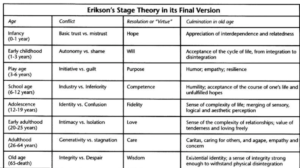
When a psychosocial crisis is resolved in a healthy way, the individual develops a core psychological strength, which Erikson called a virtue. These virtues are not moral traits, but emotional capacities that support resilience and well-being.

Examples include:

  • Hope – belief that life is dependable

  • Will – confidence in one’s choices

  • Purpose – motivation to pursue goals

  • Competence – belief in one’s abilities

  • Fidelity – loyalty to one’s identity

  • Love – capacity for deep connection

  • Care – concern for future generations

  • Wisdom – acceptance of life’s meaning

These virtues help individuals navigate stress, loss, transitions, and relationships throughout life.

  1. Unresolved Crises Do Not Mean Permanent Damage

One of the most compassionate aspects of Erikson’s theory is its non-deterministic nature. Failing to resolve a crisis at the “right” age does not mean lifelong pathology.

Instead:

  • It may lead to emotional difficulties

  • Identity confusion can emerge during transitions

  • Relationship problems may repeat familiar patterns

However, Erikson believed that later life experiences can reopen and repair earlier stages. Supportive relationships, corrective emotional experiences, therapy, and self-awareness allow individuals to:

  • Rebuild trust

  • Reclaim autonomy

  • Redefine identity

  • Learn intimacy

This aligns closely with modern trauma-informed and attachment-based therapies.

Why These Foundations Matter Clinically

Understanding these principles helps mental health professionals:

  • Normalize clients’ struggles as developmental, not personal failures

  • Identify the origin of emotional patterns

  • Frame healing as a process, not a fix

  • Instill hope that growth remains possible at every life stage

In essence, Erikson’s theory tells us this:

You are not broken—you are still developing.
Your struggles are signals of unfinished developmental work, not signs of weakness.

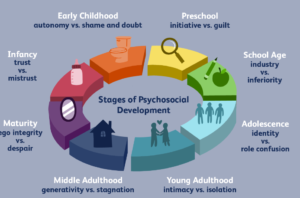
Stage 1: Trust vs. Mistrust (Infancy | 0–1 year)

Central Question: Can I trust the world?

In infancy, the primary task is developing basic trust. This depends on consistent caregiving—feeding, comfort, warmth, and responsiveness.

Healthy Resolution

  • The child feels safe and secure
  • Develops confidence that needs will be met
  • Leads to the virtue of Hope

Unhealthy Resolution

  • Inconsistent or neglectful care creates mistrust
  • May lead to anxiety, fear, emotional insecurity

Adult Impact:
Adults with unresolved mistrust may struggle with dependency, intimacy, or constant fear of abandonment.

Stage 2: Autonomy vs. Shame and Doubt (Early Childhood | 1–3 years)

Central Question: Can I do things on my own?

As toddlers gain motor and language skills, they seek independence—choosing clothes, feeding themselves, saying “no.”

Healthy Resolution

  • Encouragement supports autonomy
  • Child develops confidence and self-control
  • Leads to the virtue of Will

Unhealthy Resolution

  • Overly critical or controlling parenting creates shame
  • Child doubts abilities and fears mistakes

Adult Impact:
May appear as low self-esteem, perfectionism, or fear of making decisions.

Stage 3: Initiative vs. Guilt (Preschool | 3–6 years)

Central Question: Is it okay for me to want and do things?

Children begin planning activities, playing roles, and asserting power over their environment.

Healthy Resolution

  • Initiative is encouraged
  • Child learns leadership and imagination
  • Leads to the virtue of Purpose

Unhealthy Resolution

  • Excessive punishment or criticism creates guilt
  • Child suppresses curiosity and ambition

Adult Impact:
Chronic guilt, difficulty asserting needs, fear of taking initiative.

Stage 4: Industry vs. Inferiority (School Age | 6–12 years)

Central Question: Am I competent and capable?

School introduces structured learning, comparison with peers, and achievement.

Healthy Resolution

  • Recognition of effort builds competence
  • Child develops confidence in skills
  • Leads to the virtue of Competence

Unhealthy Resolution

  • Repeated failure or criticism leads to inferiority
  • Child feels “not good enough”

Adult Impact:
Workplace insecurity, impostor syndrome, fear of failure.

Stage 5: Identity vs. Role Confusion (Adolescence | 12–18 years)

Central Question: Who am I?

This is one of the most critical stages. Adolescents explore beliefs, career goals, sexuality, and values.

Healthy Resolution

  • Exploration leads to stable identity
  • Sense of self is coherent
  • Leads to the virtue of Fidelity

Unhealthy Resolution

  • Pressure or lack of exploration causes confusion
  • Identity diffusion or dependence on others’ expectations

Adult Impact:
Unstable relationships, career confusion, chronic self-doubt.

Stage 6: Intimacy vs. Isolation (Young Adulthood | 18–40 years)

Central Question: Can I form deep relationships?

The focus shifts from identity to emotional closeness—romantic partnerships, friendships, commitment.

Healthy Resolution

  • Ability to form secure, reciprocal relationships
  • Leads to the virtue of Love

Unhealthy Resolution

  • Fear of closeness or emotional withdrawal
  • Loneliness and isolation

Clinical Insight:
Many relationship issues stem from unresolved identity or trust crises from earlier stages.

Stage 7: Generativity vs. Stagnation (Middle Adulthood | 40–65 years)

Central Question: Am I contributing to the world?

Generativity involves nurturing others—children, students, communities, or meaningful work.

Healthy Resolution

  • Sense of productivity and contribution
  • Leads to the virtue of Care

Unhealthy Resolution

  • Feeling stuck, unproductive, or self-absorbed
  • Emotional emptiness or midlife crisis

Adult Impact:
Burnout, dissatisfaction, lack of purpose.

Stage 8: Integrity vs. Despair (Late Adulthood | 65+ years)

Central Question: Was my life meaningful?

In old age, individuals reflect on life achievements, regrets, and mortality.

Healthy Resolution

  • Acceptance of life as meaningful
  • Sense of peace and fulfillment
  • Leads to the virtue of Wisdom

Unhealthy Resolution

  • Regret, bitterness, fear of death
  • Feelings of despair and hopelessness

Why Erikson’s Theory Still Matters Today

Erik Erikson designed his psychosocial model not only as a theory of development, but as a practical framework for understanding human suffering, resilience, and growth. Because it links emotional difficulties to developmental experiences, Erikson’s model is widely used across multiple mental health and helping professions.

Below is an expanded explanation of how and why Erikson’s model is applied in these fields, and how unresolved psychosocial crises often appear in adult psychological struggles.


  1. Psychotherapy and Counseling

In psychotherapy, Erikson’s model helps clinicians understand where emotional development may have stalled.

Therapists often use the stages to:

  • Identify core emotional wounds (e.g., mistrust, shame, identity confusion)

  • Understand recurring relationship patterns

  • Explore early caregiving experiences without blame

  • Frame problems developmentally rather than pathologically

Clinical Examples

  • Chronic fear of abandonment → unresolved Trust vs. Mistrust

  • Excessive self-criticism → unresolved Autonomy vs. Shame

  • Lack of direction or emptiness → unresolved Identity vs. Role Confusion

Using Erikson’s framework allows therapy to focus on repairing developmental needs, not just reducing symptoms. This aligns well with psychodynamic, attachment-based, and integrative therapeutic approaches.

  1. Child Development and Parenting Guidance

In child psychology and parenting education, Erikson’s stages offer clear age-appropriate emotional tasks.

Professionals use the model to:

  • Help parents understand normal developmental behaviors

  • Prevent over-control or excessive criticism

  • Encourage autonomy, initiative, and competence

  • Reduce shame-based parenting practices

Practical Parenting Insights

  • Toddlers need choices to develop autonomy

  • Preschoolers need encouragement, not punishment, for curiosity

  • School-age children need recognition of effort, not comparison

By aligning parenting strategies with psychosocial stages, caregivers can support emotionally secure and confident children, reducing the risk of later mental health difficulties.

  1. Career Counseling and Vocational Guidance

Erikson’s theory is highly relevant in career counseling, especially during adolescence, early adulthood, and midlife.

Career counselors apply the model to:

  • Understand identity struggles behind career indecision

  • Address fear of failure rooted in inferiority

  • Support career transitions and midlife re-evaluation

  • Help clients connect work with meaning and contribution

Developmental Lens in Career Issues

  • Frequent job changes → identity confusion

  • Fear of leadership roles → unresolved inferiority

  • Midlife burnout → stagnation vs. generativity conflict

Rather than pushing quick career choices, Erikson’s model encourages identity exploration and value clarification, leading to more sustainable career paths.

  1. Geriatric Mental Health

In geriatric psychology, Erikson’s final stage—Integrity vs. Despair—is central to emotional well-being in later life.

Mental health professionals use this stage to:

  • Support life review and meaning-making

  • Address regret, grief, and fear of death

  • Reduce depression and existential distress

  • Promote acceptance and wisdom

Therapeutic Applications

  • Reminiscence therapy

  • Narrative therapy

  • Meaning-centered interventions

Helping older adults integrate life experiences—both successes and failures—supports emotional peace and dignity in aging.

  1. Trauma-Informed Care

Trauma often disrupts psychosocial development by interfering with safety, trust, autonomy, and identity. Erikson’s model is therefore especially valuable in trauma-informed care.

Practitioners use it to:

  • Understand trauma as developmental interruption

  • Avoid blaming clients for survival adaptations

  • Create corrective emotional experiences

  • Restore a sense of control, connection, and meaning

Trauma and Development

  • Childhood abuse → mistrust and shame

  • Chronic neglect → emotional numbness

  • Complex trauma → fragmented identity

Erikson’s framework helps clinicians meet clients at the developmental level where trauma occurred, rather than focusing only on adult symptoms.

Understanding Adult Psychological Struggles Through Erikson’s Lens

Many adult difficulties are not random—they are developmental echoes:

  • Relationship difficulties often reflect unresolved trust or intimacy conflicts

  • Low self-worth frequently stems from shame or inferiority

  • Emotional numbness can be a defense developed during earlier unmet emotional needs

By identifying which psychosocial crisis remains unresolved, therapy can move from “What’s wrong with me?” to “What developmental need was unmet?”

Why This Model Remains Clinically Powerful

Erikson’s theory is still widely used because it:

  • Humanizes psychological distress

  • Normalizes struggle as part of development

  • Integrates well with modern therapeutic approaches

  • Offers hope that healing is possible at any stage of life

Clinical and Counseling Applications

As a counselor or mental health practitioner, Erikson’s stages help:

  • Identify developmental wounds
  • Understand recurring behavioral patterns
  • Tailor interventions based on life stage
  • Normalize clients’ struggles as developmental, not personal failures

Conclusion

Erik Erikson’s psychosocial theory offers a deeply compassionate and hopeful view of human development. At its core, it reminds us that growth does not stop at childhood or adolescence—it continues throughout the entire lifespan, shaped by relationships, reflection, and lived experience.

Growth Is Continuous, Not Fixed

Erikson rejected the idea that early life permanently determines who we become. Instead, he emphasized that development is fluid and revisable. Each stage introduces new opportunities to revisit earlier conflicts under different life conditions.

For example:

  • An adult who lacked trust in childhood may learn safety through a secure relationship

  • Someone who grew up with shame may rediscover autonomy through therapy or mastery experiences

  • A person with identity confusion may find clarity later through career shifts, parenting, or personal loss

This perspective challenges fatalistic thinking and replaces it with psychological flexibility and hope.

Healing Is Always Possible

Unresolved psychosocial crises do not mean failure—they reflect needs that were unmet at a particular time. Erikson believed that healing occurs when individuals receive:

  • Awareness – understanding the origin of emotional patterns

  • Supportive relationships – corrective emotional experiences that rewrite old expectations

  • Therapeutic intervention – structured spaces to process, integrate, and reframe experiences

Modern psychotherapy often recreates the conditions necessary for healthy psychosocial resolution—safety, validation, choice, and meaning.

Reworking Developmental Conflicts in Adulthood

Life naturally brings moments that reopen earlier stages:

  • Intimate relationships revisit trust and autonomy

  • Career transitions reawaken competence and identity

  • Parenthood activates generativity and unresolved childhood experiences

  • Aging invites reflection on integrity and life meaning

Rather than seeing these moments as setbacks, Erikson’s model frames them as second chances for growth.

Human Development Is About Meaning, Not Perfection

Perhaps the most profound contribution of Erikson’s theory is its emphasis on meaning-making. Development is not about completing stages flawlessly or avoiding pain—it is about:

  • Integrating successes and failures

  • Making sense of suffering

  • Accepting limitations without despair

  • Finding coherence in one’s life story

Psychological health, in this sense, is the ability to say:
“My life was imperfect, but it was meaningful.”

A Lifespan Perspective for Mental Health

Erikson’s theory aligns closely with contemporary mental health practices that value:

  • Narrative identity

  • Self-compassion

  • Trauma-informed care

  • Lifelong learning and adaptation

It invites both clinicians and individuals to ask not “What went wrong?” but “What is still trying to grow?”

In essence:

Erikson’s psychosocial theory reminds us that healing is not about erasing the past, but about understanding it, integrating it, and growing beyond it. At every stage of life, humans retain the capacity to develop new strengths, deeper connections, and richer meaning.

Frequently Asked Questions (FAQ): Erikson’s Psychosocial Theory


1. Who proposed the psychosocial theory of development?

Erikson’s psychosocial theory was proposed by Erik Erikson, a German-American developmental psychologist. He expanded earlier psychoanalytic ideas by emphasizing the role of social relationships and culture in shaping personality across the entire lifespan.


2. How many stages are there in Erikson’s psychosocial theory?

Erikson proposed eight psychosocial stages, spanning from infancy to late adulthood. Each stage involves a central psychological conflict that must be negotiated for healthy emotional development.


3. What is meant by a “psychosocial crisis”?

A psychosocial crisis refers to a developmental conflict between two opposing tendencies (for example, trust vs. mistrust or intimacy vs. isolation). These crises are not disasters; they are normal psychological challenges that promote growth when addressed constructively.


4. What happens if a psychosocial stage is not resolved properly?

If a stage is not resolved in a healthy way, it may lead to:

  • Emotional insecurity

  • Low self-esteem

  • Relationship difficulties

  • Identity confusion

However, Erikson emphasized that unresolved stages are not permanent failures. They can be revisited and healed later in life through insight, supportive relationships, and therapy.


5. Can adults revisit and resolve earlier psychosocial stages?

Yes. One of the most important aspects of Erikson’s theory is that development is lifelong. Adults often revisit earlier stages during:

  • Romantic relationships

  • Career transitions

  • Parenthood

  • Therapy

  • Major life crises

These moments provide opportunities for corrective emotional experiences and psychological healing.


6. How is Erikson’s theory used in psychotherapy and counseling?

Therapists use Erikson’s framework to:

  • Identify developmental roots of emotional struggles

  • Understand recurring relationship patterns

  • Normalize clients’ difficulties as developmental, not pathological

  • Guide therapeutic goals such as rebuilding trust, autonomy, or identity

It is especially useful in psychodynamic, attachment-based, and trauma-informed approaches.


7. Why is Erikson’s theory important for parenting?

Erikson’s stages help parents understand age-appropriate emotional needs, such as:

  • Trust in infancy

  • Autonomy in toddlerhood

  • Initiative in preschool years

  • Competence in school-age children

This understanding reduces harmful practices like overcontrol, excessive criticism, or unrealistic expectations.


8. How does Erikson’s theory explain identity confusion in adolescents?

During adolescence, individuals face the crisis of Identity vs. Role Confusion. Without adequate exploration and social support, adolescents may struggle with:

  • Self-doubt

  • Peer pressure

  • Career indecision

  • Unstable self-image

Healthy identity formation requires time, experimentation, and acceptance.

9. Is Erikson’s theory relevant in old age?

Yes. The final stage, Integrity vs. Despair, is central to geriatric mental health. It focuses on:

  • Life review

  • Acceptance of one’s life story

  • Coping with regret and mortality

  • Developing wisdom and emotional peace

This stage is especially relevant in counseling older adults.

10. What is the main message of Erikson’s psychosocial theory?

The core message is that human development is about meaning, not perfection. Growth continues throughout life, and healing is always possible. Psychological struggles often reflect unfinished developmental work, not personal weakness.

Reference