
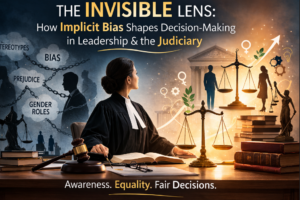
In modern societies, we often believe that decision-making—especially in leadership and judicial systems—is purely rational and objective. Judges evaluate evidence, leaders analyze facts, and decisions are expected to be impartial. However, psychology reveals a deeper truth: human decisions are rarely free from cognitive influences. One of the most powerful yet subtle influences is implicit bias.
Implicit bias refers to the unconscious attitudes or stereotypes that affect our understanding, actions, and judgments without conscious awareness. Unlike explicit prejudice, implicit biases operate silently, often contradicting our conscious beliefs about fairness and equality.
The Psychological Mechanism of Implicit Bias
From a cognitive psychology perspective, the human brain continuously relies on mental shortcuts known as heuristics to process the vast amount of information it encounters every day. Because our cognitive resources are limited, the brain cannot carefully analyze every situation in detail. Instead, heuristics allow individuals to make rapid judgments and decisions with minimal cognitive effort. These shortcuts are often useful and adaptive, helping us respond quickly in complex environments. However, they can also lead to systematic cognitive biases, especially when decisions are influenced by stereotypes, past experiences, cultural narratives, and social conditioning.
Over time, people internalize societal messages about gender roles, authority, and competence. These internalized patterns become part of our implicit cognitive schemas, which automatically shape perceptions and expectations. For instance, research in social and organizational psychology has shown that many individuals unconsciously associate leadership traits such as assertiveness, dominance, and authority with masculinity, while associating nurturing, caregiving, and emotional sensitivity with femininity. Importantly, these associations can operate even among individuals who consciously endorse gender equality and strongly believe in fairness.
This phenomenon can be better understood through the dual-process theory of cognition, which proposes that human thinking operates through two interacting systems.
- System 1 thinking is fast, intuitive, automatic, and largely unconscious. It relies heavily on heuristics and learned associations, enabling people to make quick judgments without deliberate reasoning. Because it operates automatically, System 1 can easily activate implicit stereotypes and biases without the individual being aware of it.
- In contrast, System 2 thinking is slow, deliberate, analytical, and effortful. It involves conscious reasoning, critical evaluation of evidence, and reflective decision-making. System 2 has the capacity to monitor and override automatic responses generated by System 1, but it requires attention and cognitive effort.
Implicit bias primarily operates through System 1 processing, influencing perceptions, evaluations, and judgments before conscious reasoning has the opportunity to intervene. As a result, individuals may unknowingly interpret behaviors, competence, or credibility through the lens of unconscious associations. Understanding this cognitive mechanism is crucial for recognizing how implicit bias can shape decision-making processes in areas such as leadership selection, workplace evaluation, and judicial reasoning, even when individuals strive to act fairly and objectively.
Implicit Bias in Leadership and Judicial Decision-Making
In leadership contexts, implicit bias can subtly influence a wide range of professional decisions, including hiring practices, promotion opportunities, performance evaluations, and perceptions of competence or authority. Even when organizations aim to promote fairness and merit-based evaluation, unconscious stereotypes may shape how leadership qualities are interpreted.
Women leaders, for example, often face what psychologists describe as the “double bind dilemma.” Leadership is traditionally associated with traits such as assertiveness, decisiveness, and dominance—qualities that are culturally coded as masculine. When women demonstrate these traits, they may be perceived as overly aggressive, unlikable, or difficult. Conversely, when they exhibit warmth, empathy, or cooperation—traits socially associated with femininity—they may be judged as less authoritative or less capable of leading effectively. This tension creates a psychological and social challenge where women leaders are evaluated through conflicting expectations.
Within judicial systems, implicit bias can also influence how information is perceived and interpreted. Judges, lawyers, and jurors are expected to make objective decisions based on evidence and legal reasoning; however, psychological research suggests that unconscious cognitive processes can still shape interpretations of evidence, credibility of witnesses, and behavioral judgments. For instance, stereotypes related to gender, race, social class, or cultural background may unconsciously affect how individuals interpret a person’s reliability, honesty, or responsibility. Studies in legal psychology have shown that subtle cues—such as appearance, speech patterns, or emotional expression—can sometimes influence perceptions of guilt, innocence, or moral accountability, even among highly trained professionals who consciously strive for neutrality.
It is important to emphasize that implicit bias does not necessarily reflect deliberate prejudice or intentional discrimination. Instead, it highlights how deeply embedded social stereotypes and automatic cognitive processes interact with institutional structures and professional decision-making. These unconscious influences illustrate the complex relationship between individual cognition and broader social norms, reminding us that achieving true fairness requires not only ethical commitment but also awareness of the psychological mechanisms that shape judgment and behavior.
Gender Dynamics and the Importance of Representation
The presence of women in leadership and judiciary roles plays a crucial role in promoting gender-sensitive perspectives and reducing systemic bias. From the perspective of social role theory, representation helps challenge traditional stereotypes about authority and competence.
Moreover, diverse leadership teams encourage cognitive diversity, which improves decision-making quality by incorporating multiple perspectives and reducing groupthink.
Psychological Strategies to Reduce Implicit Bias
Psychology also offers evidence-based approaches to minimize implicit bias in decision-making:
-
Awareness Training
Recognizing that everyone possesses implicit biases is the first step toward reducing their influence. -
Structured Decision-Making
Using standardized evaluation criteria can reduce reliance on subjective judgments. -
Perspective-Taking
Research shows that actively considering another person’s viewpoint can reduce stereotypical thinking. -
Diverse Environments
Regular interaction with diverse groups helps weaken automatic stereotypes over time.
Toward More Conscious Leadership
Implicit bias reminds us that fairness is not only a moral commitment but also a psychological challenge. By understanding how unconscious processes influence judgment, institutions can design systems that promote equity, transparency, and accountability.
As more women step into leadership and judicial roles, they not only break structural barriers but also contribute to reshaping the psychological landscape of authority and decision-making.
Ultimately, the goal is not to eliminate human cognition—an impossible task—but to ensure that our decisions are guided more by awareness than by invisible biases.
Reference
1. Implicit Bias and Social Cognition
Greenwald, A. G., & Banaji, M. R. (1995).
Implicit Social Cognition: Attitudes, Self-Esteem, and Stereotypes.
Journal Psychological Review.
🔗 https://doi.org/10.1037/0033-295X.102.1.4
2. Dual-Process Theory of Thinking
Kahneman, D. (2011).
Thinking, Fast and Slow.
🔗 https://us.macmillan.com/books/9780374533557/thinkingfastandslow
3. Gender Bias in Leadership Evaluation
Heilman, M. E. (2001).
Description and Prescription: How Gender Stereotypes Prevent Women’s Ascent Up the Organizational Ladder.
Journal of Social Issues.
🔗 https://doi.org/10.1111/0022-4537.00234
5. The Psychology of Protest: How Crowds Think, Feel, and Act Together
Written by Baishakhi Das
Counselor | Mental Health Practitioner
B.Sc, M.Sc, PG Diploma in Counseling
Pingback: Breaking the Habit Loop: Quitting Smoking on No Smoking Day