
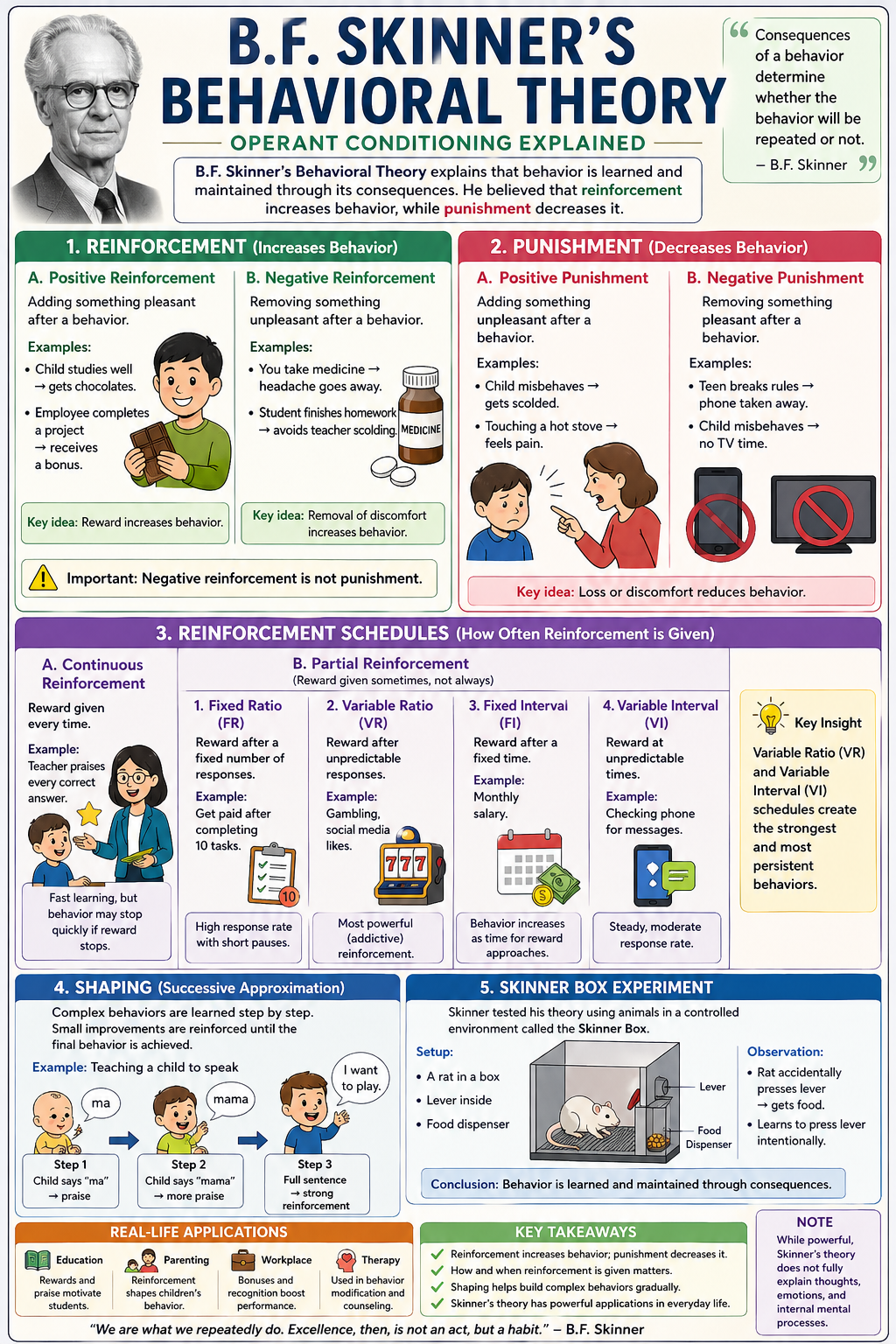
“Why do we repeat some behaviors without even thinking? The answer lies in Skinner’s powerful theory of reinforcement.”
Introduction
Behavioral psychology focuses on observable actions rather than internal thoughts or emotions. One of the most influential figures in this field is Burrhus Frederic Skinner (B.F. Skinner), who developed a powerful framework known as Operant Conditioning. His theory explains how behavior is shaped and maintained by its consequences.
Skinner believed that human and animal behavior is not random—it is learned through interaction with the environment. By understanding how reinforcement and punishment work, we can influence behavior in predictable ways. This theory has wide applications in education, parenting, therapy, workplace management, and even digital technology.
Core Concept: Operant Conditioning
At the heart of Skinner’s theory is Operant Conditioning, a learning process in which behavior is influenced by consequences.
In simple terms:
- If a behavior is followed by a positive outcome, it is likely to be repeated.
- A behavior is followed by a negative outcome, it is less likely to be repeated.
Basic Structure
- Behavior → Consequence → Future Behavior
Key Components of Skinner Behavioral Theory
1. Reinforcement
Reinforcement is the central mechanism in B. F. Skinner’s theory of Operant Conditioning. It refers to any consequence that strengthens a behavior, increasing the likelihood that the behavior will be repeated in the future.
The key idea is simple but powerful:
Behavior that is reinforced tends to be repeated.
Reinforcement works by creating an association between behavior and outcome, shaping how individuals interact with their environment over time.
A. Positive Reinforcement
Positive reinforcement involves adding a desirable stimulus after a behavior occurs.
It answers the question: “What reward follows this behavior?”
How it works psychologically
When a person receives something pleasant (reward), the brain releases dopamine, reinforcing the neural pathway associated with that behavior. Over time, the behavior becomes habitual.
Examples
- Child learning behavior
A child completes homework → receives praise or chocolate → associates studying with reward → studies consistently. - Workplace motivation
Employee meets targets → gets bonus/promotion → increases productivity. - Social behavior
A person posts on social media → receives likes/comments → continues posting more frequently. - Counselling application
A client practices relaxation techniques → therapist praises effort → client continues practicing.
Key insight: Positive reinforcement builds desired behaviors without fear or pressure, making it one of the most effective tools in education and therapy.
B. Negative Reinforcement
Negative reinforcement involves removing an unpleasant stimulus after a behavior occurs.
It answers: “What discomfort is removed after this behavior?”
Common Misconception:
Negative reinforcement is often confused with punishment.
But:
- Reinforcement (positive or negative) = increases behavior
- Punishment = decreases behavior
How it works psychologically
The behavior becomes stronger because it helps the individual escape or avoid discomfort.
Examples
- Health behavior
Taking medicine → headache disappears → increases likelihood of taking medicine again. - Academic behavior
Student completes homework → avoids teacher scolding → continues completing work. - Daily life
Wearing sunscreen → avoids sunburn → continues using sunscreen. - Mental health context
A person avoids social situations → anxiety reduces → avoidance behavior increases (this can become maladaptive).
Clinical insight: Negative reinforcement plays a big role in anxiety disorders, where avoidance behaviors are maintained because they reduce discomfort.
2. Punishment
Punishment refers to consequences that reduce or weaken a behavior, making it less likely to occur again.
Behavior followed by unpleasant outcomes tends to decrease.
However, Skinner himself was cautious about punishment, as it often produces temporary suppression rather than long-term change.
A. Positive Punishment
Positive punishment involves adding an unpleasant stimulus after a behavior.
Examples
- Child misbehaves → gets scolded → reduces misbehavior
- Touching fire → pain → avoids touching again
- Employee violates rules → receives warning → avoids violation
Limitations
- May create fear or anxiety
- Does not teach alternative behavior
- Can damage relationships
B. Negative Punishment
Negative punishment involves removing a desirable stimulus after a behavior.
Examples
- Teen breaks rules → phone confiscated → reduces rule-breaking
- Child misbehaves → no TV time → improves behavior
- Student disrupts class → loses playtime → reduces disruption
Why it works
The loss of something valued creates a cost associated with the behavior, discouraging repetition.
Important Insight on Punishment
While punishment can stop behavior quickly, it is less effective than reinforcement for long-term behavior change because:
- It does not explain what to do instead
- May lead to avoidance or aggression
- It can harm emotional well-being
In counselling and parenting, reinforcement is preferred over punishment.
3. Reinforcement Schedules
Skinner discovered that the timing and frequency of reinforcement significantly influence how strongly a behavior is learned and maintained.
This led to the concept of Reinforcement Schedules.
A. Continuous Reinforcement
Behavior is reinforced every time it occurs.
Example
- Teacher praises every correct answer
- Dog gets a treat every time it sits on command
Advantages
- Fast learning
- Clear association
Disadvantages
- Behavior may stop quickly when reinforcement stops (extinction)
B. Partial Reinforcement
Behavior is reinforced only sometimes, making it more resistant to extinction.
1. Fixed Ratio (FR)
Reinforcement after a fixed number of responses.
Example:
- Factory worker paid after producing 10 items
- Loyalty card: buy 5 coffees, get 1 free
Produces high response rate with short pauses
2. Variable Ratio (VR)
Reinforcement after an unpredictable number of responses.
Example:
- Gambling
- Social media engagement (likes/comments)
Produces very high and persistent behavior
Most addictive schedule
3. Fixed Interval (FI)
Reinforcement after a fixed time period.
Example:
- Monthly salary
- Weekly test preparation
Behavior increases as the time for reward approaches
4. Variable Interval (VI)
Reinforcement at unpredictable time intervals.
Example:
- Checking phone notifications
- Surprise quizzes
Produces steady, moderate behavior
Key Insight
Variable schedules (especially VR) create the strongest habits, which is why they are widely used in:
- Gaming
- Social media
- Marketing strategies
4. Shaping
Shaping is a process of reinforcing small steps toward a desired complex behavior.
Instead of expecting perfect behavior immediately, gradual improvements are rewarded.
How Shaping Works
- Identify target behavior
- Reinforce small steps toward it
- Gradually increase expectations
Examples
Child Development
- Child says “ma” → praise
- Says “mama” → more praise
- Forms sentence → strong reinforcement
Therapy Context
- Client avoids social interaction
- Step 1: Makes eye contact → reinforced
- Step 2: Says “hello” → reinforced
- Step 3: Holds conversation → reinforced
Used widely in:
- Autism interventions
- Behavioral therapy
- Skill training
Key Insight
Shaping allows learning of complex behaviors that would not occur naturally, making it one of Skinner’s most practical contributions.
Skinner Box Experiment
The Skinner Box (Operant Conditioning Chamber) was a controlled experimental setup used by Skinner to study behavior scientifically.
Experimental Setup
- Animal (rat or pigeon) placed inside a box
- Lever or key present
- Food dispenser connected to lever
Learning Process
- Animal explores randomly
- Accidentally presses lever → receives food
- Associates lever press with reward
- Begins pressing lever intentionally
Advanced Findings
Skinner also demonstrated:
- Reinforcement schedules
- Extinction (behavior stops when reinforcement stops)
- Superstitious behavior (random reinforcement creates false associations)
Example of Superstitious Behavior
A pigeon receives food randomly → starts turning in circles → believes turning causes food → repeats behavior
Similar to human superstitions (e.g., lucky rituals)
Applications of Skinner’s Theory
1. Education
Teachers use reinforcement to encourage learning.
Example:
- Star stickers for good work
- Praise for participation
- Grades as reinforcement
Problem: Over-reliance on rewards can reduce intrinsic motivation.
2. Parenting
Parents shape children’s behavior using rewards and punishments.
Example:
- Rewarding good behavior (positive reinforcement)
- Time-out for misbehavior (negative punishment)
3. Workplace
Organizations use reinforcement systems.
Example:
- Bonuses, promotions → positive reinforcement
- Warning letters → punishment
4. Therapy (Behavioral Therapy)
Used in:
Example:
Token economy system:
- Earn points for good behavior
- Exchange points for rewards
5. Technology & Social Media
Apps use variable reinforcement schedules.
Example:
- Notifications
- Likes and comments
Keeps users engaged (sometimes addictive).
Strengths of Skinner’s Theory
- Scientifically measurable
- Practical and applicable
- Useful in behavior modification
- Effective in structured environments
Criticisms of Skinner’s Theory
Despite its usefulness, the theory has limitations:
1. Ignores Internal Mental Processes: It focuses only on observable behavior, ignoring thoughts and emotions.
2. Over-Simplifies Human Behavior : Human behavior is more complex than just reward and punishment.
3. Ethical Concerns: Manipulation of behavior, Excessive control
4. Reduces Free Will: Suggests humans are controlled by environment, not choice.
Skinner vs Other Theorists
| Theorist | Theory | Key Idea |
|---|---|---|
| Pavlov | Classical Conditioning | Learning through association |
| Watson | Behaviorism | Focus on observable behavior |
| Skinner | Operant Conditioning | Learning through consequences |
Practical Examples for Better Understanding
Example 1: Studying Habit
- Student studies → gets good marks → continues studying
Positive reinforcement
Example 2: Avoiding Traffic Rules
- Breaks rules → fined → stops breaking rules
Punishment
Example 3: Gym Motivation
- Exercise → feel healthier → continue exercising
Negative reinforcement (removal of discomfort)
Example 4: Social Media Addiction
- Post content → get likes randomly → keep posting
Variable ratio reinforcement
How to Apply Skinner’s Theory in Daily Life
1. Build Good Habits: Reward yourself after completing tasks.
2. Break Bad Habits: Introduce mild punishment or remove rewards.
3. Parenting Tip: Use more reinforcement than punishment.
4. Counseling Practice Insight: Use behavioral contracts, Apply token economy systems, Reinforce small improvements in clients
Conclusion
Skinner’s Behavioral Theory provides a powerful lens to understand how behavior is shaped by consequences. Through operant conditioning, reinforcement, punishment, and shaping, we can influence learning and behavior in structured ways.
Although it has limitations, its practical applications make it one of the most impactful psychological theories in real-world settings. Whether in classrooms, therapy rooms, or daily life, Skinner’s principles continue to guide behavior modification strategies.
Frequently Asked Questions (FAQ)
1. What is B.F. Skinner’s Behavioral Theory?
B. F. Skinner’s Behavioral Theory focuses on how behavior is learned and shaped through consequences, mainly using reinforcement and punishment.
2. What is operant conditioning in simple terms?
Operant conditioning is a learning process where behavior is influenced by rewards or punishments, making it more or less likely to occur again.
3. What is the difference between positive and negative reinforcement?
- Positive reinforcement adds a reward (e.g., praise).
- Negative reinforcement removes discomfort (e.g., avoiding scolding).
Both increase behavior.
4. Is negative reinforcement the same as punishment?
No. Negative reinforcement increases behavior by removing something unpleasant, while punishment decreases behavior.
5. What are real-life examples of reinforcement?
Examples include giving children rewards for good behavior, bonuses at work, or receiving likes on social media posts.
6. What are reinforcement schedules?
Reinforcement schedules refer to how often rewards are given, such as continuous, fixed ratio, variable ratio, fixed interval, and variable interval.
7. Which reinforcement schedule is most effective?
Variable ratio reinforcement is the most powerful because it creates strong and persistent behavior (e.g., gambling, social media engagement).
8. What is shaping in psychology?
Shaping is a technique where small steps toward a desired behavior are reinforced until the full behavior is learned.
9. How is Skinner’s theory used in therapy?
It is used in behavior therapy, token economy systems, and interventions for conditions like autism, anxiety, and addiction.
10. What are the limitations of Skinner’s theory?
It ignores internal mental processes, oversimplifies human behavior, and may raise ethical concerns regarding control and manipulation.
References
Here are credible academic references you can include:
- Skinner, B. F. (1953). Science and human behavior. New York: Macmillan.
- Skinner, B. F. (1938). The behavior of organisms: An experimental analysis. New York: Appleton-Century-Crofts.
- Cherry, K. (2023). Operant conditioning: What it is and how it works. Retrieved from https://www.verywellmind.com/operant-conditioning-a2-2794863
- McLeod, S. (2018). Skinner – operant conditioning. Retrieved from https://www.simplypsychology.org/operant-conditioning.html
- American Psychological Association. (n.d.). Behaviorism. Retrieved from https://dictionary.apa.org/behaviorism
-
Monoprova Counselling, (2026), “About Us”,
-
Monoprova Counselling, (2026), “Contact Us”,
This article is written for knowledge purposes, aiming to help readers understand the topic better and gain useful insights for learning and awareness.
Pingback: How Aripiprazole Affects Behaviour: Psychological Effects