Structure of Personality: Id, Ego & Superego Explained Simply

Introduction

Impulsive actions often leave us wondering why we didn’t think twice.
Guilt has a way of appearing even in complete privacy.
These experiences point to an inner conflict between what we want and what we believe we should do.

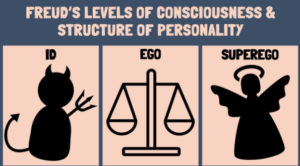
To answer these questions, Sigmund Freud proposed one of the most influential models of personality in psychology—the structural model of personality, consisting of the Id, Ego, and Superego.

Freud believed that human personality is not a single, unified system. Instead, personality is shaped through a dynamic interaction of three mental forces; together, they constantly negotiate and influence behavior.These forces operate largely outside conscious awareness and shape our thoughts, emotions, decisions, behavior, and even mental health.

This article explains the Id, Ego, and Superego in simple language, with real-life examples, clinical relevance, and everyday applications, making it useful for students, counselors, educators, and general readers.

Freud’s Structural Model of Personality: An Overview

Freud introduced the structural model in his work The Ego and the Id (1923). According to him:

  • Personality develops through inner conflict

  • Behavior is the result of interaction, not dominance of one part

  • Psychological problems arise when these parts are imbalanced

The three components are:

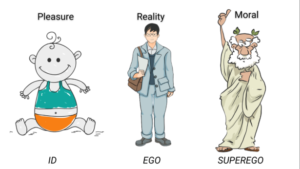
  1. Id – “I want it now”

  2. Ego – “Let’s think logically”

  3. Superego – “This is right or wrong”

They are not physical structures of the brain but theoretical constructs that help explain human behavior.

The Id: The Primitive Core of Personality

What Is the Id?

The Id is the oldest and most primitive part of personality. It is present from birth and operates entirely in the unconscious mind.

The id follows the pleasure principle, meaning:

“Seek pleasure, avoid pain, and satisfy desires immediately.”

The id does not care about:

  • Morality

  • Social rules

  • Consequences

  • Reality

Key Characteristics of the Id

  • Completely unconscious

  • Irrational and impulsive

  • Demands instant gratification

  • Driven by biological instincts

Freud believed the id contains two major instinctual drives:

  • Life instincts (Eros) – hunger, thirst, sex, survival

  • Death instincts (Thanatos) – aggression, destruction

Real-Life Examples of the Id

  • A baby crying loudly until it is fed

  • Eating junk food despite knowing it’s unhealthy

  • Sudden anger and shouting without thinking

  • Impulsive spending without planning

In adulthood, id-driven behavior may appear as:

  • Addictions

  • Aggression

  • Risk-taking

  • Poor impulse control

Id and Mental Health

When the id dominates personality:

  • The person may act recklessly

  • Difficulty delaying gratification

  • Problems with authority and rules

  • Higher risk of antisocial behavior

The id itself is not “bad”—it provides energy and motivation—but without regulation, it becomes destructive.
The Ego: The Rational Decision-Maker

What Is the Ego?

The Ego develops from the id during early childhood. It acts as the mediator between the id’s demands, the superego’s moral pressure, and external reality.

The ego follows the reality principle, which means:

“How can I satisfy this desire in a realistic and socially acceptable way?”

Functions of the Ego

  • Logical thinking

  • Problem-solving

  • Planning and decision-making

  • Delaying gratification

  • Reality testing

The ego operates at all three levels:

  • Conscious

  • Preconscious

  • Unconscious

Everyday Examples of the Ego

  • Feeling hungry (id) but waiting until lunchtime

  • Wanting to shout at your boss but choosing calm communication

  • Saving money instead of spending impulsively

The ego says:

“Not now.”
“Let’s find a better way.”
“Think about consequences.”

Ego Strength and Mental Health

A healthy ego leads to:

  • Emotional balance

  • Good coping skills

  • Problem-solving ability

  • Healthy relationships

A weak ego may result in:

  • Anxiety

  • Poor decision-making

  • Dependence on defense mechanisms

  • Emotional instability

The Superego: The Moral Judge

What Is the Superego?

The Superego represents moral values, conscience, and societal rules. It develops around the age of 4–6 years through parental guidance, cultural norms, and social expectations.

The superego strives for perfection, not pleasure or practicality.

Components of the Superego

  1. Conscience

    • Punishes wrongdoing

    • Produces guilt, shame, anxiety

  2. Ego Ideal

    • Rewards good behavior

    • Produces pride, self-worth

Examples of the Superego

  • Feeling guilty for lying

  • Feeling ashamed after hurting someone

  • Wanting to be a “good person”

  • Avoiding temptation due to moral values

The superego says:

“This is wrong.”
“You should not do this.”
“Be better.”

Superego and Psychological Problems

An overly strict superego may cause:

  • Excessive guilt

  • Low self-esteem

  • Anxiety disorders

  • Depression

  • Perfectionism

A weak superego may lead to:

  • Lack of empathy

  • Moral indifference

  • Rule-breaking behavior

Interaction Between Id, Ego, and Superego

Personality is shaped by constant conflict among these three systems.

Example: Eating Cake on a Diet

  • Id: “Eat it now!”

  • Superego: “It’s unhealthy. Don’t do it.”

  • Ego: “I’ll have a small piece today and exercise later.”
    In this way,
    healthy behavior emerges as the ego creates balance between desire and self-control.

Defense Mechanisms: Ego’s Tools for Balance

When inner conflicts create anxiety, therefore, the ego unconsciously relies on defense mechanisms to protect the individual. unconsciously to protect the individual.

Common defense mechanisms include:

  • Repression

  • Denial

  • Projection

  • Rationalization

  • Displacement

  • Regression

  • Sublimation

Example:

  • Anger at your boss → shouting at family (displacement)

Defense mechanisms are normal, but excessive use can lead to emotional problems.

Clinical Importance in Counseling & Therapy

Understanding the id–ego–superego helps counselors:

  • Identify unconscious conflicts

  • Understand resistance and defense patterns

  • Explore guilt, shame, and impulse control

  • Address childhood-based emotional struggles

In psychodynamic therapy, strengthening the ego is often a key therapeutic goal.

Criticism of the Structural Model

Despite its influence, Freud’s model is criticized for:

  • Lack of scientific testing

  • Overemphasis on unconscious processes

  • Cultural and gender bias

  • Abstract concepts difficult to measure

However, it remains foundational in personality theory and psychotherapy.

Modern Relevance of Id, Ego & Superego

Even today, Freud’s model is used to:

  • Understand emotional conflicts

  • Explain impulsive vs controlled behavior

  • Analyze moral guilt and anxiety

  • Interpret dreams and slips of speech

  • Support psychodynamic counseling

Many modern therapies have evolved but still rely on these core ideas.

Simple Summary Table

Component Key Function Operates On Example
Id Pleasure Unconscious “I want it now”
Ego Reality All levels “Let’s think”
Superego Morality Mostly unconscious “This is wrong”

Conclusion

Freud’s structural model—Id, Ego, and Superego—offers a powerful way to understand human behavior, emotional conflict, and personality development. While the id provides energy, the superego provides values, and the ego maintains balance.

Mental well-being depends not on eliminating any part, but on creating harmony among all three.

Understanding this model helps us become more self-aware, emotionally regulated, and psychologically resilient.

Frequently Asked Questions (FAQ)

Structure of Personality: Id, Ego & Superego Explained Simply


1. What is the structure of personality according to Freud?

According to Sigmund Freud, personality is made up of three interacting components: Id, Ego, and Superego. These parts work together to shape thoughts, emotions, behavior, and decision-making.


2. What is the Id in simple words?

The Id is the impulsive part of personality that wants immediate pleasure. It operates unconsciously and follows the pleasure principle, meaning it seeks instant satisfaction without considering consequences.


3. Is the Id bad or unhealthy?

No. The id is not bad; it provides basic motivation and energy for survival. Problems occur only when the id dominates behavior without control from the ego and superego.


4. What is the Ego and why is it important?

The Ego is the rational decision-maker. It follows the reality principle and balances the demands of the id, the rules of the superego, and real-life situations. A strong ego is essential for emotional stability and mental health.


5. What is the Superego?

The Superego represents moral values, conscience, and societal rules learned from parents and culture. It guides behavior by creating feelings of guilt, shame, pride, or self-approval.


6. What happens if the Superego is too strong?

An overly strong superego can lead to:

  • Excessive guilt

  • Low self-esteem

  • Anxiety or depression

  • Perfectionism

Such individuals may be very self-critical and fear making mistakes.


7. What happens if the Ego is weak?

A weak ego may struggle to manage inner conflicts, leading to:

  • Anxiety

  • Poor decision-making

  • Emotional outbursts

  • Overuse of defense mechanisms


8. How do Id, Ego, and Superego work together?

They constantly interact:

  • Id: “I want this now.”

  • Superego: “This is wrong.”

  • Ego: “Let’s find a realistic and acceptable solution.”

Healthy personality results from effective balance among the three.


9. What are defense mechanisms?

Defense mechanisms are unconscious strategies used by the ego to reduce anxiety caused by conflicts between the id and superego. Examples include repression, denial, projection, rationalization, and sublimation.


10. Are defense mechanisms normal?

Yes. Everyone uses defense mechanisms. They become problematic only when used excessively or rigidly, interfering with healthy emotional functioning.


11. How is this theory useful in counseling and therapy?

Understanding id, ego, and superego helps therapists:

  • Identify unconscious conflicts

  • Understand guilt, shame, and impulse control

  • Work with childhood experiences

  • Strengthen ego functioning

This is especially useful in psychodynamic counseling.


12. Is Freud’s structure of personality scientifically proven?

Freud’s model is largely theoretical and not easily testable through experiments. However, it remains influential for understanding personality, emotions, and therapeutic processes.


13. Is the Id–Ego–Superego theory still relevant today?

Yes. While modern psychology has evolved, this model is still used to explain emotional conflicts, moral struggles, impulsive behavior, and inner tension in both clinical and everyday contexts.


14. Can this theory be explained to students easily?

Yes. Using simple examples like hunger, anger, or temptation makes the id–ego–superego model easy to understand for school, college, and competitive exams.


15. What is the main idea of Freud’s structure of personality?

The core idea is that human behavior results from a constant inner conflict between desire (id), morality (superego), and reality (ego). Mental health depends on how well the ego manages this balance.

Written by Baishakhi Das
Qualifications: B.Sc, M.Sc, PG Diploma in Counseling
Role: Counselor / Mental Health Practitioner

Reference

Psychoanalytic Theory: Freud’s View of the Human Mind
https://www.simplypsychology.org/wp-content/uploads/Freud_Iceberg.jpeg?utm_source=chatgpt.com

Introduction

The Psychoanalytic Theory, developed by Sigmund Freud, is one of the most influential and controversial theories in the history of psychology. Freud’s ideas reshaped how humanity understands the human mind, behavior, emotions, personality, and mental illness. At a time when psychological science was still in its infancy, Freud dared to suggest that much of human behavior is driven by unconscious forces, hidden desires, unresolved childhood conflicts, and instinctual drives.

Freud proposed that the mind is not fully accessible to conscious awareness and that our thoughts, feelings, and actions are often shaped by mental processes operating outside our awareness. This radical idea challenged traditional views of rationality and free will and laid the foundation for modern psychotherapy.

Although many of Freud’s ideas have been debated, modified, or criticized, his psychoanalytic framework continues to influence clinical practice, personality theory, literature, art, and popular culture. This article explores Freud’s view of the human mind in depth—covering its structure, levels of consciousness, instinctual drives, personality development, defense mechanisms, and lasting impact.

Historical Background of Psychoanalytic Theory

Freud was born in 1856 in Austria and trained as a neurologist. While treating patients with hysteria and unexplained physical symptoms, Freud observed that many psychological problems could not be explained by organic causes alone. Working with Josef Breuer, he noticed that patients experienced relief when they talked freely about painful memories—a process later known as catharsis.

From these observations, Freud developed psychoanalysis, both as a theory of personality and a method of therapy. He believed that psychological symptoms arise from unresolved unconscious conflicts, often rooted in early childhood experiences.

https://upload.wikimedia.org/wikipedia/commons/3/36/Sigmund_Freud%2C_by_Max_Halberstadt_%28cropped%29.jpg?utm_source=chatgpt.com

Freud’s Topographical Model: Levels of Consciousness

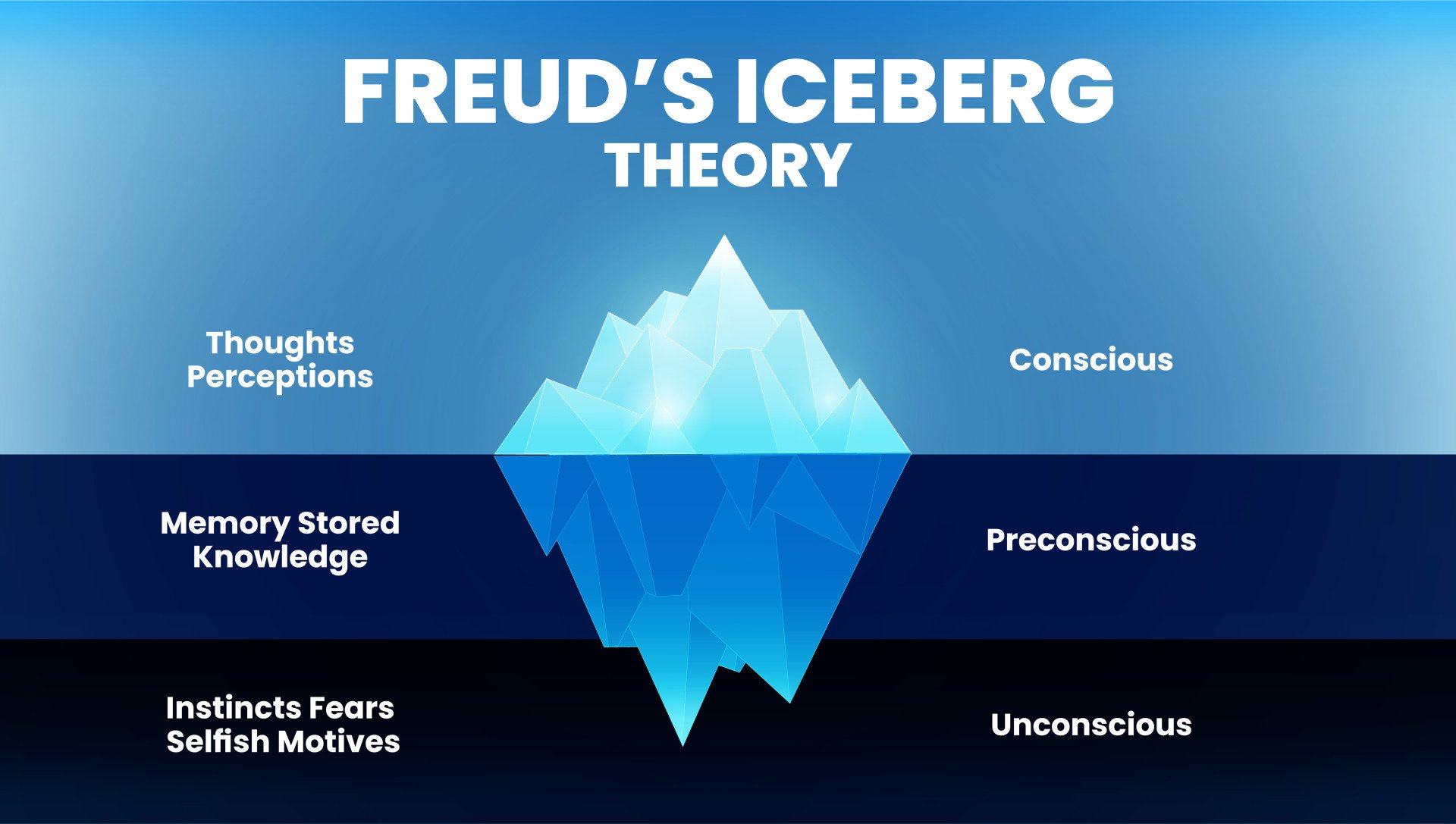
Freud divided the human mind into three levels of awareness:

1. Conscious Mind

The conscious mind includes thoughts, feelings, perceptions, and sensations that we are aware of at any given moment. For example, reading this article, feeling tired, or being aware of anxiety before an exam all belong to conscious awareness.

2. Preconscious Mind

The preconscious contains information that is not currently in awareness but can be easily brought into consciousness. Memories such as your phone number or yesterday’s lunch exist in the preconscious until needed.

3. Unconscious Mind

The unconscious is the most influential and mysterious part of the mind. It contains repressed memories, unresolved conflicts, traumatic experiences, forbidden desires, and instinctual urges. Freud believed that the unconscious mind strongly influences behavior, emotions, dreams, and slips of the tongue (Freudian slips).

The unconscious mind is symbolically represented by the iceberg model, where only a small portion (conscious) is visible above the surface, while the larger mass (unconscious) remains hidden beneath.

The Structural Model of Personality

Freud later refined his theory and introduced the structural model, which explains how personality functions through three interacting components:

1. Id

The id is the most primitive part of personality, present from birth. It operates entirely in the unconscious and follows the pleasure principle, seeking immediate gratification of instincts and desires.

Characteristics of the id:

  • Irrational and impulsive

  • Seeks pleasure and avoids pain

  • Contains sexual (libido) and aggressive instincts

Example: A child crying loudly for food without considering social rules is acting from the id.

2. Ego

The ego develops during early childhood and operates across the conscious, preconscious, and unconscious levels. It follows the reality principle, balancing the demands of the id with the constraints of reality.

Functions of the ego:

  • Logical thinking

  • Decision-making

  • Problem-solving

  • Delaying gratification

The ego acts as a mediator between instinctual urges and societal expectations.

3. Superego

The superego represents internalized moral standards and social rules, largely derived from parents and culture. It develops around the age of five.

Components of the superego:

  • Conscience: punishes behavior with guilt

  • Ego ideal: rewards behavior with pride

The superego strives for perfection and can be overly harsh, leading to feelings of shame or inferiority.

Psychic Energy and Instincts

Freud believed that human behavior is motivated by instinctual energies:

Life Instincts (Eros)

These instincts promote survival, growth, and pleasure. The energy associated with life instincts is called libido, primarily expressed through sexual and affectionate behaviors.

Death Instincts (Thanatos)

Freud later proposed death instincts, which drive aggressive, destructive, and self-destructive behaviors. These instincts may be directed outward as aggression or inward as self-harm.

Psychosexual Stages of Development

One of Freud’s most debated contributions is his theory of psychosexual development, which proposes that personality develops through a series of stages centered on erogenous zones.

1. Oral Stage (0–1 year)

Pleasure is focused on the mouth (sucking, biting).
Fixation may lead to dependency, smoking, overeating, or oral aggression.

2. Anal Stage (1–3 years)

Pleasure focuses on bowel control.
Fixation may result in:

  • Anal-retentive traits: perfectionism, rigidity

  • Anal-expulsive traits: messiness, impulsivity

3. Phallic Stage (3–6 years)

Focus on genital pleasure.
Key concepts:

  • Oedipus Complex: boys’ unconscious desire for the mother and rivalry with the father

  • Electra Complex: girls’ emotional attachment to the father

Resolution leads to identification with the same-sex parent.

4. Latency Stage (6–puberty)

Sexual urges are dormant. Energy is redirected toward learning, friendships, and skill development.

5. Genital Stage (adolescence onward)

Mature sexual interests develop. Successful navigation leads to balanced relationships and productivity.

Defense Mechanisms: Ego’s Protective Strategies

Defense mechanisms are unconscious strategies used by the ego to reduce anxiety caused by internal conflicts.

Common defense mechanisms include:

  • Repression: Blocking distressing thoughts from awareness

  • Denial: Refusing to accept reality

  • Projection: Attributing one’s own feelings to others

  • Displacement: Redirecting emotions to a safer target

  • Rationalization: Justifying unacceptable behavior

  • Regression: Reverting to earlier developmental behaviors

  • Sublimation: Channeling impulses into socially acceptable activities

Defense mechanisms are normal but become problematic when overused.

Dream Analysis: The Royal Road to the Unconscious

Freud believed that dreams provide insight into unconscious desires. He distinguished between:

  • Manifest content: the literal storyline of the dream

  • Latent content: the hidden psychological meaning

Dreams use symbols, condensation, and displacement to disguise unacceptable wishes.

Psychoanalysis as Therapy

Freud developed psychoanalysis as a therapeutic method aimed at making the unconscious conscious. Key techniques include:

  • Free association

  • Dream interpretation

  • Analysis of resistance

  • Transference analysis

The goal is insight, emotional release, and resolution of inner conflicts.

Criticism of Freud’s Theory

Despite its influence, Freud’s theory has faced criticism:

  • Overemphasis on sexuality

  • Lack of scientific testability

  • Gender bias

  • Cultural limitations

Modern psychology has moved toward evidence-based approaches, yet many core ideas remain influential.

Legacy and Modern Relevance

Freud’s work inspired later theorists such as Carl Jung, Alfred Adler, and Erik Erikson. Contemporary therapies like psychodynamic therapy continue to draw from psychoanalytic principles.

Conclusion

Freud’s psychoanalytic theory offers a profound, if complex, understanding of the human mind. By emphasizing unconscious processes, childhood experiences, and internal conflict, Freud transformed psychology from the study of behavior alone into an exploration of inner life. While not without flaws, Freud’s view of the human mind remains a cornerstone of psychological thought, reminding us that beneath conscious awareness lies a vast and powerful mental world shaping who we are.

Frequently Asked Questions (FAQ)

Psychoanalytic Theory: Freud’s View of the Human Mind


1. What is Psychoanalytic Theory?

Psychoanalytic theory is a psychological framework proposed by Sigmund Freud that explains human behavior in terms of unconscious motives, childhood experiences, and inner psychological conflicts. It emphasizes that much of our mental life operates outside conscious awareness.


2. Why is the unconscious mind important in Freud’s theory?

Freud believed the unconscious mind stores repressed memories, unresolved conflicts, and instinctual desires that strongly influence behavior, emotions, dreams, and mental health. Even though we are unaware of these contents, they shape our everyday actions.


3. What are the three levels of consciousness according to Freud?

Freud divided the mind into:

  • Conscious: thoughts and feelings we are aware of

  • Preconscious: information that can be easily recalled

  • Unconscious: hidden desires, memories, and conflicts


4. What are the id, ego, and superego?

They are the three components of personality:

  • Id: instinctual, pleasure-seeking, unconscious

  • Ego: rational, reality-oriented decision-maker

  • Superego: moral conscience and internalized social rules

Personality develops through the constant interaction of these three systems.


5. What is the pleasure principle and reality principle?

  • The pleasure principle (id) seeks immediate gratification of desires.

  • The reality principle (ego) delays gratification and considers social norms and consequences.


6. What are psychosexual stages of development?

Freud proposed that personality develops through five stages:

  1. Oral

  2. Anal

  3. Phallic

  4. Latency

  5. Genital

Unresolved conflicts at any stage may lead to fixation, affecting adult personality.


7. What is fixation in psychoanalytic theory?

Fixation occurs when an individual becomes stuck at a particular psychosexual stage due to unresolved conflict, leading to specific personality traits or behavioral patterns in adulthood.


8. What are defense mechanisms?

Defense mechanisms are unconscious strategies used by the ego to reduce anxiety caused by conflicts between the id, ego, and superego. Common examples include repression, denial, projection, displacement, regression, rationalization, and sublimation.


9. Are defense mechanisms always unhealthy?

No. Defense mechanisms are normal and necessary for psychological functioning. However, excessive or rigid use of certain defenses can contribute to emotional difficulties and mental health problems.


10. What role do dreams play in Freud’s theory?

Freud viewed dreams as the “royal road to the unconscious.” He believed dreams express hidden desires through symbols.

  • Manifest content: what we remember

  • Latent content: the hidden meaning


11. What is psychoanalysis as a therapy?

Psychoanalysis is a long-term therapeutic approach that aims to uncover unconscious conflicts through techniques such as free association, dream analysis, and transference, helping individuals gain insight and emotional healing.


12. What is transference in psychoanalysis?

Transference occurs when a client projects feelings from past relationships (often with parents) onto the therapist. Analyzing transference helps reveal unresolved emotional conflicts.


13. Why is Freud’s theory criticized?

Major criticisms include:

  • Overemphasis on sexuality

  • Lack of scientific testing

  • Gender bias

  • Cultural limitations

Despite this, Freud’s ideas remain historically and clinically influential.


14. Is Freud’s psychoanalytic theory still relevant today?

Yes. While modern psychology has evolved, psychoanalytic concepts continue to influence psychodynamic therapy, personality studies, trauma work, and understanding unconscious processes.


15. How is psychoanalytic theory useful in counseling?

It helps counselors understand:

  • Deep-rooted emotional patterns

  • Childhood trauma effects

  • Repeated relationship conflicts

  • Defense mechanisms and resistance

This insight supports long-term emotional growth and self-awareness.

Reference