
Why do we act on impulse, feel guilt alone, or wonder who we really are? Freud’s Structure of Personality – Id, Ego, and Superego give surprising answers.
Structure of Personality: Introduction
Impulsive actions often leave us wondering why we didn’t think twice.
Guilt has a way of appearing even in complete privacy.
These experiences point to an inner conflict between what we want and what we believe we should do.
To answer these questions, Sigmund Freud proposed one of the most influential models of personality in psychology—the structural model of personality, consisting of the Id, Ego, and Superego.
Freud believed that human personality is not a single, unified system. Instead, personality is shaped through a dynamic interaction of three mental forces; together, they constantly negotiate and influence behavior.These forces operate largely outside conscious awareness and shape our thoughts, emotions, decisions, behavior, and even mental health.
This article explains the Id, Ego, and Superego in simple language, with real-life examples, clinical relevance, and everyday applications, making it useful for students, counselors, educators, and general readers.
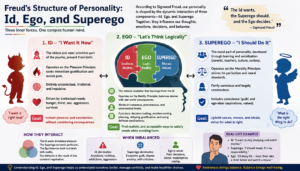
Structure of Personality: Freud’s Structural Model of Personality
Freud introduced the structural model of personality in his seminal work The Ego and the Id (1923). He proposed that the psyche is not a single, unified entity but a dynamic system of three interacting agencies: the Id, Ego, and Superego. These components are not physical brain structures; they are theoretical constructs that help explain how thoughts, emotions, motives, and behaviours arise from inner psychological forces.
Core Psychological Principles of the Model
Personality develops through inner conflict
Freud believed that personality evolves as a result of ongoing tensions between instinctual drives, moral demands, and external reality. These conflicts begin in early childhood and continue throughout life.
Behaviour is the result of interaction, not dominance of one part
Healthy functioning does not come from eliminating the Id or suppressing the Superego, but from the Ego’s ability to balance all three. Behaviour emerges from the dynamic interplay among these forces.
Psychological problems arise when these parts are imbalanced
When the Id dominates, behaviour becomes impulsive and reckless. The Superego is overly harsh, excessive guilt, shame, and anxiety develop. When the Ego is weak, coping fails and defence mechanisms become rigid and maladaptive.
Most of this process is unconscious
The majority of the Id’s operations, many Superego demands, and large parts of Ego functioning occur outside conscious awareness. This unconscious activity shapes our feelings, choices, and mental health in invisible ways.
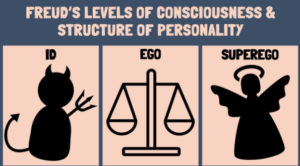
The Three Components: Psychological Functions and Principles
1. Id – “I want it now”
- Nature: The oldest and most primitive part of the psyche, present from birth.
- Operating principle: Pleasure principle – seeks immediate gratification of needs and desires, and avoidance of pain.
- Consciousness level: Entirely unconscious.
Key features:
- Irrational, illogical, and impulsive
- Driven by biological instincts and libidinal energy (psychic energy)
- Contains two major instinctual drives:
-
-
Life instincts (Eros): hunger, thirst, sex, survival, creativity
-
Death instincts (Thanatos): aggression, destruction, self-sabotage
-
-
Psychological role: The Id is the source of psychic energy and basic motivation. Without it, there would be no drive to act, but without regulation, its impulses can be destructive.
2. Ego – “Let’s think logically”
- Nature: The rational, executive part of personality that develops from the Id during early childhood.
- Operating principle: Reality principle – seeks to satisfy the Id’s desires in realistic, safe, and socially acceptable ways.
- Consciousness level: Operates at conscious, preconscious, and unconscious levels.
Key functions:
- Logical thinking and problem-solving
- Planning, decision-making, and delaying gratification
- Reality testing (distinguishing internal fantasies from external reality)
- Mediating between the Id’s demands, the Superego’s moral pressure, and external constraints
- Managing anxiety and employing defence mechanisms when conflicts become overwhelming
Psychological role: The Ego is the executive agent of personality. It organizes perception, cognition, and behaviour to maintain psychological balance and adapt to the environment.
3. Superego – “This is right or wrong”
- Nature: The moral and ethical component of personality, internalizing societal and parental values.
- Development: Begins to form around age 4–6 through identification with parents, cultural norms, religious teachings, and social expectations.
- Operating principle: Morality (or ideal) principle – strives for perfection, not just pleasure or reality.
Components:
- Conscience: Punishes wrongdoing with feelings of guilt, shame, and anxiety.
- Ego Ideal: Rewards good behaviour with pride, self-worth, and feelings of accomplishment.
Consciousness level: Mostly unconscious, though some moral standards operate consciously.
Psychological role: The Superego provides internalized moral guidance and standards of behaviour. It judges the Ego’s actions and shapes aspirations, ideals, and self-evaluation.
How the Three Components Interact: A Psychological Perspective
Personality is shaped by constant psychological conflict among these three systems:
- The Id pushes for immediate satisfaction of drives.
- Superego imposes moral restraints and demands perfection.
- The Ego negotiates between them, seeking realistic compromises that satisfy needs without violating moral or social rules.
Example (psychological dynamics):
Feeling the urge to yell at a colleague:
- Id: “Shout now; it will feel good.”
- Superego: “That’s wrong; you should be respectful.”
- Ego: “I’m angry, but I’ll wait until later and express my concerns calmly.”
This compromise reflects psychological balance. When the Ego successfully mediates, behaviour is adaptive and mental health is maintained.
Balance and Mental Health: A Psychological Summary
Healthy personality: The Ego is strong and flexible, capable of managing Id impulses and Superego demands without excessive guilt or reckless behaviour.
Imbalanced personality:
- Id-dominated: Impulsivity, aggression, poor impulse control, risk of antisocial behaviour.
- Superego-dominated: Excessive guilt, shame, perfectionism, anxiety, depression.
- Ego-weak: Poor coping, anxiety, emotional instability, overreliance on defence mechanisms.
Mental well-being depends not on eliminating any part, but on creating harmony among all three.
The Id: The Primitive Core of Personality
What Is the Id?
The Id is the oldest, most primitive, and earliest-developing part of personality. It is present from birth and operates entirely in the unconscious mind, meaning we have no direct access to its contents. The Id is the reservoir of basic biological drives and instinctual energies that form the foundation of human motivation.
Id follows the pleasure principle, which means: “Seek pleasure, avoid pain, and satisfy desires immediately.” This principle drives the Id to seek instant gratification of all needs, urges, and impulses—regardless of time, context, consequences, or morality. The Id does not reason, plan, or delay. It demands immediate satisfaction.
The Id does not care about:
- Morality or ethics
- Social rules or norms
- Long-term consequences
- External reality or practical limitations
- Other people’s needs or feelings
In Freud’s view, the Id is amoral and illogical—it is driven purely by instinct and the urge to reduce tension or discomfort.
Key Characteristics of the Id
Structure of Personality: Freud’s Instinctual Drives Within the Id
Freud believed the Id contains two major instinctual drives that shape human behaviour:
1. Life Instincts (Eros)
Associated with survival, pleasure, and reproduction.
Includes drives such as:
- Hunger and thirst
- Sex and sexual pleasure
- Self-preservation and survival
- Creativity and bonding
Eros is the drive that seeks to build, connect, and maintain life.
2. Death Instincts (Thanatos)
Associated with aggression, destruction, and self-sabotage.
Includes drives such as:
- Aggression toward others
- Hostility and anger
- Self-destructive behaviours
- Repetition of harmful patterns
Thanatos is the unconscious drive that seeks to return to a state of calm or non-existence, often expressed as aggression when blocked.
These two forces constantly interact within the Id, creating internal tension that the Ego must manage.
Examples of the Id
The Id’s influence is visible in everyday situations where impulse overrides reason:
- A baby crying loudly until it is fed: The baby demands immediate food and does not wait or consider the caregiver’s situation.
- Eating junk food despite knowing it’s unhealthy: The urge for taste and pleasure overrides long-term health concerns.
- Sudden anger and shouting without thinking: An impulsive emotional outburst that disregards consequences or social norms.
- Impulsive spending without planning: Buying something immediately for pleasure, ignoring budget or future needs.
- Looking at forbidden content when no one is watching: Acting on curiosity or desire without considering moral or social rules.
In adulthood, id-driven behaviour may appear more subtly or intensely as:
- Addictions (alcohol, drugs, gambling, food)
- Aggression or verbal abuse
- Risk-taking behaviours (dangerous driving, reckless decisions)
- Poor impulse control (interrupting, oversleeping, procrastination)
- Sexual compulsivity
- Difficulty waiting or tolerating frustration
Id and Mental Health: Psychological Implications
When the Id Dominates Personality
When the Id is overactive or under-regulated by the Ego and Superego, the following psychological patterns may emerge:
Reckless or impulsive behaviour
Acting without thinking about consequences, rules, or others’ well-being.
Difficulty delaying gratification
Struggling to wait for rewards, tolerate discomfort, or plan for the future.
Problems with authority and rules
Disregarding laws, social norms, or workplace expectations; difficulty following structure.
Higher risk of antisocial behaviour
Increased likelihood of aggression, manipulation, or violation of others’ rights.
Emotional dysregulation
Quick shifts in mood, intense reactions, and poor coping with frustration.
Addictive tendencies
Greater vulnerability to substance use, behavioural addictions, or compulsions.
In extreme cases, Id dominance may contribute to traits associated with antisocial personality disorder, impulse-control disorders, or substance use disorders.
The Id Is Not “Bad”—It Is Necessary
The Id itself is not morally bad. It is a necessary and natural part of the psyche:
- Provides the energy and motivation for survival, creativity, and action.
- It drives basic needs like hunger, thirst, sex, and safety.
- Fuels passion, desire, and the will to live.
However, without regulation, the Id becomes destructive. A healthy personality requires the Ego to mediate Id impulses in realistic and socially acceptable ways, and the Superego to provide moral guidance.
Psychological Summary: The Id’s Role in Personality
- The Id is the source of instinctual energy and basic drives.
- It operates on the pleasure principle, seeking immediate gratification.
- Entirely unconscious, irrational, and impulsive.
- It contains life instincts (Eros) and death instincts (Thanatos).
- When unregulated, the Id leads to impulsivity, aggression, and poor self-control.
- When balanced by the Ego and Superego, the Id contributes to motivation, creativity, and vitality.
Understanding the Id helps explain why we feel strong urges, act impulsively, or struggle with self-control—and why developing a strong, flexible Ego is essential for mental health.
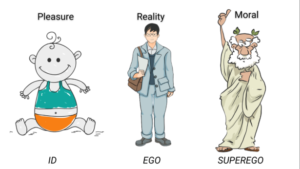
The Ego: The Rational Decision-Maker
What Is the Ego?
The Ego develops from the Id during early childhood (roughly between ages 1 and 3) as the child begins to interact with the external world. It emerges as the part of the psyche that can perceive reality, think logically, and make decisions.
The Ego acts as the mediator between:
- The Id’s instinctual demands for immediate pleasure
- The Superego’s moral pressures and ideals
- External reality and its constraints
The Ego follows the reality principle, which means: “How can I satisfy this desire in a realistic, safe, and socially acceptable way?” Unlike the Id, the Ego can delay gratification, plan ahead, and consider consequences. It seeks to satisfy the Id’s needs in ways that are practical and acceptable to society.
Key Functions of the Ego
Levels of Consciousness in the Ego
Unlike the Id (which is entirely unconscious), the Ego operates at all three levels of consciousness:
- Conscious: Thoughts, decisions, and actions we are aware of (e.g., deciding to study instead of watch TV).
- Preconscious: Memories and knowledge that can be brought into awareness easily (e.g., remembering your phone number).
- Unconscious: Ego processes that occur outside awareness, including many defence mechanisms (e.g., repression, denial).
This flexibility allows the Ego to function both consciously and unconsciously, adapting to different situations.
Everyday Examples of the Ego in Action
The Ego is active in everyday situations where reason overrides impulse:
Feeling hungry (Id) but waiting until lunchtime: The Ego recognises it’s not mealtime and plans to eat later.
Wanting to shout at your boss but choosing calm communication: The Ego considers consequences and chooses a respectful way to express anger.
Saving money instead of spending impulsively: The Ego delays gratification for long-term financial goals.
Studying for an exam instead of going out with friends: The Ego prioritises future success over immediate pleasure.
Apologising after a slip-up: The Ego recognises a mistake and takes responsibility to repair the relationship.
The Ego says:
- “Not now.”
- “Let’s find a better way.”
- “Think about consequences.”
- “I can wait.”
- “This isn’t safe or appropriate.”
Ego Strength and Mental Health
A Healthy (Strong) Ego Leads To:
- Emotional balance – stable mood, appropriate emotional responses
- Good coping skills – ability to handle stress and adversity
- Problem-solving ability –finding solutions rather than avoiding issues
- Healthy relationships –mutual respect, communication, boundaries
- Reality-based thinking – accurate perception of self and others
- Flexibility – adapting to change without falling apart
A Weak Ego May Result In:
- Anxiety – excessive worry, fear, or tension
- Poor decision-making – impulsive or Avoidant choices
- Dependence on defence mechanisms – overusing denial, projection, or rationalisation
- Emotional instability – mood swings, outbursts, difficulty regulating emotions
- Fragile self-esteem – easily shaken by criticism or failure
- Difficulty tolerating frustration – low frustration tolerance
In psychodynamic therapy, strengthening the Ego is often a key therapeutic goal—helping clients develop better coping, reality testing, and emotional regulation.
The Superego: The Moral Judge
What Is the Superego?
The Superego represents moral values, conscience, and societal rules. It is the moral agency of personality, internalising the standards of parents, caregivers, culture, religion, and society.
The Superego begins to develop around age 4–6 years during Freud’s phallic stage of psychosexual development, particularly through the Oedipus/Electra complex, when the child identifies with same-sex parents and internalises their values.
Unlike the Id (which seeks pleasure) and the Ego (which seeks reality), the Superego strives for perfection. It judges behaviour and creates feelings of pride or guilt based on whether actions align with internalised moral standards.
Components of the Superego
- The Conscience tells you what you should not do and punishes violations.
- The Ego Ideal tells you what you should do and rewards compliance with feelings of worthiness.
Together, they create an internal moral compass that guides behaviour even when no one is watching.
Structure of Personality: Examples of the Superego in Action
Feeling guilty for lying: The Conscience activates, creating discomfort and regret.
Feeling ashamed after hurting someone: The Superego judges the action as wrong and produces shame.
Wanting to be a “good person”: The Ego Ideal sets high standards for behaviour and character.
Avoiding temptation due to moral values: The Superego prevents you from acting on impulses that violate your ethics.
Feeling proud after helping someone: The Ego Ideal rewards good behaviour with satisfaction.
The Superego says:
- “This is wrong.”
- “You should not do this.”
- “Be better.”
- “You’re not good enough.”
- “Must always do the right thing.”
Structure of Personality: Superego and Psychological Problems
An Overly Strict (Harsh) Superego May Cause:
- Excessive guilt – feeling guilty even for minor mistakes or thoughts
- Low self-esteem – constant self-criticism and feelings of inadequacy
- Anxiety disorders – chronic worry about doing something wrong
- Depression – deep self-blame, hopelessness, and worthlessness
- Perfectionism – unrelenting standards, fear of failure
- Rigidity – inability to be flexible or forgiving of self and others
- Moralistic self-judgment – harsh internal dialogue and self-punishment
People with a harsh Superego often appear virtuous but suffer internally from constant self-criticism.
A Weak or Underdeveloped Superego May Lead To:
- Lack of empathy – difficulty understanding others’ feelings
- Moral indifference – little concern for right or wrong
- Rule-breaking behaviour – disregard for laws, norms, or social expectations
- Impulsivity – acting without considering consequences
- Shallow relationships – manipulation or exploitation of others
- Antisocial tendencies – limited conscience or remorse
A weak Superego may contribute to traits seen in antisocial personality disorder or conduct disorders.
Interaction Between Id, Ego, and Superego
Personality is shaped by constant psychological conflict among these three systems. The Ego must balance the Id’s desires, the Superego’s moral demands, and the constraints of reality.
Example: Eating Cake on a Diet
In this way, healthy behaviour emerges as the Ego creates balance between desire and self-control.
Another Example: Anger at Work
- Id: “Shout at your boss and quit!”
- Superego: “That’s disrespectful. You should never lose your temper.”
- Ego: “I’m angry. I’ll take a break, calm down, and talk to my boss later.”
The Ego’s compromise protects the relationship while honouring the emotion.
Defence Mechanisms: The Ego’s Tools for Balance
When inner conflicts create anxiety, the Ego unconsciously relies on defence mechanisms to protect the individual from emotional distress. These are automatic psychological strategies that reduce anxiety by distorting reality, denying facts, or redirecting emotions.
Defence mechanisms are normal and everyone uses them. They become problematic only when used excessively, rigidly, or inappropriately, interfering with healthy functioning.
Common Defence Mechanisms
Example: Displacement in Action
- Situation: You’re angry at your boss but can’t express it.
- Defence: You displace the anger onto your family by shouting at them.
- Result: The original anger is hidden, but the family suffers.
Healthy vs. Unhealthy Use of Defence Mechanisms
- Healthy use: Occasional, flexible, and adaptive (e.g., sublimation, humour).
- Unhealthy use: Chronic, rigid, and distorting reality (e.g., denial, projection).
In therapy, identifying and working with defence mechanisms helps clients become more aware of unconscious patterns and develop healthier coping strategies.
Psychological Summary
- The Ego is the rational, mediating agency that balances Id, Superego, and reality.
- Superego is the moral agency, guiding behaviour through conscience and ego ideals.
- The Id provides energy and drives, the Superego provides values and standards, and the Ego maintains balance and adaptation.
- Mental health depends on the Ego’s ability to manage conflicts without excessive anxiety or maladaptive defences.
- Defence mechanisms are normal tools, but excessive use can lead to emotional problems.
Understanding these three components helps explain why we feel inner conflict, how we make decisions, and what happens when personality becomes imbalanced.
Structure of Personality: Clinical Importance in Counseling & Therapy
Understanding the id–ego–superego helps counselors:
- Identify unconscious conflicts
- Understand resistance and defense patterns
- Explore guilt, shame, and impulse control
- Address childhood-based emotional struggles
In psychodynamic therapy, strengthening the ego is often a key therapeutic goal.

Structure of Personality: Criticism of the Structural Model
Despite its influence, Freud’s model is criticized for:
- Lack of scientific testing
- Overemphasis on unconscious processes
- Cultural and gender bias
- Abstract concepts difficult to measure
However, it remains foundational in personality theory and psychotherapy.
Structure of Personality: Modern Relevance of Id, Ego & Superego
Even today, Freud’s model is used to:
- Understand emotional conflicts
- Explain impulsive vs controlled behavior
- Analyze moral guilt and anxiety
- Interpret dreams and slips of speech
- Support psychodynamic counseling
Many modern therapies have evolved but still rely on these core ideas.
Structure of Personality: Simple Summary Table
| Component | Key Function | Operates On | Example |
|---|---|---|---|
| Id | Pleasure | Unconscious | “I want it now” |
| Ego | Reality | All levels | “Let’s think” |
| Superego | Morality | Mostly unconscious | “This is wrong” |
Structure of Personality: Conclusion
Freud’s structural model—Id, Ego, and Superego—offers a powerful way to understand human behavior, emotional conflict, and personality development. While the id provides energy, the superego provides values, and the ego maintains balance.
Mental well-being depends not on eliminating any part, but on creating harmony among all three.
Understanding this model helps us become more self-aware, emotionally regulated, and psychologically resilient.
Frequently Asked Questions (FAQ)
Structure of Personality: Id, Ego & Superego Explained Simply
1. What is the structure of personality according to Freud?
According to Sigmund Freud, personality is made up of three interacting components: Id, Ego, and Superego. These parts work together to shape thoughts, emotions, behavior, and decision-making.
2. What is the Id in simple words (Structure of Personality)?
The Id is the impulsive part of personality that wants immediate pleasure. It operates unconsciously and follows the pleasure principle, meaning it seeks instant satisfaction without considering consequences.
3. Is the Id bad or unhealthy (Structure of Personality) ?
No. The id is not bad; it provides basic motivation and energy for survival. Problems occur only when the id dominates behavior without control from the ego and superego.
4. What is the Ego and why is it important (Structure of Personality)?
The Ego is the rational decision-maker. It follows the reality principle and balances the demands of the id, the rules of the superego, and real-life situations. A strong ego is essential for emotional stability and mental health.
5. What is the Superego (Structure of Personality)?
The Superego represents moral values, conscience, and societal rules learned from parents and culture. It guides behavior by creating feelings of guilt, shame, pride, or self-approval.
6. What happens if the Superego is too strong (Structure of Personality)?
An overly strong superego can lead to:
- Excessive guilt
- Low self-esteem
- Anxiety or depression
- Perfectionism
Such individuals may be very self-critical and fear making mistakes.
7. What happens if the Ego is weak (Structure of Personality)?
A weak ego may struggle to manage inner conflicts, leading to:
- Anxiety
- Poor decision-making
- Emotional outbursts
- Overuse of defense mechanisms
8. How do Id, Ego, and Superego work together (Structure of Personality)?
They constantly interact:
- Id: “I want this now.”
- Superego: “This is wrong.”
- Ego: “Let’s find a realistic and acceptable solution.”
Healthy personality results from effective balance among the three.
9. What are defense mechanisms (Structure of Personality)?
Defense mechanisms are unconscious strategies used by the ego to reduce anxiety caused by conflicts between the id and superego. Examples include repression, denial, projection, rationalization, and sublimation.
10. Are defense mechanisms normal (Structure of Personality)?
Yes. Everyone uses defense mechanisms. They become problematic only when used excessively or rigidly, interfering with healthy emotional functioning.
11. How is this theory useful in counseling and therapy (Structure of Personality)?
Understanding id, ego, and superego helps therapists:
- Identify unconscious conflicts
- Understand guilt, shame, and impulse control
- Work with childhood experiences
- Strengthen ego functioning
This is especially useful in psychodynamic counseling.
12. Is Freud’s structure of personality scientifically proven?
Freud’s model is largely theoretical and not easily testable through experiments. However, it remains influential for understanding personality, emotions, and therapeutic processes.
13. Is the Id–Ego–Superego theory still relevant today (Structure of Personality)?
Yes. While modern psychology has evolved, this model is still used to explain emotional conflicts, moral struggles, impulsive behavior, and inner tension in both clinical and everyday contexts.
14. Can this theory be explained to students easily?
Yes. Using simple examples like hunger, anger, or temptation makes the id–ego–superego model easy to understand for school, college, and competitive exams.
15. What is the main idea of Freud’s structure of personality?
The core idea is that human behavior results from a constant inner conflict between desire (id), morality (superego), and reality (ego). Mental health depends on how well the ego manages this balance.
Reference
-
Sigmund Freud (1923). The ego and the id. London: Hogarth Press.
Link: https://www.gutenberg.org/ebooks/38219 -
Freud, S. (1915). The unconscious. In The Standard Edition of the Complete Psychological Works of Sigmund Freud (Vol. 14).
Link: https://www.bartleby.com/psych/122.html -
Freud, S. (1900). The interpretation of dreams. London: Hogarth Press.
Link: https://www.gutenberg.org/ebooks/15489 -
Feist, J., Feist, G. J., & Roberts, T. A. (2018). Theories of personality (9th ed.). New York: McGraw-Hill Education.
Link: https://www.mheducation.com -
Corey, G. (2017). Theory and practice of counseling and psychotherapy (10th ed.). Boston: Cengage Learning.
Link: https://www.cengage.com -
McLeod, S. A. (2023). Id, ego and superego. Simply Psychology.
Link: https://www.simplypsychology.org/psyche.html - Psychoanalytic Theory: Freud’s View of the Human Mind
This article is written for knowledge purposes, aiming to help readers understand the topic better and gain useful insights for learning and awareness.
Pingback: Defense Mechanisms in Daily Life: Real Examples Explained
Pingback: Neo-Freudians: How Jung, Adler & Horney Modified Freud