
Introduction
The Psychoanalytic Theory, developed by Sigmund Freud, is one of the most influential and controversial theories in the history of psychology. Freud’s ideas reshaped how humanity understands the human mind, behavior, emotions, personality, and mental illness. At a time when psychological science was still in its infancy, Freud dared to suggest that much of human behavior is driven by unconscious forces, hidden desires, unresolved childhood conflicts, and instinctual drives.
Freud proposed that the mind is not fully accessible to conscious awareness and that our thoughts, feelings, and actions are often shaped by mental processes operating outside our awareness. This radical idea challenged traditional views of rationality and free will and laid the foundation for modern psychotherapy.
Although many of Freud’s ideas have been debated, modified, or criticized, his psychoanalytic framework continues to influence clinical practice, personality theory, literature, art, and popular culture. This article explores Freud’s view of the human mind in depth—covering its structure, levels of consciousness, instinctual drives, personality development, defense mechanisms, and lasting impact.
Historical Background of Psychoanalytic Theory
Freud was born in 1856 in Austria and trained as a neurologist. While treating patients with hysteria and unexplained physical symptoms, Freud observed that many psychological problems could not be explained by organic causes alone. Working with Josef Breuer, he noticed that patients experienced relief when they talked freely about painful memories—a process later known as catharsis.
From these observations, Freud developed psychoanalysis, both as a theory of personality and a method of therapy. He believed that psychological symptoms arise from unresolved unconscious conflicts, often rooted in early childhood experiences.

Freud’s Topographical Model: Levels of Consciousness
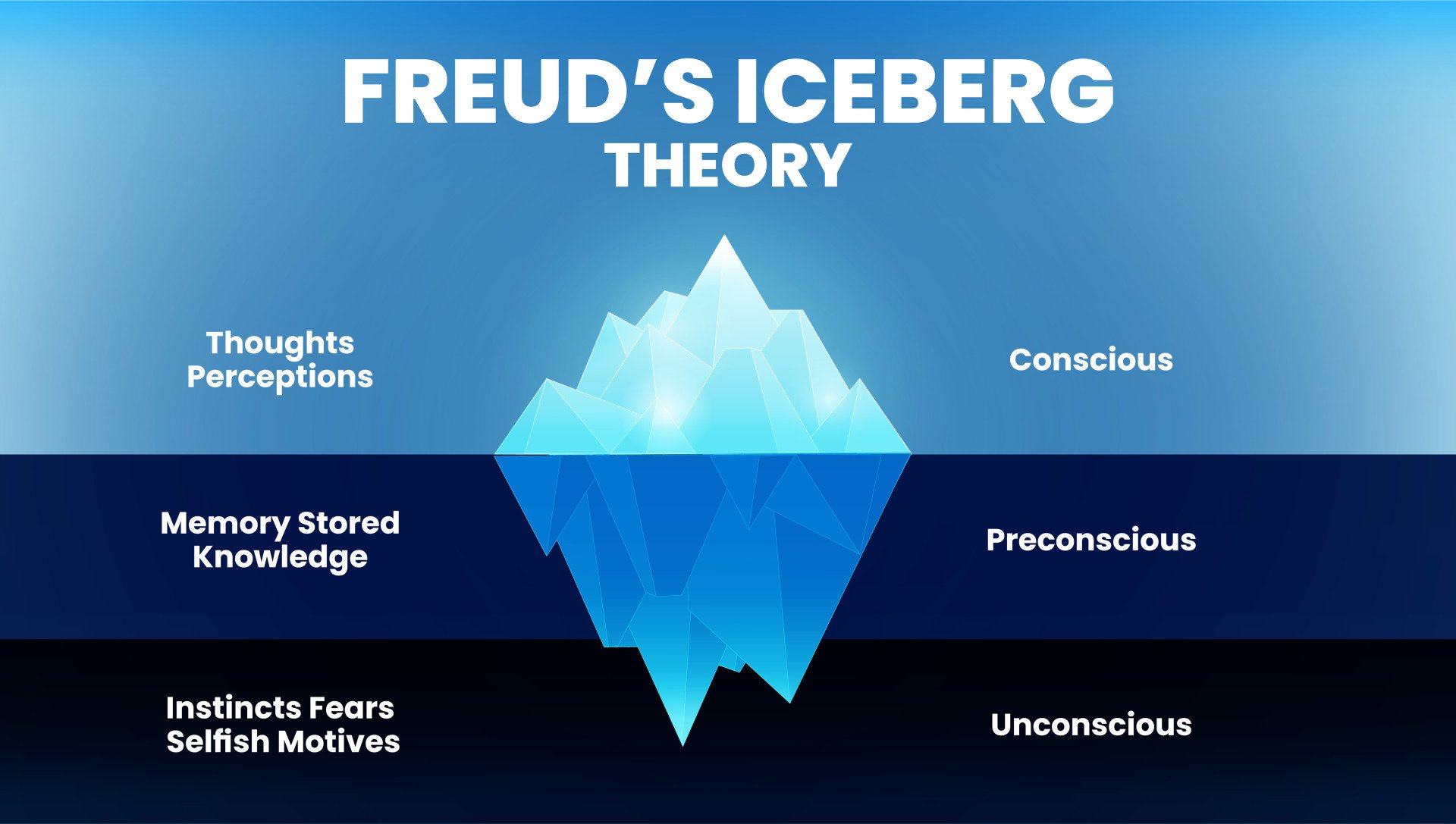
Sigmund Freud, the father of psychoanalysis, revolutionized our understanding of the mind by dividing it into three distinct levels of awareness, much like layers of an iceberg. This topographical model (from the Greek word topos, meaning “place”) maps out how consciousness operates, revealing why we often act in ways that puzzle even ourselves. Let’s dive into each level.
1. Conscious Mind:
The conscious mind is the tip of the mental iceberg—what’s fully in your awareness right now. It handles immediate thoughts, feelings, perceptions, and sensations. For instance, as you read this, you’re consciously processing these words; you might notice a rumbling stomach or the tension of pre-exam anxiety. This level is logical and rational, guided by your current focus, but it’s just a tiny fraction of your mental activity—about 10%, by Freud’s estimate.
2. Preconscious Mind:
Think of the preconscious as a mental waiting room: information not in your spotlight but easily retrievable with minimal effort. It’s like your brain’s quick-access folder. Examples include your home address, what you ate for lunch yesterday, or a song lyric that pops up when prompted. In therapy, clients often pull preconscious memories during free association, uncovering insights that bridge everyday awareness to deeper issues.
3. Unconscious Mind:
The unconscious is the vast, submerged bulk of the iceberg—the powerhouse driving much of human behavior without our knowledge. Here lurk repressed memories, unresolved childhood conflicts, traumatic experiences, forbidden desires (like aggression or sexuality), and raw instinctual urges rooted in the id. Freud argued this hidden realm fuels slips of the tongue (Freudian slips), dreams, neuroses, and even physical symptoms like phobias.
For example, someone with unexplained road rage might trace it to an unconscious fear from a childhood car accident. In counseling, techniques like dream analysis help bring these shadows to light, promoting healing. Freud warned that ignoring the unconscious leads to “the return of the repressed,” where buried urges manifest as anxiety, depression, or self-sabotage.
This model underscores why talk therapy works: by exploring beyond the conscious, we access the mind’s hidden drivers. The iceberg metaphor captures it perfectly—only a sliver shows above water, while the massive unconscious shapes our course.
The Structural Model of Personality
Freud wasn’t done with his iceberg after the topographical model. In his later work, like The Ego and the Id (1923), he introduced the structural model—a dynamic trio of mental agencies that clash and collaborate to shape personality. Picture them as inner roommates: the wild id throwing parties, the practical ego paying the bills, and the judgmental superego enforcing house rules. Their constant tug-of-war explains everything from impulse control to moral dilemmas.
1. Id: The Primal Engine:
The id is personality’s raw, unfiltered core—fully formed at birth and lurking entirely in the unconscious. Powered by the pleasure principle, it demands instant gratification for basic instincts like hunger, sex (libido), and aggression, ignoring time, logic, or consequences.
Key characteristics:
- Impulsive and irrational, like a toddler’s tantrum.
- Blindly seeks pleasure, dodges pain.
- Houses innate drives that fuel survival but can overwhelm if unchecked.
Example: A hungry infant’s piercing cry for milk? Pure id—no thought for who’s sleeping nearby. In adults, it shows in binge-eating during stress or road-rage outbursts, reminding us why therapy often targets these unchecked urges.
2. Ego: The Reality Broker:
Emerging in toddlerhood, the ego is the id’s sensible executive, spanning conscious, preconscious, and unconscious levels. Guided by the reality principle, it delays gratification, weighs options, and navigates the real world to satisfy the id without chaos.
Core functions:
- Logical reasoning and problem-solving.
- Decision-making under pressure.
- Mediating between id’s fantasies and superego’s ideals.
Example: Craving a midnight snack? The ego checks the fridge, portion size, and tomorrow’s schedule instead of raiding it impulsively. In counseling, strengthening the ego helps clients with anxiety manage triggers effectively.
3. Superego: The Inner Critic:
Kicking in around age 5 via parental and cultural imprinting, the superego is our moral compass, pushing for perfection on the perfection principle. It’s split into two parts: the conscience (which whips up guilt for “bad” behavior) and the ego ideal (which doles out pride for “good” deeds).
But it’s a double-edged sword—overly rigid superegos breed shame, low self-esteem, or OCD-like perfectionism.
Example: Skipping a workout might spark superego guilt (“You’re lazy!”), while acing an exam brings ego-ideal pride. Therapists often work to balance harsh superegos, freeing clients from paralyzing self-judgment.
These three forces are in perpetual tension: the id yells “Want it now!”, the ego replies “Not yet—let’s plan,” and the superego scolds “You shouldn’t even want it!” Healthy personalities arise from ego strength, but imbalances fuel neuroses. For UPSC aspirants or anyone in high-stress roles, understanding this model demystifies why deadlines trigger guilt spirals or procrastination binges.
At the heart of Freud’s theories pulses psychic energy—a finite reservoir like hydraulic pressure in the mind, powering behavior through clashing instincts. Freud saw humans as instinct-driven machines, where unmet drives create tension that demands release. This dualistic view, blending life-affirming and destructive forces, explains everything from creative bursts to wartime atrocities. Let’s break down the two primal engines.
Life Instincts (Eros): The Drive to Thrive
Eros, named after the Greek god of love, encompasses instincts for survival, reproduction, growth, and unity. Its core fuel is libido—not just sexual energy, but a broad life force animating hunger, creativity, bonding, and pleasure-seeking.
Key features:
- Promotes self-preservation and species continuation.
- Expressed in affectionate hugs, artistic pursuits, or nurturing relationships.
- Blocked libido leads to “libidinal stagnation,” manifesting as depression or neurosis.
Example: A parent’s protective hug or an artist’s late-night inspiration? Pure Eros at work. In therapy, channeling libido through sublimation (redirecting urges into work or hobbies) helps clients combat anxiety—think UPSC toppers turning exam stress into focused study marathons.
Death Instincts (Thanatos): The Pull Toward Destruction
Introduced in Beyond the Pleasure Principle (1920), Thanatos shocked Freud’s followers by positing an innate drive toward death, dissolution, and aggression—a counterforce to Eros seeking equilibrium through destruction. Turned outward, it fuels violence; inward, self-sabotage like addiction or suicidal ideation.
Key features:
- Aggressive, repetitive, and entropy-seeking (breaking things down).
- Explains war, vandalism, or thrill-seeking risks.
- Often masked in “repetition compulsion,” where we unconsciously recreate traumas.
Example: Road rage exploding over a minor fender-bender or a perfectionist burning out from self-criticism? Thanatos in action. Counselors address it by fostering Eros balance, using techniques like mindfulness to redirect aggression into assertiveness.
Freud’s radical idea? Life and death instincts bind in a tense fusion—Eros builds, Thanatos dismantles—creating the human drama. Modern psychology debates Thanatos (e.g., as evolutionary aggression), but it remains potent for understanding self-harm in trauma survivors or societal violence. For mental health pros, it’s a reminder: healthy psyches harmonize these forces, turning raw energy into resilient growth.
Psychosexual Stages of Development: Building Personality Through Pleasure Zones
Freud’s psychosexual theory posits that childhood unfolds in five stages, each fixated on an erogenous zone where libido concentrates, shaping adult personality. Trauma or overindulgence at any stage risks fixation—stuck energy creating lifelong traits. Controversial today (critics call it phallocentric and untestable), it still illuminates therapy by linking early experiences to patterns like addiction or relationship woes. Think of it as wiring the personality circuit—get it right, and circuits hum; glitch it, and sparks fly.
1. Oral Stage (0–1 Year): Mouth Matters
The newborn’s world revolves around the mouth—sucking, biting, tasting for nourishment and comfort. Caregivers are all-important here.
Fixation risks:
- Overindulgence: Dependency, passivity, habits like smoking, overeating, or nail-biting.
- Frustration: Oral aggression, sarcasm, or pessimism (“life sucks”).
Example: Adult “oral personalities” might soothe stress with endless snacks—common in high-anxiety clients we see in counseling.
2. Anal Stage (1–3 Years): Control Central
Toilet training introduces control: pleasure from retaining/expelling feces symbolizes autonomy. Parental reactions (punitive vs. lax) set the tone.
Fixation outcomes:
- Anal-retentive: Orderly, stingy, obsessive-compulsive traits, perfectionism.
- Anal-expulsive: Messy, rebellious, impulsive, generous to a fault.
Example: The rigid UPSC aspirant hoarding notes? Classic retentive ego, thriving on structure but cracking under flexibility.
3. Phallic Stage (3–6 Years): Gender Awakening
Libido shifts to genitals, sparking curiosity and rivalry. This is Freud’s most infamous phase.
Key dynamics:
-
Oedipus Complex (boys): Unconscious love for mom, jealousy of dad—resolved by identifying with father, forming the superego.
-
Electra Complex (girls): Attachment to dad, “penis envy”—leading to maternal identification.
- Fixation: Sexual identity issues, vanity, or promiscuity.
Example: Authority fears in adults often trace to unresolved Oedipal tensions, surfacing in therapy dreams.
4. Latency Stage (6 to Puberty): The Calm Before
Sexual drives hibernate as energy pours into social skills, school, sports, and same-sex friendships. It’s a “repression” period for maturation. No major fixations, but neglect here stalls emotional growth. Example: The bookish kid building intellect—prepping for adult productivity.
5. Genital Stage (Puberty Onward): Mature Integration
Puberty reignites libido, but now it’s balanced: genital-focused, other-centered love, and creative pursuits. Success across prior stages yields healthy relationships and vocation. Immaturity lingers if earlier fixations persist. Example: Fulfilling partnerships where Eros meets reality, minus childish demands.
Freud urged resolving these via analysis to “free” libido for genital maturity. While modern views emphasize culture and attachment (e.g., Erikson), the model spotlights how early wounds echo—vital for counselors treating personality disorders.
Defense Mechanisms: Ego’s Protective Strategies
When id urges clash with superego morals, anxiety erupts—like an internal alarm. The ego deploys defense mechanisms: unconscious tricks to repress, disguise, or redirect threats, buying time for reality-testing. Normal in moderation (we all deny a bad haircut occasionally), they turn pathological when rigid, fueling disorders like anxiety or personality issues. Here’s a rundown of Freud’s classics, with counseling insights.
- Repression: The granddaddy—banishing painful memories or urges to the unconscious. Example: Forgetting childhood abuse, only for it to leak via nightmares. Therapy gently retrieves these for healing.
- Denial: Flat-out rejecting reality. Example: “I’m fine” amid crumbling relationships—common in addiction denial, delaying recovery.
- Projection: Flinging your flaws onto others. Example: A cheating spouse accusing their partner of infidelity; helps bigots externalize prejudice.
- Displacement: Venting frustration on a safe target. Example: Yelling at your dog after a boss’s critique—redirects rage without job loss.
- Rationalization: Spinning excuses for failures. Example: “I didn’t want that promotion anyway” masks hurt pride; UPSC aspirants often rationalize low scores this way.
- Regression: Slipping to childlike behaviors under stress. Example: Thumb-sucking or tantrums in adults during grief—ego reverting for comfort.
- Sublimation: The healthy hero—channeling taboo impulses into approved outlets. Example: Aggressive drives become sports achievements; libido fuels art. Freud’s gold standard for maturity.
Overreliance warps personality—think chronic projection in paranoia. In sessions, we spot these via patterns, reframing them consciously for ego strength.
Dream Analysis: The Royal Road to the Unconscious
Freud called dreams “the royal road” to the id because sleep lowers defenses, letting repressed wishes surface in disguised form (The Interpretation of Dreams, 1900). Not random noise, but symbolic messages.
- Manifest Content: The surface story—what you remember (e.g., flying over a city).
- Latent Content: The hidden truth—unconscious desires (e.g., escape from marital strife).
Disguises include:
- Symbols: Phallic images (guns, snakes) for sex; tunnels for birth.
- Condensation: Merging ideas into one image.
- Displacement: Swapping key figures (boss becomes a monster).
Example: Dreaming of devouring cake? Latent hunger for love (oral fixation). Analysts “decode” via free association, uncovering conflicts. Modern therapy adapts this for trauma processing, blending with CBT.
These tools reveal the psyche’s underbelly—defenses guard it by day, dreams unlock it by night. Mastering them empowers self-awareness, key for counselors and anyone navigating inner turmoil.
Psychoanalysis: Making the Unconscious Conscious
Freud pioneered psychoanalysis (circa 1890s) as talk therapy’s cornerstone—a deep dive to unearth unconscious conflicts, dissolve defenses, and foster psychic health. Unlike quick fixes, it seeks insight: understanding repressed drives to “where id was, ego shall be.” Sessions (4–5x/week, couch-bound) last years, but shortened variants thrive today. The aim? Cathartic release (abreaction), ego strengthening, and conflict resolution—transforming neuroses into resilience.
Key Techniques: Unlocking the Vault
- Free Association: Lie back and say whatever pops into mind—no censorship. Streams reveal hidden chains. Example: “Dog… bite… angry mom” uncovers Oedipal rage. It bypasses ego resistance, surfacing repressed material.
- Dream Interpretation: As Freud’s “royal road,” decode manifest (surface plot) to latent (true wish) content via symbols and slips. Example: Falling dreams signal anxiety loss of control; analyst probes associations for roots.
- Analysis of Resistance: When clients clam up, change topics, or miss sessions, it’s the ego defending. Gently confronting builds awareness. Example: “Notice how exam talk triggers silence?”—exposes fear of failure tied to anal-stage control.
- Transference Analysis: Clients project feelings onto the therapist (e.g., seeing them as a stern father). Interpreting this relives and resolves past dynamics. Example: Idealizing the analyst as a rescuer reveals unmet childhood needs—working through it heals attachment wounds.
- The Goal: Insight, Relief, Rebirth: Through these, patients gain “working through”—repetitive insight till change sticks. Emotional release follows, like lancing a boil. Success yields mature genital-stage functioning: balanced relationships, creativity, less anxiety.
Real-World Case: A perfectionist (anal-retentive) client free-associates to toilet-training shame, processes via transference, sublimates into career success.
Critics note it’s time-intensive and unproven empirically, but influences CBT, mindfulness, and even apps today. For Indian counselors, it adapts well to cultural taboos around family conflicts—unspoken caste anxieties or parental expectations often emerge.
Psychoanalysis isn’t for all, but its legacy empowers: by befriending the unconscious, we rewrite our scripts.
Criticism of Freud’s Theories: Trailblazer with Flaws
Freud’s ideas ignited psychology but drew fire for being bold yet brittle. Pioneering the unconscious earned him “father of therapy,” yet critics— from feminists to scientists—poked holes. While not gospel, his framework sparked empiricism. Here’s a balanced look at key knocks, plus why echoes persist.
Overemphasis on Sexuality
Freud reduced drives to libido everywhere (even thumbsucking as oral sex). Critics like Jung argued for broader spirituality; behaviorists ignored “unobservables.” Counter: It spotlighted repressed emotions, foundational to trauma therapy.
Lack of Scientific Testability
Unfalsifiable claims (e.g., “everyone has an Oedipus complex”) defy lab tests—no double-blinds for the unconscious. Popper deemed it pseudoscience. Modern Shift: Neuroscience now scans brains for repression-like activity, validating indirectly.
Gender Bias
Phallocentric views (penis envy, women as “mutilated males”) irked feminists like Horney and Klein, who stressed womb envy and relational psychology. Electra complex feels outdated. Rebuttal: Cultural artifact of Victorian Vienna; revised in object-relations theory.
Cultural Limitations
Eurocentric, middle-class biases ignore collectivist societies (e.g., India’s joint families dilute Oedipal drama). Instincts overlook nurture. Adaptation: Cross-cultural studies tweak for context, like filial piety as superego variant.
Legacy: Influence Over Orthodoxy
Post-Freud, psychology pivoted to evidence-based titans—Skinner (behaviorism), Rogers (humanism), Beck (CBT)—with RCTs proving efficacy. Yet, core gems endure: unconscious biases (e.g., implicit tests), talk therapy’s catharsis, dream symbolism in PTSD treatment.
In India, for UPSC psych optional or counseling, Freud’s a staple—critiques sharpen analysis, blending with Indian thinkers like Dalal on culturally attuned psychoanalysis. Flawed? Yes. Revolutionary? Absolutely. It humanized the mind, paving roads to today’s integrated approaches.
Takeaway: Test theories against life—Freud reminds us: peek beneath the surface.
Freud’s Enduring Legacy and Modern Relevance
Dismissed as dusty dogma? Think again—Freud’s seismic shift from rational mind to turbulent unconscious birthed psychoanalysis and rippled worldwide. Though evidence-based therapies dominate, his DNA threads modern mental health. From Jung’s archetypes to Netflix’s “inception” tropes, Freud lingers.
Neo-Freudians: Building on the Giant
Freud’s disciples rebelled, expanding his canvas:
- Carl Jung: Broke for collective unconscious—universal archetypes (shadow, anima) over sex. Dreams as mythic wisdom; influences art therapy, MBTI.
- Alfred Adler: Ditched id for inferiority complex and striving for superiority. Social interest heals; roots positive psychology, Adlerian therapy for kids.
- Erik Erikson: Extended psychosexuals to eight psychosocial stages across life (e.g., trust vs. mistrust). Lifespan focus fits India’s multigenerational families.
Others like Horney (cultural neuroses) and Sullivan (interpersonal) humanized it further.
Contemporary Echoes in Therapy and Beyond
- Psychodynamic Therapy: Short-term Freud-lite—focuses transference, defenses in 20–40 sessions. Proven for depression, personality disorders (APA-endorsed).
- Mental Health Mainstream: Unconscious bias training (workplaces), attachment theory (parenting), CBT’s “automatic thoughts” nod to repression.
- Neuroscience Nod: fMRI shows amygdala “unconscious” fear; psychedelics echo abreaction.
Indian Context: In Kolkata clinics or online counseling, psychodynamic probes family taboos (e.g., arranged marriage transference). UPSC psych optional loves this—Erikson’s identity crisis explains youth unrest; Jung’s self suits spiritual seekers.
Why Freud Matters Today
He democratized the psyche: “Talk about it” normalized therapy in stigma-shy cultures. Amid AI and hustle, his warning rings—ignore the unconscious, court burnout.
Final Thought: Freud didn’t have the last word, but he gave us the vocabulary. Dive in, adapt, heal.
Conclusion: Freud’s Lasting Mirror to the Mind
Sigmund Freud didn’t just theorize—he cracked open the human psyche, revealing an iceberg where conscious thoughts bob atop a seething unconscious sea of instincts, conflicts, and childhood echoes. From the id-ego-superego tug-of-war and psychosexual stages to defenses, dreams, and analytic couches, his framework shifted psychology from surface behaviors to soul-deep exploration.
Flawed by sex-centric bias and untestability? Undeniably. Yet, neo-Freudians refined it, neuroscience echoes it, and therapies worldwide wield it. In our anxiety-riddled era—think UPSC marathons or urban isolation—Freud whispers: Listen to your slips, dreams, and shadows. Repress, and they rule; confront, and you reclaim power.
Spot anal-retentive clients in perfectionist spirals; channel Thanatos aggression via sublimation. For seekers, a reminder—inner life trumps outer hustle. Freud’s genius? He made the invisible visible, urging: “Know thyself.”
Reflect & Act: Journal a recent “Freudian slip”—what unconscious urge lurks? Dive deeper, heal bolder.
Freud endures not as dogma, but as invitation: Beneath awareness lies the mind’s vast world, shaping who we are—and who we become.
Frequently Asked Questions (FAQ)
1. What is Psychoanalytic Theory?
Psychoanalytic theory is a psychological framework proposed by Sigmund Freud that explains human behavior in terms of unconscious motives, childhood experiences, and inner psychological conflicts. It emphasizes that much of our mental life operates outside conscious awareness.
2. Why is the unconscious mind important in Freud’s theory?
Freud believed the unconscious mind stores repressed memories, unresolved conflicts, and instinctual desires that strongly influence behavior, emotions, dreams, and mental health. Even though we are unaware of these contents, they shape our everyday actions.
3. What are the three levels of consciousness according to Freud?
Freud divided the mind into:
- Conscious: thoughts and feelings we are aware of
- Preconscious: information that can be easily recalled
- Unconscious: hidden desires, memories, and conflicts
4. What are the id, ego, and superego?
They are the three components of personality:
- Id: instinctual, pleasure-seeking, unconscious
- Ego: rational, reality-oriented decision-maker
- Superego: moral conscience and internalized social rules
Personality develops through the constant interaction of these three systems.
5. What is the pleasure principle and reality principle?
- The pleasure principle (id) seeks immediate gratification of desires.
- The reality principle (ego) delays gratification and considers social norms and consequences.
6. What are psychosexual stages of development?
Freud proposed that personality develops through five stages:
- Oral
- Anal
- Phallic
- Latency
- Genital
Unresolved conflicts at any stage may lead to fixation, affecting adult personality.
7. What is fixation in psychoanalytic theory?
Fixation occurs when an individual becomes stuck at a particular psychosexual stage due to unresolved conflict, leading to specific personality traits or behavioral patterns in adulthood.
8. What are defense mechanisms?
Defense mechanisms are unconscious strategies used by the ego to reduce anxiety caused by conflicts between the id, ego, and superego. Common examples include repression, denial, projection, displacement, regression, rationalization, and sublimation.
9. Are defense mechanisms always unhealthy?
No. Defense mechanisms are normal and necessary for psychological functioning. However, excessive or rigid use of certain defenses can contribute to emotional difficulties and mental health problems.
10. What role do dreams play in Freud’s theory?
Freud viewed dreams as the “royal road to the unconscious.” He believed dreams express hidden desires through symbols.
- Manifest content: what we remember
- Latent content: the hidden meaning
11. What is psychoanalysis as a therapy?
Psychoanalysis is a long-term therapeutic approach that aims to uncover unconscious conflicts through techniques such as free association, dream analysis, and transference, helping individuals gain insight and emotional healing.
12. What is transference in psychoanalysis?
Transference occurs when a client projects feelings from past relationships (often with parents) onto the therapist. Analyzing transference helps reveal unresolved emotional conflicts.
13. Why is Freud’s theory criticized?
Major criticisms include:
- Overemphasis on sexuality
- Lack of scientific testing
- Gender bias
- Cultural limitations
Despite this, Freud’s ideas remain historically and clinically influential.
14. Is Freud’s psychoanalytic theory still relevant today?
Yes. While modern psychology has evolved, psychoanalytic concepts continue to influence psychodynamic therapy, personality studies, trauma work, and understanding unconscious processes.
15. How is psychoanalytic theory useful in counseling?
It helps counselors understand:
- Deep-rooted emotional patterns
- Childhood trauma effects
- Repeated relationship conflicts
- Defense mechanisms and resistance
This insight supports long-term emotional growth and self-awareness.
Reference
-
Freud, S. (1900). The interpretation of dreams. London: Hogarth Press.
Link: https://www.gutenberg.org/ebooks/15489 -
Freud, S. (1923). The ego and the id. London: Hogarth Press.
Link: https://www.gutenberg.org/ebooks/38219 -
Freud, S. (1915). The unconscious. In Standard Edition of the Complete Psychological Works of Sigmund Freud (Vol. 14).
Link: https://www.bartleby.com/psych/122.html -
Freud, S. (1905). Three essays on the theory of sexuality. London: Hogarth Press.
Link: https://www.gutenberg.org/ebooks/14969 -
American Psychiatric Association. (2022). DSM-5-TR: Diagnostic and statistical manual of mental disorders (5th ed., text rev.). Washington, DC: Author.
Link: https://www.psychiatry.org/psychiatrists/practice/dsm -
McLeod, S. A. (2023). Sigmund Freud’s psychoanalytic theory. Simply Psychology.
Link: https://www.simplypsychology.org/Sigmund-Freud.html - How to Practice Self-Care as a Busy Man
Pingback: Structure of Personality: Id Ego & Superego Explained Simply
Pingback: The Right Way to Talk to Kids About Sex psychological Guide
Pingback: Trait Theory of Personality: Allport, Cattell & Eysenck