Emotional Burnout: Symptoms You Shouldn’t Ignore

Introduction: When Exhaustion Goes Beyond Tiredness

Everyone feels tired sometimes. Long days, responsibilities, emotional demands, and stress are part of modern life. But emotional burnout is different. It is not solved by a weekend off, a good night’s sleep, or a short break.

Emotional burnout is a state of chronic emotional, mental, and physical exhaustion caused by prolonged stress—especially stress that feels inescapable, unrecognized, or unsupported. It slowly drains motivation, empathy, and a sense of meaning, often without dramatic warning signs.

Many people ignore burnout because they believe:

  • “This is just stress.”

  • “I should be able to handle this.”

  • “Others have it worse.”

  • “Once things settle down, I’ll feel better.”

But burnout does not suddenly appear—it builds quietly. And the longer it goes unnoticed, the deeper its impact on mental health, relationships, and physical well-being.

This article explores what emotional burnout really is, how it develops, the symptoms you should never ignore, and how recovery is possible.

What Is Emotional Burnout?

Emotional burnout is a condition marked by persistent emotional depletion, reduced capacity to cope, and a sense of detachment or hopelessness. It occurs when emotional demands consistently exceed a person’s internal and external resources.

Burnout commonly affects:

  • Caregivers

  • Parents

  • Healthcare professionals

  • Counselors and teachers

  • Corporate employees

  • Homemakers

  • Individuals in emotionally demanding relationships

However, burnout is not limited to work—it can arise from chronic family conflict, financial stress, caregiving roles, trauma, or prolonged emotional suppression.

Burnout vs Stress: Understanding the Difference

Stress involves too much pressure.
Burnout involves nothing left to give.

Stress Burnout
Over-engagement Emotional disengagement
Anxiety and urgency Hopelessness and numbness
Feeling overwhelmed Feeling empty
Still motivated Loss of motivation
Temporary Chronic

Stress says, “I can’t keep up.”
Burnout says, “I don’t care anymore.”

How Emotional Burnout Develops

Burnout is rarely sudden. It develops in stages, often unnoticed.

Stage 1: Chronic Overload

  • High expectations

  • Constant responsibility

  • Lack of rest

  • Emotional overextension

Stage 2: Emotional Suppression

  • Ignoring needs

  • “Pushing through”

  • Minimizing feelings

  • Avoiding vulnerability

Stage 3: Depletion

  • Reduced energy

  • Emotional exhaustion

  • Loss of enthusiasm

Stage 4: Detachment

  • Numbness

  • Cynicism

  • Withdrawal from people

Stage 5: Breakdown

  • Anxiety or depressive symptoms

  • Physical illness

  • Emotional shutdown

Recognizing burnout earlier prevents deeper psychological harm.

Emotional Burnout Symptoms You Shouldn’t Ignore

1. Persistent Emotional Exhaustion

You feel drained even after rest. Emotional tasks—listening, caring, responding—feel overwhelming. You may think:

  • “I have nothing left.”

  • “I can’t handle one more thing.”

This exhaustion is emotional, not just physical.

2. Loss of Motivation and Meaning

Tasks that once mattered now feel pointless. You may continue functioning out of obligation, not interest.

Common thoughts:

  • “What’s the point?”

  • “Nothing excites me anymore.”

  • “I’m just going through the motions.”

This loss of meaning is a core burnout signal.

3. Emotional Numbness

Instead of intense feelings, you feel nothing. Happiness, sadness, excitement, and empathy feel distant.

Numbness is not strength—it is a protective shutdown when the nervous system is overwhelmed.

4. Increased Irritability or Detachment

Small things trigger anger or frustration. Alternatively, you may feel emotionally detached and indifferent.

You might:

  • Withdraw from loved ones

  • Avoid conversations

  • Feel guilty for being unavailable

5. Chronic Fatigue

You feel tired all the time, regardless of sleep. Getting through the day feels like an effort.

Burnout fatigue is deep and persistent, not relieved by rest alone.

6. Cognitive Difficulties

Burnout affects thinking:

  • Poor concentration

  • Forgetfulness

  • Indecisiveness

  • Mental fog

You may feel mentally “slow” or ineffective, which further lowers confidence.

7. Physical Symptoms Without Clear Cause

Emotional burnout often manifests physically:

  • Headaches

  • Digestive issues

  • Body aches

  • Weakened immunity

  • Sleep disturbances

The body expresses what the mind has been suppressing.

8. Increased Anxiety or Hopelessness

Burnout can coexist with:

  • Anxiety

  • Low mood

  • Feelings of helplessness

  • Fear of the future

Unchecked burnout may evolve into clinical anxiety or depression.

Emotional Burnout in Different Life Roles

Burnout in the Workplace

  • Feeling undervalued

  • Constant pressure without control

  • Emotional labor without recognition

  • Fear of failure or replacement

High performers are especially vulnerable.

Burnout in Caregivers and Parents

  • Emotional over-responsibility

  • Lack of support

  • No personal time

  • Guilt for needing rest

Caregivers often normalize burnout until collapse occurs.

Burnout in Relationships

  • Constant emotional giving

  • One-sided dynamics

  • Suppressed resentment

  • Fear of conflict

Love does not protect against burnout—lack of boundaries does.

Why Emotional Burnout Is Often Ignored

  • It develops gradually

  • Productivity may remain intact

  • Society rewards overwork

  • Emotional pain is minimized

  • Many confuse burnout with weakness

Ignoring burnout does not make it disappear—it deepens it.

The Psychological Cost of Ignoring Burnout

Untreated burnout can lead to:

  • Anxiety disorders

  • Depression

  • Emotional disconnection

  • Relationship breakdown

  • Identity confusion

  • Loss of self-worth

Burnout does not mean failure—it means you’ve been strong for too long without support.

How Emotional Burnout Affects Identity

Many people tie self-worth to:

  • Productivity

  • Caregiving

  • Achievement

  • Responsibility

Burnout disrupts identity:

“If I can’t function like before, who am I?”

Healing requires redefining worth beyond output.

Recovery from Emotional Burnout: What Actually Helps

1. Acknowledge the Burnout

Naming burnout reduces shame. You are not lazy, weak, or ungrateful—you are exhausted.

2. Reduce Emotional Load (Not Just Tasks)

Burnout is not solved by time management alone. Emotional labor must be addressed.

Ask:

  • What am I emotionally carrying?

  • Where am I over-giving?

  • What boundaries are missing?

3. Rest Without Guilt

True rest is non-productive rest—without self-judgment.

Burnout recovery requires permission to pause.

4. Reconnect with Emotions Safely

Burnout suppresses feelings. Gentle emotional reconnection—through journaling, therapy, or quiet reflection—is essential.

5. Seek Professional Support

Therapy helps:

  • Identify burnout patterns

  • Process suppressed emotions

  • Rebuild boundaries

  • Restore emotional regulation

You do not need to reach crisis to seek help.

When to Seek Help Immediately

Seek professional support if:

  • Burnout lasts more than a few months

  • You feel emotionally numb or hopeless

  • Anxiety or depression symptoms increase

  • Physical health is affected

  • You feel disconnected from yourself or loved ones

Burnout is treatable, especially when addressed early.

Preventing Emotional Burnout Long-Term

  • Set emotional boundaries

  • Normalize asking for help

  • Separate worth from productivity

  • Schedule rest like responsibility

  • Check in with emotions regularly

Prevention is not selfish—it is sustainable care.

Final Thoughts: Burnout Is a Signal, Not a Failure

Emotional burnout is your mind and body asking for care, balance, and recognition. It does not mean you are incapable—it means you have exceeded your emotional capacity without adequate support.

Listening to burnout symptoms early is an act of self-respect.

You deserve rest before collapse.
Support before exhaustion.
Care before breakdown.

Frequently Asked Questions (FAQ): Emotional Burnout


1. What is emotional burnout?

Emotional burnout is a state of chronic emotional, mental, and physical exhaustion caused by prolonged stress and emotional overload. It develops when demands consistently exceed a person’s capacity to cope, leading to exhaustion, detachment, and loss of motivation.


2. How is emotional burnout different from stress?

Stress involves feeling overwhelmed but still engaged and motivated. Burnout, on the other hand, is marked by emotional depletion, numbness, and disengagement. Stress says, “I have too much to do,” while burnout says, “I have nothing left to give.”


3. What are the early symptoms of emotional burnout?

Early signs include persistent fatigue, irritability, lack of motivation, emotional exhaustion, difficulty concentrating, sleep problems, and feeling detached from work or relationships. Ignoring these signs can lead to more serious mental health concerns.


4. Can emotional burnout affect physical health?

Yes. Emotional burnout often manifests physically through headaches, digestive issues, weakened immunity, muscle pain, sleep disturbances, and chronic fatigue. The body reflects prolonged emotional and psychological stress.


5. Who is most at risk of emotional burnout?

Burnout commonly affects caregivers, parents, healthcare professionals, teachers, counselors, corporate employees, and individuals in emotionally demanding roles or relationships. However, anyone experiencing prolonged stress without adequate support can develop burnout.


6. Is emotional burnout the same as depression?

No, but they can overlap. Burnout is primarily related to chronic stress and emotional overload, while depression is a clinical mood disorder. Untreated burnout can increase the risk of anxiety or depressive disorders over time.


7. Can emotional burnout be prevented?

Yes. Prevention includes setting emotional boundaries, balancing responsibilities, prioritizing rest, seeking social support, and addressing stress early. Regular emotional check-ins and self-care practices reduce the risk significantly.


8. How does therapy help with emotional burnout?

Therapy helps individuals identify burnout patterns, process suppressed emotions, rebuild boundaries, and develop healthier coping strategies. Approaches such as Cognitive Behavioral Therapy (CBT) and stress-management interventions are especially effective.


9. When should someone seek professional help for burnout?

You should seek professional help if burnout symptoms persist for weeks or months, interfere with daily functioning, cause emotional numbness or hopelessness, or are accompanied by anxiety, depression, or physical health problems.

Written by Baishakhi Das

Counselor | Mental Health Practitioner
Qualifications: B.Sc in Psychology | M.Sc  | PG Diploma in Counseling

Reference 


High-Functioning Anxiety: When You Look Fine but Aren’t

Introduction: The Anxiety No One Notices

You meet deadlines.
You perform well at work.
You’re dependable, organized, and always “on top of things.”

From the outside, your life looks controlled, successful—even admirable.

But inside, your mind rarely rests.

This is high-functioning anxiety—a hidden form of anxiety where a person appears capable and composed, yet internally struggles with constant worry, self-doubt, and mental exhaustion. Unlike anxiety disorders that visibly disrupt daily functioning, high-functioning anxiety often goes unrecognized, both by others and by the individual experiencing it.

Because society rewards productivity, perfectionism, and emotional restraint, high-functioning anxiety is frequently praised rather than treated.

This article explores what high-functioning anxiety really is, how it feels, why it develops, and—most importantly—how healing is possible.

What Is High-Functioning Anxiety?

High-functioning anxiety is not an official diagnostic category in clinical manuals. Instead, it is a descriptive term used to explain a pattern where anxiety coexists with high achievement and outward competence.

People with high-functioning anxiety:

  • Meet responsibilities

  • Maintain relationships

  • Appear calm and confident

  • Rarely “break down” publicly

Yet internally, they experience:

  • Persistent worry

  • Overthinking

  • Fear of failure

  • Emotional tension

  • Chronic stress

Their anxiety fuels performance, rather than stopping it—until burnout, physical illness, or emotional collapse eventually occurs.

How High-Functioning Anxiety Feels from the Inside

High-functioning anxiety is often misunderstood because it doesn’t look like panic attacks or avoidance. Instead, it feels like:

  • A mind that never switches off

  • Constant mental rehearsal of worst-case scenarios

  • Feeling responsible for everything and everyone

  • An inner voice that says, “Don’t mess this up”

  • Difficulty relaxing, even during rest

  • Guilt when doing nothing

Many describe it as living in a state of permanent alertness.

Common Signs and Symptoms

Emotional & Cognitive Signs

  • Excessive worrying disguised as “planning”

  • Fear of disappointing others

  • Difficulty tolerating uncertainty

  • Harsh self-criticism

  • Overthinking conversations and decisions

  • Feeling restless even during calm moments

Behavioral Signs

  • Overworking and difficulty saying no

  • Perfectionism

  • Procrastination due to fear of failure

  • People-pleasing

  • Avoiding asking for help

  • Over-preparing for simple tasks

Physical Symptoms

  • Muscle tension

  • Headaches

  • Digestive issues

  • Fatigue despite adequate sleep

  • Racing heart or shallow breathing

  • Trouble falling asleep due to racing thoughts

Why High-Functioning Anxiety Often Goes Unnoticed

1. Productivity Masks Distress

In many cultures, productivity is equated with mental strength. If someone is achieving goals, their internal suffering is easily dismissed—even by professionals.

2. You Don’t “Look Anxious”

Because high-functioning anxiety lacks dramatic outward symptoms, people may hear:

  • “But you’re doing so well.”

  • “You don’t seem anxious.”

  • “Everyone feels stressed.”

These responses invalidate the inner experience.

3. You’ve Normalized Anxiety

Many individuals have lived with anxiety for so long that it feels like their personality, not a mental health concern.

High-Functioning Anxiety vs Generalized Anxiety Disorder (GAD)

Aspect High-Functioning Anxiety Generalized Anxiety Disorder
Daily Functioning Appears intact Often impaired
Work Performance High or excessive May decline
Visibility Hidden More noticeable
Help-Seeking Rare More likely
Risk Burnout, chronic stress Functional impairment

A person can have both—but not all high-functioning anxiety meets diagnostic criteria for GAD.

The Role of Perfectionism

Perfectionism is not striving for excellence—it is fear-driven performance.

At its core:

  • “If I make a mistake, I’ll lose worth.”

  • “I must stay in control to feel safe.”

Perfectionism keeps anxiety hidden because success becomes the proof that “nothing is wrong,” even while the nervous system remains overwhelmed.

Childhood Roots of High-Functioning Anxiety

High-functioning anxiety often develops early in life, especially in environments where:

  • Love was conditional on performance

  • Emotional expression was discouraged

  • Children had to mature too quickly

  • Praise was tied to achievement

  • Mistakes were criticized or punished

The child learns:

“If I stay alert, do well, and don’t need anything, I’ll be safe.”

That survival strategy later becomes anxiety in adulthood.

High-Functioning Anxiety in Relationships

People with high-functioning anxiety often:

  • Overthink texts and conversations

  • Take responsibility for others’ emotions

  • Fear being “too much”

  • Struggle to ask for reassurance

  • Appear emotionally strong but feel lonely

They may be excellent partners, friends, and caregivers—but often at the cost of their own emotional needs.

The Hidden Cost: Burnout and Emotional Exhaustion

Because high-functioning anxiety is unsustainable, it often leads to:

  • Burnout

  • Chronic fatigue

  • Emotional numbness

  • Irritability

  • Loss of motivation

  • Anxiety spikes or depressive symptoms

Many only seek help after their coping strategies collapse.

Why High-Functioning Anxiety Is Not “Helpful Anxiety”

Some believe anxiety keeps them successful.

In reality:

  • Anxiety narrows thinking

  • Reduces creativity

  • Increases health risks

  • Weakens emotional resilience

Productivity achieved through anxiety is survival-based, not sustainable well-being.

How Therapy Helps High-Functioning Anxiety

Therapy does not aim to remove ambition or responsibility—it helps separate self-worth from performance.

Effective approaches include:

Cognitive Behavioral Therapy (CBT)

  • Identifies anxiety-driven thought patterns

  • Challenges catastrophic thinking

  • Builds healthier internal dialogue

Acceptance-Based Approaches

  • Reduces resistance to uncertainty

  • Builds emotional tolerance

  • Teaches nervous system regulation

Emotion-Focused Work

  • Helps recognize suppressed emotions

  • Builds self-compassion

  • Encourages authentic expression

Practical Steps to Begin Healing

1. Redefine Rest

Rest is not a reward—it is a biological need.

2. Practice “Good Enough”

Perfection is anxiety’s fuel. Aim for sufficient, not flawless.

3. Learn to Pause

Short pauses calm the nervous system more effectively than long breaks taken too late.

4. Separate Identity from Output

You are not your productivity.

5. Seek Support Early

You do not need to “fall apart” to deserve help.

When to Seek Professional Help

Consider therapy if:

  • Your mind never feels quiet

  • You feel tired even when things go well

  • Anxiety controls your self-worth

  • You fear slowing down

  • You feel emotionally disconnected despite success

High-functioning anxiety is still anxiety—and it is treatable.

Final Thoughts: You Don’t Have to Earn Peace

High-functioning anxiety convinces people that safety comes from vigilance, control, and constant effort. But peace does not come from doing more—it comes from learning to feel safe without overperforming.

You can be capable and calm.
Driven and rested.
Successful and emotionally supported.

Looking fine doesn’t mean you are fine—and that truth deserves care, not dismissal.

Frequently Asked Questions (FAQ): High-Functioning Anxiety


1. What is high-functioning anxiety?

High-functioning anxiety is a non-clinical descriptive term used to explain a pattern where a person appears successful, productive, and emotionally stable, yet experiences chronic internal anxiety, excessive worry, and mental strain. It often goes unnoticed because daily functioning remains intact.


2. Is high-functioning anxiety a diagnosable disorder?

No. High-functioning anxiety is not an official diagnosis in diagnostic manuals like the DSM-5. However, many people with high-functioning anxiety may meet criteria for anxiety-related conditions such as generalized anxiety disorder (GAD) or experience clinically significant distress that benefits from professional support.


3. How is high-functioning anxiety different from regular anxiety?

The key difference lies in external functioning. People with high-functioning anxiety continue to perform well at work and in relationships, while internally feeling tense, overwhelmed, and constantly on edge. In contrast, more visible anxiety disorders often interfere with daily responsibilities.


4. What are common signs of high-functioning anxiety?

Common signs include:

  • Constant overthinking and worry

  • Perfectionism and fear of failure

  • Difficulty relaxing or resting

  • People-pleasing behaviors

  • Physical symptoms like fatigue, muscle tension, or headaches

  • Feeling guilty when not being productive


5. Can high-functioning anxiety lead to burnout?

Yes. Because anxiety is often masked by productivity, individuals may ignore early warning signs. Over time, this can lead to burnout, emotional exhaustion, sleep problems, irritability, or depressive symptoms.


6. What causes high-functioning anxiety?

High-functioning anxiety often develops due to:

  • Childhood environments with high expectations

  • Conditional approval based on performance

  • Emotional neglect or pressure to “stay strong”

  • Long-term stress and responsibility

  • Personality traits like perfectionism and high conscientiousness


7. Is high-functioning anxiety harmful if it helps me succeed?

While it may appear helpful in the short term, anxiety-driven success is not sustainable. Chronic anxiety increases the risk of physical illness, emotional burnout, and reduced quality of life. Healthy motivation does not require constant fear or self-pressure.


8. How can therapy help with high-functioning anxiety?

Therapy helps individuals:

  • Identify anxiety-driven thought patterns

  • Separate self-worth from productivity

  • Learn emotional regulation and nervous system calming

  • Develop self-compassion and realistic standards

Approaches like Cognitive Behavioral Therapy (CBT) and acceptance-based therapies are particularly effective.


9. When should someone seek professional help?

You should consider professional support if:

  • Your mind rarely feels calm

  • You feel exhausted despite success

  • Anxiety controls your decisions

  • You fear slowing down

  • You feel emotionally disconnected or overwhelmed

You do not need to “break down” to deserve help.


Written by Baishakhi Das

Counselor | Mental Health Practitioner
Qualifications: B.Sc in Psychology | M.Sc  | PG Diploma in Counseling

Reference 


Moral Development Theory: Piaget vs Kohlberg

Moral development theory explains how people learn to distinguish right from wrong, how moral reasoning changes with age, and why individuals justify moral decisions differently. It focuses not just on behavior, but on the thinking process behind moral judgments.

Two key contributors to this field are Jean Piaget and Lawrence Kohlberg. Piaget laid the foundation by showing that children actively construct their moral understanding as their thinking develops. He explained how children move from rigid, authority-based rules to a more flexible understanding of intentions and fairness through social interaction.

Building on this work, Kohlberg expanded moral development into a lifespan theory, proposing that moral reasoning progresses through six stages from childhood to adulthood. He emphasized that morality is best understood by examining how people justify their decisions, not simply what choice they make.

Together, Piaget and Kohlberg demonstrated that moral development is a gradual, developmental process shaped by cognitive growth and social experience.

Jean Piaget’s Theory of Moral Development (Expanded Explanation)

https://e5jup2y78j7.exactdn.com/wp-content/uploads/2024/04/piaget-stages-of-development-1536x1024-1.webp

Jean Piaget viewed moral development as a natural outcome of cognitive development. He believed that children are not born with an understanding of morality, nor do they simply absorb moral rules from adults. Instead, children are active thinkers who construct their moral understanding through interaction with their environment and with others. As children’s thinking becomes more sophisticated, their moral reasoning also becomes more flexible and mature.

Piaget emphasized that morality evolves alongside a child’s ability to think logically, take perspectives, and understand intentions. This means that moral development is developmental, not merely the result of discipline or instruction.

Core Assumptions of Piaget’s Theory

Piaget’s theory rests on several key ideas:

  • Morality develops through social interaction, particularly with peers rather than adults. Peer relationships allow children to negotiate, cooperate, and experience fairness.

  • Children gradually move from rule acceptance to rule negotiation, learning that rules are created by people and can be modified.

  • Cognitive maturity plays a central role in moral reasoning; children’s judgments depend on how they think, not just on fear of punishment.

  • Moral understanding shifts from an external authority-based system to an internal, reasoned system.

Based on these assumptions, Piaget identified two major stages of moral development.

Stage 1: Heteronomous Morality (Moral Realism)

Age Range: Approximately 4–7 years

In this early stage, children view morality as externally controlled.

Key Characteristics

  • Rules are seen as fixed, absolute, and unchangeable

  • Authority figures such as parents, teachers, or elders define what is right and wrong

  • Moral judgment is based on consequences, not intentions

  • Punishment is perceived as automatic and unavoidable (“If you do something wrong, you will be punished”)

Example

A child believes:

“Breaking five cups by accident is worse than breaking one cup on purpose.”

Here, the child focuses on the amount of damage rather than the intention behind the action.

Psychological Insight

This stage reflects egocentric thinking. Children are limited in their ability to take another person’s perspective and therefore struggle to understand intentions, motives, or situational factors.

Stage 2: Autonomous Morality (Moral Relativism)

Age Range: Around 8–12 years and beyond

As children grow cognitively and socially, they enter a more advanced form of moral reasoning.

Key Characteristics

  • Rules are understood as social agreements, not absolute laws

  • Intentions matter more than outcomes

  • Concepts of fairness, equality, and reciprocity become important

  • Children recognize that rules can be changed through mutual consent

  • Moral judgments become more flexible and context-sensitive

Example

A child believes:

“Breaking one cup on purpose is worse than breaking five accidentally.”

This reflects an understanding that intention is more important than the physical outcome.

Psychological Insight

Autonomous morality develops largely through peer interaction, where children experience cooperation, conflict resolution, and shared decision-making rather than one-sided authority.

Strengths of Piaget’s Theory

  • First systematic and scientific study of children’s moral reasoning

  • Highlighted the importance of intentions in moral judgment

  • Emphasized the crucial role of peer relationships in moral development

  • Shifted the view of children from passive learners to active moral thinkers

Limitations of Piaget’s Theory

  • Focused mainly on childhood, offering limited insight into adult moral development

  • Based on small and homogeneous samples

  • Underestimated younger children’s ability to show moral understanding

  • Did not fully account for emotional, cultural, or contextual influences on morality

Why Piaget’s Theory Still Matters

Despite its limitations, Piaget’s work laid the foundation for modern moral development theories, particularly influencing later theorists like Kohlberg. His central idea—that morality grows through thinking, interaction, and experience—remains a cornerstone in psychology, education, and child counseling.


Lawrence Kohlberg’s Theory of Moral Development

Lawrence Kohlberg expanded on Jean Piaget’s foundational ideas and proposed that moral reasoning develops through six distinct stages, organized into three hierarchical levels. Unlike Piaget, who focused mainly on childhood, Kohlberg argued that moral development is a lifelong process that can continue into adulthood, although not everyone reaches the highest stages.

Kohlberg’s theory places emphasis on moral reasoning rather than moral behavior. He was less interested in whether a person’s decision was “right” or “wrong” and more concerned with the reasoning used to justify that decision. According to Kohlberg, two people might make the same moral choice but be operating at very different levels of moral development, depending on whether their reasoning is based on fear of punishment, social approval, obedience to law, or internal ethical principles.

To study moral reasoning, Kohlberg used moral dilemmas, most famously the Heinz dilemma, where individuals were asked to explain what a person should do and, more importantly, why. The justification revealed the individual’s stage of moral development. This approach highlighted that moral growth involves a gradual shift from externally controlled reasoning (punishment and authority) to internally guided principles such as justice, rights, and human dignity.

Kohlberg’s Three Levels & Six Stages

https://www.simplypsychology.org/wp-content/uploads/kohlberg-moral-development.jpeg

Lawrence Kohlberg proposed that moral reasoning develops through three levels, each consisting of two stages. These stages represent increasingly complex ways of thinking about moral issues. Progression through the stages depends on cognitive growth, social experiences, and exposure to moral dilemmas, and not everyone reaches the highest levels.

Level 1: Preconventional Morality

Typical Age: Childhood

At this level, morality is externally controlled. Children understand right and wrong based on personal consequences, not social rules or ethical principles.

Stage 1: Obedience and Punishment Orientation

In the earliest stage, behavior is guided by the desire to avoid punishment.

Key Features

  • Authority figures are seen as all-powerful

  • Rules are fixed and unquestioned

  • Moral decisions are based on fear of consequences

Example

“Stealing is wrong because you’ll go to jail.”

Psychological Insight
Moral reasoning is egocentric and consequence-focused, similar to Piaget’s heteronomous morality.

Stage 2: Self-Interest Orientation

At this stage, children begin to recognize that others also have needs, but morality is still self-centered.

Key Features

  • Right action is what benefits oneself

  • Moral decisions are transactional (“You help me, I help you”)

  • Fairness is understood as equal exchange, not empathy

Example

“Heinz should steal the drug because he needs his wife.”

Psychological Insight
This stage reflects a pragmatic view of morality driven by personal gain rather than social norms.

Level 2: Conventional Morality

Typical Age: Adolescence to adulthood

Here, individuals internalize social norms and expectations. Morality is defined by the desire to maintain relationships and social order.

Stage 3: Good Boy / Good Girl Orientation

Key Features

  • Strong desire for social approval

  • Being “good” means meeting others’ expectations

  • Intentions and emotions begin to matter

Example

“People will think Heinz is a good husband.”

Psychological Insight
Moral behavior is motivated by empathy and the need to belong, rather than fear of punishment.

Stage 4: Law and Order Orientation

Key Features

  • Emphasis on law, authority, and duty

  • Rules are necessary to maintain social order

  • Moral reasoning extends beyond close relationships to society as a whole

Example

“If everyone steals, society will collapse.”

Psychological Insight
This stage reflects respect for institutions and the belief that laws must be obeyed to prevent chaos.

Level 3: Postconventional Morality

Typical Age: Adulthood (not all individuals reach this level)

At this highest level, morality is guided by internalized ethical principles, which may sometimes conflict with laws or social norms.

Stage 5: Social Contract Orientation

Key Features

  • Laws are viewed as social agreements

  • Emphasis on individual rights and democratic values

  • Rules can be changed if they no longer serve the greater good

Example

“Life is more important than property.”

Psychological Insight
Moral reasoning balances societal rules with human rights and ethical considerations.

Stage 6: Universal Ethical Principles

Key Features

  • Morality is based on self-chosen ethical principles

  • Principles such as justice, dignity, and equality guide decisions

  • Willingness to act according to conscience, even at personal cost

Example

“Human life must be protected regardless of law.”

Psychological Insight
This stage represents ideal moral reasoning, though very few people consistently operate at this level.

Strengths of Kohlberg’s Theory

  • Explains moral reasoning across the lifespan

  • Provides a clear, structured framework for understanding moral growth

  • Widely applied in education, ethics, law, and psychology

  • Emphasizes reasoning over blind rule-following

Limitations of Kohlberg’s Theory

  • Cultural bias toward Western, individualistic values

  • Overemphasis on justice-based reasoning, neglecting care, empathy, and emotion

  • Moral reasoning does not always translate into moral behavior

  • Many individuals function at different stages depending on context

Summary Insight

Kohlberg’s theory shows that moral development is a journey from self-interest to social responsibility to ethical principles. It highlights that morality is not static but evolves through reflection, experience, and increasing cognitive complexity.

Piaget vs Kohlberg: Key Differences

Aspect Piaget Kohlberg
Focus Children’s moral thinking Lifespan moral reasoning
Stages 2 stages 6 stages
Key Factor Cognitive development Moral reasoning structure
Role of Authority Strong in early stages Gradually replaced by principles
Method Observation & interviews Moral dilemmas

How Piaget and Kohlberg’s Theories Complement Each Other

Jean Piaget and Lawrence Kohlberg did not offer competing explanations of moral development; instead, their theories build upon one another, creating a more complete picture of how morality develops across the lifespan.

Piaget explains how moral understanding begins. His work focuses on early childhood and shows how children initially view rules as fixed and externally imposed, and gradually come to understand intentions, fairness, and mutual respect through cognitive growth and peer interaction. In this sense, Piaget identifies the origins of moral thinking, highlighting how basic moral concepts emerge alongside cognitive development.

Kohlberg takes these foundational ideas further by explaining how moral reasoning becomes more complex over time. Extending beyond childhood into adolescence and adulthood, Kohlberg demonstrates how individuals move from consequence-based reasoning to socially oriented thinking and, in some cases, to abstract ethical principles. His theory maps the progression and refinement of moral reasoning across different life stages.

Together, their theories show that morality is not a fixed trait or a set of rules learned once in childhood. Instead, morality is a dynamic, developmental process shaped by cognitive maturity, social relationships, and moral reflection. Piaget provides the roots—the early formation of moral understanding—while Kohlberg provides the branches, illustrating how that understanding expands, differentiates, and becomes principled over time.

Modern Psychological Perspective

Contemporary psychology recognizes that:

  • Emotion, empathy, and culture shape morality

  • Moral reasoning does not always predict behavior

  • Context matters (stress, trauma, social pressure)

Later theories (e.g., care-based ethics, social intuitionism) expand beyond strict stage models.

Conclusion

Piaget and Kohlberg transformed our understanding of moral development.
Piaget showed us how children begin to think morally, while Kohlberg demonstrated how moral reasoning can evolve into principled thinking.

Together, their theories remind us that morality is not taught—it is constructed, questioned, and refined over time.

Frequently Asked Questions (FAQ): Moral Development – Piaget & Kohlberg


1. What is moral development?

Moral development refers to the process by which individuals learn to distinguish right from wrong, develop moral values, and reason about ethical issues. It focuses on how people think about moral problems, not just how they behave.


2. How did Jean Piaget explain moral development?

Jean Piaget explained moral development as part of cognitive development. He believed children actively construct moral understanding through interaction with peers and their environment. According to Piaget, children move from seeing rules as fixed and authority-driven to understanding them as flexible social agreements based on intentions and fairness.


3. How is Kohlberg’s theory different from Piaget’s?

Lawrence Kohlberg expanded Piaget’s work by proposing a six-stage, lifespan model of moral development. While Piaget focused mainly on childhood, Kohlberg explained how moral reasoning can continue to evolve into adulthood. Kohlberg emphasized justifications for moral decisions, not the decisions themselves.


4. What are the three levels of Kohlberg’s moral development?

Kohlberg proposed three levels:

  • Preconventional – morality based on punishment and self-interest

  • Conventional – morality based on social approval and law

  • Postconventional – morality based on ethical principles and human rights

Each level contains two stages, making six stages in total.


5. Do all people reach the highest stage of moral development?

No. Kohlberg believed that not everyone reaches postconventional morality. Many adults function primarily at the conventional level, where maintaining social order and following laws are central.


6. Why is Kohlberg’s theory criticized?

Common criticisms include:

  • Cultural bias toward Western, justice-oriented values

  • Overemphasis on reasoning over emotion and care

  • Moral reasoning does not always predict moral behavior

Later theories (e.g., care ethics) addressed these gaps.


7. How do Piaget and Kohlberg’s theories complement each other?

Piaget explains how moral understanding begins in childhood, while Kohlberg explains how moral reasoning becomes more complex over time. Together, they show morality as a developmental process, not a fixed trait—Piaget provides the foundation, and Kohlberg maps its expansion.


8. Why are these theories important in psychology and education?

These theories help:

  • Teachers understand children’s moral reasoning

  • Counselors assess ethical thinking and decision-making

  • Psychologists study moral judgment across development

  • Parents guide discipline using age-appropriate reasoning

Written by Baishakhi Das

Counselor | Mental Health Practitioner
Qualifications: B.Sc in Psychology | M.Sc  | PG Diploma in Counseling


Reference Links (Authoritative Sources)


Piaget’s Cognitive Development Theory

https://www.beginlearning.com/wp-content/uploads/2022/03/learning-through-play_3.jpg

Jean Piaget was a Swiss developmental psychologist whose work transformed the field of child psychology and education. Before Piaget, many theories assumed that children think in the same way as adults, only with less information or experience. Children were often viewed as “miniature adults” whose intelligence simply increased with age. Piaget strongly challenged this idea and demonstrated that children think in fundamentally different ways from adults, not inferior ways.

According to Piaget, children are active participants in their own learning. Rather than passively absorbing knowledge from parents, teachers, or the environment, children construct knowledge by exploring, experimenting, asking questions, and interacting with the world around them. Through daily experiences—playing, touching objects, making mistakes, and solving problems—children gradually build mental structures that help them understand reality.

Piaget introduced the idea that learning happens through a process of adaptation, where children constantly try to make sense of new experiences. When children encounter something new, they either fit it into what they already know (assimilation) or change their existing understanding to accommodate the new information (accommodation). This continuous balancing process helps children move toward more stable and complex ways of thinking.

His Cognitive Development Theory explains how thinking develops from birth through adolescence in a fixed sequence of four universal stages. Each stage represents a qualitative shift in thinking, meaning children do not just learn more information—they develop new ways of reasoning. For example, an infant understands the world mainly through sensory experiences and physical actions, while an adolescent can think abstractly, reason logically, and imagine future possibilities.

Core Assumptions of Piaget’s Theory

Before exploring Piaget’s stages of cognitive development, it is essential to understand the foundational assumptions that guide his theory. These principles explain how and why children’s thinking changes over time.

1. Children Are Active Learners

Piaget believed that children are not passive recipients of information. Instead, they are naturally curious and motivated to understand their surroundings. Learning occurs when children interact directly with the environment—by touching, manipulating objects, experimenting, asking questions, and even making mistakes.

Children learn best through:

  • Play

  • Exploration

  • Trial and error

  • Real-life experiences

Example:
A child does not learn that fire is hot simply by being told. They learn more deeply by observing heat, feeling warmth from a distance, or seeing others react, which helps them construct their own understanding.

👉 This idea strongly supports activity-based learning rather than rote memorization.

2. Cognitive Development Happens in Stages

According to Piaget, cognitive development does not occur in a smooth, continuous manner. Instead, it unfolds in distinct stages, each marked by qualitative differences in thinking.

This means:

  • Children do not simply think “less logically” than adults

  • They think differently, using different mental processes

Each stage introduces new cognitive abilities while limiting others. A child cannot fully understand concepts from a later stage until they are cognitively ready.

Example:
Teaching abstract algebra to a 6-year-old is ineffective—not because the child lacks intelligence, but because their brain is not yet developmentally prepared for abstract reasoning.

3. All Children Pass Through the Same Stages

Piaget proposed that all children worldwide move through the same sequence of stages, regardless of:

  • Culture

  • Language

  • Socioeconomic background

However, the speed of progression may vary due to factors such as:

  • Environment

  • Education

  • Health

  • Individual experiences

A child may take longer or shorter to reach a stage, but no stage can be skipped.

Example:
A child cannot jump directly from concrete thinking to abstract reasoning without first mastering earlier logical operations.

4. Learning Involves Adaptation

Piaget viewed cognitive development as a process of biological adaptation, similar to how living organisms adapt to survive. Children constantly try to maintain balance between what they already know and what they experience in the world.

This adaptation occurs through two complementary processes:

  • Assimilation

  • Accommodation

Together, they help children make sense of new information and experiences.

🧠 Key Cognitive Processes in Piaget’s Theory 

🔹 Schema

A schema is a mental structure or framework that helps individuals organize and interpret information. Schemas develop from simple to complex as children grow.

Schemas can relate to:

  • Objects (dog, ball, chair)

  • Actions (grasping, throwing)

  • Events (going to school, eating meals)

Example:
A child’s early schema for a “dog” may include:

  • Four legs

  • Fur

  • Tail

When the child sees a cow and calls it a “dog,” they are using an incomplete schema. With experience, the schema becomes more accurate.

🔹 Assimilation

Assimilation occurs when a child fits new experiences into existing schemas without changing them.

It reflects the child’s attempt to understand the world using what they already know.

Example:

  • Calling all four-legged animals “dogs”

  • Thinking a dolphin is a fish because it lives in water

Assimilation is common in early childhood and shows how children simplify complex information.

🔹 Accommodation

Accommodation occurs when existing schemas must be changed or new schemas created because the current understanding does not work.

This process leads to cognitive growth.

Example:

  • Learning that cows, cats, and dogs are different animals

  • Understanding that dolphins are mammals, not fish

Accommodation often requires effort and may initially cause confusion—but it leads to more accurate thinking.

🔹 Equilibration

Equilibration is the self-regulating process that balances assimilation and accommodation. It explains how children move from one stage of thinking to the next.

  • When existing schemas work → equilibrium

  • When new information creates confusion → disequilibrium

  • When schemas are adjusted → equilibrium is restored

Example:
A child feels confused when they realize not all four-legged animals are dogs. Through learning and correction, the child reorganizes their understanding, leading to more stable knowledge.

Why These Concepts Matter

Understanding these core assumptions helps:

  • Teachers design developmentally appropriate lessons

  • Parents set realistic expectations

  • Counselors interpret children’s behavior more accurately

  • Psychologists understand how thinking evolves over time

Piaget’s framework reminds us that children’s mistakes are not failures—they are signs of active learning and cognitive growth.

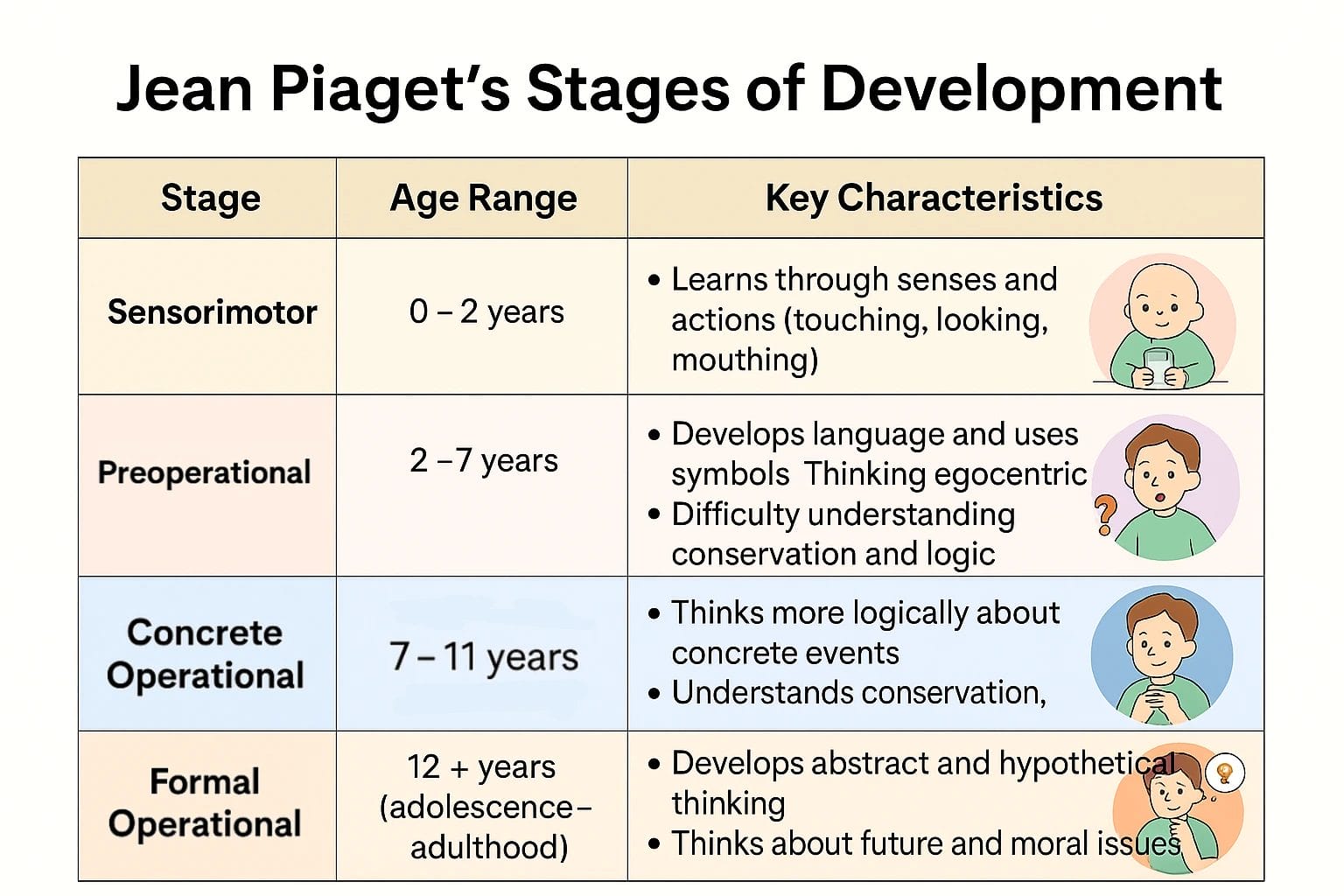
The Four Stages of Cognitive Development

1️⃣ Sensorimotor Stage (Birth–2 Years)

Key Characteristics:

  • Learning through sensory experiences and motor actions

  • No symbolic thinking initially

  • Development of object permanence

Major Achievement: Object Permanence

Understanding that objects continue to exist even when not visible.

Example:

  • A baby cries when a toy is hidden (no object permanence).

  • Later, the baby searches for the hidden toy (object permanence achieved).

Real-Life Example:

Peek-a-boo becomes funny only after object permanence develops.

2️⃣ Preoperational Stage (2–7 Years)

https://www.healthychildren.org/SiteCollectionImagesArticleImages/pretend-play-1.jpg

Key Characteristics:

  • Rapid language development

  • Symbolic play (pretending)

  • Thinking is egocentric

  • Lack of logical operations

Important Concepts:

🔸 Egocentrism

Difficulty seeing situations from others’ perspectives.

Example:
A child assumes everyone knows what they know.

🔸 Animism

Belief that inanimate objects have feelings.

Example:
“The sun is angry today.”

🔸 Lack of Conservation

Inability to understand that quantity remains the same despite changes in appearance.

Example:
Water poured from a short glass into a tall glass is seen as “more.”

Example:

A child believes breaking a biscuit makes two bigger biscuits instead of the same amount.

3️⃣ Concrete Operational Stage (7–11 Years)

https://learningmole.com/wp-content/uploads/2023/11/student-boy-with-chalk-chalkboard.jpg

Key Characteristics:

  • Logical thinking develops

  • Thinking is tied to concrete objects

  • Reduced egocentrism

Important Abilities:

🔸 Conservation

Understanding quantity remains constant.

Example:
Recognizing that reshaped clay is still the same amount.

🔸 Reversibility

Understanding actions can be reversed.

Example:
Knowing 5 + 3 = 8 and 8 − 3 = 5.

🔸 Classification

Ability to group objects by multiple features.

Example:
Sorting buttons by color and size.

 Example:

A child understands that sharing one chocolate equally means fairness, not appearance.


4️⃣ Formal Operational Stage (12 Years and Up)

https://socialsci.libretexts.org/%40api/deki/files/126567/Screenshot_2023-08-30_203512.png?revision=1

Key Characteristics:

  • Abstract thinking

  • Hypothetical reasoning

  • Logical problem-solving

  • Metacognition (thinking about thinking)

Hypothetico-Deductive Reasoning

Ability to form hypotheses and test them logically.

Example:
“If I study more, I might score better — but if I change my method, results may improve.”

Real-Life Example:

Adolescents debate:

  • Justice

  • Ethics

  • Future goals

  • Social issues

🏫 Educational Implications of Piaget’s Theory

  • Learning should be developmentally appropriate

  • Children learn best through active exploration

  • Teachers should act as facilitators, not just instructors

  • Concrete experiences are crucial before abstract concepts

⚠️ Criticisms of Piaget’s Theory

Despite its influence, Piaget’s theory has limitations:

  • Underestimates children’s abilities

  • Stages may overlap

  • Cultural and social factors are less emphasized

  • Some skills appear earlier than Piaget suggested

🌱 Why Piaget’s Theory Still Matters Today

  • Foundation of modern child psychology

  • Influences teaching methods and curriculum design

  • Helps parents understand age-appropriate expectations

  • Widely used in counseling, assessment, and education

🧠 Final Thoughts

Piaget’s Cognitive Development Theory provides a strong framework for understanding how children think, not just what they know. Piaget showed that intelligence is not simply about gaining information, but about changes in the way children reason and understand the world as they grow.

The theory emphasizes that children are active constructors of knowledge. They learn by exploring their environment, experimenting, and making sense of their experiences. Errors and confusion are not failures; they are natural and necessary parts of learning.

Piaget also highlighted that development is a process of continuous adjustment and growth. As children encounter new experiences, they adapt their thinking, gradually moving from simple understanding to more complex reasoning. Overall, the theory helps parents, educators, and professionals respect developmental readiness and support learning in a way that matches how children naturally think and grow.

Frequently Asked Questions (FAQ): Piaget’s Cognitive Development Theory


1. Who proposed the Cognitive Development Theory?

The theory was proposed by Jean Piaget, a Swiss developmental psychologist known for his pioneering work on child cognition.


2. What is the main idea of Piaget’s Cognitive Development Theory?

The core idea is that children are active learners who construct knowledge through interaction with their environment. Cognitive development is about how thinking changes, not just how much information a child has.


3. How many stages are there in Piaget’s theory?

Piaget proposed four stages of cognitive development:

  1. Sensorimotor (birth–2 years)

  2. Preoperational (2–7 years)

  3. Concrete operational (7–11 years)

  4. Formal operational (12 years and above)

Each stage represents a qualitative change in thinking.


4. What are schemas in Piaget’s theory?

Schemas are mental frameworks that help children organize and interpret information. They develop and become more complex as children grow and gain experience.


5. What is the difference between assimilation and accommodation?

  • Assimilation: Fitting new information into existing schemas

  • Accommodation: Modifying existing schemas to adapt to new information

Both processes work together to support learning and cognitive growth.


6. Is Piaget’s theory still relevant today?

Yes. Piaget’s theory continues to influence education, psychology, counseling, and parenting, especially in understanding age-appropriate learning and child-centered teaching methods.


7. What are the main criticisms of Piaget’s theory?

Some researchers believe Piaget:

  • Underestimated children’s abilities

  • Paid limited attention to social and cultural influences

  • Described development as more rigid than it actually is

Despite this, his theory remains foundational in developmental psychology.


Written by Baishakhi Das

Counselor | Mental Health Practitioner
Qualifications: B.Sc in Psychology | M.Sc  | PG Diploma in Counseling

Reference Links


Fatherhood and Mental Health: What Every Dad Should Know

Fatherhood is often described as one of life’s most meaningful roles—but it is also one of the least emotionally discussed. While much attention is rightly given to mothers’ mental health, fathers’ emotional experiences are frequently minimized, overlooked, or dismissed with phrases like “men are strong” or “fathers just need to provide.”

In reality, fatherhood brings profound psychological, emotional, relational, and identity changes. When these changes go unsupported, many fathers struggle silently—with stress, anxiety, depression, anger, emotional distance, or burnout.

This article explores fatherhood and mental health in depth, addressing the emotional challenges fathers face, why many struggle in silence, and what every dad should know to protect his mental well-being.

Fatherhood Is a Major Psychological Transition

Becoming a father is not just a role change—it is an identity shift.

Men often experience:

  • Increased responsibility and pressure

  • Fear of failure as a provider or protector

  • Changes in self-identity and priorities

  • Reduced personal freedom

  • Emotional reactivation of their own childhood experiences

Unlike women, men are rarely prepared emotionally for this transition. Many enter fatherhood with high expectations but little guidance, leading to internal stress and self-doubt.

Common Mental Health Challenges in Fathers

1. Paternal Depression (Yes, Fathers Get Depressed Too)

Depression in fathers often looks different from stereotypical sadness.

Common signs include:

  • Irritability or anger

  • Emotional numbness

  • Withdrawal from family

  • Overworking or avoiding home

  • Increased substance use

  • Physical complaints (headaches, fatigue)

Many fathers do not recognize these signs as depression, delaying help-seeking.

2. Anxiety and Constant Worry

Fathers frequently experience anxiety related to:

  • Financial responsibility

  • Child’s safety and future

  • Relationship changes with partner

  • Work–life balance

This anxiety may remain unspoken, manifesting instead as restlessness, control, or emotional distance.

3. Anger and Emotional Dysregulation

For many men, anger becomes the default emotion, especially when sadness, fear, or overwhelm feel unacceptable.

Unaddressed anger can:

  • Damage partner relationships

  • Create fear in children

  • Increase guilt and shame

  • Lead to emotional disconnection

Anger in fathers is often a signal of unmet emotional needs, not moral failure.

4. Loneliness and Emotional Isolation

Even in families, many fathers feel deeply alone.

Reasons include:

  • Reduced social connections

  • Emotional focus shifting primarily to the mother–child bond

  • Lack of spaces where men can speak openly

  • Belief that they must “handle it alone”

Loneliness in fathers is strongly linked to depression and burnout.

Postpartum Mental Health in Fathers

Postpartum mental health is not exclusive to mothers. Fathers can experience:

  • Postnatal depression

  • Anxiety

  • Identity confusion

  • Feelings of invisibility

Risk factors include:

  • Partner’s postpartum depression

  • Sleep deprivation

  • Relationship strain

  • Prior mental health history

Yet paternal postpartum mental health remains severely under-recognized.

How Fatherhood Reactivates Childhood Wounds

Fatherhood often brings unresolved childhood experiences to the surface.

Fathers may find themselves thinking:

  • “I don’t want to become my father”

  • “I don’t know how to show affection”

  • “I never learned how to be emotionally present”

Unhealed childhood emotional neglect, abuse, or absence can affect:

  • Emotional availability

  • Attachment with children

  • Parenting style

  • Self-criticism and guilt

Awareness of these patterns is the first step toward breaking generational cycles.

Impact of a Father’s Mental Health on Children

A father’s mental health significantly affects a child’s:

  • Emotional regulation

  • Sense of safety

  • Self-esteem

  • Social development

Children don’t need perfect fathers—they need emotionally present and regulated ones.

When fathers model:

  • Emotional awareness

  • Healthy coping

  • Repair after mistakes

children learn resilience and emotional security.

Why Fathers Often Don’t Seek Help

Common barriers include:

  • Stigma around male vulnerability

  • Fear of being seen as weak

  • Belief that others’ needs matter more

  • Lack of male-focused mental health spaces

Many fathers seek help only when:

  • Relationships break down

  • Anger becomes unmanageable

  • Physical symptoms appear

Early support can prevent long-term harm.

Healthy Ways Fathers Can Support Their Mental Health

1. Normalize Emotional Struggle

Feeling overwhelmed does not mean you are failing as a father. It means you are human.

2. Build Emotional Language

Learning to name emotions reduces anger, stress, and emotional shutdown.

3. Prioritize Sleep and Physical Health

Sleep deprivation alone can severely impact mood, patience, and decision-making.

4. Create Support Systems

This may include:

  • Trusted friends

  • Support groups

  • Therapy or counseling

Isolation intensifies distress.

5. Seek Professional Support Early

Therapy is not about weakness—it is about responsibility and self-awareness.

A Message to Fathers

You are allowed to:

  • Feel overwhelmed

  • Ask for help

  • Rest

  • Talk about fear and doubt

  • Take care of your mental health

Strong fathers are not those who suffer silently—but those who choose awareness, support, and growth.

Final Reflection

Fatherhood is not just about providing—it is about presence. A father’s mental health shapes not only his own well-being, but the emotional climate of his family and the future emotional health of his children.

By acknowledging the emotional realities of fatherhood, breaking silence around men’s mental health, and encouraging support-seeking, we create healthier fathers, stronger families, and more emotionally secure children.

FREQUENTLY ASKED QUESTIONS (FAQ)


1. Is it normal for fathers to struggle with mental health?

Yes. Fatherhood brings major emotional, identity, and lifestyle changes. Stress, anxiety, sadness, anger, or emotional numbness are common and valid experiences, not signs of weakness.


2. What does depression look like in fathers?

Depression in fathers often appears as:

  • Irritability or anger

  • Emotional withdrawal

  • Overworking or avoidance

  • Fatigue and sleep problems

  • Substance use

Many fathers don’t feel “sad,” which is why paternal depression often goes unnoticed.


3. Can fathers experience postpartum depression?

Yes. Paternal postpartum depression affects many men, especially during the first year after childbirth. Risk increases if:

  • The partner has postpartum depression

  • Sleep deprivation is severe

  • There is relationship stress

  • The father has a history of mental health issues


4. How does a father’s mental health affect children?

A father’s mental health influences a child’s:

  • Emotional security

  • Stress regulation

  • Self-esteem

  • Behavioral development

Emotionally present fathers support healthier psychological outcomes in children.


5. Why do many fathers avoid seeking help?

Common reasons include:

  • Social stigma around male vulnerability

  • Pressure to “be strong”

  • Fear of being judged as weak

  • Lack of father-focused mental health resources


6. Is anger in fathers a mental health issue?

Anger is often a secondary emotion masking stress, fear, sadness, or burnout. Persistent anger may signal unmet emotional needs or emotional overload and deserves attention, not shame.


7. When should a father seek professional help?

Support is strongly recommended if emotional distress:

  • Is harming relationships

  • Leads to aggression or emotional shutdown

  • Interferes with work or parenting

  • Coexists with trauma, anxiety, or depression

Early help prevents long-term impact.


8. Does therapy really help fathers?

Yes. Therapy helps fathers:

  • Regulate emotions

  • Process stress and trauma

  • Improve relationships

  • Build emotional confidence

  • Break intergenerational patterns

Therapy is a strength-based choice, not a failure.


9. How can fathers support their mental health daily?

  • Get adequate sleep where possible

  • Share emotional load with trusted people

  • Limit overworking

  • Practice emotional awareness

  • Seek professional support early


10. What is the most important message for fathers?

You don’t have to suffer silently.
Caring for your mental health is part of caring for your family.

Written by Baishakhi Das

Counselor | Mental Health Practitioner
Qualifications: B.Sc in Psychology | M.Sc  | PG Diploma in Counseling

Reference 

  1. World Health Organization (WHO) – Mental Health
    https://www.who.int/teams/mental-health-and-substance-use
    (Global mental health framework and family wellbeing)

  2. American Psychological Association – Fathers & Mental Health
    https://www.apa.org/monitor/2013/02/fatherhood
    (Psychological impact of fatherhood on men)

  3. National Institute of Mental Health (NIMH) – Men and Mental Health
    https://www.nimh.nih.gov/health/topics/men-and-mental-health
    (Male depression, anxiety, help-seeking barriers)

  4. Postpartum Support International – Paternal Mental Health
    https://www.postpartum.net/get-help/help-for-dads/
    (Postpartum depression and anxiety in fathers)

  5. Psychology Today – Fathers and Emotional Health
    https://www.psychologytoday.com/us/basics/fatherhood
    (Fatherhood, stress, identity, and emotional wellbeing)

  6. NHS (UK) – Men’s Mental Health
    https://www.nhs.uk/mental-health/conditions/
    (Accessible public mental health guidance)

  7. Harvard Center on the Developing Child – Parents & Mental Health
    https://developingchild.harvard.edu

  8. 7 Signs You Need to Talk to a Therapist — Don’t Ignore These


Anger Management: Understanding, Regulating, and Transforming Anger in Healthy Ways

Anger is one of the most misunderstood emotions. It is often labeled as negative, dangerous, or destructive, yet anger itself is not the problem. Unregulated, suppressed, or explosive anger is what creates harm—to relationships, physical health, and mental well-being.

Anger management is not about controlling or eliminating anger. It is about understanding what anger is communicating, regulating the body’s response, and expressing emotions in healthy, constructive ways.

This article explores anger management in depth—covering the psychology of anger, its causes, types, consequences, and evidence-based strategies to manage it effectively.

What Is Anger?

Anger is a natural emotional response to perceived threat, injustice, frustration, or boundary violation. From an evolutionary perspective, anger helped humans survive by preparing the body to respond to danger.

When anger arises:

  • Heart rate increases

  • Muscles tense

  • Stress hormones like adrenaline and cortisol are released

  • The brain shifts into a survival-oriented mode

This response is automatic. The problem arises when anger becomes chronic, overwhelming, or poorly expressed.

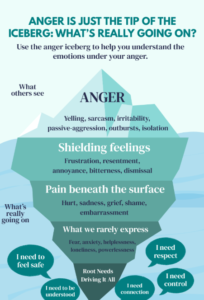
The Anger Iceberg: What Lies Beneath Anger

Psychologically, anger is often a secondary emotion. This means it sits on the surface, protecting more vulnerable feelings underneath.

Common emotions beneath anger include:

  • Hurt

  • Fear

  • Shame

  • Rejection

  • Helplessness

  • Loneliness

For many individuals—especially those taught to suppress vulnerability—anger becomes the only acceptable emotion. Understanding what lies beneath anger is a key step in managing it.

Common Causes of Anger

Anger does not emerge randomly. It usually develops from a combination of internal and external factors.

1. Unmet Emotional Needs

Feeling unheard, unappreciated, disrespected, or ignored can build resentment over time.

2. Stress and Burnout

Chronic stress lowers emotional tolerance, making even small triggers feel overwhelming.

3. Trauma and Past Experiences

Individuals with childhood abuse, neglect, or emotional invalidation may have a heightened anger response due to a sensitized nervous system.

4. Poor Emotional Regulation Skills

Many people were never taught how to recognize, name, or express emotions safely.

5. Cognitive Distortions

Rigid beliefs such as “People must respect me” or “This should not happen” intensify anger reactions.

Types of Anger Expression

Anger can manifest in different ways, each with its own psychological cost.

1. Explosive Anger

  • Yelling, aggression, verbal or physical outbursts

  • Often followed by guilt or shame

  • Damages relationships and trust

2. Suppressed Anger

  • Avoidance, emotional shutdown, people-pleasing

  • May lead to anxiety, depression, psychosomatic symptoms

3. Passive-Aggressive Anger

  • Sarcasm, silent treatment, indirect hostility

  • Creates confusion and unresolved conflict

4. Chronic Irritability

  • Constant frustration, impatience, bitterness

  • Often linked to burnout or unresolved trauma

Healthy anger management aims to replace these patterns with assertive and regulated expression.

The Impact of Unmanaged Anger

When anger is not addressed, it can affect multiple areas of life:

Mental Health

  • Anxiety disorders

  • Depression

  • Emotional numbness

  • Substance use

Physical Health

  • High blood pressure

  • Headaches

  • Digestive issues

  • Increased risk of heart disease

Relationships

  • Frequent conflicts

  • Emotional distance

  • Fear and lack of safety

  • Breakdown of trust

Anger that is ignored does not disappear—it often turns inward or spills outward.

Anger Management:

  1. Awareness – recognizing anger early

  2. Regulation – calming the body and nervous system

  3. Expression – communicating needs safely and clearly

It is a skill set, not a personality trait.

Practical Anger Management Techniques

1. Recognize Early Warning Signs

Anger gives signals before it explodes:

  • Tight jaw or fists

  • Rapid breathing

  • Racing thoughts

  • Feeling “heated” or restless

Early awareness allows intervention before escalation.

2. Regulate the Body First

You cannot reason with an overactivated nervous system.

Helpful techniques:

  • Slow diaphragmatic breathing

  • Grounding exercises (5–4–3–2–1 method)

  • Physical movement (walking, stretching)

Regulation brings the brain back online.

3. Identify the Real Emotion

Ask yourself:

  • What am I really feeling right now?

  • What need feels threatened or unmet?

Naming emotions reduces their intensity.

4. Challenge Angry Thought Patterns

Cognitive reframing helps reduce emotional intensity:

  • Replace “They are disrespecting me” with “I feel ignored, and that hurts”

  • Replace “This always happens” with “This situation is difficult, not permanent”

5. Learn Assertive Communication

Healthy anger expression sounds like:

  • “I felt upset when…”

  • “I need…”

  • “This boundary is important to me”

Assertiveness respects both self and others.

6. Release Anger Safely

Anger needs an outlet—not destruction.

Healthy outlets include:

  • Journaling

  • Exercise

  • Creative expression

  • Talking with a trusted person

Anger, Masculinity, and Social Conditioning

Many men are socialized to:

  • Avoid vulnerability

  • Suppress sadness or fear

  • Use anger as the only emotional outlet

This makes anger management especially important in men’s mental health. Learning emotional language and regulation is not weakness—it is emotional maturity.

When to Seek Professional Help

Anger management therapy may be helpful if:

  • Anger feels uncontrollable
  • It begins to harm personal and professional relationships.
  • It increases the risk of aggressive or violent behavior.
  • It occurs alongside trauma-related symptoms, anxiety, or depressive disorders.

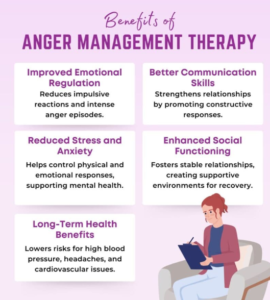
Therapy helps uncover underlying causes and builds long-term emotional regulation skills.

Final Reflection

Anger is not the enemy—it is a messenger. It points to boundaries, unmet needs, pain, and injustice. When understood and regulated, anger can become a source of clarity, self-respect, and change.

True anger management is not about suppressing emotion—it is about learning to listen, regulate, and respond rather than react.

Written by Baishakhi Das

Counselor | Mental Health Practitioner
Qualifications: B.Sc in Psychology | M.Sc  | PG Diploma in Counseling

Frequently Asked Questions (FAQ): Anger Management


1. Is anger a bad emotion?

No. Anger itself is a normal and healthy emotion. It signals that something feels unfair, threatening, or emotionally painful. Problems arise when anger is suppressed, misdirected, or expressed aggressively.


2. What is the difference between anger and aggression?

Anger is an emotion, while aggression is a behavior. You can feel angry without being aggressive. Anger management focuses on regulating the emotion so it can be expressed assertively rather than destructively.


3. Why do some people get angry more easily than others?

Anger sensitivity can be influenced by:

  • Childhood experiences and emotional modeling

  • Chronic stress or burnout

  • Trauma or unresolved emotional wounds

  • Poor emotional regulation skills

  • Rigid thinking patterns

People who grew up in invalidating or unsafe environments often have a lower emotional tolerance for frustration.


4. Is anger always caused by the present situation?

Often, no. Many anger reactions are triggered by old emotional wounds. The current situation may resemble earlier experiences of rejection, disrespect, or powerlessness, activating a stronger response than the present moment alone would justify.


5. What are the physical signs that anger is building up?

Common early signs include:

  • Tight jaw or clenched fists

  • Rapid heartbeat

  • Shallow or fast breathing

  • Feeling hot or restless

  • Racing or rigid thoughts

Recognizing these signs early is key to effective anger management.


6. Can suppressed anger cause health problems?

Yes. Chronic suppression of anger has been linked to:

  • Anxiety and depression

  • Headaches and digestive problems

  • High blood pressure

  • Emotional numbness

  • Passive-aggressive behavior

Anger that is not expressed safely often turns inward.


7. Are anger management techniques effective?

Yes—when practiced consistently. Techniques such as breathing exercises, cognitive restructuring, emotional awareness, and assertive communication are evidence-based and widely used in psychotherapy.


8. When should someone seek professional help for anger?

Professional support is recommended if:

  • Anger feels uncontrollable

  • It harms relationships or work life

  • There is verbal or physical aggression

  • Anger is linked with trauma, anxiety, or depression

Therapy helps address both symptoms and root causes of anger.


9. Is anger management only for people who “lose control”?

No. Anger management is also for people who:

  • Suppress emotions

  • Feel chronically irritated

  • Struggle to set boundaries

  • Feel guilt or shame after expressing anger

Healthy anger expression is a life skill, not a crisis tool.


10. What is the core goal of anger management?

The goal is not to eliminate anger, but to:

  • Understand what anger is communicating

  • Regulate the body’s stress response

  • Express emotions clearly and respectfully

In short: respond instead of react.


Reference 

  1. American Psychological Association – Anger
    https://www.apa.org/topics/anger
    — Evidence-based overview of anger, its effects, and management strategies.

  2. National Institute of Mental Health – Stress and Emotion Regulation
    https://www.nimh.nih.gov/health/topics/stress
    — Explains how stress impacts emotional control, including anger.

  3. Verywell Mind – Anger Management Techniques
    https://www.verywellmind.com/anger-management-strategies-4178870
    — Practical, psychology-backed anger management strategies.

  4. Mayo Clinic – Anger Management: Tips to Tame Your Temper
    https://www.mayoclinic.org/healthy-lifestyle/adult-health/in-depth/anger-management/art-20045434
    — Medical perspective on anger, health risks, and coping skills.

  5. Psychology Today – Understanding Anger
    https://www.psychologytoday.com/us/basics/anger
    — Explores emotional, cognitive, and relational aspects of anger.

  6. World Health Organization – Mental Health and Emotional Regulation
    https://www.who.int/teams/mental-health-and-substance-use
    — Global mental health framework relevant to emotional regulation.

  7. National Health Service (UK) – Anger Management
    https://www.nhs.uk/mental-health/conditions/anger-management/
    — Public mental health guidance on managing anger safely.

  8. 7 Signs You Need to Talk to a Therapist — Don’t Ignore These


Real Stories: How Men Turned Their Mental Health Around

For many men, mental health struggles do not look like sadness or tears. They often show up as anger, emotional numbness, workaholism, isolation, addiction, or physical complaints. Social expectations around masculinity—“be strong,” “don’t talk,” “handle it yourself”—push many men to suffer silently for years.

This article shares real-life inspired stories (names changed for privacy) that reflect common patterns seen in counseling rooms. These stories show that healing is possible, not through sudden transformation, but through awareness, support, and small, consistent changes.

Story 1: “I Didn’t Know I Was Depressed Because I Was Still Functioning”

– Rakesh, 38, Corporate Professional

Rakesh had a stable job, a family, and financial security. From the outside, everything looked fine. Inside, he felt empty, irritable, and disconnected. He worked long hours, avoided emotional conversations, and snapped at his wife and children.

He didn’t identify as “depressed” because he was still going to work and meeting responsibilities. It was only after recurring headaches, insomnia, and a panic episode that he sought help.

Turning Point

In therapy, Rakesh realized he was experiencing high-functioning depression. He had learned early in life that emotions were weakness, so he coped by suppressing them.

What Helped

  • Psychoeducation about male depression

  • Learning emotional language

  • Weekly therapy sessions

  • Setting boundaries at work

Outcome

Over time, Rakesh reported feeling more present, less irritable, and emotionally available to his family. His biggest realization:

“I wasn’t broken—I was exhausted from pretending I was okay.”

Story 2: “Anger Was Easier Than Admitting I Was Hurt”

– Imran, 42, Small Business Owner

Imran was known for his temper. Family members described him as “short-fused” and “controlling.” What no one saw was his unprocessed childhood trauma—a violent home and constant emotional invalidation.

Whenever he felt criticized or ignored, his nervous system reacted as if he was under threat. Anger became his shield.

Turning Point

After his marriage reached the brink of separation, Imran agreed to counseling—reluctantly.

What Helped

  • Trauma-informed therapy

  • Understanding anger as a secondary emotion

  • Learning grounding and regulation skills

  • Exploring childhood emotional neglect

Outcome

Imran didn’t “lose” his anger—he learned to understand it. His reactions softened, and his relationships became less conflict-driven.

“Anger was protecting me. Once I felt safe, I didn’t need it as much.”

Story 3: “I Felt Like a Failure Because I Lost My Job”

– Suman, 35, IT Professional

When Suman was laid off during an economic downturn, his self-worth collapsed. He stopped socializing, avoided family gatherings, and felt deep shame. He believed:

“If I’m not earning, I’m nothing.”

His anxiety increased, sleep reduced, and he began withdrawing emotionally from his partner.

Turning Point

A friend encouraged him to speak to a counselor, framing it not as weakness but as support.

What Helped

  • Challenging identity tied only to productivity

  • Career counseling combined with emotional support

  • Routine building during unemployment

  • Normalizing grief around job loss

Outcome

Suman eventually found new work, but more importantly, he rebuilt a healthier sense of self not solely tied to income.

“Losing my job broke my confidence—but rebuilding it changed my life.”

Story 4: “I Didn’t Know How Lonely I Was Until I Spoke About It”

– Arjun, 29, Single, Living Alone

Arjun rarely talked about his feelings. He spent most evenings scrolling on his phone, gaming, or watching shows. He didn’t feel sad—just numb and disconnected.

He believed loneliness was something “weak people” complained about.

Turning Point

During a health checkup, the doctor asked about stress and sleep. For the first time, Arjun admitted he felt invisible.

What Helped

  • Normalizing male loneliness

  • Group therapy sessions

  • Building offline social routines

  • Learning to initiate emotional conversations

Outcome

Arjun didn’t suddenly become extroverted, but he developed meaningful connections.

“Loneliness wasn’t the absence of people—it was the absence of connection.”

Common Themes Across These Stories

Despite different backgrounds, these men shared common experiences:

  • Emotional suppression

  • Shame around vulnerability

  • Identity tied to productivity or control

  • Delayed help-seeking

  • Fear of being judged

And common healing factors:

  • Being heard without judgment

  • Understanding emotions, not fighting them

  • Safe therapeutic relationships

  • Small, consistent lifestyle changes

Why These Stories Matter

Men often don’t seek help until:

  • Relationships break down

  • Physical symptoms appear

  • Anger becomes unmanageable

  • Burnout sets in

Sharing real stories reduces stigma and sends a powerful message:

You don’t have to reach a breaking point to ask for help.

A Message to Men Who Are Struggling

You don’t need to have the “right words.”
You don’t need to be falling apart.
You don’t need to do this alone.

Mental health recovery is not about becoming someone else—it’s about becoming more yourself, with support.

Final Thought

These stories are not about dramatic transformations. They are about men choosing honesty over silence, support over isolation, and healing over endurance.

you can Also Read

7 Signs You Need to Talk to a Therapist — Don’t Ignore These

Top 7 Tools Men Can Use to Track Their Mental Wellness


Attachment Theory: How Childhood Bonds Shape Adult Relationships

Human beings are wired for connection. From the moment we are born, our emotional survival depends on the quality of our earliest relationships. Attachment Theory explains how these early bonds—especially with primary caregivers—shape the way we love, trust, depend on others, and manage closeness throughout our lives.

Developed by John Bowlby and later expanded through research by Mary Ainsworth, attachment theory is now one of the most influential frameworks in developmental psychology, psychotherapy, and relationship counseling.

This article explores attachment theory in depth—its origins, attachment styles, psychological mechanisms, and how childhood bonding patterns continue to influence adult romantic relationships, emotional regulation, and mental health.

What Is Attachment Theory?

Attachment theory explains that early emotional bonds with caregivers shape an “internal working model”—a deeply ingrained psychological framework that guides how individuals perceive themselves, others, and relationships throughout life. This concept was originally proposed by John Bowlby, who emphasized that these models are formed in infancy through repeated interactions with primary caregivers.

What Is an Internal Working Model?

An internal working model is not a conscious belief system. Rather, it is an emotional and relational blueprint that answers some of life’s most fundamental questions:

    • How safe is the world?
      Early caregiving teaches a child whether the environment is predictable or threatening. Consistent care fosters a sense of safety, while neglect or unpredictability can create chronic anxiety or hypervigilance.

  • Are other people reliable and responsive?
    When caregivers respond sensitively, the child learns that others can be depended on. When responses are inconsistent, rejecting, or frightening, the child may learn to expect disappointment, abandonment, or emotional danger.

  • Am I worthy of love and care?
    The way a child’s needs are met (or dismissed) shapes self-worth. Attuned caregiving supports a sense of inherent worth, whereas repeated invalidation can lead to feelings of being “too much,” unimportant, or unlovable.

  • How should closeness and separation feel?
    Children learn whether closeness is comforting or overwhelming, and whether separation is tolerable or terrifying. These early lessons later influence how adults handle intimacy, distance, conflict, and loss.

How These Models Influence Adult Relationships

These internal working models do not disappear as we grow older. Instead, they operate quietly in the background, shaping adult relationship patterns—often without conscious awareness. They become especially active during emotionally charged moments such as:

  • Romantic conflict

  • Perceived rejection or abandonment

  • Deep intimacy or vulnerability

  • Grief, loss, or major life stress

For example:

  • Someone who learned that love is unpredictable may become anxious and clingy in relationships.

  • Someone who learned that emotions are ignored may suppress needs and avoid closeness.

  • Someone whose early bonds were frightening may both crave and fear intimacy at the same time.

What often appears as “overreacting,” “emotional distance,” or “relationship insecurity” is frequently the activation of an old attachment model, not a reaction to the present situation alone.

Why This Insight Is So Important

Attachment theory shifts the narrative from self-blame to understanding. It helps individuals recognize that many relationship behaviors are learned adaptations, not character flaws. These patterns once served a purpose—emotional survival in early relationships—even if they no longer serve well in adulthood.

In Simple Terms

How we were loved teaches us how to love.
But just as importantly, attachment theory reminds us that what was learned in early relationships can be unlearned, reshaped, and healed through awareness, emotionally safe relationships, and therapeutic support.

The Role of Early Caregivers

Infants are biologically programmed to seek closeness to caregivers for safety and comfort. Crying, clinging, and following are not “bad habits”—they are survival behaviors.

When caregivers respond with:

  • Consistency

  • Emotional attunement

  • Physical and emotional availability

the child learns:

“I am safe. My needs matter. Others can be trusted.”

When caregiving is inconsistent, rejecting, frightening, or absent, the child adapts by developing protective attachment strategies. These strategies help the child survive emotionally—but may later interfere with adult relationships.

The Four Main Attachment Styles

1. Secure Attachment

Childhood Experience

  • Caregivers are emotionally available and responsive

  • Child feels safe exploring and returning for comfort

Adult Relationship Patterns

  • Comfortable with intimacy and independence

  • Able to communicate needs clearly

  • Trusts partners and manages conflict constructively

Core Belief

“I am worthy of love, and others can be trusted.”

Secure attachment is associated with healthier relationships, emotional regulation, and psychological resilience.

  1. Anxious (Preoccupied) Attachment

Childhood Experience

  • Inconsistent caregiving

  • Love feels unpredictable

Adult Relationship Patterns

  • Fear of abandonment

  • Constant need for reassurance

  • Hypervigilance to partner’s moods

  • Difficulty tolerating distance

Core Belief

“I must stay close to be loved, or I will be abandoned.”

Anxious attachment often shows up as people-pleasing, emotional dependency, and intense relationship anxiety.

  1. Avoidant (Dismissive) Attachment

Childhood Experience

  • Emotionally distant or rejecting caregivers

  • Emotional needs minimized or ignored

Adult Relationship Patterns

  • Discomfort with closeness

  • Strong independence

  • Emotional withdrawal during conflict

  • Difficulty expressing vulnerability

Core Belief

“Depending on others is unsafe; I must rely on myself.”

Avoidant attachment is often mistaken for confidence, but it is rooted in emotional self-protection.

  1. Fearful-Avoidant (Disorganized) Attachment

Childhood Experience

  • Caregivers are frightening, abusive, or unpredictable

  • Child experiences both comfort and fear from the same figure

Adult Relationship Patterns

  • Desire for closeness combined with fear of it

  • Push–pull relationship dynamics

  • Emotional chaos, mistrust

  • Higher risk of trauma-related symptoms

Core Belief

“I want connection, but it is dangerous.”

This style is strongly linked to childhood trauma and unresolved emotional wounds.

How Attachment Styles Shape Adult Romantic Relationships

Attachment patterns are often most clearly expressed in close romantic relationships, because these relationships activate the same emotional systems that were shaped in early caregiving. Romantic partners unconsciously become attachment figures, which means old emotional expectations are easily reawakened—especially during moments of threat or uncertainty.

When Attachment Patterns Become Most Visible

Attachment behaviors tend to intensify when:

1. There Is Emotional Vulnerability

Moments of openness—such as expressing needs, sharing fears, or depending on a partner—can activate deep attachment responses. For securely attached individuals, vulnerability feels connecting. For insecurely attached individuals, it may trigger fear of rejection, engulfment, or emotional exposure.

For example:

  • Anxiously attached individuals may seek constant reassurance

  • Avoidantly attached individuals may withdraw or minimize emotions

  • Fearfully attached individuals may oscillate between closeness and distance

screenshot 2025 11 20 000712

  1. Conflict Arises

Conflict signals a potential threat to connection. During disagreements, attachment systems become highly active, often overriding logic and calm communication.

  • Anxious attachment may show as heightened emotional expression, protest behaviors, or fear-driven arguments

  • Avoidant attachment may show as emotional shutdown, defensiveness, or avoidance of discussion

  • Secure attachment allows for disagreement without fear of abandonment

Conflict is rarely just about the topic—it is about whether the bond feels safe.

  1. Separation or Rejection Is Perceived

Actual or imagined separation—missed calls, emotional distance, delayed responses, or perceived indifference—can strongly trigger attachment fears.

  • Anxious individuals may experience intense distress and fear abandonment

  • Avoidant individuals may detach emotionally to regain control

  • Fearful individuals may experience confusion, mistrust, and emotional chaos

Even minor events can feel overwhelming when they echo early attachment wounds.

Common Relationship Dynamics Explained

Anxious–Avoidant Dynamic: The Pursuit–Withdrawal Pattern

This is one of the most common and painful relationship patterns.

  • The anxious partner seeks closeness, reassurance, and emotional engagement

  • The avoidant partner experiences this as pressure and pulls away

  • The more one pursues, the more the other withdraws

Both partners are trying to feel safe—but using opposite strategies shaped by early attachment experiences.

Fearful Attachment: Intense and Unstable Relationships

Individuals with fearful (disorganized) attachment often crave closeness but fear it at the same time.

This can lead to:

  • Push–pull dynamics

  • Sudden emotional shifts

  • Difficulty trusting partners

  • High emotional intensity followed by withdrawal

These relationships are often marked by passion, confusion, and repeated ruptures.

Secure Attachment: Emotional Safety and Repair

Securely attached partners are not conflict-free, but they are repair-oriented.

They tend to:

  • Communicate needs openly

  • Tolerate vulnerability

  • Take responsibility during conflict

  • Reconnect after emotional ruptures

The key difference is not the absence of problems, but the ability to repair and reconnect.

Why Many Conflicts Are About the Past, Not the Present

Many relationship arguments appear to be about:

  • Tone of voice

  • Texting frequency

  • Time spent together

  • Minor disagreements

But underneath, they are often driven by old attachment fears such as:

  • “I will be abandoned”

  • “My needs don’t matter”

  • “Closeness is unsafe”

  • “I will lose myself if I depend on someone”

When these fears are triggered, partners react from a younger emotional state, responding not only to the present partner but to past relational experiences.

A Therapeutic Perspective

Understanding attachment dynamics helps individuals and couples shift from blame to insight. Instead of asking:

“Why are we always fighting about this?”

They can ask:

“What attachment need is being threatened right now?”

This shift opens the door to empathy, emotional safety, and lasting change.

screenshot 2025 11 24 000049

Attachment styles strongly influence how adults manage emotions:

  • Secure attachment → balanced emotional regulation

  • Anxious attachment → emotional overwhelm

  • Avoidant attachment → emotional suppression

  • Disorganized attachment → emotional dysregulation

This explains why some people:

  • Shut down during conflict

  • Become emotionally reactive

  • Struggle to express needs

  • Feel numb or overwhelmed in relationships

Attachment, Trauma, and Mental Health

Attachment theory is central to trauma-informed care. Early neglect, abuse, or chronic emotional invalidation disrupt attachment security and increase vulnerability to:

  • Anxiety disorders

  • Depression

  • Complex trauma

  • Relationship burnout

  • Emotional numbness

Importantly, attachment adaptations are not flaws—they are survival responses.

Can Attachment Styles Change?

Yes. Attachment is not fixed.

Attachment styles can shift through:

  • Secure romantic relationships

  • Psychotherapy (especially attachment-based therapy)

  • Self-awareness and emotional skills training

  • Corrective emotional experiences

Therapy often provides what was missing earlier: consistency, safety, validation, and emotional attunement.

Attachment Theory in Counseling and Psychotherapy

Mental health professionals use attachment theory to:

  • Understand relationship patterns

  • Address fear of abandonment or intimacy

  • Heal childhood emotional wounds

  • Improve emotional regulation

  • Strengthen relational security

It is widely integrated into:

  • Psychodynamic therapy

  • Emotionally Focused Therapy (EFT)

  • Trauma-informed approaches

Why Attachment Theory Matters

Attachment theory helps us move away from self-blame and toward understanding. It reframes struggles as learned relational patterns, not personal defects.

It answers powerful questions:

  • Why do I fear closeness?

  • Why do I chase unavailable partners?

  • Why does intimacy feel overwhelming or unsafe?

And most importantly, it offers hope:

What was learned in relationship can be healed in relationship.

Final Reflection

Attachment theory reminds us that love is not just an emotion—it is a developmental experience. Our earliest bonds shape how we connect, protect ourselves, and seek comfort. But they do not define our destiny.

With awareness, supportive relationships, and therapeutic work, individuals can move toward earned secure attachment, building healthier, safer, and more fulfilling relationships across adulthood.

Frequently Asked Questions (FAQ): Attachment Theory & Adult Relationships


1. What is attachment theory?

Attachment theory explains how early emotional bonds with caregivers shape our expectations of safety, closeness, and trust in relationships. It was developed by John Bowlby and expanded through research by Mary Ainsworth.


2. What is an “internal working model”?

An internal working model is a mental–emotional blueprint formed in childhood that influences:

  • How safe the world feels

  • Whether others can be trusted

  • How worthy we feel of love

  • How we experience closeness and separation

These models guide adult relationship behavior, often outside conscious awareness.


3. What are the main attachment styles?

The four commonly described attachment styles are:

  • Secure – comfortable with intimacy and independence

  • Anxious (Preoccupied) – fears abandonment, seeks reassurance

  • Avoidant (Dismissive) – values independence, avoids vulnerability

  • Fearful-Avoidant (Disorganized) – desires closeness but fears it


4. How do attachment styles affect adult romantic relationships?

Attachment styles influence how people:

  • Communicate needs

  • Handle conflict

  • Respond to emotional closeness

  • React to distance or rejection

For example, anxious partners may pursue reassurance, while avoidant partners may withdraw, creating a pursue–withdraw cycle.


5. Why do small conflicts feel so intense in some relationships?

Because conflicts often activate old attachment fears, such as abandonment, rejection, or loss of control. The emotional reaction may be less about the present issue and more about earlier relational experiences being triggered.


6. Can attachment styles change over time?

Yes. Attachment styles are not fixed traits. They can shift through:

  • Secure and emotionally responsive relationships

  • Psychotherapy (especially attachment-based or trauma-informed therapy)

  • Increased self-awareness and emotional regulation skills

Many adults develop what is called earned secure attachment.


7. Is insecure attachment a sign of weakness?

No. Insecure attachment patterns are adaptive survival strategies learned in response to early environments. They helped individuals cope emotionally at the time, even if they create difficulties later.


8. How is attachment theory used in therapy?

Therapists use attachment theory to:

  • Understand relationship patterns

  • Address fear of abandonment or intimacy

  • Improve emotional regulation

  • Heal childhood emotional wounds

It is commonly integrated into psychodynamic therapy, Emotionally Focused Therapy (EFT), and trauma-informed care.


9. Does attachment theory apply only to romantic relationships?

No. Attachment patterns influence all close relationships, including friendships, parent–child bonds, and even therapeutic relationships. Romantic partnerships simply activate attachment systems more strongly.


10. What is the key message of attachment theory?

The central message is hopeful:
How we learned to love can be relearned.
Early relationships shape us, but they do not define our future. With awareness, safety, and support, healthier patterns of connection are always possible.

Reference


Erikson’s Psychosocial Stages Across the Lifespan: A Deep Exploration

Human development is not limited to childhood—it unfolds across the entire lifespan. One of the most influential frameworks that explains this lifelong growth is Erikson’s Psychosocial Theory of Development, proposed by Erik Erikson.

Unlike theories that focus primarily on childhood or biological maturation, Erikson emphasized social relationships, identity, and emotional challenges that individuals face at different stages of life. Each stage presents a psychosocial crisis—a conflict between two opposing forces. How a person resolves these crises shapes personality, emotional health, and relationships throughout life.

This article explores all eight psychosocial stages in depth, explaining their psychological meaning, real-life implications, and relevance in modern mental health practice.

Core Principles of Erikson’s Theory

Life-Span Psychological Development

Erikson was one of the first psychologists to challenge the idea that personality is fully formed in childhood. He proposed that psychological growth continues from birth to old age, with each life phase bringing new challenges, responsibilities, and opportunities for growth.

This means:

  • Adults are not “finished products”

  • Midlife crises, identity shifts, and late-life reflections are normal

  • Change and healing are possible at any age

From a counseling perspective, this principle is deeply hopeful. A person who struggled with trust in childhood or identity in adolescence can still revisit and resolve these conflicts later through insight, supportive relationships, or therapy.

  1. Social Interaction Is Central

At the heart of Erikson’s theory is the belief that human beings are fundamentally relational. Psychological health is shaped not in isolation, but through interactions with:

  • Parents and caregivers

  • Peers and teachers

  • Romantic partners

  • Work environments

  • Society and culture

Each psychosocial crisis emerges from the tension between the individual’s inner needs and the social world’s responses. For example:

  • Trust develops when caregivers are consistent

  • Identity forms through social feedback and belonging

  • Intimacy grows through mutual emotional availability

When social environments are invalidating, abusive, neglectful, or overly restrictive, psychosocial development can be disrupted—often showing up later as anxiety, avoidance, people-pleasing, or emotional withdrawal.

  1. Each Stage Builds on the Previous Ones

Erikson emphasized that development is cumulative, not isolated. Each stage lays a psychological foundation for the next.

For example:

  • If trust is not established, independence feels frightening.
  • Without autonomy, taking action feels risky.
  • Without a clear sense of self, closeness with others feels unsafe.

Unresolved conflicts do not disappear—they often resurface later in disguised forms, such as:

  • Relationship difficulties rooted in early mistrust

  • Work insecurity tied to childhood inferiority

  • Fear of commitment linked to identity confusion

This is why adults sometimes experience intense emotional reactions that seem “out of proportion”—they are often responding from an earlier, unresolved developmental stage.

  1. Healthy Resolution Leads to Psychological Virtues

When a psychosocial crisis is resolved in a healthy way, the individual develops a core psychological strength, which Erikson called a virtue. These virtues are not moral traits, but emotional capacities that support resilience and well-being.

Examples include:

  • Hope – belief that life is dependable

  • Will – confidence in one’s choices

  • Purpose – motivation to pursue goals

  • Competence – belief in one’s abilities

  • Fidelity – loyalty to one’s identity

  • Love – capacity for deep connection

  • Care – concern for future generations

  • Wisdom – acceptance of life’s meaning

These virtues help individuals navigate stress, loss, transitions, and relationships throughout life.

  1. Unresolved Crises Do Not Mean Permanent Damage

One of the most compassionate aspects of Erikson’s theory is its non-deterministic nature. Failing to resolve a crisis at the “right” age does not mean lifelong pathology.

Instead:

  • It may lead to emotional difficulties

  • Identity confusion can emerge during transitions

  • Relationship problems may repeat familiar patterns

However, Erikson believed that later life experiences can reopen and repair earlier stages. Supportive relationships, corrective emotional experiences, therapy, and self-awareness allow individuals to:

  • Rebuild trust

  • Reclaim autonomy

  • Redefine identity

  • Learn intimacy

This aligns closely with modern trauma-informed and attachment-based therapies.

Why These Foundations Matter Clinically

Understanding these principles helps mental health professionals:

  • Normalize clients’ struggles as developmental, not personal failures

  • Identify the origin of emotional patterns

  • Frame healing as a process, not a fix

  • Instill hope that growth remains possible at every life stage

In essence, Erikson’s theory tells us this:

You are not broken—you are still developing.
Your struggles are signals of unfinished developmental work, not signs of weakness.

Stage 1: Trust vs. Mistrust (Infancy | 0–1 year)

Central Question: Can I trust the world?

In infancy, the primary task is developing basic trust. This depends on consistent caregiving—feeding, comfort, warmth, and responsiveness.

Healthy Resolution

  • The child feels safe and secure
  • Develops confidence that needs will be met
  • Leads to the virtue of Hope

Unhealthy Resolution

  • Inconsistent or neglectful care creates mistrust
  • May lead to anxiety, fear, emotional insecurity

Adult Impact:
Adults with unresolved mistrust may struggle with dependency, intimacy, or constant fear of abandonment.

Stage 2: Autonomy vs. Shame and Doubt (Early Childhood | 1–3 years)

Central Question: Can I do things on my own?

As toddlers gain motor and language skills, they seek independence—choosing clothes, feeding themselves, saying “no.”

Healthy Resolution

  • Encouragement supports autonomy
  • Child develops confidence and self-control
  • Leads to the virtue of Will

Unhealthy Resolution

  • Overly critical or controlling parenting creates shame
  • Child doubts abilities and fears mistakes

Adult Impact:
May appear as low self-esteem, perfectionism, or fear of making decisions.

Stage 3: Initiative vs. Guilt (Preschool | 3–6 years)

Central Question: Is it okay for me to want and do things?

Children begin planning activities, playing roles, and asserting power over their environment.

Healthy Resolution

  • Initiative is encouraged
  • Child learns leadership and imagination
  • Leads to the virtue of Purpose

Unhealthy Resolution

  • Excessive punishment or criticism creates guilt
  • Child suppresses curiosity and ambition

Adult Impact:
Chronic guilt, difficulty asserting needs, fear of taking initiative.

Stage 4: Industry vs. Inferiority (School Age | 6–12 years)

Central Question: Am I competent and capable?

School introduces structured learning, comparison with peers, and achievement.

Healthy Resolution

  • Recognition of effort builds competence
  • Child develops confidence in skills
  • Leads to the virtue of Competence

Unhealthy Resolution

  • Repeated failure or criticism leads to inferiority
  • Child feels “not good enough”

Adult Impact:
Workplace insecurity, impostor syndrome, fear of failure.

Stage 5: Identity vs. Role Confusion (Adolescence | 12–18 years)

Central Question: Who am I?

This is one of the most critical stages. Adolescents explore beliefs, career goals, sexuality, and values.

Healthy Resolution

  • Exploration leads to stable identity
  • Sense of self is coherent
  • Leads to the virtue of Fidelity

Unhealthy Resolution

  • Pressure or lack of exploration causes confusion
  • Identity diffusion or dependence on others’ expectations

Adult Impact:
Unstable relationships, career confusion, chronic self-doubt.

Stage 6: Intimacy vs. Isolation (Young Adulthood | 18–40 years)

Central Question: Can I form deep relationships?

The focus shifts from identity to emotional closeness—romantic partnerships, friendships, commitment.

Healthy Resolution

  • Ability to form secure, reciprocal relationships
  • Leads to the virtue of Love

Unhealthy Resolution

  • Fear of closeness or emotional withdrawal
  • Loneliness and isolation

Clinical Insight:
Many relationship issues stem from unresolved identity or trust crises from earlier stages.

Stage 7: Generativity vs. Stagnation (Middle Adulthood | 40–65 years)

Central Question: Am I contributing to the world?

Generativity involves nurturing others—children, students, communities, or meaningful work.

Healthy Resolution

  • Sense of productivity and contribution
  • Leads to the virtue of Care

Unhealthy Resolution

  • Feeling stuck, unproductive, or self-absorbed
  • Emotional emptiness or midlife crisis

Adult Impact:
Burnout, dissatisfaction, lack of purpose.

Stage 8: Integrity vs. Despair (Late Adulthood | 65+ years)

Central Question: Was my life meaningful?

In old age, individuals reflect on life achievements, regrets, and mortality.

Healthy Resolution

  • Acceptance of life as meaningful
  • Sense of peace and fulfillment
  • Leads to the virtue of Wisdom

Unhealthy Resolution

  • Regret, bitterness, fear of death
  • Feelings of despair and hopelessness

Why Erikson’s Theory Still Matters Today

Erik Erikson designed his psychosocial model not only as a theory of development, but as a practical framework for understanding human suffering, resilience, and growth. Because it links emotional difficulties to developmental experiences, Erikson’s model is widely used across multiple mental health and helping professions.

Below is an expanded explanation of how and why Erikson’s model is applied in these fields, and how unresolved psychosocial crises often appear in adult psychological struggles.


  1. Psychotherapy and Counseling

In psychotherapy, Erikson’s model helps clinicians understand where emotional development may have stalled.

Therapists often use the stages to:

  • Identify core emotional wounds (e.g., mistrust, shame, identity confusion)

  • Understand recurring relationship patterns

  • Explore early caregiving experiences without blame

  • Frame problems developmentally rather than pathologically

Clinical Examples

  • Chronic fear of abandonment → unresolved Trust vs. Mistrust

  • Excessive self-criticism → unresolved Autonomy vs. Shame

  • Lack of direction or emptiness → unresolved Identity vs. Role Confusion

Using Erikson’s framework allows therapy to focus on repairing developmental needs, not just reducing symptoms. This aligns well with psychodynamic, attachment-based, and integrative therapeutic approaches.

  1. Child Development and Parenting Guidance

In child psychology and parenting education, Erikson’s stages offer clear age-appropriate emotional tasks.

Professionals use the model to:

  • Help parents understand normal developmental behaviors

  • Prevent over-control or excessive criticism

  • Encourage autonomy, initiative, and competence

  • Reduce shame-based parenting practices

Practical Parenting Insights

  • Toddlers need choices to develop autonomy

  • Preschoolers need encouragement, not punishment, for curiosity

  • School-age children need recognition of effort, not comparison

By aligning parenting strategies with psychosocial stages, caregivers can support emotionally secure and confident children, reducing the risk of later mental health difficulties.

  1. Career Counseling and Vocational Guidance

Erikson’s theory is highly relevant in career counseling, especially during adolescence, early adulthood, and midlife.

Career counselors apply the model to:

  • Understand identity struggles behind career indecision

  • Address fear of failure rooted in inferiority

  • Support career transitions and midlife re-evaluation

  • Help clients connect work with meaning and contribution

Developmental Lens in Career Issues

  • Frequent job changes → identity confusion

  • Fear of leadership roles → unresolved inferiority

  • Midlife burnout → stagnation vs. generativity conflict

Rather than pushing quick career choices, Erikson’s model encourages identity exploration and value clarification, leading to more sustainable career paths.

  1. Geriatric Mental Health

In geriatric psychology, Erikson’s final stage—Integrity vs. Despair—is central to emotional well-being in later life.

Mental health professionals use this stage to:

  • Support life review and meaning-making

  • Address regret, grief, and fear of death

  • Reduce depression and existential distress

  • Promote acceptance and wisdom

Therapeutic Applications

  • Reminiscence therapy

  • Narrative therapy

  • Meaning-centered interventions

Helping older adults integrate life experiences—both successes and failures—supports emotional peace and dignity in aging.

  1. Trauma-Informed Care

Trauma often disrupts psychosocial development by interfering with safety, trust, autonomy, and identity. Erikson’s model is therefore especially valuable in trauma-informed care.

Practitioners use it to:

  • Understand trauma as developmental interruption

  • Avoid blaming clients for survival adaptations

  • Create corrective emotional experiences

  • Restore a sense of control, connection, and meaning

Trauma and Development

  • Childhood abuse → mistrust and shame

  • Chronic neglect → emotional numbness

  • Complex trauma → fragmented identity

Erikson’s framework helps clinicians meet clients at the developmental level where trauma occurred, rather than focusing only on adult symptoms.

Understanding Adult Psychological Struggles Through Erikson’s Lens

Many adult difficulties are not random—they are developmental echoes:

  • Relationship difficulties often reflect unresolved trust or intimacy conflicts

  • Low self-worth frequently stems from shame or inferiority

  • Emotional numbness can be a defense developed during earlier unmet emotional needs

By identifying which psychosocial crisis remains unresolved, therapy can move from “What’s wrong with me?” to “What developmental need was unmet?”

Why This Model Remains Clinically Powerful

Erikson’s theory is still widely used because it:

  • Humanizes psychological distress

  • Normalizes struggle as part of development

  • Integrates well with modern therapeutic approaches

  • Offers hope that healing is possible at any stage of life

Clinical and Counseling Applications

As a counselor or mental health practitioner, Erikson’s stages help:

  • Identify developmental wounds
  • Understand recurring behavioral patterns
  • Tailor interventions based on life stage
  • Normalize clients’ struggles as developmental, not personal failures

Conclusion

Erik Erikson’s psychosocial theory offers a deeply compassionate and hopeful view of human development. At its core, it reminds us that growth does not stop at childhood or adolescence—it continues throughout the entire lifespan, shaped by relationships, reflection, and lived experience.

Growth Is Continuous, Not Fixed

Erikson rejected the idea that early life permanently determines who we become. Instead, he emphasized that development is fluid and revisable. Each stage introduces new opportunities to revisit earlier conflicts under different life conditions.

For example:

  • An adult who lacked trust in childhood may learn safety through a secure relationship

  • Someone who grew up with shame may rediscover autonomy through therapy or mastery experiences

  • A person with identity confusion may find clarity later through career shifts, parenting, or personal loss

This perspective challenges fatalistic thinking and replaces it with psychological flexibility and hope.

Healing Is Always Possible

Unresolved psychosocial crises do not mean failure—they reflect needs that were unmet at a particular time. Erikson believed that healing occurs when individuals receive:

  • Awareness – understanding the origin of emotional patterns

  • Supportive relationships – corrective emotional experiences that rewrite old expectations

  • Therapeutic intervention – structured spaces to process, integrate, and reframe experiences

Modern psychotherapy often recreates the conditions necessary for healthy psychosocial resolution—safety, validation, choice, and meaning.

Reworking Developmental Conflicts in Adulthood

Life naturally brings moments that reopen earlier stages:

  • Intimate relationships revisit trust and autonomy

  • Career transitions reawaken competence and identity

  • Parenthood activates generativity and unresolved childhood experiences

  • Aging invites reflection on integrity and life meaning

Rather than seeing these moments as setbacks, Erikson’s model frames them as second chances for growth.

Human Development Is About Meaning, Not Perfection

Perhaps the most profound contribution of Erikson’s theory is its emphasis on meaning-making. Development is not about completing stages flawlessly or avoiding pain—it is about:

  • Integrating successes and failures

  • Making sense of suffering

  • Accepting limitations without despair

  • Finding coherence in one’s life story

Psychological health, in this sense, is the ability to say:
“My life was imperfect, but it was meaningful.”

A Lifespan Perspective for Mental Health

Erikson’s theory aligns closely with contemporary mental health practices that value:

  • Narrative identity

  • Self-compassion

  • Trauma-informed care

  • Lifelong learning and adaptation

It invites both clinicians and individuals to ask not “What went wrong?” but “What is still trying to grow?”

In essence:

Erikson’s psychosocial theory reminds us that healing is not about erasing the past, but about understanding it, integrating it, and growing beyond it. At every stage of life, humans retain the capacity to develop new strengths, deeper connections, and richer meaning.

Frequently Asked Questions (FAQ): Erikson’s Psychosocial Theory


1. Who proposed the psychosocial theory of development?

Erikson’s psychosocial theory was proposed by Erik Erikson, a German-American developmental psychologist. He expanded earlier psychoanalytic ideas by emphasizing the role of social relationships and culture in shaping personality across the entire lifespan.


2. How many stages are there in Erikson’s psychosocial theory?

Erikson proposed eight psychosocial stages, spanning from infancy to late adulthood. Each stage involves a central psychological conflict that must be negotiated for healthy emotional development.


3. What is meant by a “psychosocial crisis”?

A psychosocial crisis refers to a developmental conflict between two opposing tendencies (for example, trust vs. mistrust or intimacy vs. isolation). These crises are not disasters; they are normal psychological challenges that promote growth when addressed constructively.


4. What happens if a psychosocial stage is not resolved properly?

If a stage is not resolved in a healthy way, it may lead to:

  • Emotional insecurity

  • Low self-esteem

  • Relationship difficulties

  • Identity confusion

However, Erikson emphasized that unresolved stages are not permanent failures. They can be revisited and healed later in life through insight, supportive relationships, and therapy.


5. Can adults revisit and resolve earlier psychosocial stages?

Yes. One of the most important aspects of Erikson’s theory is that development is lifelong. Adults often revisit earlier stages during:

  • Romantic relationships

  • Career transitions

  • Parenthood

  • Therapy

  • Major life crises

These moments provide opportunities for corrective emotional experiences and psychological healing.


6. How is Erikson’s theory used in psychotherapy and counseling?

Therapists use Erikson’s framework to:

  • Identify developmental roots of emotional struggles

  • Understand recurring relationship patterns

  • Normalize clients’ difficulties as developmental, not pathological

  • Guide therapeutic goals such as rebuilding trust, autonomy, or identity

It is especially useful in psychodynamic, attachment-based, and trauma-informed approaches.


7. Why is Erikson’s theory important for parenting?

Erikson’s stages help parents understand age-appropriate emotional needs, such as:

  • Trust in infancy

  • Autonomy in toddlerhood

  • Initiative in preschool years

  • Competence in school-age children

This understanding reduces harmful practices like overcontrol, excessive criticism, or unrealistic expectations.


8. How does Erikson’s theory explain identity confusion in adolescents?

During adolescence, individuals face the crisis of Identity vs. Role Confusion. Without adequate exploration and social support, adolescents may struggle with:

  • Self-doubt

  • Peer pressure

  • Career indecision

  • Unstable self-image

Healthy identity formation requires time, experimentation, and acceptance.

9. Is Erikson’s theory relevant in old age?

Yes. The final stage, Integrity vs. Despair, is central to geriatric mental health. It focuses on:

  • Life review

  • Acceptance of one’s life story

  • Coping with regret and mortality

  • Developing wisdom and emotional peace

This stage is especially relevant in counseling older adults.

10. What is the main message of Erikson’s psychosocial theory?

The core message is that human development is about meaning, not perfection. Growth continues throughout life, and healing is always possible. Psychological struggles often reflect unfinished developmental work, not personal weakness.

Reference


7 Signs You Need to Talk to a Therapist — Don’t Ignore These

Because waiting until “it gets worse” is often how people suffer longer than they need to

Introduction: Therapy Is Not Just for Crisis

Many people believe therapy is only for those who are “mentally ill,” broken, or unable to function. In reality, therapy is most effective before life feels unmanageable.

People often delay seeking help because:

  • “Others have it worse”

  • “I should handle this myself”

  • “It’s just a phase”

  • “I don’t want to be judged”

  • “I don’t even know what I’d say”

As a result, emotional distress builds quietly—showing up as irritability, exhaustion, disconnection, physical symptoms, or relationship problems.

This article explains 7 clear signs you may need to talk to a therapist, using real-life experiences—not labels—to help you recognize when support could make a meaningful difference.

🌱 You don’t need to be at rock bottom to ask for help. You just need to notice that something isn’t okay.

What Therapy Really Is (and Isn’t)

Before we explore the signs, let’s clear a few myths.

Therapy is:

  • A confidential space to think and feel clearly

  • Support for understanding patterns, not blaming yourself

  • A way to learn skills, not just talk about problems

  • Helpful even if you “can’t explain” what’s wrong

Therapy is not:

  • A sign of weakness

  • Only for severe mental illness

  • About being told what to do

  • Endless talking without change

Sign 1: Your Emotions Feel Overwhelming or Hard to Control

Everyone experiences emotions—but when feelings start to take over your daily life, it’s a signal worth paying attention to.

What This Can Look Like

  • Crying easily or feeling close to tears

  • Sudden anger or irritability

  • Emotional numbness or emptiness

  • Mood swings that feel unpredictable

  • Feeling “too much” or “not feeling anything”

You may notice yourself saying:

  • “I don’t know why I react like this”

  • “Small things set me off”

  • “I feel emotionally exhausted”

Why This Matters

When emotions feel unmanageable, it’s often because:

  • They’ve been suppressed for a long time

  • Stress has crossed your coping capacity

  • Past experiences are being triggered

  • You never learned emotional regulation skills

Therapy helps you understand, regulate, and respond to emotions instead of being controlled by them.

Sign 2: You’re Constantly Anxious, On Edge, or Overthinking

Anxiety doesn’t always look like panic attacks. Often, it shows up quietly as mental noise that never switches off.

Common Signs

  • Constant worrying about the future

  • Overanalyzing conversations or decisions

  • Difficulty relaxing, even during rest

  • Tight chest, racing thoughts, restlessness

  • Feeling unsafe without knowing why

You might tell yourself:

  • “This is just how my mind works”

  • “I’m just being responsible”

  • “Once this situation ends, I’ll be fine”

Why Therapy Helps

Chronic anxiety is exhausting. Therapy helps you:

  • Identify thinking patterns that fuel anxiety

  • Learn grounding and calming techniques

  • Understand the emotional roots of fear

  • Reduce avoidance and reassurance-seeking

🧠 An anxious mind isn’t a weak mind—it’s a tired one.

Sign 3: You Feel Persistently Low, Numb, or Disconnected

https://lonerwolf.com/wp-content/uploads/2022/11/feeling-disconnected-5.jpg

Not all depression looks like sadness.

Many people experience:

  • Emotional flatness

  • Loss of motivation

  • Feeling disconnected from themselves or others

  • Going through life on “autopilot”

Subtle Warning Signs

  • Nothing feels enjoyable anymore

  • You feel tired even after rest

  • You’re functioning, but not living

  • You feel empty rather than sad

This often gets dismissed as:

  • “Burnout”

  • “Adulthood”

  • “Just being practical”

Why You Shouldn’t Ignore This

Emotional numbness is often the mind’s way of protecting itself from overwhelm—but staying numb long-term disconnects you from joy, meaning, and relationships.

Therapy helps gently reconnect you to:

  • Emotions

  • Motivation

  • Purpose

  • A sense of self


Sign 4: Your Relationships Are Struggling or Repeating the Same Conflicts

https://www.verywellmind.com/thmb/QkCKcZABooPU0T2zDHgbG4YILLo%3D/1500x0/filters%3Ano_upscale%28%29%3Amax_bytes%28150000%29%3Astrip_icc%28%29/GettyImages-736992639-5aa2d5c13037130037d42e52.jpg

If relationship problems keep repeating—across partners, friendships, or family—it may not be “bad luck.”

Common Relationship Signs

  • Frequent misunderstandings or arguments

  • Emotional distance or withdrawal

  • Fear of intimacy or closeness

  • Difficulty trusting others

  • People saying you’re “hard to reach emotionally”

You might notice patterns like:

  • Choosing similar partners

  • Avoiding difficult conversations

  • Shutting down during conflict

How Therapy Helps

Therapy explores:

  • Attachment patterns

  • Emotional triggers

  • Communication styles

  • Unmet needs

It’s not about blaming anyone—it’s about understanding your role in relational dynamics and learning healthier ways to connect.

Sign 5: You’re Using Work, Substances, or Distractions to Cope

Coping isn’t the problem. Avoidant coping is.

Signs of Avoidance

  • Overworking to avoid feelings

  • Excessive scrolling, gaming, or binge-watching

  • Increased alcohol or substance use

  • Constant busyness to avoid stillness

You might say:

  • “I just don’t like sitting idle”

  • “This helps me relax”

  • “At least I’m productive”

What’s Really Happening

Avoidance provides short-term relief but long-term emotional cost. The feelings don’t disappear—they wait.

Therapy helps you:

  • Face emotions safely and gradually

  • Develop healthier coping tools

  • Reduce dependence on avoidance strategies

Sign 6: Past Experiences Still Affect You More Than You Realize

https://www.treatmentindiana.com/wp-content/uploads/2023/04/HSF-how-to-manage-stress-illustration.webp

You don’t need to label your past as “trauma” for it to have impact.

This May Look Like

  • Strong reactions to certain situations

  • Fear of abandonment or rejection

  • Difficulty trusting others

  • Feeling unsafe emotionally

  • Old memories resurfacing unexpectedly

Many people say:

  • “It wasn’t that bad”

  • “Others had it worse”

  • “I should be over it by now”

Important Truth

Your nervous system doesn’t respond to logic—it responds to experience.

Therapy helps you:

  • Process unresolved experiences

  • Reduce emotional reactivity

  • Build a sense of safety

  • Separate past from present

Sign 7: You Feel Stuck, Lost, or Unsure About Yourself

Sometimes the biggest sign isn’t distress—it’s confusion.

Common Experiences

  • Feeling disconnected from who you are

  • Questioning life direction or purpose

  • Feeling stuck despite external success

  • Loss of meaning or motivation

You might wonder:

  • “Is this all there is?”

  • “Why don’t I feel fulfilled?”

  • “I don’t recognize myself anymore”

How Therapy Supports Growth

Therapy isn’t only about fixing problems—it’s about:

  • Self-discovery

  • Clarifying values

  • Making aligned life choices

  • Personal growth and identity development

Why People Delay Therapy (And Why You Don’t Have To)

Common barriers:

  • Fear of judgment

  • Belief you should “handle it alone”

  • Not knowing how to start

  • Worry about cost or time

But therapy is most effective before problems become crises.

🌱 You don’t need a diagnosis to deserve support.

What Happens in Therapy (Realistically)

  • You talk at your own pace

  • Silence is okay

  • You don’t need to have the right words

  • Therapy is collaborative, not forced

  • Progress looks like clarity, not perfection

When to Seek Immediate Help

If you experience:

  • Thoughts of self-harm or hopelessness

  • Feeling unsafe with yourself

  • Loss of control over impulses

Please seek immediate professional or emergency support. Help is available, and you are not alone.

How to Take the First Step

  • Start with one session

  • Choose a therapist you feel comfortable with

  • It’s okay to switch if it doesn’t feel right

  • Therapy is a process, not a one-time fix

Conclusion: Listening Early Changes Everything

Ignoring emotional signs doesn’t make them disappear—it teaches them to speak louder.

Therapy is not about weakness. It’s about:

  • Awareness

  • Healing

  • Growth

  • Choosing yourself before burnout chooses for you

🧠 If something inside you is asking for attention, that itself is reason enough to listen.


Written by Baishakhi Das

Counselor | Mental Health Practitioner
Qualifications: B.Sc in Psychology | M.Sc  | PG Diploma in Counseling

FAQ Section 


1. How do I know if I really need therapy?

If emotional distress, anxiety, relationship problems, or feeling stuck is affecting your daily life, therapy can help—even if you don’t have a diagnosis.


2. Do I need to be depressed or anxious to see a therapist?

No. Therapy is also helpful for stress, burnout, emotional numbness, relationship issues, personal growth, and self-understanding.


3. What are early signs that therapy might help?

Early signs include constant overthinking, emotional overwhelm, sleep problems, irritability, withdrawal from others, and feeling stuck or disconnected.


4. Is it okay to seek therapy even if others seem to have bigger problems?

Yes. Pain is not a competition. If something is affecting you, it deserves attention and care.


5. How long should I wait before seeking professional help?

You don’t need to wait. Therapy is often more effective when started early, before stress or emotional pain becomes overwhelming.


6. What happens in the first therapy session?

The first session usually involves sharing what brought you to therapy, discussing goals, and understanding how therapy can support you—at your own pace.


7. Can therapy help if I don’t know what’s wrong?

Yes. Many people seek therapy because something feels “off” even if they can’t explain it. Therapy helps bring clarity.


8. Is therapy confidential?

Yes. Therapy sessions are confidential, with a few safety-related exceptions explained by the therapist.


9. How do I choose the right therapist?

Look for someone you feel comfortable with. It’s okay to ask questions, and it’s also okay to switch therapists if it doesn’t feel like the right fit.


10. Is seeking therapy a sign of weakness?

No. Seeking therapy is a sign of self-awareness, responsibility, and willingness to take care of your mental health.

Reference