
Introduction
We are living in a world where Artificial Intelligence (AI) has become part of daily life—from classrooms and smartphones to entertainment, learning apps, and digital parenting. From YouTube algorithms influencing a child’s attention to AI-powered toys supporting language development, today’s children are growing up surrounded by intelligent technologies.
This is the first generation that is “co-raised” by parents and AI.
AI is transforming how children learn, behave, communicate, regulate emotions, and think. At the same time, it is reshaping how parents guide, discipline, protect, and monitor their children. Understanding the impact of AI on childhood development and parenting dynamics is crucial for raising emotionally healthy and resilient children in an AI-powered world. This article explores how AI influences child behavior, its benefits and hidden risks, and practical strategies for healthy digital parenting.
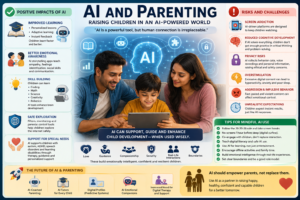
Understanding AI in the Context of Parenting
Artificial Intelligence (AI) is no longer limited to robots or futuristic machines. It has quietly become part of everyday family life through content recommendation algorithms on platforms such as YouTube, Netflix, and Instagram, AI-powered toys and chatbots, educational and tutoring apps, smart home assistants, parental monitoring tools, content filters, voice recognition systems, and even AI-based mental health applications. As a result, children may interact with AI regularly, sometimes before they even understand what artificial intelligence is.
Parents are also increasingly using AI to support different aspects of parenting. It can help with learning activities, homework, entertainment, skill development, communication, safety monitoring, and behavior management. For many parents, these technologies provide convenient support and quick access to information and resources.
However, the growing presence of AI in family life means that technology is becoming more than just a tool. It can influence how parents make decisions and how children learn, think, communicate, regulate emotions, and interact socially. This makes understanding AI an important part of modern digital parenting—using technology in a way that supports a child’s development without allowing it to replace parental guidance and real-world human interaction.
2. How AI Is Changing Child Behavior
Artificial Intelligence is becoming increasingly integrated into children’s daily lives, influencing how they learn, play, communicate, and respond to their environment. Its effects can be both positive and challenging, depending on the type of technology, the child’s age, the amount of exposure, and how parents guide its use. From a behavioral psychology perspective, AI can create new learning opportunities while also influencing attention, emotional regulation, social behavior, and everyday habits.
2.1. Impact on Attention Span
Many AI-powered platforms, including YouTube, Reels, and gaming applications, use personalized algorithms to recommend content that is likely to keep users engaged. Fast-paced videos, frequent novelty, instant feedback, and rapid switching between activities can make digital experiences highly stimulating.
For example: A child may watch a 20-second video, immediately move to another, then another, receiving something new every few seconds. Later, when the same child has to read a textbook for 20 minutes, the slower pace may feel boring or difficult.
Why does this happen?
Digital platforms continuously provide novelty and immediate feedback. This can reinforce a pattern of seeking frequent stimulation. It does not mean that AI automatically causes an attention disorder, but excessive exposure to highly stimulating content may make sustained attention and tolerance for slower activities more challenging for some children.
AI can also support attention when used appropriately. Interactive educational activities, visual explanations, and personalized learning can make difficult topics more engaging.
The goal is therefore not to eliminate technology, but to balance highly stimulating digital activities with reading, creative play, outdoor activities, and uninterrupted learning time.
2.2. Emotional Regulation and Instant Gratification
Digital entertainment can provide children with immediate rewards, feedback, and stimulation. When children repeatedly experience quick rewards, they may become less comfortable with waiting, boredom, or delayed gratification.
For example: A child is playing a game on a tablet. When the parent asks them to stop for dinner, the child immediately becomes angry, cries, or says, “Just five more minutes!” The problem may not simply be the device; the transition from a highly rewarding activity to a less stimulating one can be difficult.
Why does this happen?
Highly engaging digital activities provide continuous stimulation and immediate reinforcement. From a behavioral perspective, behaviors followed by rewarding experiences are more likely to be repeated. As a result, a child may strongly prefer the immediate reward of digital entertainment over activities where rewards come later.
This may appear as:
- Irritability when screen time ends
- Difficulty tolerating boredom
- Low frustration tolerance
- Repeated requests for more screen time
- Difficulty shifting between activities
It is more accurate to describe this as reinforcement of immediate reward-seeking rather than saying that AI creates a “dopamine dependency.” Dopamine is involved in the brain’s reward and motivation systems, but the simple idea that screens “release dopamine and rewire the brain” is scientifically too broad.
2.3. Reduced Real-Life Social Interaction
Children develop social skills through repeated interactions with parents, siblings, teachers, and peers. Face-to-face interaction gives them opportunities to understand facial expressions, body language, tone of voice, empathy, turn-taking, and conflict resolution.
For example: Imagine a child who spends several hours talking to an AI chatbot but has very little opportunity to play with other children. The chatbot responds immediately and patiently, but real children may disagree, interrupt, misunderstand, or become upset. The child needs real-world interaction to learn how to manage these situations.
Why does this matter?
Human relationships are unpredictable and require children to adjust their behavior. A child learns social skills by practising them—not simply by receiving information about them.
Excessive replacement of real-world interaction with digital interaction may therefore reduce opportunities to practise:
- Reading emotional cues
- Empathy
- Conversation skills
- Conflict resolution
- Cooperation
- Emotional flexibility
AI can support social learning through stories, role-play, and communication exercises, but it should supplement rather than replace human relationships.
2.4. Academic Skills: Boost or Barrier?
AI-powered educational apps, personalized tutors, and chatbots can make learning more accessible. They can provide explanations, adjust difficulty, give immediate feedback, and allow children to learn at their own pace.
For example: A child struggling with fractions can ask an AI tutor to explain the concept using a pizza or chocolate-bar example. The child can then practise several problems and receive immediate feedback.
This can be highly beneficial.
However, the same technology can become problematic when the child simply asks AI for the answer.
For example: Instead of attempting a mathematics problem, a student takes a photo of the question and asks AI to solve it. The student gets the correct answer but does not understand how the solution was reached.
Why does this happen?
When the difficult part of a task is consistently outsourced, the child gets fewer opportunities to practise independent reasoning, problem-solving, persistence, and critical thinking.
Therefore, parents and teachers should encourage children to try first, use AI for hints or explanations, and then solve the problem independently.
AI should function as a learning assistant—not a substitute for thinking.
2.5. Impact on Creativity
AI can generate drawings, stories, music, images, and ideas within seconds. Used appropriately, these tools can encourage experimentation and help children explore creative possibilities.
For example: A child writes their own short story and then asks AI to suggest three different endings. The child can compare the ideas and create their own final version.
Here, AI expands the creative process.
But consider another situation: A child is asked to draw a picture and immediately asks AI to generate the entire artwork. The child may receive a polished result without actually practising drawing, imagining, experimenting, or making mistakes.
Why does this matter?
Creativity develops through exploration, curiosity, trial and error, and independent thinking. If children consistently outsource the creative process to AI, they may become more passive consumers rather than active creators.
AI should therefore support children’s imagination rather than replace it.
2.6. Emotional Attachment to Technology
Some children may begin treating chatbots, voice assistants, or AI companions as social partners. They may talk to them, ask questions, share thoughts, or use them for entertainment and comfort.
For example: A child may tell an AI chatbot, “I am sad because my friend didn’t play with me,” and receive an immediate, supportive response. This may encourage the child to put their feelings into words.
However, imagine the child gradually choosing the chatbot every time they feel upset instead of approaching a parent, teacher, sibling, or friend.
Why can this become a concern?
AI can provide responsive conversation, but it does not experience emotions or participate in relationships in the same way humans do. Real relationships require mutual understanding, empathy, compromise, patience, and emotional reciprocity.
Excessive reliance on AI for emotional support could therefore contribute to:
- Dependence on predictable digital responses
- Expectation of immediate responses
- Avoidance of difficult human interactions
- Reduced opportunities to practise relationship skills
Children should be encouraged to use technology as a tool while continuing to build secure and meaningful human relationships.
2.7. Behavior and Discipline Challenges
Digital entertainment often provides children with choice, control, novelty, and immediate rewards. Parenting, on the other hand, requires children to learn boundaries, patience, responsibility, and delayed gratification.
For example: A child is watching YouTube and the parent says, “Time to switch it off and get ready for bed.” The child begins negotiating: “One more video,” “Just five minutes,” or “Let me finish this one.” When the parent refuses, the child may become angry or have a tantrum.
Why does this happen?
The child is moving from a highly rewarding activity to an activity with fewer immediate rewards. If parents frequently give in after tantrums or repeated requests, the child may learn that protesting can sometimes lead to more screen time. This is a basic example of reinforcement in behavioral psychology.
For this reason, parents can make digital boundaries more effective by:
- Giving a warning before screen time ends
- Keeping rules consistent
- Using predictable screen schedules
- Avoiding repeated negotiations
- Offering an alternative activity after screen time
- Praising appropriate transitions
The goal of digital parenting is not simply to control technology use. It is to teach children how to manage technology, tolerate limits, regulate emotions, and develop healthy habits in a digital world.
3. How AI Is Transforming Parenting
AI is not only changing how children learn and behave; it is also changing how parents manage everyday responsibilities. From helping with homework to monitoring online activity, AI can make some aspects of parenting more convenient. At the same time, depending too heavily on technology may create new challenges for parental involvement, boundaries, and children’s independence.
3.1. Convenience and Parenting Support
AI can provide parents with quick support for everyday tasks such as homework assistance, language learning, bedtime stories, activity ideas, emotional development resources, safety monitoring, and digital reminders.
For example: A parent may ask an AI tool for age-appropriate activities to help a child practise reading or for ideas to explain difficult mathematics in a simpler way. Instead of spending a long time searching for resources, the parent can receive suggestions within seconds.
Why can this be helpful?
Parenting often involves making repeated decisions about learning, routines, activities, and behavior. AI can reduce some of this practical workload and provide parents with ideas when they are unsure what to do.
However, AI should be treated as a support tool rather than an authority. Parents still need to consider their child’s individual needs, developmental level, family circumstances, and professional advice when necessary.
3.2. Over-Reliance on AI for Babysitting
For busy or overwhelmed parents, digital technology can sometimes function as a convenient “modern babysitter.” Children may be given access to YouTube Kids, cartoons, AI-powered games, interactive toys, or other digital entertainment while parents complete household tasks or work.
For example: A parent may give a child a tablet during dinner preparation so the child remains occupied. Occasionally, this may be a practical solution. The concern arises when the device becomes the child’s primary source of entertainment, stimulation, or emotional calming.
Why can this become problematic?
Children need opportunities for physical play, conversation, imaginative play, problem-solving, and interaction with caregivers. If digital entertainment consistently replaces these experiences, children may have fewer opportunities to practise important developmental skills.
The issue is therefore not whether parents ever use technology to keep a child occupied. It is whether technology becomes a regular substitute for parental interaction and age-appropriate offline activities.
3.3. Parental Control and Safety Tools
AI-powered parental tools can help parents manage children’s digital environments. Depending on the technology, these tools may assist with screen-time tracking, content filtering, app restrictions, online activity monitoring, cyberbullying detection, and blocking potentially harmful websites.
For example: A parent may use parental controls to prevent a younger child from accessing age-inappropriate content or to automatically stop certain apps after a predetermined amount of screen time.
Why can this be useful?
Children may not yet have the judgment or digital literacy needed to identify every online risk. Appropriate parental controls can therefore provide an additional layer of protection while children gradually learn how to navigate the digital world independently.
However, monitoring tools should work alongside conversation and digital education, not replace them. Children should gradually learn why certain content is unsafe and how to make responsible decisions online.
3.4. Emotional Support and Guidance for Parents
Parenting can involve uncertainty, especially when parents are dealing with tantrums, sleep difficulties, learning problems, sibling conflicts, or questions about child development. AI tools can provide quick explanations, parenting strategies, activity suggestions, and general information about child psychology.
For example: A parent whose child frequently refuses to follow instructions may ask an AI tool for possible reasons and strategies for responding calmly. The parent may receive suggestions such as using clear instructions, offering limited choices, or reinforcing appropriate behavior.
Why can this be helpful?
Immediate access to information can help parents generate ideas and feel less alone when facing everyday parenting challenges. AI can function as an information and brainstorming tool, particularly when professional resources are not immediately available.
However, AI should not replace a qualified psychologist, pediatrician, teacher, or other professional when a child has persistent developmental, behavioral, emotional, or mental health concerns.
3.5. The Risk of “Digital Over-Parenting”
Technology can help parents protect their children, but constant monitoring can also become excessive. AI systems may allow parents to track location, monitor online behavior, analyse performance, or make predictions about a child’s behavior.
For example: A teenager may have their location constantly tracked, messages monitored, activities analysed, and academic performance digitally recorded. Although the parent may be acting out of concern for safety, the child may experience this as a lack of privacy or trust.
Why can this become problematic?
Children gradually need opportunities to make decisions, experience manageable mistakes, solve problems independently, and develop confidence in their own judgment. Excessive surveillance may communicate the message that they cannot be trusted to manage situations themselves.
This can potentially contribute to stress, reduced autonomy, fear of making mistakes, or conflict between parents and children.
Healthy digital parenting therefore requires a balance between protection and independence. The goal should not be to monitor every aspect of a child’s life, but to provide appropriate supervision while gradually giving children more responsibility as they mature.
4. Positive Impacts of AI on Children
AI is not inherently harmful to children. When used appropriately and with adult guidance, it can support learning, creativity, communication, accessibility, and skill development. The key factor is how, why, and how often AI is used, rather than simply whether a child uses it.
4.1. Improved Learning
AI-powered educational tools can personalize learning by adjusting the difficulty level, providing instant feedback, and explaining concepts in different ways.
For example: A child struggling with multiplication can use an AI learning tool that provides simpler explanations, visual examples, and additional practice questions based on the child’s performance.
Why is this helpful?
Children do not all learn at the same pace. Personalized technology can give additional practice without making a child feel embarrassed about asking the same question repeatedly. AI can therefore act as a learning assistant while allowing teachers and parents to remain actively involved.
However, children should still be encouraged to think, attempt problems independently, and understand the reasoning behind an answer rather than simply accepting AI-generated solutions. UNICEF also highlights AI’s potential to support learning and accessibility for children with disabilities when developed and used responsibly.
4.2. Better Emotional Awareness
AI-powered stories, interactive activities, and educational tools can introduce children to emotions, empathy, communication, and social situations.
For example: An interactive story may show a character feeling left out and ask the child, “How do you think the character feels?” or “What could you do to help?”
Why is this helpful?
Such activities can give children opportunities to identify emotions and think about different perspectives. However, emotional intelligence develops primarily through real relationships and experiences. AI can support emotional learning, but it cannot replace conversations with parents, teachers, or peers.
4.3. Skill Building
AI can give children opportunities to explore areas such as coding, mathematics, science, creative writing, design, and robotics.
For example: A child interested in coding can ask an AI tutor to explain a programming concept, generate a simple practice task, and help identify an error in their code.
Why is this helpful?
Immediate access to explanations and practice can encourage curiosity and independent exploration. The developmental benefit comes from active engagement with the task, not simply from using AI.
AI should therefore be used to help children practise and explore skills rather than doing the entire task for them.
4.4. Safer Digital Exploration
Parental controls, content filters, age restrictions, and monitoring tools can provide an additional layer of protection while children explore digital spaces.
For example: Parents can use filtering tools to restrict inappropriate websites or limit access to certain applications.
Why is this helpful?
Young children may not yet have the judgment required to identify every online risk. Appropriate supervision can reduce exposure to harmful or age-inappropriate content.
However, technology-based protection should be combined with digital literacy and open communication. Children need to learn how to identify risks rather than depending entirely on filters. UNICEF emphasizes the importance of child safety, privacy, transparency, and human oversight in AI systems.
4.5. Support for Children with Special Needs
AI Digital Parenting and digital technologies may provide useful support for some children with autism, ADHD, speech and language difficulties, learning disabilities, and other developmental needs.
For example: A child with communication difficulties may use an assistive technology tool to practise language, while a child with autism may use visual or interactive social stories to rehearse everyday situations.
AI may also support personalized learning, communication, accessibility, and certain therapeutic or educational activities.
However, AI should supplement—not replace—qualified professionals and individualized intervention. Its usefulness will vary according to the child’s needs, the quality of the tool, and how it is implemented.
5. Risks and Challenges of AI for Children: A Digital Parenting Perspective
The same technologies that provide opportunities can also create risks when used excessively, without supervision, or in ways that replace important developmental experiences. These risks are not caused by AI alone; they can also be influenced by the type of content, duration of use, sleep, family environment, and the child’s individual characteristics.
5.1. Excessive or Problematic Screen Use
Many digital platforms use personalized recommendations, notifications, rewards, and continuous content to maintain engagement.
For example: A child watches one recommended video after another and continues using the platform much longer than originally intended.
Why can this become a problem?
When digital activities consistently displace sleep, physical activity, schoolwork, family interaction, or offline play, they can interfere with healthy development. The concern should therefore be problematic or excessive use, rather than automatically labeling all frequent screen use as “addiction.”
5.2. Reduced Opportunities for Cognitive Development
AI can provide answers almost instantly. While this is useful for learning, excessive dependence on AI may reduce opportunities for children to struggle productively with a problem.
For example: A student asks AI Digital Parenting to solve every mathematics problem instead of attempting the questions independently.
Why does this matter?
Problem-solving, critical thinking, memory, and persistence develop through active practice. If AI Digital Parenting consistently does the difficult thinking for the child, the child may practise these skills less often.
The goal should be to teach children to think first and use AI as support, rather than allowing AI to become a shortcut for every task.
5.3. Privacy and Data Risks
AI-powered applications may collect information such as voice recordings, usage patterns, learning preferences, behavioral data, or other personal information depending on the product and its privacy practices.
For example: A child uses an AI Digital Parenting learning application that records voice responses and stores information about their learning progress.
Why is this concerning?
Children may not fully understand what information they are sharing or how it may be stored and used. This creates important questions about consent, privacy, data security, and who has access to children’s information.
Parents should therefore check an application’s privacy policy, data collection practices, age requirements, and parental controls before allowing children to use it.
5.4. Overstimulation and Sleep Disruption
Highly stimulating digital content can make it difficult for some children to disengage, particularly when screens are used close to bedtime.
For example: A child plays an exciting game or watches fast-paced videos immediately before sleeping and then struggles to settle down.
Why can this happen?
Digital media can delay bedtime and replace sleep, physical activity, and quiet routines. Research and pediatric guidance emphasize the importance of balancing media use with sleep, physical activity, and other developmental needs.
Rather than claiming that AI Digital Parenting directly causes “hyperactivity,” it is more accurate to say that excessive or poorly timed digital media use may contribute to difficulties with sleep, attention, or emotional regulation in some children.
5.5. Aggression and Impulsive Behavior
Fast-paced or highly stimulating content may influence children’s arousal and behavior, particularly when combined with other risk factors.
For example: A child becomes highly excited while playing a competitive game and reacts angrily when asked to stop.
Why is this important?
Children are still developing impulse control and emotional regulation. Repeated exposure to highly stimulating activities, combined with poor boundaries or insufficient sleep, may make transitions and emotional regulation more difficult for some children.
It would be too strong, however, to claim that AI directly causes aggression. The relationship is more complex and depends on content, context, child characteristics, and family environment.
5.6. Unrealistic Expectations of Instant Results
AI Digital Parenting can answer questions, generate images, write text, and complete tasks within seconds.
For example: A child asks an AI Digital Parenting tool to create a picture and receives a finished image immediately. Later, the child may become frustrated when learning to draw requires repeated practice.
Why does this matter?
Children need to learn that meaningful skills often require patience, mistakes, repetition, and delayed rewards. If every digital experience provides an immediate result, ordinary activities may feel unnecessarily slow.
This is why children need regular opportunities to practise patience, persistence, and delayed gratification.
6. AI and Parenting Styles: A New Psychological Perspective on Digital Parenting
AI Digital Parenting does not automatically create a particular parenting style. Instead, existing parenting patterns may influence how parents use AI Digital Parenting.
The same technology can be used differently by different parents. One parent may use monitoring tools to support safety, while another may use them excessively because of anxiety or a strong need for control.
6.1. Authoritarian Parenting
Parents with highly controlling parenting practices may use technology primarily for monitoring and enforcing rules, such as strict screen limits, location tracking, or extensive content filtering.
For example: A parent may continuously monitor a teenager’s online activity and immediately punish them whenever they encounter content the parent disapproves of.
Possible concern: When monitoring becomes excessive and communication is limited, children may become more secretive, hide online behavior, or resist parental control.
The goal should be supervision with communication, rather than surveillance alone.
6.2. Permissive Parenting
Parents who struggle to maintain boundaries may use digital entertainment to avoid conflict or keep children occupied.
For example: A child asks for another hour of gaming, and the parent agrees simply because saying “no” leads to an argument.
Possible concern: Inconsistent boundaries may make it difficult for children to develop self-regulation, responsibility, and tolerance for limits.
6.3. Authoritative and Attachment-Focused Parenting
Parents who combine warmth with appropriate boundaries may use AI Digital Parenting as a supplementary tool for learning, creativity, emotional education, and family activities.
For example: A parent and child use an AI Digital Parenting storytelling tool together and then discuss how the characters felt and what they could have done differently.
Why can this be beneficial?
The technology becomes an opportunity for interaction rather than a replacement for it. The parent remains involved while the child learns to use technology responsibly.
6.4. Overprotective Parenting
Parents who are highly concerned about safety may use AI Digital Parenting for constant location tracking, behavioral monitoring, or digital surveillance.
For example: A parent continues monitoring a teenager’s location and online activity even when the child has demonstrated responsible behavior.
Possible concern: Excessive monitoring may communicate a lack of trust and reduce opportunities for children to develop independence and decision-making skills.
Healthy digital parenting requires a balance between safety, trust, supervision, and growing autonomy.
7. How Parents Can Use AI Mindfully: A Digital Parenting Guide
The goal of digital parenting is not to completely remove technology from children’s lives. Instead, parents can create a healthy balance in which technology supports development without replacing sleep, physical activity, learning, play, or human relationships.
7.1. Protect the Eyes and Encourage Breaks
The 20-20-20 rule is commonly used to reduce digital eye strain: after about 20 minutes of near-screen work, look at something around 20 feet away for about 20 seconds.
This can be a useful habit during prolonged screen-based activities, but it should not be presented as a complete solution to children’s screen-related health risks.
Parents should also encourage children to take regular movement breaks and spend time away from screens.
7.2. Create a Digital Curfew
Instead of focusing only on a fixed number of screen hours, families can establish predictable screen-free periods, particularly around bedtime.
For example: The family may keep the last hour before bedtime screen-free and replace it with reading, conversation, music, or a calming routine.
Protecting sleep is particularly important because digital media can interfere with bedtime and sleep routines.
7.3. Practise Co-Engagement
Whenever possible, parents should participate in children’s digital activities rather than simply handing over a device.
For example: Instead of allowing a child to watch an educational video alone, a parent can watch it with them and ask, “What did you learn?” or “What do you think will happen next?”
This transforms passive screen use into an opportunity for conversation, learning, and connection.
7.4. Teach Digital and AI Literacy
Children should gradually learn:
- What AI is
- How recommendation algorithms work
- Why certain content appears on their screens
- That AI can make mistakes
- Why personal information should be protected
- How to question and verify AI-generated information
For example: If a child asks AI a question and receives an incorrect answer, the parent can use the situation to teach the child that AI is a tool—not an unquestionable source of truth.
UNICEF emphasizes the importance of preparing children with AI literacy and skills while ensuring age-appropriate safety, privacy, transparency, and human oversight.
7.5. Use AI as a Learning Tool, Not a Shortcut
Parents can encourage children to use AI for brainstorming, explanations, practice, and feedback rather than simply generating completed homework.
A useful rule is:
Try → Think → Ask AI → Check → Learn.
This helps children remain active participants in their own learning.
7.6. Protect Offline Childhood Experiences
Children still need outdoor play, reading, hobbies, family conversations, board games, creative activities, and face-to-face friendships.
These experiences support physical health, social development, emotional regulation, and independence. WHO guidance emphasizes limiting sedentary behavior and ensuring children have sufficient opportunities for physical activity and sleep.
7.7. Build Emotional Intelligence Without Depending on AI
AI can introduce children to emotions, but emotional intelligence is developed through real experiences.
Parents can teach children:
- Patience
- Self-control
- Empathy
- Problem-solving
- Communication
- Conflict resolution
- Delayed gratification
For example: When a child loses a game, instead of immediately using a device to distract them, a parent can help the child name the emotion, tolerate the disappointment, and think about what they can do differently next time.
7.8. Set Clear and Consistent Boundaries
Children benefit from predictable rules around technology.
Examples include:
- No screens during meals
- Devices kept outside the bedroom at night
- Age-appropriate app restrictions
- Defined gaming or entertainment periods
- Regular screen-free family activities
- Clear rules about sharing personal information online
The most effective boundaries are not necessarily the strictest ones. They are clear, consistent, age-appropriate, and explained to the child. The AAP similarly recommends family media plans that consider the child’s developmental stage and the family’s individual circumstances rather than applying one universal rule to every child.
8. The Future: What Will AI-Influenced Digital Parenting Look Like?
AI is likely to become increasingly integrated into education, parenting, healthcare, and children’s everyday lives. Some of the following developments are already emerging, while others remain future possibilities.
Prediction 1: AI-Coached Parenting
Parents may increasingly use AI Digital Parenting systems to identify patterns in children’s learning, behavior, routines, or mood and receive suggestions for responding to particular situations.
For example, an AI Digital Parenting system might identify that a child’s difficult behavior occurs repeatedly around bedtime and suggest examining sleep routines, transitions, or environmental factors.
However, AI-generated interpretations should not be treated as psychological diagnoses. Human judgment and professional assessment will remain important.
Prediction 2: AI Tutors for Every Child
Personalized AI tutors may become increasingly common, providing children with individualized explanations, practice, feedback, and learning support.
The major challenge will be ensuring that personalized learning strengthens independent thinking rather than encouraging dependence on AI.
Prediction 3: Digital Profiles and Predictive Systems
Future systems may create detailed digital profiles based on children’s learning patterns, preferences, and interactions.
These systems could potentially help personalize education, but they also raise serious questions about privacy, consent, data ownership, and the long-term consequences of predicting a child’s behavior.
Prediction 4: AI Emotional Companions
Children may increasingly interact with AI companions for conversation, entertainment, and emotional support. This area is already receiving attention from child-safety organizations because of potential risks involving emotional dependence, inappropriate interactions, privacy, and children’s developing understanding of relationships.
The challenge will be ensuring that AI companionship does not replace meaningful human relationships.
Prediction 5: Greater Need for Digital Mental Health Support
As children’s digital environments become more complex, there may be greater demand for support related to problematic technology use, online experiences, emotional difficulties, and digital habits.
However, “screen detox” should not be presented as a universal psychological treatment. In many cases, the goal should be healthy technology use, behavioral change, emotional support, and restoration of balance, with professional intervention when clinically necessary.
The future of parenting will therefore not be about choosing between AI Digital Parenting and human parenting. It will be about learning how to use AI responsibly while protecting the things children need most: human connection, emotional security, physical activity, creativity, independence, and real-world experience.
Conclusion
Artificial Intelligence can be a powerful tool for learning, creativity, communication, and child development. However, no technology can replace the emotional connection children build through real relationships.
Children need more than information and entertainment. They need emotional warmth, companionship, secure attachment, real-life interaction, guidance, encouragement, and healthy boundaries. These experiences help children develop empathy, emotional regulation, confidence, and a sense of security. Parents should therefore use AI wisely—as a supportive tool rather than a replacement for parenting. AI can help with learning, activities, and information, but children still need parents who listen to them, play with them, guide them, comfort them, and teach them how to navigate the real world.
The goal of digital parenting is not to keep children away from technology. It is to teach them how to use technology safely, thoughtfully, and responsibly while maintaining a healthy balance between the digital and real world. With mindful use and active parental involvement, AI can become a partner in raising emotionally intelligent, confident, independent, and capable children—without replacing the human connection they need to thrive.
Reference
-
UNICEF – Impact of digital technology on children
https://www.unicef.org -
American Psychological Association (APA) – Research on technology and child development
https://www.apa.org -
Harvard Graduate School of Education – Studies on AI in education and learning behavior
https://www.gse.harvard.edu -
Pew Research Center – Data on parents and technology use
https://www.pewresearch.org -
World Health Organization (WHO) – Screen time and child health guidelines
https://www.who.int - What Is CBT? A Simple Guide for Everyone
- Contact Us