
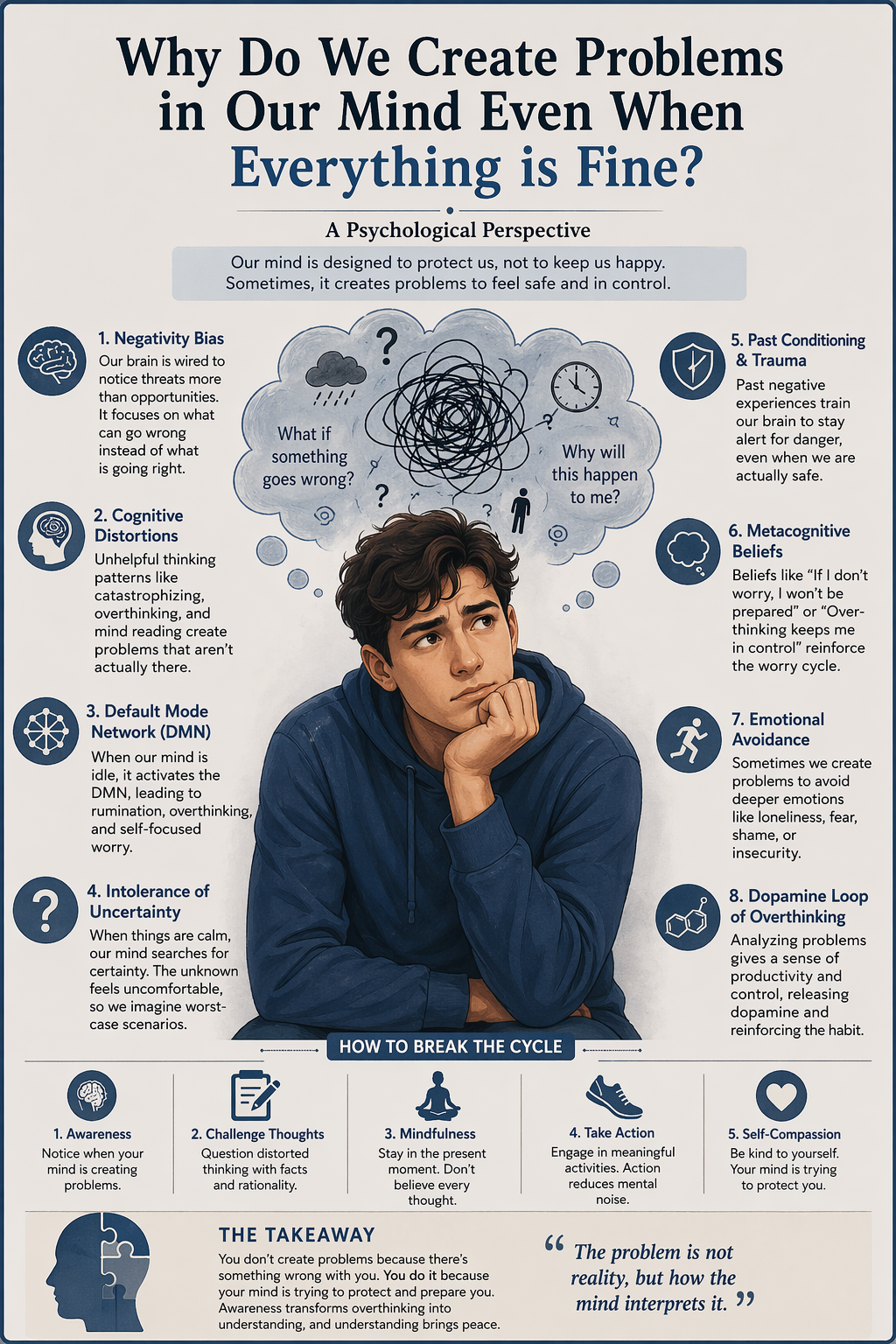
When your mind won’t let calm stick, it’s inventing problems to feel safe. Your brain is wired for survival—not peace—so calm feels unusual and triggers worry.
Introduction: When Calm Feels Uncomfortable
Have you ever noticed that just when things seem stable—no crisis, no conflict—your mind suddenly starts generating worries? You begin to question decisions, imagine worst-case scenarios, or feel uneasy without a clear reason. From a psychological perspective, this is not a flaw in your personality; it is a function of how the human brain is wired.
The mind is not built for peace—it is built for survival. And sometimes, survival mechanisms misfire in safe environments, leading us to create problems even when none objectively exist.
The Brain’s Primary Role: Threat Detection, Not Happiness
At its core, the brain prioritizes safety over satisfaction. Evolutionarily, humans survived not by being relaxed, but by being alert to danger.
This leads to what psychologists call hypervigilance—a heightened sensitivity to potential threats. Even in modern life, where physical dangers are fewer, the brain continues scanning for risks.
This is closely linked to the Negativity Bias, a cognitive tendency where negative stimuli have a stronger impact than positive ones. Research shows that the brain processes negative information faster and retains it longer.
Example:
Even if 9 things go right and 1 goes wrong, your mind will likely focus on that one issue.
So when life becomes calm, the brain may interpret the absence of problems as unusual—and begin searching for one.
Cognitive Distortions: When Thinking Patterns Create Problems
A major contributor to imagined problems is Cognitive Distortions, a concept from Cognitive Behavioral Therapy (CBT). These are systematic errors in thinking that skew perception.
Common distortions include:
- Catastrophizing: Expecting the worst possible outcome
- Mind Reading: Assuming others are thinking negatively about you
- Overgeneralization: One negative event defines everything
- Emotional Reasoning: “I feel anxious, so something must be wrong”
These distortions create a false narrative of threat, even in neutral or positive situations.
Clinical Insight:
Aaron Beck’s cognitive model suggests that our thoughts—not events—shape our emotional experience. So even when reality is stable, distorted thinking can manufacture distress.
The Role of the Default Mode Network (DMN)
When the brain is not focused on a specific task, it activates the Default Mode Network (DMN). This network is responsible for:
- Self-reflection
- Future planning
- Daydreaming
- Rumination
While useful, the DMN often leads to overthinking and worry, especially in individuals prone to anxiety.
Psychological Mechanism:
An idle mind doesn’t stay empty—it becomes internally active, often revisiting past mistakes or imagining future problems.
This is why people frequently feel more anxious at night or during inactivity—the DMN is fully engaged.
Intolerance of Uncertainty: The Need for Control in the mind
Humans have a natural discomfort with uncertainty, known as Intolerance of Uncertainty (IU).
When everything is going well, there is often a lack of immediate problems to solve. Ironically, this uncertainty (“What if something goes wrong?”) can trigger anxiety.
To cope, the mind tries to:
- Predict future risks
- Analyze situations excessively
- Create hypothetical problems to feel prepared
This creates a paradox:
We generate problems to reduce uncertainty—but end up increasing anxiety.
Conditioning and Past Experiences
Our past experiences shape how we interpret present situations. Through classical and operant conditioning, the brain learns associations between events and emotions.
If someone has experienced:
- Trauma
- Chronic stress
- Unpredictable environments
Their brain may remain in a state of anticipatory anxiety, expecting danger even in safe contexts.
This is often seen in:
In such cases, the mind is not “creating problems” randomly—it is replaying learned survival patterns.
The Role of Metacognition:
Another layer is Metacognition, or thinking about one’s own thoughts.
People may develop beliefs like:
- “If I don’t worry, I’ll be unprepared”
- “Overthinking helps me stay in control”
These beliefs reinforce worry as a coping strategy, even when it becomes maladaptive.
This leads to:
- Rumination (repetitive thinking about past events)
- Worry cycles (persistent concern about future threats)
Over time, the brain begins to normalize mental problem creation as a default state.
Emotional Avoidance: Problems as Distractions
Interestingly, sometimes the mind creates problems to avoid deeper emotions.
This is known as Experiential Avoidance.
Instead of confronting:
- Loneliness
- Fear of failure
- Low self-worth
The mind shifts focus to “safer” concerns like:
- Minor issues
- Hypothetical scenarios
- Overanalyzing decisions
In this sense, creating problems becomes a defense mechanism.
The Dopamine Loop of Overthinking
Neuroscience suggests that thinking—even worrying—can activate the brain’s dopamine system.
When we analyze problems, the brain feels like it is:
- Being productive
- Solving something
- Gaining control
This creates a reinforcement loop, where overthinking feels useful, even if it leads to distress.
Social and Cultural Influences
Modern society also reinforces mental problem creation:
- Productivity culture promotes constant thinking and planning
- Social media increases comparison and self-doubt
- Information overload overwhelms cognitive processing
This leads to cognitive fatigue, making the brain more prone to distortions and anxiety.
When It Becomes a Clinical Concern
Occasional overthinking is normal. However, it becomes problematic when it leads to:
- Persistent anxiety
- Sleep disturbances
- Difficulty concentrating
- Emotional exhaustion
Clinically, this may relate to:
How to Break the Cycle (Psychological Interventions)
1. Cognitive Restructuring (CBT): Identify and challenge cognitive distortions.
2. Mindfulness-Based Techniques: Focus on present-moment awareness to reduce DMN overactivity.
3. Acceptance and Commitment Therapy (ACT): Learn to accept thoughts without engaging with them.
4. Behavioral Activation: Engage in meaningful activities to reduce idle mental time.
5. Emotional Processing: Address underlying emotions instead of avoiding them.
A Simple Psychological Reframe
Instead of asking: “Why am I creating problems?”
Try asking: “What is my mind trying to protect me from?”
This shifts the perspective from self-criticism to understanding.
Conclusion: The Mind as an Overprotective Guardian
The tendency to create problems in the mind is not a defect—it is an overextension of a protective system. The brain is constantly trying to anticipate, prepare, and control.
However, in safe environments, this system can become overactive, leading to unnecessary worry.
Understanding these mechanisms—negativity bias, cognitive distortions, DMN activity, and conditioning—helps us recognize that: The problem is not reality, but how the mind interprets it.
With awareness and psychological tools, it is possible to shift from automatic problem creation to intentional mental clarity.
Frequently Asked Questions (FAQs)
1. Why does my mind create problems when everything is fine?
Because the brain is wired for survival, not peace. It constantly scans for threats, even in safe situations.
2. What is overthinking in psychology?
Overthinking is repetitive, excessive thinking about past or future events, often linked to anxiety.
3. What is negativity bias?
It is the brain’s tendency to focus more on negative experiences than positive ones.
4. What are cognitive distortions?
They are irrational thinking patterns like catastrophizing, mind reading, and overgeneralization.
5. What is the Default Mode Network (DMN)?
A brain network active during rest that leads to self-reflection, rumination, and overthinking.
6. Why do I feel anxious when things are calm?
Because the brain interprets calmness as unusual and starts searching for potential threats.
7. What is intolerance of uncertainty?
It is discomfort with unknown outcomes, leading to excessive worry and control-seeking behavior.
8. Can overthinking be a coping mechanism?
Yes. It can act as a way to avoid deeper emotions or feel in control.
9. When does overthinking become a problem?
When it leads to anxiety, sleep issues, or emotional exhaustion.
10. How can I stop creating problems in my mind?
Through mindfulness, cognitive restructuring, and reducing rumination.
References
Beck, A. T. (1976). Cognitive therapy and the emotional disorders.
American Psychological Association. (n.d.). Stress and cognition.
https://www.apa.org
Verywell Mind. (n.d.). Overthinking and anxiety.
https://www.verywellmind.com
Monoprova Counselling, (2026), “About Us”,
Monoprova Counselling, (2026), “Contact Us”,
This article is written for knowledge purposes, aiming to help readers understand the topic better and gain useful insights for learning and awareness.
Pingback: How Aripiprazole Affects Behaviour: Psychological Effects
Pingback: Why Do We Feel Nervous Before Important Events?