
The Psychology of Jealousy: Understanding Its Hidden Emotional Roots
The psychology of jealousy explores one of the most powerful and misunderstood human emotions. Jealousy can arise in romantic relationships, friendships, family systems, workplaces, and social settings. Almost everyone experiences jealousy at some point, yet many people feel ashamed of admitting it because society often labels jealousy as “immature,” “toxic,” or a sign of insecurity.
But psychologically, jealousy is not inherently bad or abnormal. It is a complex emotional response that can emerge when something we deeply value—such as a relationship, connection, attention, status, or sense of belonging—feels threatened.
At its core, jealousy often involves a combination of fear, insecurity, comparison, attachment, and the perceived possibility of losing something important. The emotion itself is not necessarily harmful. What matters is how we interpret it and what we do in response to it.
However, when jealousy becomes intense, persistent, obsessive, or disconnected from actual evidence, it can contribute to anxiety, overthinking, controlling behaviors, relationship conflict, and declining self-worth. What begins as a fear of losing someone can gradually become a cycle of reassurance-seeking, suspicion, comparison, and emotional distress.
What Is Jealousy? The True Psychological Definition
To understand the psychology of jealousy, it is important to first understand what jealousy actually means. One of the most common misconceptions is confusing jealousy with envy. Although these emotions can overlap, they are psychologically different.
Jealousy vs. Envy: What’s the Difference?
Envy occurs when you want something that another person has.
Jealousy typically arises when you perceive a threat to something you value—especially a close relationship, emotional connection, attention, status, or sense of security.
For example:
- You may feel envy when your friend buys a new car and you wish you had one too.
- You may feel jealousy when your partner becomes unusually close to someone you perceive as a romantic rival.
In simple terms:
- Envy says: “I want what you have.”
- Jealousy says: “I’m afraid I might lose what I value.”
What Does Jealousy Mean Psychologically?
From a psychological perspective, jealousy is a complex emotional response to a perceived threat involving something or someone we value. It can involve several emotions at the same time, including fear, anxiety, anger, sadness, insecurity, and uncertainty.
In romantic relationships, jealousy often emerges when a person perceives that a third party could threaten their emotional connection, exclusivity, or sense of importance within the relationship. Importantly, perceived threat does not always mean there is an actual threat. A person’s interpretation of a situation can trigger jealousy even when there is little or no objective evidence of betrayal or rejection.
For example, a partner replying to someone’s message may be completely harmless. However, if someone already has strong fears of abandonment or betrayal, they may interpret that interaction as a potential threat. This is why understanding the psychology of jealousy requires looking beyond the visible emotion and examining the thoughts, beliefs, past experiences, attachment patterns, and relationship dynamics underneath it.
Where Does Jealousy Occur?
Jealousy is not limited to romantic relationships. It can appear whenever a valued connection, position, or sense of belonging feels threatened.
Common examples include:
- Romantic relationships — fear of losing a partner or their affection
- Friendships — feeling replaced when a close friend develops another friendship
- Sibling relationships — competing for parental attention or approval
- Family systems — feeling less valued or prioritized within the family
- Workplaces — feeling threatened by a colleague’s recognition, promotion, or influence
- Social circles — comparing popularity, appearance, status, or relationships
- Social media — interpreting likes, comments, followers, and online interactions as signs of social or relational competition
Is Jealousy Always Unhealthy?
No. Feeling jealous does not automatically mean that someone is insecure, immature, or toxic.
A brief feeling of jealousy can provide information about what matters to us. It may signal a need for reassurance, clearer boundaries, greater communication, or reflection on an underlying insecurity.
The problem usually begins when jealousy becomes persistent, disproportionate, obsessive, or controlling.
For example, experiencing a moment of discomfort when your partner seems unusually close to someone may be a normal emotional response. Constantly checking their phone, monitoring their whereabouts, accusing them without evidence, or restricting who they can interact with is very different.
Therefore, the emotion itself is not necessarily the problem.
The important question is: What do you do with your jealousy?
Learning to recognize the emotion without automatically acting on it is an important part of developing emotional security, healthier relationships, and greater self-awareness.
Why Jealousy Exists: The Evolutionary Psychology of Jealousy
The psychology of jealousy becomes easier to understand when we consider why humans developed the capacity to experience this emotion in the first place. From an evolutionary psychology perspective, jealousy may have developed as a protective response to perceived threats involving important relationships, resources, social bonds, and reproductive opportunities.
Throughout human history, maintaining social connections was important for survival. Cooperation provided access to food, protection, caregiving, social belonging, and support in raising children. From this perspective, emotional responses that encouraged people to protect important relationships may have offered adaptive advantages.
However, evolutionary explanations describe possible influences on jealousy—they do not mean that every jealous reaction is biologically predetermined or that modern jealousy is always rational.
1. Protection of Important Bonds
Human beings are highly social. Historically, strong social bonds provided access to:
- Food and resources
- Protection from danger
- Social support
- Childcare and cooperation
- Group belonging
A perceived threat to an important relationship could therefore create emotional distress and motivate a person to protect that connection.
In modern life, the same emotional system may become activated when we feel that a partner, friend, family member, or social group is becoming emotionally distant or prioritizing someone else.
2. Fear of Abandonment and Loss
Another important part of the psychology of jealousy is the fear of losing an important connection.
When someone perceives that a valued relationship may be at risk, the brain and body can respond with heightened vigilance. A person may start monitoring changes in behavior, searching for signs of rejection, or repeatedly asking for reassurance.
In ancestral environments, losing important social relationships could have serious consequences. Today, however, the same threat-detection mechanisms can sometimes become activated by situations that are not actually dangerous.
This helps explain why jealousy can feel much stronger than the situation itself seems to justify.
3. Evolutionary Perspectives on Romantic Jealousy
Evolutionary psychologists have proposed that jealousy may have been shaped partly by challenges related to maintaining long-term partnerships, sexual exclusivity, parental investment, and access to resources.
Some evolutionary theories have suggested differences between men and women in the types of threats that may trigger jealousy. However, these findings are not absolute rules, and individual differences, culture, relationship experiences, personality, and attachment patterns play major roles in how jealousy is experienced.
Therefore, it is more accurate to say that evolutionary factors may contribute to jealousy rather than claiming that men and women experience jealousy in completely different ways.
The Biology of Jealousy: How the Brain and Body React
The biology of jealousy is closely connected to the brain’s systems for detecting threats, processing emotions, evaluating social information, and regulating behavior.
Jealousy does not occur in a single “jealousy center” in the brain. Instead, it involves interactions among multiple neural and physiological systems.
1. Amygdala and Threat Detection
The amygdala plays an important role in detecting emotionally significant or threatening information.
When someone perceives a threat to an important relationship, amygdala-related threat processing can contribute to:
- Fear
- Anxiety
- Anger
- Increased vigilance
- Rapid emotional reactions
This does not mean the amygdala simply “causes jealousy.” Rather, it is one component of a broader emotional network involved in processing perceived threats.
2. Prefrontal Cortex and Emotional Regulation
The prefrontal cortex contributes to decision-making, attention, impulse control, and emotional regulation.
When jealousy becomes intense, a person may find it harder to step back and evaluate a situation objectively. Instead of asking, “What evidence do I actually have?”, they may immediately react to the emotion.
Effective emotional regulation helps create a pause between feeling jealous and acting on jealousy.
3. Reward and Attachment Systems
Close relationships involve brain systems associated with reward, motivation, attachment, and social bonding.
When an important relationship feels secure, social interactions can be rewarding and comforting. When that relationship appears threatened, the sudden change in perceived security can produce distress and a strong desire to restore the connection.
This is one reason jealousy can feel emotionally intense and difficult to ignore.
4. Stress Response and Cortisol
Jealousy can also activate the body’s stress-response system.
When a person perceives a significant relational threat, physiological stress responses may increase. This can contribute to sensations such as:
- Increased heart rate
- Muscle tension
- Sweating
- Stomach discomfort
- Restlessness
- Difficulty concentrating
These physical reactions can make jealousy feel like a whole-body emotional experience, rather than simply a thought.
5. Social Comparison and Emotional Processing
Jealousy is also strongly influenced by how we interpret ourselves in relation to other people.
For example:
- “They are more attractive than me.”
- “Are they more successful than me.”
- “Maybe my partner prefers them.”
- “Friend maybe likes them more than me.”
These interpretations can intensify feelings of inadequacy and threat.
It is therefore better to understand jealousy through social comparison, threat perception, attachment, and emotional regulation than to attribute it primarily to the “mirror neuron system.” Evidence does not support the idea that mirror neurons are a simple biological cause of jealousy.
Why Does Jealousy Feel So Physically Intense?
One reason the psychology of jealousy can be so powerful is that emotional experiences are connected to physiological responses.
When jealousy activates the body’s threat and stress systems, a person may experience:
- A racing heart
- Stomach knots or discomfort
- Sweating
- Shaking or trembling
- Muscle tension
- Restlessness
- Racing thoughts
- Difficulty concentrating
The experience can feel overwhelming because the mind and body respond together. This is why jealousy is not simply “being insecure.” It is an emotional experience involving thoughts, feelings, physiological arousal, and behavioral impulses.
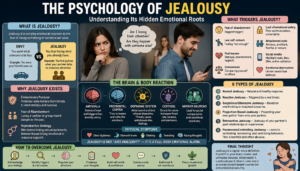
Jealousy vs. Insecurity: Understanding the Psychological Difference
Although jealousy and insecurity are closely connected, they are not the same thing.
Jealousy Is an Emotion
Jealousy is an emotional response to a perceived threat involving something or someone we value.
It may sound like: “I’m afraid I might lose you.”
Insecurity Is an Underlying Vulnerability
Insecurity refers to uncertainty or self-doubt about one’s worth, adequacy, acceptance, or safety.
It may sound like: “I’m afraid I’m not good enough for you.”
A person can therefore experience jealousy without having chronically low self-esteem. Likewise, someone can feel deeply insecure without being jealous.
However, insecurity can make jealousy more intense because a person who already doubts their own worth may interpret ambiguous situations as evidence that they are about to be rejected or replaced.
Jealousy Can Be Temporary; Insecurity Can Be More Persistent
A person may experience jealousy in a particular situation and then return to feeling secure once the perceived threat disappears.
Insecurity, on the other hand, can be a more persistent pattern of self-doubt that influences how a person interprets relationships and social situations.
This is why understanding jealousy requires looking beneath the immediate emotion.
- Sometimes jealousy is about the situation.
- It sometimes is about fear of loss.
- And sometimes it reveals a deeper belief: “What if I am not enough?”
Recognizing that difference is an important step toward understanding and managing jealousy in a healthier way.
What Triggers Jealousy? The Psychological Layers
Understanding the psychology of jealousy means looking beyond the visible emotion and asking a deeper question: What makes a person feel threatened in the first place?
Jealousy rarely develops from a single cause. It can emerge from a combination of attachment needs, past experiences, self-esteem, relationship insecurity, social comparison, and the way a person interprets ambiguous situations.
Two people can experience exactly the same situation and react completely differently. One person may feel mildly uncomfortable and move on, while another may become anxious, suspicious, or overwhelmed.
Here are some of the most common psychological factors that can trigger or intensify jealousy.
1. Fear of Abandonment
One of the strongest emotional drivers of jealousy is the fear of losing an important relationship.
A person may think: “What if they find someone better and leave me?”
This fear can make ordinary situations feel threatening. A delayed reply, a new friendship, or a partner’s interaction with someone attractive may be interpreted as evidence that the relationship is becoming less secure. Fear of abandonment is particularly relevant when someone has previously experienced rejection, inconsistent caregiving, relationship loss, or betrayal.
2. Low Self-Esteem and Self-Doubt
When people have a negative view of themselves, they may be more likely to compare themselves with perceived rivals.
Thoughts may include:
- “They’re more attractive than me.”
- “More successful than I am.”
- “Why would my partner choose me when they could have someone better?”
In these situations, jealousy may be less about the other person and more about how someone evaluates their own worth.
The underlying belief is often: “If someone better comes along, I will be replaced.”
3. Past Betrayal, Rejection, or Emotional Hurt
Previous experiences can shape how a person interprets present relationships.
For example, someone who has experienced:
- Infidelity
- Abandonment
- Repeated rejection
- Emotional manipulation
- Inconsistent caregiving
- A painful relationship breakup
may become more sensitive to signs that resemble previous experiences. However, it is important to remember that past trauma does not automatically cause jealousy. People respond to difficult experiences differently, and jealousy can occur even without a history of trauma. The important factor is how past experiences influence present-day expectations and threat perception.
4. Social Comparison
Comparison is a major contributor to jealousy.
Seeing someone who appears more:
- Attractive
- Successful
- Confident
- Socially popular
- Financially secure
- Accomplished
can trigger feelings of inadequacy. Social comparison becomes particularly powerful when a person believes that another individual’s strengths make them more likely to receive something the person values.
For example: “They are more attractive, so my partner might prefer them.”
The comparison itself may not create jealousy. It is the meaning attached to the comparison that can make the emotion stronger.
5. Lack of Emotional Safety
Jealousy can become more intense when a relationship does not feel emotionally secure.
Factors such as:
- Poor communication
- Unclear boundaries
- Inconsistent affection
- Lack of transparency
- Frequent conflict
- Unpredictable behavior
- Repeated broken promises
can make it difficult for someone to feel secure in the relationship.
When emotional safety is low, the brain may become more vigilant for signs of rejection or betrayal. In contrast, consistent communication and clearly defined boundaries can reduce uncertainty and make jealousy easier to regulate.
6. Attachment Style
Attachment patterns can influence how people respond to closeness, uncertainty, and perceived threats within relationships.
However, attachment style should not be treated as a fixed explanation for someone’s behavior. People with more anxious attachment characteristics may be especially sensitive to rejection, distance, or signs that a partner’s attention is shifting. This can contribute to reassurance-seeking and heightened jealousy.
People with more avoidant attachment characteristics may experience relationship insecurity differently. Instead of openly expressing jealousy, they may distance themselves, suppress emotional needs, or minimize the importance of the relationship. People with fearful-avoidant or disorganized attachment patterns may experience conflicting needs for closeness and protection, sometimes producing unpredictable emotional responses.
People with more secure attachment tend to have greater confidence in their relationships and may be better able to communicate concerns without immediately assuming rejection. Still, attachment style is one factor among many. Personality, relationship quality, past experiences, self-esteem, and current circumstances also influence jealousy.
7. Social Media and Digital Comparison
Modern technology has created new opportunities for jealousy to develop.
Social media can expose people to:
- Curated “highlight reels”
- Idealized relationships
- Edited appearances
- Public displays of affection
- Likes and comments
- New followers
- Online interactions
- Direct messages
- Dating-app activity
Because social media provides only a limited view of someone’s life, people can easily fill in the missing information with assumptions.
For example:
- “Why did they like that person’s photo?”
- “Who is sending them messages?”
- “Why are they following this person?”
- “Did they post with them but not with me?”
Repeatedly monitoring these signals can create a cycle of comparison → uncertainty → jealousy → checking → temporary reassurance → more checking.
8. Emotional Deprivation and Unmet Needs
When important emotional needs remain unmet, jealousy can become more intense.
A person may feel:
- Unappreciated
- Ignored
- Unimportant
- Emotionally disconnected
- Unwanted
- Taken for granted
In such situations, jealousy may function as a signal that something feels missing.
For example, someone who rarely receives affection from their partner may become particularly sensitive when they see their partner showing warmth toward someone else.
- The underlying emotion may not simply be: “I’m jealous.”
- It may actually be: “I want to feel important to you.”
This distinction is crucial because treating jealousy only as a problem can cause us to miss the unmet emotional need underneath it.
The Common Pattern Behind Jealousy
Although jealousy has many possible triggers, a common psychological sequence looks like this:
Trigger → Interpretation → Emotional Threat → Jealousy → Urge to Act
For example:
- Trigger: Your partner talks to someone attractive.
- Interpretation: “They might like this person more than me.”
- Threat: “I could lose my relationship.”
- Emotion: Jealousy and anxiety.
- Urge: Check their phone, ask repeated questions, or seek reassurance.
The important point is that the trigger is not always the true cause of jealousy.
Often, the emotional intensity comes from the meaning we assign to the situation.
Understanding that difference is one of the first steps toward developing healthier emotional responses and greater security in relationships.
Types of Jealousy: 6 Common Psychological Patterns
Understanding the different types of jealousy can help you recognize what is happening beneath the emotion. Jealousy does not always look the same. For some people, it is a brief emotional reaction to a genuine threat. For others, it may involve persistent suspicion, comparison, fear, or attempts to control another person.
Psychology does not use one universally accepted classification of exactly six types of jealousy. However, several common patterns of jealousy can be identified based on their triggers, thoughts, and behavioral responses.
1. Normal or Situational Jealousy
Jealousy can be a normal emotional response when someone perceives a meaningful threat to an important relationship or connection.
For example, you might feel uncomfortable if your partner behaves flirtatiously with someone else or if a close friend suddenly becomes much closer to another person. A brief emotional reaction does not automatically mean that someone is insecure or controlling. Healthy emotional processing involves recognizing the feeling, understanding what triggered it, and communicating appropriately rather than immediately acting on it.
Example: “I felt uncomfortable seeing how close you two were. Can we talk about what happened?”
The emotion becomes problematic when the response becomes disproportionate, controlling, or harmful.
2. Reactive Jealousy
Reactive jealousy occurs when jealousy is triggered by an actual event or behavior that reasonably challenges a person’s sense of security in a relationship.
For example:
- A partner openly flirts with someone else.
- Partner hides important interactions.
- A close friend repeatedly excludes you while prioritizing another friendship.
- Partner violates an agreed-upon relationship boundary.
In reactive jealousy, there may be a genuine situation that needs to be addressed.
However, even when the trigger is real, the response still matters. Healthy communication and boundary-setting are very different from retaliation, surveillance, or controlling behavior.
3. Suspicious or Obsessive Jealousy
Suspicious jealousy occurs when jealousy is driven primarily by uncertainty, assumptions, imagined scenarios, or repeated interpretation of ambiguous information.
A person may repeatedly think:
- “What if they’re hiding something?”
- “Why were they online but didn’t reply to me?”
- “Who were they talking to?”
- “What if they secretly like someone else?”
There may be little objective evidence supporting these fears, but the thoughts can feel extremely convincing.
This pattern can lead to:
- Repeated reassurance-seeking
- Checking social media
- Monitoring online activity
- Repeated questioning
- Rumination
- Difficulty trusting reassurance
When these thoughts become persistent and significantly interfere with daily life or relationships, professional support may be helpful.
4. Projection-Based Jealousy
Projection occurs when a person attributes their own thoughts, feelings, fears, or impulses to someone else.
For example, someone who is experiencing guilt about their own attraction to another person may become unusually suspicious that their partner is also interested in someone else.
Similarly, a person who fears being unfaithful may become excessively concerned that their partner will be unfaithful. However, projection should not be assumed every time someone experiences jealousy. Sometimes suspicion is based on genuine relationship problems, and sometimes it comes from anxiety or previous experiences.
The key question is: “Am I reacting to what is actually happening, or am I placing my own fears onto the other person?”
5. Retroactive Jealousy
Retroactive jealousy refers to distress or jealousy related to a partner’s romantic or sexual history before the current relationship.
A person may become preoccupied with questions such as:
- “Who was their ex?”
- “Were they happier with them?”
- “Did they love them more than they love me?”
- “What did they do together?”
The past itself cannot be changed, but repeated comparison with previous partners can create significant emotional distress in the present.
Retroactive jealousy may involve:
- Repeated questioning about past relationships
- Comparing yourself with an ex-partner
- Searching for information about previous partners
- Replaying imagined scenarios
- Seeking repeated reassurance
The problem is often not the partner’s past, but the meaning the person assigns to that past.
6. Possessive or Controlling Jealousy
Possessive jealousy occurs when fear of losing someone begins to turn into attempts to control their behavior, relationships, communication, or freedom.
Examples include:
- Checking a partner’s phone without permission
- Monitoring their social-media activity
- Demanding passwords
- Tracking their whereabouts
- Restricting who they can interact with
- Preventing them from seeing friends or family
- Repeatedly interrogating them about their activities
- Making threats or using intimidation
This is an important boundary. Feeling jealous is an emotion. Controlling another person’s freedom is a behavior. Jealousy does not justify surveillance, coercion, intimidation, or abuse.
When jealousy repeatedly leads to controlling or abusive behavior, it is no longer simply an emotional experience—it has become a serious relationship and safety concern.
Why Understanding Your Type of Jealousy Matters
Identifying the pattern behind your jealousy can help you understand what is actually happening.
Ask yourself:
- Is there a genuine threat, or am I interpreting uncertainty as danger?
- Am I reacting to something happening now or something that happened in the past?
- I am comparing myself with someone else?
- Am I seeking reassurance, or trying to control the other person?
- What fear is underneath my jealousy?
The goal is not to label yourself as a “jealous person.” The goal is to understand the trigger, interpretation, emotional need, and behavior behind your jealousy. Once you understand that pattern, you can begin changing the response rather than simply fighting the emotion.
Hidden Signs of Jealousy People Often Don’t Recognize
The psychology of jealousy is not always obvious. Jealousy does not necessarily appear as anger, accusations, or dramatic confrontation. Sometimes it is subtle, internalized, or disguised as concern, curiosity, insecurity, or even “care.”
A person may genuinely believe they are simply being cautious while their thoughts and behaviors are actually being driven by fear of losing someone or feeling replaced.
1. Overanalyzing Their Every Action
Jealousy can cause a person to pay excessive attention to small changes in someone’s behavior.
Thoughts may include:
- “Why were they online but didn’t reply?”
- “Did they take so long to respond?”
- “Why did they like that person’s post?”
Individually, these questions may seem harmless. The problem occurs when ordinary behaviors are repeatedly interpreted as evidence of rejection, betrayal, or loss.
2. Feeling Threatened by Other People
A jealous person may feel uncomfortable when someone they perceive as attractive, successful, confident, or socially desirable enters an important relationship. Sometimes there may be no actual threat.
The emotional reaction may come from the thought: “What if they become more important than me?”
This is particularly common when self-worth is strongly tied to being someone’s preferred or most important person.
3. Competing With Perceived Rivals
Jealousy can turn relationships into an unconscious competition.
A person may begin trying to become more:
- Attractive
- Successful
- Interesting
- Desirable
- Accomplished
than the person they perceive as a rival. Instead of asking, “What do I want for myself?”, their attention becomes focused on “How do I compare with them?”
4. Sudden Irritability
Jealousy does not always feel like fear.
It can also appear as:
- Irritability
- Anger
- Frustration
- Withdrawal
- Mood changes
For example, someone may become noticeably uncomfortable whenever their partner repeatedly mentions a particular person. The underlying emotion may still be fear or insecurity, even though it appears externally as anger.
5. Excessive Social-Media Checking
Repeatedly checking someone’s online activity can become a behavioral expression of jealousy.
This may involve checking:
- Who they follow
- Follows them
- Whose posts they like
- Who comments on their content
- When they were last online
- Who they interact with
The behavior often creates a temporary sense of reassurance.
But that reassurance may not last. Uncertainty → Checking → Temporary Relief → New Doubt → More Checking
Over time, this cycle can reinforce anxiety rather than resolve it.
6. Needing Constant Reassurance
A person experiencing jealousy may repeatedly ask:
- “Do you still love me?”
- “Am I good enough for you?”
- “Are you sure you don’t like them?”
- “Would you ever leave me for someone else?”
Reassurance can be healthy when it is part of normal relationship communication. However, when reassurance becomes constant and provides only temporary relief, it can become part of an anxiety-maintaining cycle.
7. Feeling Insecure Around Their Friends
Some people experience jealousy specifically around their partner’s friends or social circle.
They may compare themselves with people who appear more:
- Attractive
- Confident
- Outgoing
- Successful
- Socially connected
The underlying fear may be: “What if my partner enjoys being with them more than being with me?”
8. Micromanaging a Partner’s Behavior
Sometimes jealousy disguises itself as concern.
A person may say: “I’m only asking because I care.”
But repeatedly monitoring someone’s clothing, friendships, whereabouts, messages, or social interactions can gradually become controlling. It is important to distinguish communicating a boundary from controlling another person’s behavior.
Jealousy can explain a controlling impulse, but it does not justify controlling behavior.
Jealousy Often Looks Like Fear Before It Looks Like Anger
One of the most important insights in the psychology of jealousy is that the emotion underneath the behavior is often fear.
Fear of:
- Losing someone
- Being replaced
- Being rejected
- Not being enough
- Being betrayed
- Becoming unimportant
Understanding this underlying fear can help a person respond to jealousy more effectively.
The Psychology Behind Jealousy in Romantic Relationships
Romantic jealousy often develops around fundamental psychological needs for attachment, security, belonging, trust, and emotional significance.
When these needs feel threatened, jealousy may emerge as an attempt to protect the relationship or restore a sense of security.
1. Attachment and Emotional Security
Close relationships provide important emotional experiences such as feeling:
- Loved
- Valued
- Preferred
- Prioritized
- Accepted
- Secure
When these experiences become uncertain, jealousy may increase. However, jealousy does not automatically mean that someone has an insecure attachment style. Relationship circumstances and the behavior of the partner also matter.
2. Fear of Replacement
A common thought underlying jealousy is: “What if someone better comes along and I am replaced?”
This fear may be particularly strong when someone already struggles with self-worth or has experienced rejection or betrayal.
The perceived rival may therefore become a symbol of a deeper fear: “Maybe I am not enough.”
3. Fear of Betrayal
Previous experiences of infidelity, dishonesty, abandonment, or relationship instability can influence how a person interprets future situations.
Someone who has been betrayed may become more alert to potential warning signs. However, it is not accurate to assume that everyone who experiences betrayal develops trauma-related jealousy. Responses to painful experiences vary considerably between individuals. The important issue is whether the past experience continues to influence present-day thoughts, emotions, and behaviors.
4. Emotional Dependency
When one person becomes the center of someone’s entire emotional world, perceived threats to the relationship can feel overwhelming.
For example, if someone has very few sources of:
- Friendship
- Social support
- Personal interests
- Identity
- Self-esteem
they may become heavily dependent on their partner for emotional validation. In that situation, losing the relationship can feel like losing a major part of their identity. Developing a broader sense of self and maintaining meaningful connections outside the relationship can therefore support emotional resilience.
5. Feeling Unworthy of Love
Low self-worth can significantly influence how someone interprets relationship situations.
Thoughts may include:
- “Why would they choose me?”
- “They can do better than me.”
- “Eventually they’ll realize I’m not enough.”
When these beliefs are already present, another person’s attractiveness or confidence may be interpreted as evidence that the relationship is at risk. The jealousy may therefore be less about the other person and more about an underlying belief about one’s own worth.
Jealousy in Friendships: A Silent Emotional Pattern
Romantic jealousy receives considerable attention, but friendship jealousy is equally real.
Friendships can involve attachment, belonging, emotional intimacy, identity, and a strong need to feel valued.
A person may become jealous when a close friend develops a new friendship or appears to prefer spending time with someone else.
Common Signs of Jealousy in Friendships
These may include:
- Feeling left out
- Comparing how close you are with other friends
- Feeling hurt when your friend bonds with someone else
- Competing for attention
- Becoming anxious when friendship dynamics change
- Interpreting a friend’s new friendship as personal rejection
- Seeking repeated reassurance about the friendship
At the core may be a fear of losing importance, closeness, or belonging. Healthy friendships allow relationships to expand without requiring one person to remain someone’s only or most important connection.
Jealousy in Workplaces and Social Circles
Jealousy can also emerge outside close relationships.
In workplaces and social environments, it often overlaps with social comparison, status concerns, self-esteem, and perceived competition.
Workplace Jealousy
Workplace jealousy may involve:
- Comparing professional achievements
- Feeling inferior to colleagues
- Resenting another person’s promotion
- Comparing salary or recognition
- Feeling threatened by someone’s skills
- Believing another person’s success reduces your own value
It is important to distinguish jealousy from envy here. You want the promotion your colleague received, that is primarily envy. If You fear that your colleague’s success will reduce your own position, recognition, or importance, jealousy may also be involved.
Jealousy in Social Circles
Social jealousy can involve:
- Feeling less attractive
- Feeling overshadowed
- Comparing popularity
- Feeling excluded
- Feeling less successful
- Worrying about being replaced within a social group
Social media can intensify these comparisons by constantly exposing people to carefully selected images of other people’s lives.
Why Do Some People Feel Jealousy More Intensely?
Not everyone responds to relational threats in the same way.
The psychology of jealousy suggests that individual differences in self-esteem, attachment, past experiences, emotional regulation, personality, and relationship security can influence how strongly jealousy is experienced.
1. Childhood Emotional Neglect
When a child’s emotional needs are repeatedly dismissed or inadequately responded to, they may develop difficulties recognizing, expressing, or trusting emotional needs later in life.
For some people, this can contribute to a stronger need for reassurance in adult relationships.
However, childhood emotional neglect does not automatically cause jealousy. Human development is influenced by many interacting factors.
2. Critical or Inconsistent Parenting
Growing up with highly critical, unpredictable, or inconsistent caregiving may influence beliefs about acceptance and rejection.
A person may become particularly sensitive to signs that they are:
- Not good enough
- Being rejected
- Being compared
- Losing someone’s approval
These beliefs can influence jealousy later, particularly in emotionally significant relationships.
3. Past Betrayal or Relationship Loss
Infidelity, abandonment, rejection, or emotionally painful relationships can influence future expectations.
A person may begin to think: “It happened before. It could happen again.”
This can increase vigilance and make ambiguous situations feel threatening.
4. Low Self-Esteem
Low self-esteem can make jealousy more difficult to regulate.
When someone fundamentally believes: “I am not enough,”
another person’s strengths may feel like evidence supporting that belief. Building self-worth is therefore an important part of managing jealousy.
5. High Emotional Sensitivity
Some people naturally experience emotions more intensely or notice subtle interpersonal changes more readily.
High sensitivity does not mean someone is automatically jealous or emotionally unstable.
However, when emotional sensitivity combines with uncertainty, low self-esteem, or relationship insecurity, perceived threats may feel particularly intense.
6. Anxious Attachment Characteristics
People with stronger anxious attachment characteristics may be more sensitive to signs of rejection, distance, or changes in a partner’s availability.
They may respond by:
- Seeking reassurance
- Monitoring the relationship
- Worrying about abandonment
- Overanalyzing interactions
But attachment style is not destiny. People can develop more secure patterns through healthy relationships, self-awareness, emotional regulation, and therapy when appropriate.
How Jealousy Can Affect Your Mental and Emotional Well-Being
Occasional jealousy is a normal emotional experience. However, persistent or poorly regulated jealousy can become emotionally exhausting.
It may contribute to:
- Anxiety
- Rumination
- Overthinking
- Emotional exhaustion
- Self-criticism
- Reduced confidence
- Relationship insecurity
- Reassurance-seeking
- Difficulty concentrating
- Obsessive preoccupation
The more attention a person gives to jealousy-related thoughts, the more difficult it can become to shift attention back to everyday life.
How Jealousy Can Damage Relationships
When jealousy repeatedly turns into suspicion, accusation, or control, it can gradually damage the relationship it was intended to protect.
1. Erosion of Trust
Constant suspicion communicates: “I don’t believe you.”
Over time, repeated accusations can undermine trust on both sides.
2. Communication Breakdown
Instead of expressing vulnerability, a person may communicate jealousy through:
- Anger
- Accusations
- Silence
- Interrogation
- Defensive behavior
This makes genuine communication more difficult.
3. Emotional Distance
A partner who constantly feels monitored or questioned may begin to feel:
- Judged
- Distrusted
- Suffocated
- Emotionally exhausted
They may eventually withdraw from the relationship.
4. Repetitive Jealousy Cycles
A common cycle looks like: Trigger → Jealousy → Argument → Reassurance → Temporary Relief → New Trigger → Jealousy
Without addressing the underlying beliefs and behaviors, reassurance alone may provide only short-term relief.
5. Resentment
When jealousy repeatedly leads to accusations, restrictions, or conflict, resentment can develop on both sides.
- The jealous person may feel: “You don’t understand my fear.”
- Other person may feel: “You don’t trust me.”
Without intervention, both experiences can reinforce each other.
How to Overcome Jealousy: Science-Based Strategies
The goal of managing jealousy is not to suppress or eliminate the emotion.
Instead, the goal is to understand the emotion, regulate the physiological response, examine the thoughts behind it, communicate effectively, and choose healthier behaviors.
Step 1: Acknowledge the Jealousy
Start by naming the emotion. “I am feeling jealous right now.” This creates psychological distance between you and the emotion.
You are experiencing jealousy; you are not defined by it.
Step 2: Identify the Trigger
Ask yourself:
- “What exactly triggered me?”
- “Did I interpret as a threat?”
- “What am I afraid might happen?”
- “Is this reminding me of something from my past?”
The goal is to move from: “I’m jealous.”
to: “I’m jealous because I am afraid of being replaced.”
That distinction creates clarity.
Step 3: Identify the Underlying Belief
Look beneath the immediate emotion.
Ask: “What does this situation make me believe about myself?”
You may discover beliefs such as:
- “I’m not attractive enough.”
- “Am i not important enough.”
- “People always leave.”
- “I have to compete for love.”
- “If someone better appears, I’ll be rejected.”
These deeper beliefs may be more important to address than the jealousy itself.
Step 4: Regulate Your Body Before Reacting
Intense emotions can make rational thinking more difficult.
Before confronting someone or making an accusation, try:
- Slow breathing
- Grounding exercises
- Progressive muscle relaxation
- A short walk
- Mindfulness
- Taking a brief pause before responding
The principle is simple: Regulate first. Respond second.
You do not have to act on every emotional impulse.
Step 5: Reality-Check Your Assumptions
Ask yourself:
- “What evidence do I actually have?”
- “Am I assuming?”
- “Is there another explanation?”
- “Am I reacting to facts or to a story I created about those facts?”
This does not mean ignoring genuine warning signs. It means separating evidence from interpretation.
Step 6: Build Self-Worth
Jealousy often becomes more manageable when your sense of worth is not completely dependent on another person’s attention.
Focus on:
- Personal strengths
- Achievements
- Individual goals
- Friendships
- Hobbies and interests
- Personal growth
- Independence
- Self-compassion
The goal is not to convince yourself that you are “better” than everyone else.
It is to develop the belief: “Someone else’s qualities do not reduce my worth.”
Step 7: Communicate Without Accusing
- Instead of: “Why are you always flirting with other people?”
- Try: “I felt insecure when I saw that interaction, and I’d like to talk about what happened.”
- Instead of: “You don’t care about me.”
- Try: “I’ve been feeling emotionally disconnected lately, and I need more reassurance and communication.”
Healthy communication focuses on feelings, needs, observations, and boundaries rather than accusations.
Step 8: Work on Attachment and Emotional Regulation
If jealousy repeatedly appears across relationships, it may be useful to explore the broader emotional pattern.
Helpful approaches may include:
- Psychotherapy
- Cognitive-behavioral strategies
- Attachment-focused therapy
- Emotional regulation skills
- Journaling
- Mindfulness
- Self-reflection
The goal is not to permanently label yourself with an attachment style. It is to develop more secure ways of responding to closeness, uncertainty, and conflict.
Step 9: Reduce Unhealthy Comparison
If social media consistently triggers jealousy, consider changing how you use it.
You might:
- Reduce passive scrolling
- Mute triggering accounts
- Take regular breaks
- Stop checking another person’s activity repeatedly
- Focus on your own goals rather than online comparisons
You do not have to eliminate social media completely. The goal is to prevent it from becoming a constant source of emotional comparison.
Step 10: Practice Trust Without Ignoring Boundaries
Trust does not mean blindly believing everything. Healthy trust involves allowing another person reasonable freedom while maintaining clear relationship boundaries.
There is an important difference between:
- Trust: “I believe you, and if something concerns me, I’ll communicate it.”
- Control: “I need to monitor you so I can make sure you don’t betray me.”
Healthy relationships require both trust and boundaries.
When Does Jealousy Become Unhealthy? When to Seek Professional Help
Jealousy becomes a serious concern when it consistently interferes with daily functioning, emotional well-being, or relationships.
Consider seeking professional support if jealousy involves:
- Persistent suspicion without evidence
- Repeated checking or surveillance
- Controlling behavior
- Extreme reassurance-seeking
- Explosive anger
- Obsessive jealousy-related thoughts
- Significant anxiety or panic symptoms
- Severe emotional dependency
- Repeated boundary violations
- Threats, intimidation, or abusive behavior
Intense jealousy can sometimes occur alongside broader difficulties involving anxiety, obsessive thinking, attachment insecurity, low self-esteem, or previous relationship trauma. However, jealousy alone does not establish a mental-health diagnosis.
A mental-health professional can help identify the underlying pattern and develop healthier ways of responding.
Final Thoughts: Jealousy Doesn’t Make You Weak—It Makes You Human
The psychology of jealousy teaches us that jealousy is more complicated than simply being “insecure” or “toxic.”
Jealousy is a human emotional response. Fear of loss is human. Wanting to feel loved, valued, and secure is human. The goal is not to eliminate every jealous feeling. The goal is to understand it before it controls your behavior.
You can learn to:
- Understand your jealousy
- Identify its triggers
- Regulate intense emotions
- Challenge unhelpful assumptions
- Communicate your needs
- Build self-worth
- Develop healthier attachment patterns
- Set appropriate boundaries
- Strengthen trust
- Create more secure relationships
Remember:
Jealousy is not necessarily the problem.
The problem begins when fear turns into suspicion, insecurity turns into control, or emotional pain turns into harmful behavior. When you understand your jealousy, you may discover that the emotion is pointing toward something deeper—a fear, an unmet need, an old belief, or a desire for emotional security.
And that is where meaningful change begins.
Reference
-
American Psychological Association – Jealousy & Emotions
https://www.apa.org/monitor/2019/02/jealousy -
Verywell Mind – Understanding Jealousy
https://www.verywellmind.com/understanding-jealousy-5210212 -
Psychology Today – Attachment Theory
https://www.psychologytoday.com/us/basics/attachment -
Harvard Health – Emotional Reactions & the Brain
https://www.health.harvard.edu/mind-and-mood/emotions-and-the-brain -
NIMH – Anxiety & Emotional Stress
https://www.nimh.nih.gov/health/topics/anxiety-disorders - Why Modern Relationships Fail: Attachment Theory Explained
- Contact Us