
Father’s Postpartum Depression: Introduction
When a baby is born, the spotlight naturally falls on the mother—and rightfully so. Pregnancy, childbirth, and postpartum recovery bring immense physical and emotional changes. However, alongside the mother’s experience, another story may be unfolding quietly in many homes—one that is rarely acknowledged: fathers can also experience Father’s postpartum depression.
At the same time, fatherhood is often expected to be a period of pride, strength, and responsibility. Men are frequently expected to be supportive, stable, and emotionally unaffected. As a result, when fathers experience emotional difficulties after the birth of a child, their struggles may go unnoticed, unspoken, and untreated.
Moreover, the pressure to “stay strong” can make it even harder for fathers to recognize what they are experiencing or feel comfortable asking for help. Instead of expressing sadness or vulnerability, some may withdraw, become irritable, work excessively, or simply try to push through their distress.
Therefore, paternal postpartum depression is not only real but also relatively common and frequently underdiagnosed. Recognizing these symptoms is an important step toward ensuring that fathers receive the support they need during this major life transition.
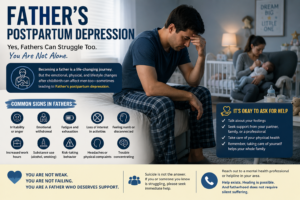
Father’s Postpartum Depression: Understanding Postpartum Depression Beyond Mothers
What Is Postpartum Depression?
Postpartum depression (PPD) is a mood disorder that can develop after the birth of a child. Although it is most commonly associated with mothers, it can also affect fathers during the postpartum period. In fact, fathers may experience depressive symptoms during the first year after childbirth, even though they do not go through pregnancy or delivery themselves.
In fathers, this experience is commonly described as:
- Paternal Postpartum Depression
- Paternal Perinatal Depression
However, paternal depression often receives less attention than maternal postpartum depression. Despite growing awareness and research, many fathers are still not routinely screened for depressive symptoms. As a result, the condition can remain misunderstood, overlooked, or untreated.
Importantly, recognizing postpartum depression as a possible experience for both parents helps create a more complete understanding of mental health after childbirth. It also makes it easier for fathers to recognize that struggling emotionally does not mean they are failing as parents.
Father’s Postpartum Depression: How Common Is Postpartum Depression in Fathers?
Postpartum depression in fathers is more common than many people realize. Although estimates vary across studies and populations, research suggests that a significant number of new fathers experience depressive symptoms during the postpartum period.
Studies suggest that:
- Around 8–10% of fathers experience postpartum depression.
- Moreover, the risk can increase substantially—up to 25–50% in some studies—when the mother is also experiencing postpartum depression.
- Interestingly, symptoms may not appear immediately. For many fathers, depressive symptoms can become more noticeable around 3–6 months after childbirth.
However, these figures may not capture the full extent of the problem. Because fathers are often less likely to recognize depressive symptoms, disclose emotional difficulties, or seek professional help, paternal postpartum depression may be underreported and underdiagnosed.
Therefore, the absence of an immediate crisis after childbirth does not necessarily mean a father is emotionally well. Symptoms can emerge gradually, making awareness and ongoing support particularly important during the first year of parenthood.
Father’s Postpartum Depression: Can Men Really Get Postpartum Depression Without Giving Birth?
Yes. Although fathers do not experience pregnancy or childbirth themselves, becoming a parent can still bring significant psychological, hormonal, relational, and lifestyle changes. These changes can place considerable emotional demands on new fathers and, in some cases, contribute to depressive symptoms.
Importantly, postpartum depression is not caused by childbirth alone. Rather, it can develop through a combination of biological, psychological, and environmental factors, including:
- Stress and increased responsibility
- Sleep deprivation
- Major changes in identity and daily routines
- Changes in the couple’s relationship
- Emotional pressure and expectations of fatherhood
- Hormonal changes that may occur in new fathers
In addition to these psychological and social factors, biological changes may also play a role.
Biological Factors: Hormonal Changes in Fathers
Interestingly, becoming a father can be accompanied by measurable hormonal changes. Research suggests that some new fathers experience shifts in hormones involved in stress, bonding, and reproductive functioning.
Hormonal Changes May Include:
- Changes in testosterone levels
- In cortisol, a hormone involved in the body’s stress response
- Changes in prolactin and oxytocin, which are associated with caregiving, bonding, and social behavior
For example, lower testosterone levels have been associated with symptoms such as:
- Low mood
- Fatigue
- Irritability
- Reduced motivation
However, hormonal changes alone do not explain paternal postpartum depression. Instead, biological changes may interact with sleep deprivation, chronic stress, relationship difficulties, and the psychological demands of becoming a parent.
Therefore, paternal postpartum depression is best understood as a multifactorial condition rather than the result of a single hormonal or psychological cause. This broader perspective is important because it shows that fathers’ mental health after childbirth can be influenced by several interconnected factors.

Father’s Postpartum Depression: How Paternal Postpartum Depression Can Look Different
Paternal postpartum depression does not always present as obvious sadness or tearfulness. While some fathers may experience low mood, others may show changes in behavior, mood, or physical well-being that are easier to overlook.
Common Signs in Fathers Include:
- Irritability, frustration, or anger
- Emotional withdrawal or avoiding conversations
- Spending excessive hours at work to escape stress at home
- Increased use of substances, such as alcohol or tobacco, as a way of coping
- Risk-taking or impulsive behavior
- Loss of interest in spending time with the partner or baby
- Feeling emotionally numb, detached, or disconnected
- Headaches, body aches, or other unexplained physical complaints
Importantly, these behaviors should not automatically be interpreted as depression. They can also occur in response to sleep deprivation, stress, relationship difficulties, or other challenges of early parenthood. However, when these changes are persistent, significant, or occur alongside other depressive symptoms, they may signal that a father is struggling and needs support.
Because these symptoms may not resemble the “classic” picture of depression, paternal postpartum depression can easily be mistaken for ordinary stress, anger, work pressure, or simply “adjusting to fatherhood.” As a result, both fathers and those around them may fail to recognize that something more serious is happening.
Looking beyond sadness is therefore essential when identifying depression in new fathers. Recognizing changes in behavior, emotional connection, and coping patterns can make it easier to identify fathers who may need help.
Father’s Postpartum Depression: Silent Symptoms Fathers Often Ignore
Not every father experiencing postpartum depression will recognize it as depression. In many cases, symptoms may be minimized, rationalized, or hidden behind the belief that struggling is simply part of becoming a parent.
A father may tell himself:
- “Others have it harder.”
- “I need to be strong.”
- “This will pass.”
However, repeatedly dismissing these experiences can make it harder to recognize when normal adjustment has developed into significant emotional distress.
Father’s Postpartum Depression: Silent Symptoms May Include:
- Persistent or chronic exhaustion
- A sense of emotional emptiness or numbness
- Feeling trapped, overwhelmed, or unable to cope
- Guilt about not enjoying fatherhood
- Wanting to escape from responsibilities or the situation
These experiences deserve attention rather than dismissal. A father does not need to reach a crisis point before his emotional well-being becomes important.
Father’s Postpartum Depression: How Paternal Depression Affects the Family
Paternal postpartum depression does not affect fathers in isolation. Because family members are closely connected emotionally and practically, a father’s mental health can influence the wider family environment.
Impact on the Partner
When a father is experiencing depression, his ability to provide emotional and practical support may decrease. This can place additional pressure on the mother or partner, particularly during an already demanding period.
Possible effects include:
- Reduced emotional support for the mother or partner
- Increased relationship tension and conflict
- Greater difficulty coping with the demands of early parenthood
- Potential worsening of maternal postpartum depression when both parents are struggling
As a result, paternal and maternal mental health should not be viewed as completely separate concerns. Supporting one parent can sometimes help strengthen the well-being of the entire family.
Impact on the Child
A father’s depression can also influence the parent–child relationship. Research has associated paternal depression with difficulties involving:
- Emotional bonding and engagement
- The child’s emotional regulation
- Behavioral and emotional development over time
However, this does not mean that a depressed father will inevitably harm his child. Rather, it highlights why early recognition and appropriate support matter. When fathers receive help, they may be better able to engage emotionally and consistently with their children.
Father’s Postpartum Depression: Why Fathers Rarely Seek Help
Even when fathers recognize that something is wrong, taking the step to seek professional support can be difficult. Social expectations, lack of awareness, and practical barriers may all contribute to delayed help-seeking.
Fathers may avoid seeking help because of:
- Stigma surrounding mental health
- Fear of appearing weak or incapable
- Limited awareness of paternal postpartum depression
- Lack of routine mental-health screening during postnatal care
- The belief that their own needs are secondary to those of the mother and baby
Consequently, some fathers may continue coping alone until their symptoms become more severe or begin interfering with work, relationships, parenting, or daily functioning.
Seeking help earlier, however, does not mean a father has failed. It means he has recognized that his well-being matters too.
Father’s Postpartum Depression: How Long Does Paternal Postpartum Depression Last?
There is no single timeline for paternal postpartum depression. The duration and severity of symptoms can vary considerably from one father to another, depending on factors such as symptom severity, stressors, support, and access to treatment.
- Without appropriate support or treatment: Symptoms may persist for many months and, in some cases, longer.
- With appropriate support and early intervention: Many fathers can experience meaningful improvement over time.
Therefore, it is important not to assume that symptoms will simply disappear on their own. Early recognition can create an opportunity to address contributing factors, strengthen coping strategies, and access appropriate psychological or psychiatric support.
The key message is simple: struggling after the birth of a child is not something a father has to silently endure. Recognizing the signs early can be the first step toward recovery—for the father and, ultimately, for the family as a whole.

Father’s Postpartum Depression: Treatment and Recovery for Fathers
The good news is that paternal postpartum depression is treatable, and fathers do not have to navigate recovery alone. The right approach depends on the severity of symptoms, individual circumstances, available support, and whether other mental-health concerns are also present. In many cases, a combination of psychological support, practical changes, and professional care can make recovery more manageable.
1. Psychological Therapy
Psychological therapy can provide fathers with a safe and non-judgmental space to understand what they are experiencing and develop healthier ways of coping. Therapy may help fathers:
- Process changes in identity and the transition into fatherhood
- Recognize and express difficult or suppressed emotions
- Challenge self-critical or unrealistic expectations
- Develop healthier coping strategies
- Improve communication and relationships
Depending on the individual’s needs, approaches may include:
- Cognitive Behavioral Therapy (CBT)
- Interpersonal Therapy (IPT)
- Couples or relationship counseling
The goal is not simply to “think positively.” Rather, therapy can help fathers understand the factors contributing to their distress and develop practical ways to respond to them.
2. Open Communication
Talking about emotional difficulties can be an important part of recovery. Fathers may benefit from having someone they trust with whom they can speak honestly—whether that is a partner, friend, family member, therapist, or another supportive person.
However, support does not always mean immediately offering solutions.
Sometimes, listening without judgment is more helpful than trying to fix everything. Giving fathers permission to express frustration, fear, exhaustion, or vulnerability can reduce the pressure to appear as though everything is under control.
3. Lifestyle and Practical Support
Professional treatment is important, but practical support at home can also make a meaningful difference. Where possible, families can work together to reduce the pressures contributing to exhaustion and emotional overload.
Helpful steps may include:
- Prioritizing adequate rest and sleep whenever possible
- Sharing childcare and household responsibilities
- Reducing unrealistic pressure to “perform” as the perfect provider or father
- Creating space for fathers to rest, recover, and maintain healthy routines
- Offering emotional validation rather than criticism or dismissal
These changes may seem small, but reducing chronic stress and isolation can make it easier for a father to engage with treatment and recovery.
4. Medication When Needed
For some fathers, particularly when symptoms are moderate to severe, a psychiatrist may recommend medication as part of treatment. Medication decisions should always be individualized and made under appropriate medical supervision.
Taking medication for depression is not a sign of weakness, incompetence, or failure as a father. Mental-health treatment is healthcare, and seeking appropriate treatment does not diminish masculinity or parental capability.
Father’s Postpartum Depression: When Fathers Should Seek Immediate Help
Some symptoms require more urgent attention and should not be managed alone. Immediate professional support is especially important when a father is experiencing:
- Thoughts of self-harm or suicide
- Severe or uncontrollable anger or impulsivity
- Substance misuse or dependence that is affecting daily life
- An inability to function adequately at work, at home, or in caring for the child
- A feeling that he may lose control or that he or someone else may be unsafe
In these situations, urgent mental-health or emergency support should be sought. If there is an immediate risk of harm, contact local emergency services or go to the nearest emergency department.
Seeking help early is not an admission of failure. It is a protective step—for the father, the partner, and the child.
Father’s Postpartum Depression: How Families Can Support Fathers
Support from family members can play an important role in helping fathers recognize their struggles and access care. Rather than waiting for a father to reach a breaking point, families can create an environment where talking about mental health feels acceptable.
Families can:
- Acknowledge that fathers can experience postpartum mental-health difficulties
- Normalize conversations about emotional struggles
- Encourage professional support when needed
- Avoid minimizing or dismissing symptoms
- Share childcare and household responsibilities more equitably
- Check in regularly rather than assuming everything is fine
Most importantly, support should involve understanding rather than judgment. A father may not always know how to say, “I’m struggling,” so changes in behavior, mood, or connection may sometimes be important signals to notice.
Support can be protective—and early support can prevent distress from becoming more severe.
Father’s Postpartum Depression: Breaking the Silence Around Fathers’ Mental Health
Fatherhood does not make men immune to emotional struggle. Becoming a parent is a major life transition, and fathers deserve the same recognition and compassion when their mental health is affected.
Recognizing paternal postpartum depression can help:
- Reduce stigma around fathers seeking mental-health support
- Improve overall family well-being
- Strengthen the parent–partner relationship
- Support healthier parent–child relationships and development
Ultimately, caring for a father’s mental health is not separate from caring for the family. Mental health care is family care.
Father’s Postpartum Depression: Conclusion
Postpartum depression is not limited to mothers. Although fathers do not experience pregnancy or childbirth themselves, the transition into fatherhood can involve significant emotional, psychological, relational, and biological changes. For some men, these changes can contribute to depression—yet many continue to struggle silently.
Recognizing paternal postpartum depression does not take attention away from mothers or diminish the importance of maternal mental health. Instead, it expands the focus of postpartum care to include the entire family. When both parents’ mental health is acknowledged, families are better positioned to receive the support they need during one of life’s most significant transitions.
If you are a father struggling after the birth of your child, remember:
- You are not weak.
- Not failing as a father.
- You are not alone.
Most importantly, you do not have to wait until things become unbearable before asking for help. Speaking with a mental-health professional, trusted person, or healthcare provider can be an important first step toward understanding what you are experiencing and finding appropriate support.
Help exists. Recovery is possible. And fatherhood does not require silent suffering. Caring for a father’s mental health is also caring for the family he is trying so hard to support.
Reference
-
World Health Organization (WHO) – Maternal & Parental Mental Health
🔗 https://www.who.int/teams/mental-health-and-substance-use/promotion-prevention/maternal-mental-health
Anchor text: parental mental health after childbirth -
American Psychological Association (APA) – Postpartum Depression
🔗 https://www.apa.org/monitor/2019/02/postpartum-depression
Anchor text: postpartum depression in fathers and mothers -
NHS – Postnatal Depression
🔗 https://www.nhs.uk/mental-health/conditions/post-natal-depression/overview/
Anchor text: postnatal depression symptoms in parents -
Postpartum Depression: Signs New Mothers Often Ignore
- Contact Us
Pingback: Instagram Motherhood vs Reality: Postpartum Depression