
How ABA Therapy Works
ABA typically begins by identifying a target skill or behavior and assessing the individual’s current abilities. The therapist then breaks the skill into manageable components and teaches each component systematically. Additionally, the therapist measures progress throughout the intervention to evaluate learning and guide further teaching.
One commonly used framework is the ABC model:
- A – Antecedent: What happens before the behavior?
- B – Behavior: What does the individual do?
- C – Consequence: What happens immediately afterward?
Based on the assessment, the therapist selects appropriate teaching procedures and reinforcement strategies. As a result, ABA Therapy in ASD can provide structured and individualized support while helping the individual develop meaningful functional skills.
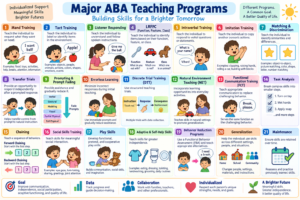
ABA Therapy in ASD: Major ABA Teaching Programs
ABA Therapy in ASD can address a wide range of communication, learning, social, adaptive, and behavioral skills. Therapists select teaching programs according to each individual’s developmental level, strengths, needs, and treatment goals. Moreover, therapists can combine structured teaching with naturalistic activities to help individuals use newly acquired skills in everyday situations.
1. Mand Training
A mand refers to a request for something an individual wants or needs. Therefore, mand training focuses on teaching functional communication that allows the individual to express preferences, needs, and requests appropriately.
For example, the therapist may teach the child to request: Food, Toys, Activities, Help, Breaks, Attention, Information
The individual may communicate through speech, gestures, signs, pictures, PECS, or an AAC device. Importantly, the therapist should select a communication method that matches the individual’s abilities and needs. The main goal involves developing an effective communication response that can replace frustration or challenging behavior.
2. Tact Training
A tact involves labeling or identifying something that the individual encounters in the environment. In other words, tact training helps the learner describe people, objects, actions, and events.
For example:
Therapist: “What is this?”
Child: “Ball.”
Tact training may include: Objects, People, Animals, Actions, Colors, Shapes, Emotions, Environmental events
As the learner progresses, the therapist can introduce more complex labels and encourage spontaneous communication.
3. Listener Responding
Listener responding teaches the individual to understand spoken language and respond appropriately to verbal instructions. Initially, therapists may introduce simple one-step directions and gradually increase their complexity.
Examples include:
- “Give me the ball.”
- “Touch your nose.”
- “Stand up.”
- “Point to the dog.”
- “Put the cup on the table.”
Furthermore, therapists can gradually introduce two-step and more complex instructions as the individual’s receptive language develops. This approach helps build functional understanding of spoken language.
4. LRFFC – Listener Responding by Function, Feature, and Class
LRFFC teaches the learner to identify or select items according to their function, feature, or class. This program helps expand receptive language and conceptual understanding.
Function
- The therapist asks: “What do you eat with?”
- Response: “Spoon.”
Feature
- The therapist asks: “Which one is red?”
- Response: The child selects the red object.
Class
- The therapist asks: “Which one is an animal?”
- Response: “Dog.”
Through LRFFC activities, the learner develops receptive language, categorization, concept formation, and verbal comprehension.
5. Intraverbal Training
Intraverbal training teaches the learner to respond to another person’s verbal statement or question when the answer does not appear directly in the environment.
For example:
Therapist: “What is your name?”
Child: “Vihan.”
Therapist: “What do you drink?”
Child: “Water.”
Therapist: “Twinkle, twinkle, little…”
Child: “Star.”
Initially, the therapist may use simple fill-in responses and familiar questions. As the learner develops stronger verbal skills, the therapist can progress toward more complex questions, conversational exchanges, and spontaneous verbal interactions.
6. Imitation Training
Imitation training teaches the child to copy another person’s actions. This skill can provide an important foundation for learning through observation and participating in social activities.
Motor imitation
Examples include: Clapping, Raising hands, Touching the head, Jumping
Object imitation
Examples include: Rolling a car, Building with blocks, Feeding a doll
Additionally, therapists can gradually introduce more complex actions and sequences. Imitation training can support social learning, play skills, motor development, and the acquisition of new behaviors.
7. Matching and Discrimination Tasks
Matching programs teach the learner to recognize similarities and differences between objects, pictures, symbols, or other stimuli. These activities can strengthen visual discrimination and early learning skills.
Tasks may include:
- Object-to-object matching
- Picture-to-picture matching
- Object-to-picture matching
- Color matching
- Shape matching
- Letter matching
- Number matching
For example, the therapist may ask the child to match a red block with another red block. As the learner progresses, the therapist can introduce more complex discrimination tasks.
8. Transfer Trials
Transfer trials help the learner respond independently after receiving a prompt or assistance. The therapist first supports the correct response and then provides another opportunity for the learner to respond with less assistance.
A common sequence may involve: Instruction → Prompt → Correct Response → Reinforcement → Transfer Trial
For example, if a child needs a prompt to answer a question, the therapist can repeat the instruction after reinforcement and give the child another opportunity to answer independently.
The primary purpose involves transferring stimulus control from the prompt to the natural instruction or stimulus while gradually reducing prompt dependence.
9. Prompting and Prompt Fading
Prompting provides additional assistance when a learner cannot independently complete a task. Therapists select the type and level of prompting according to the learner’s needs.
Common prompts include:
- Verbal prompts
- Gestural prompts
- Modeling
- Visual prompts
- Partial physical prompts
- Full physical prompts
However, therapists should avoid unnecessary prompt dependence. Therefore, they gradually fade prompts as the learner develops greater independence.
10. Errorless Learning
Errorless learning arranges teaching conditions to reduce repeated incorrect responses during initial skill acquisition. The therapist provides sufficient assistance to help the learner respond correctly and then gradually reduces that assistance.
For example, when introducing a new matching task, the therapist may provide an immediate prompt to guide the correct response. As accuracy improves, the therapist systematically decreases the prompt level.
This approach can help establish accurate responding when the learner first encounters a new or difficult skill.
11. Discrete Trial Training (DTT)
Discrete Trial Training (DTT) breaks a target skill into structured teaching opportunities. Each trial usually contains three basic components: Instruction → Response → Consequence
For example:
Therapist: “Touch red.”
Child: Touches red.
Therapist: Provides reinforcement.
The therapist can conduct multiple trials while recording the learner’s responses. Consequently, data from these trials can help the therapist evaluate acquisition and adjust the teaching procedure when necessary.
12. Natural Environment Teaching (NET)
Unlike highly structured table-based instruction, Natural Environment Teaching (NET) incorporates learning opportunities into naturally occurring activities and routines.
For example, while playing with a child:
- The child requests a toy.
- Therapist labels the toy.
- The child follows a direction.
- Therapist teaches turn-taking.
- The child practices communication during play.
In this way, NET connects skill acquisition with meaningful daily activities. As a result, learners receive opportunities to practice communication and other skills in contexts that closely resemble their everyday environments.
13. Functional Communication Training (FCT)
Functional Communication Training (FCT) teaches an appropriate communication response that can replace a challenging behavior with the same or a similar function.
For example, if a child cries or hits to escape a difficult activity, the therapist may teach the child to communicate: “Break.”
Similarly, if the child grabs a desired object, the therapist may teach: “Give me.”
The therapist should identify the function of the challenging behavior and select an appropriate replacement response. Therefore, FCT can help the individual communicate needs more effectively while reducing reliance on challenging behaviors.
14. Task Analysis
Task analysis breaks a complex skill into smaller, teachable steps. This approach allows the therapist to teach each component systematically.
For example, the therapist may divide handwashing into:
- Turn on the tap.
- Wet hands.
- Apply soap.
- Rub hands.
- Rinse hands.
- Turn off the tap.
- Dry hands.
The therapist can teach each step using appropriate prompting and reinforcement. Once the learner gains proficiency, the therapist can gradually encourage greater independence across the complete sequence.
15. Chaining
Chaining teaches a sequence of behaviors by connecting individual steps into a complete skill. Therapists commonly use two approaches:
Forward Chaining
The learner first learns the initial step and then gradually acquires the following steps.
Backward Chaining
The learner initially completes the final step while the therapist assists with the earlier steps.
For example, therapists can use chaining to teach dressing, eating, grooming, toileting, and other daily living skills. The therapist selects the approach according to the learner’s needs and the demands of the task.
16. Social Skills Training
ABA-based interventions can target functional social communication and interaction skills, including:
- Joint attention
- Turn-taking
- Sharing
- Greetings
- Responding to others
- Initiating interaction
- Following social routines
- Participating in group activities
- Eye gaze when functionally appropriate
Importantly, social skills training should focus on meaningful communication and participation rather than simply forcing the individual to display socially typical behaviors.
17. Play Skills
Play-skill programs help children develop appropriate and meaningful ways to interact with toys, people, and activities.
Programs may include:
- Functional play
- Pretend play
- Toy exploration
- Turn-taking
- Cooperative play
- Appropriate use of toys
- Independent play
Furthermore, therapists can use play activities to create natural opportunities for communication, imitation, social interaction, problem-solving, and choice-making.
18. Adaptive and Self-Help Skills
ABA can support independence in everyday activities such as:
- Toileting
- Feeding
- Dressing
- Brushing teeth
- Bathing
- Handwashing
- Grooming
- Cleaning up
- Following daily routines
Therapists can use task analysis, prompting, chaining, reinforcement, and fading to teach these skills. Ultimately, these programs should promote functional independence rather than unnecessary compliance.
19. Behavior Reduction Programs
When challenging behaviors interfere with learning, communication, participation, or safety, a Functional Behavior Assessment (FBA) can help identify factors that influence the behavior.
Possible behavioral functions include:
- Escape
- Attention
- Access to tangible items
- Automatic reinforcement
Once the therapist understands the behavior’s function, the intervention can focus on teaching an appropriate alternative response and modifying relevant environmental factors. Therefore, behavior reduction should not simply aim to suppress a behavior; instead, it should address the underlying function and provide a safer, functional alternative.
20. Generalization
Generalization occurs when an individual uses a learned skill across different people, settings, materials, and situations.
For example, if a child learns to request “water” during therapy, the therapist should create opportunities for the child to use the same communication skill:
- At home
- In school
- With parents
- With teachers
- In the community
Additionally, therapists can vary people, materials, instructions, and environments during teaching. This approach helps the learner apply skills beyond the therapy setting.
21. Maintenance
Maintenance involves helping the learner retain previously acquired skills over time. Once the individual masters a skill, therapists should periodically check whether the learner continues to use it independently.
For example, a therapist can incorporate previously learned communication, self-help, or social skills into everyday activities. In addition, caregivers and teachers can provide natural opportunities for the learner to practice these skills.
Ultimately, maintenance helps ensure that therapy produces lasting, functional skills rather than short-term performance only.
Conclusion
ABA therapy can support individuals with Autism Spectrum Disorder across communication, receptive and expressive language, social interaction, play, adaptive functioning, learning, and behavior.
Programs such as Manding, Tacting, Listener Responding, LRFFC, Intraverbals, Imitation, Matching, Discrete Trial Training, Natural Environment Teaching, Functional Communication Training, Transfer Trials, Prompt Fading, Task Analysis, Chaining, Social Skills Training, and Generalization can be incorporated according to the individual’s developmental profile and therapeutic goals.
The most important principle is that ABA should be individualized, functional, ethical, data-informed, and respectful of the person’s autonomy and dignity. The goal is not to make an autistic individual appear “less autistic,” but to help them communicate effectively, acquire meaningful skills, participate more independently, and experience a better quality of life.
Reference
- American Academy of Pediatrics (2020) — Identification, Evaluation, and Management of Children With Autism Spectrum Disorder
Read the article - Behavior Analyst Certification Board (BACB) — Ethics Code for Behavior Analysts
View the Ethics Code - PubMed — AAP Autism Clinical Report
View on PubMed - https://monoprovacounselling.in/treatment-of-autism-spectrum-disorder-asd/
- https://monoprovacounselling.in/autism-in-children-early-signs-causes-what-parents-should-do/
Good info