
This article explores how different parenting styles influence personality development, drawing from developmental psychology, attachment theory, and real-life behavioral patterns. As a mental health professional, you may notice these patterns daily—in children, adolescents, and even adults reflecting their early family experiences.
Understanding Parenting Styles: A Psychological Framework
The concept of parenting styles was systematically introduced by developmental psychologist Diana Baumrind, who identified recurring patterns in the ways parents interact with and respond to their children. Later researchers expanded and refined her framework, but the central idea remains highly relevant: parenting style describes the emotional climate in which a child is raised—including warmth, responsiveness, discipline, communication, boundaries, and expectations.
Parenting is not simply about whether a parent is “strict” or “lenient.” What matters is the overall pattern of interaction. A parent may set firm boundaries while remaining emotionally supportive, or may be highly affectionate but provide little structure. These differences can create very different developmental environments.
Parenting styles are generally discussed within four broad categories:
- Authoritative
- Authoritarian
- Permissive
- Neglectful (Uninvolved)
Each style can influence important areas of development, including self-esteem, emotional regulation, independence, resilience, empathy, social competence, and interpersonal functioning. However, parenting style does not determine a child’s personality in isolation. Rather, it is one important influence within a much larger developmental system.
Why Is Personality Development Sensitive to Parenting?
Personality development is particularly sensitive to early relationships because a child’s emotional capacities, sense of self, and understanding of relationships are still developing.
A young child does not yet have the psychological maturity to independently make sense of every experience. When a child is frightened, frustrated, rejected, praised, corrected, or comforted, they gradually learn what those experiences mean—and what they might mean about themselves and other people.
In this process, parents and primary caregivers often become a child’s first emotional regulators, mirrors, and interpreters of the social world. For example, imagine a four-year-old who becomes overwhelmed and starts crying because they cannot complete a puzzle.
- One caregiver might respond: “You’re frustrated because it’s not working. Let’s take a breath and try again.”
- Another might say: “Stop crying. It’s only a puzzle.”
The child is not simply learning how to complete a puzzle. They may also be learning something about emotion, failure, help-seeking, and self-worth. Repeated experiences like these can gradually contribute to patterns in how children understand themselves, regulate emotions, cope with difficulties, and relate to others. Several psychological domains are particularly important.
1. Emotional Regulation
Children are not born with fully developed abilities to calm themselves, tolerate frustration, or manage intense emotions. These abilities develop gradually through co-regulation—the process through which caregivers help children manage emotional states before children become increasingly capable of doing so independently.
- When caregivers acknowledge distress, help children name emotions, provide comfort, and model calm responses, children gradually learn that emotions can be experienced and managed rather than feared.
- When emotions are repeatedly dismissed, punished, ridiculed, or ignored, children may instead learn to suppress their feelings, become highly reactive, or struggle to understand what they are experiencing.
Over time, these repeated interactions can influence whether a person approaches difficult emotions with greater flexibility and regulation or with avoidance, suppression, or reactivity.
2. Self-Concept and Self-Worth
One of the earliest psychological questions a child begins to answer is: “Who am I?”
Children partly construct this understanding through the responses they receive from important caregivers.
When caregivers communicate acceptance, interest, encouragement, and realistic appreciation, children are more likely to develop a sense of being worthy, capable, and valued. In contrast, when approval consistently appears conditional on obedience, achievement, appearance, or emotional compliance, a child may begin to develop beliefs such as:
- “I am only good when I succeed.”
- “My feelings are a problem.”
- “I have to please people to be loved.”
- “Am i not good enough.”
These beliefs do not automatically become adult personality traits, but they can become schemas—deeply learned expectations about the self and relationships—that may influence confidence, perfectionism, people-pleasing, self-criticism, or fear of failure later in life.
3. Social Competence
Parents are often a child’s first social environment.
Before children learn how to navigate friendships, romantic relationships, workplaces, or larger communities, they experience relationships within the family. Everyday moments—playing together, disagreeing, apologizing, setting boundaries, receiving affection, and repairing conflict—provide opportunities to learn how relationships work.
Children gradually learn:
- How to communicate their needs
- To listen to others
- How to handle disagreement
- To set and respect boundaries
- How to repair relationships after conflict
- Whether asking for help feels safe
- Closeness feels comforting or threatening
Supportive and responsive parenting can provide a foundation for empathy, cooperation, communication, and assertiveness. On the other hand, harsh, rejecting, or highly inconsistent interactions may contribute to difficulties such as withdrawal, aggression, insecurity, or heightened sensitivity to social judgment.
4. Coping Mechanisms
Children also learn how to respond to stress by observing how the adults around them respond to stress.
When a parent faces a difficult situation and says, “This is stressful, but let’s think about what we can do,” the child is witnessing problem-solving and emotional regulation in action.
When caregivers consistently respond to stress through aggression, avoidance, emotional shutdown, or excessive control, children may learn similar ways of managing difficult experiences.
Emotionally available caregivers can model:
- Problem-solving
- Flexibility
- Persistence
- Appropriate help-seeking
- Emotional expression
Meanwhile, highly critical or emotionally unavailable environments may contribute to coping patterns such as:
- Avoidance
- Emotional suppression
- Withdrawal
- Aggression
- Excessive control
These learned responses can later influence how individuals deal with failure, rejection, criticism, pressure, uncertainty, and loss.
5. Moral Reasoning
Children do not begin life with a fully developed understanding of morality. Their early understanding of right, wrong, fairness, responsibility, and consequences develops through interactions with caregivers and their social environment.
Consider two different approaches to the same situation.
- A parent might say: “You cannot hit your sister because hitting hurts people. Tell me what happened.”
- Another might simply say: “Never do that again, or you’ll be punished.”
Both communicate a boundary, but the psychological lesson can be different. When parents combine boundaries with explanation, empathy, and opportunities for reflection, children have greater opportunities to understand why certain behaviors are harmful or responsible.
When discipline relies primarily on fear and punishment, children may become more focused on avoiding consequences than understanding the underlying value or principle. Over time, these experiences can contribute to whether behavior is guided primarily by internalized values or by external approval, punishment, and authority.
6. Attachment Patterns
Another important developmental pathway is attachment. According to John Bowlby, repeated interactions between children and their caregivers contribute to the development of internal working models—mental and emotional expectations about relationships and the self.
Through everyday experiences, children gradually develop expectations such as:
- Can I trust other people?
- Will someone respond when I need help?
- Are my emotions acceptable?
- Is closeness safe?
- What happens when I make a mistake?
- Can I depend on others without losing myself?
These expectations can influence later relationships, including interactions with authority figures, friends, romantic partners, and other significant people. They may also shape how individuals respond to conflict, criticism, emotional intimacy, rejection, and stress.
Importantly, attachment patterns are not permanent personality labels. They represent learned relational patterns that can change through new experiences, supportive relationships, self-awareness, and psychological intervention.
This is why an adult may say: “I don’t know why I react like this. This is just who I am.”
Yet sometimes what feels like a fixed part of personality is actually a learned response that once helped the person adapt to their early environment. Understanding this distinction is important because it creates room for change: what was learned in a relationship can also be relearned through healthier relationships and experiences.
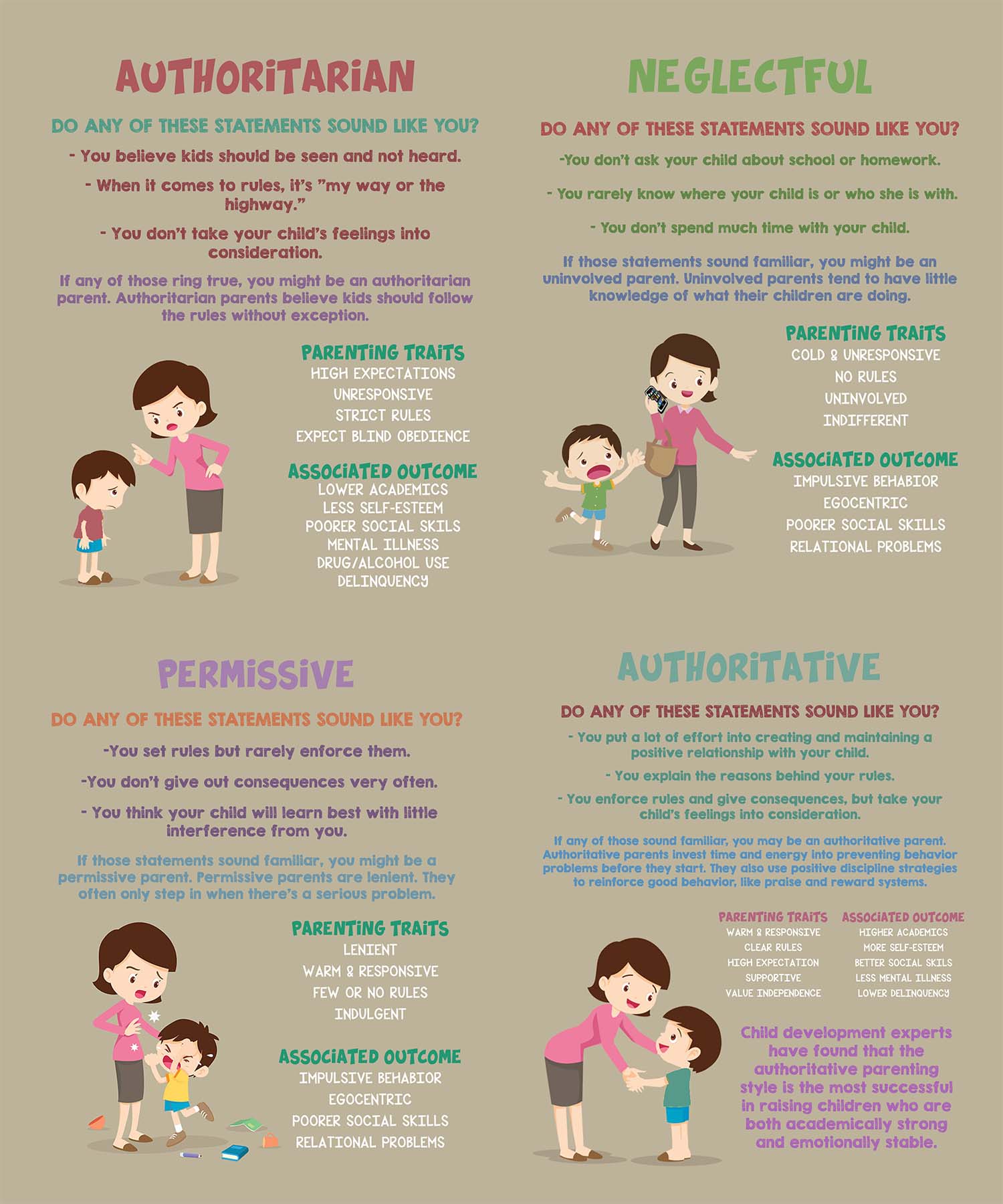
parenting styles: Why Early Parenting Has Long-Term Impact
Children are neurologically and emotionally dependent on caregivers. Their brains are highly plastic, meaning repeated emotional experiences literally shape neural pathways. What is experienced repeatedly becomes familiar, automatic, and internalized.
This is why:
- Consistent emotional safety fosters secure, adaptable personalities
- Chronic emotional neglect or fear can lead to anxiety, avoidance, or emotional numbness
Personality, then, is not simply a trait—it is the emotional memory of early relationships.
1. Authoritative Parenting: Warmth With Healthy Boundaries
Among the four commonly discussed parenting styles, authoritative parenting is generally characterized by a balance between emotional warmth and appropriate structure. The parent provides guidance and boundaries while also respecting the child’s developing autonomy.
Core Characteristics
- High warmth and emotional responsiveness
- Clear, age-appropriate rules and consistent boundaries
- Open two-way communication
- Encouragement of independence and decision-making
- Discipline focused on teaching and reasoning rather than fear
- Willingness to listen while maintaining appropriate limits
A simple example might be: “I understand that you’re angry, but hitting your brother is not okay. Let’s talk about what happened and find another way to express it.”
The parent is neither permissive nor punitive. The emotion is accepted, while the behavior is appropriately limited.
Impact on Personality Development
Children who experience this combination of warmth, structure, and responsiveness are more likely to develop:
- Healthy self-esteem – They learn that they are valued while also understanding that mistakes are part of learning.
- Emotional competence – Their emotions are acknowledged and gradually become easier to identify and regulate.
- Self-discipline – They learn to regulate behavior because they understand expectations, rather than simply because they fear punishment.
- Social confidence – They have opportunities to communicate, negotiate, cooperate, and express their needs.
- Resilience – They can experience disappointment or failure while knowing that difficulty does not mean they have lost their caregiver’s support.
This parenting style can also provide a strong foundation for secure attachment. The child can explore, make mistakes, and gradually become independent while knowing that support is available when needed.
Possible Adult Patterns
Although no parenting style guarantees a particular adult personality, people who experience consistently authoritative parenting may be more likely to develop:
- Balanced confidence
- Healthy interpersonal boundaries
- Greater emotional openness
- Adaptive coping strategies
- Greater comfort with independence and interdependence
- More stable relationship patterns
Research generally associates authoritative parenting with favorable developmental outcomes, particularly when warmth and appropriate behavioral expectations occur together.
2. Authoritarian Parenting: Control Without Enough Emotional Responsiveness
Authoritarian parenting places a strong emphasis on obedience, control, and adherence to rules, often with comparatively less emotional responsiveness.
The message may sound like: “Because I said so.”
The issue is not that the parent has rules. Children need boundaries. The concern is when obedience becomes more important than understanding, communication, or the child’s emotional experience.
Core Characteristics
- High behavioral control with relatively low warmth
- Strict rules and expectations
- Limited explanation or negotiation
- Strong emphasis on obedience and authority
- Punitive or fear-based discipline
- Limited encouragement of emotional expression
Impact on Personality Development
Depending on the child’s temperament and the intensity and consistency of the parenting environment, children may be more likely to develop:
- Lower self-confidence – Particularly when criticism is frequent and approval feels conditional.
- Fear-based compliance – Following rules primarily to avoid punishment.
- Emotional suppression – Learning that certain feelings are unacceptable or should not be expressed.
- Heightened anxiety or anger – Especially when emotional needs are repeatedly dismissed.
- Dependence on external approval – Looking to authority figures to determine whether they are “good enough.”
A child may gradually internalize a message such as: “Making a mistake means I have disappointed someone.”
For some children, this can contribute to perfectionism, excessive compliance, fear of failure, or difficulty making independent decisions. Others may respond in the opposite direction through defiance, secrecy, or rebellion.
Possible Adult Patterns
Later in life, these learned patterns may appear as:
- Difficulty expressing emotions
- Excessive fear of authority or strong submission to authority
- Harsh self-criticism
- Rigid or all-or-nothing thinking
- Heightened sensitivity to criticism
- Difficulty with emotional intimacy or conflict
A child raised in a highly authoritarian environment may therefore look exceptionally disciplined from the outside while experiencing considerable emotional pressure internally.
The important distinction is: Obedience is not the same as emotional maturity. A child can follow every rule and still struggle to understand, express, and regulate their emotions.
3. Permissive Parenting: High Warmth Without Enough Structure
Permissive parenting is often misunderstood as simply being loving or emotionally supportive. The defining feature is not warmth itself, but high warmth combined with relatively low behavioral structure and few consistent limits. A permissive parent may genuinely love their child deeply but struggle to say “no,” enforce consequences, or tolerate the child’s frustration.
For example: “I know you should stop playing now, but okay, just five more minutes.”
Repeatedly avoiding boundaries may provide immediate comfort, but it can make it harder for children to learn that frustration, limits, and delayed gratification are normal parts of life.
Core Characteristics
- High warmth and responsiveness
- Few or inconsistently enforced rules
- Flexible or unclear boundaries
- Avoidance of conflict
- Frequent accommodation of the child’s wishes
- High levels of child choice with limited parental structure
Impact on Personality Development
Children raised in highly permissive environments may experience difficulties with:
- Impulse control – Difficulty waiting, stopping, or delaying gratification.
- Frustration tolerance – Struggling when circumstances do not go their way.
- Self-discipline – Fewer opportunities to practice regulating behavior independently.
- Responsibility – Difficulty accepting limits, consequences, or age-appropriate expectations.
- Boundary awareness – Uncertainty about where their needs end and other people’s boundaries begin.
Importantly, permissive parenting does not mean that every child will become entitled or irresponsible. A child’s temperament and wider environment matter considerably. The central developmental issue is that warmth without adequate structure can leave children with insufficient opportunities to practice self-regulation.
Possible Adult Patterns
These patterns may later appear as:
- Difficulty tolerating frustration
- Impulsivity
- Difficulty managing responsibilities
- Struggles with rules or authority
- Difficulty accepting limits in relationships
- Poorer tolerance of stress or disappointment
The key lesson is:
Children need both emotional acceptance and appropriate boundaries.
- Warmth tells a child, “You are loved.”
- Boundaries teach, “You can handle limits, responsibility, and frustration.”
- Healthy development requires both.
4. Neglectful (Uninvolved) Parenting: When Emotional Connection Is Missing
Neglectful or uninvolved parenting is characterized by low emotional responsiveness and low involvement. Unlike permissive parenting, where the parent is often highly involved but provides insufficient boundaries, the uninvolved parent may provide limited emotional attention, guidance, or engagement altogether.
Sometimes basic physical needs may be met while the child’s emotional world receives little attention.
Core Characteristics
- Low warmth and low involvement
- Emotional unavailability
- Limited supervision or guidance
- Minimal engagement in the child’s emotional and social life
- Basic physical needs may be met while emotional needs remain consistently overlooked
- Caregiver may be preoccupied with personal, relational, occupational, or other difficulties
parenting styles: Impact on Personality Development
Of the four broad parenting styles, persistent uninvolved parenting is generally associated with particularly concerning developmental outcomes, especially when children’s emotional and physical needs are chronically unmet.
Children may experience:
- Low self-worth – Feeling unseen, unimportant, or emotionally disconnected.
- Difficulty with emotional regulation – Limited opportunities to learn how emotions can be understood and managed.
- Attachment difficulties – Uncertainty about whether others can be trusted or relied upon.
- Social difficulties – Fewer opportunities to learn communication, emotional reciprocity, and relationship repair.
- Greater vulnerability to psychological difficulties – Including anxiety, depression, loneliness, or maladaptive coping, particularly when neglect is severe or prolonged.
One of the most painful aspects of emotional neglect is that nothing visibly dramatic may happen. There may be no obvious punishment or constant conflict. Instead, the child repeatedly experiences something quieter: “Nobody notices what I’m feeling.”
Over time, this absence of emotional mirroring can make it difficult for children to identify, communicate, and trust their own emotional needs.
parenting styles: Possible Adult Patterns
Later, these experiences may contribute to:
- A persistent sense of emotional emptiness
- Difficulty trusting or depending on others
- Emotional detachment or avoidance
- Difficulty identifying and communicating emotional needs
- Insecure attachment patterns
- Reliance on maladaptive coping strategies
However, these outcomes are not inevitable. Supportive relationships, positive experiences outside the family, resilience, and later psychological intervention can all alter developmental trajectories.
Emotional neglect can be difficult to recognize precisely because the harm may come not from what happened, but from what consistently failed to happen—comfort, attention, validation, guidance, and emotional connection.
And that is why emotional presence matters so much in childhood.
Parenting Styles and Attachment Patterns
It strongly influence attachment styles, which shape personality across the lifespan:
| Parenting Style | Common Attachment Pattern |
|---|---|
| Authoritative | Secure |
| Authoritarian | Anxious or Fearful |
| Permissive | Anxious |
| Neglectful | Avoidant or Disorganized |
Attachment patterns later affect:
- Romantic relationships
- Conflict resolution
- Emotional intimacy
- Self-regulation
Cultural Context: Parenting in Indian Families
In many Indian households:
- Authoritarian parenting is normalized as “discipline”
- Emotional expression is often discouraged
- Obedience is prioritized over autonomy
While cultural values matter, psychological research shows that emotional responsiveness combined with structure leads to healthier personality development, regardless of culture.
Modern Indian parenting is slowly shifting toward authoritative approaches—balancing respect, boundaries, and emotional attunement.
parenting styles: Can Personality Be Changed in Adulthood?
Yes—personality can change in adulthood. While early parenting experiences leave deep psychological imprints, they do not permanently lock a person into one way of thinking, feeling, or relating. Personality is shaped by experience, and the brain retains the ability to reorganize itself throughout life. This capacity for change is what makes healing possible.
What often feels like a “fixed personality” is actually a set of learned emotional patterns—ways of coping, relating, and protecting oneself that once made sense in childhood.
parenting styles: Why Change Is Possible
Early experiences shape personality because they are repeated and emotionally powerful—not because they are unchangeable. In adulthood:
- The brain still shows neuroplasticity (the ability to form new neural pathways)
- Adults can reflect, choose, and practice new responses
- Emotional experiences can be reprocessed and updated
With the right conditions, old patterns can be replaced with healthier ones.
1. Therapy: Rewriting Emotional Templates
Psychotherapy provides a safe, consistent relationship where old patterns can be understood and transformed.
- Therapy helps identify unconscious beliefs such as “I am unsafe,” “I don’t matter,” or “Closeness leads to pain.”
- Through emotional processing, reflection, and corrective experiences, these beliefs gradually soften.
- Over time, new ways of regulating emotions, setting boundaries, and relating to others develop.
Therapy is not about changing who you are—it is about freeing who you were meant to be.
2. Secure Adult Relationships
Healing does not happen only in therapy. Safe, emotionally responsive adult relationships also reshape personality.
- Being heard, respected, and emotionally supported challenges old attachment wounds
- Consistent care helps the nervous system learn that connection is not dangerous
- Healthy conflict and repair build emotional flexibility
Over time, relationships can become corrective emotional experiences, replacing fear-based patterns with trust.
3. Self-Awareness: Making the Unconscious Conscious
Change begins with awareness.
- Recognizing emotional triggers
- Understanding recurring relationship patterns
- Noticing automatic reactions rooted in the past
When patterns are seen clearly, they lose some of their power. Self-awareness creates a pause between old conditioning and new choice.
This is the moment where growth begins.
4. Emotional Re-Parenting
Emotional re-parenting involves learning to give yourself what was missing earlier:
- Validation instead of criticism
- Comfort instead of dismissal
- Structure instead of chaos
- Compassion instead of shame
Through practices such as self-soothing, emotional labeling, boundary-setting, and inner child work, individuals slowly internalize a supportive inner voice. This process does not erase the past—but it reduces its control over the present.
parenting styles: From Survival to Choice
Many adult personality traits—people-pleasing, emotional withdrawal, perfectionism, anger, or numbness—were once survival strategies. In adulthood, they may no longer be necessary.
With insight and support:
- Reactive patterns become responsive choices
- Fear-driven behaviors become values-driven actions
- Identity shifts from “This is who I am” to “This is what I learned—and I can learn differently.”
parenting styles: Key Takeaways
- Parenting styles profoundly shape emotional and personality development
- Authoritative parenting supports the healthiest outcomes
- Emotional neglect can be as harmful as overt abuse
- Personality reflects learned emotional patterns—not personal failure
- Healing is possible at any stage of life
Final Reflection
Children do not need perfect parents—they need emotionally present adults who offer safety, guidance, and understanding. Small mistakes do not harm a child’s development; emotional absence and inconsistency do. When caregivers are responsive and willing to repair after missteps, children feel secure and valued.
Emotional presence helps children feel seen and accepted. Safety—both emotional and physical—allows them to trust their feelings and regulate stress. Guidance through clear, consistent boundaries teaches responsibility without fear, while understanding nurtures healthy self-worth.
Personality grows where connection meets consistency.
Connection provides emotional security; consistency builds trust. Together, they create a foundation for resilience, confidence, and healthy relationships.
Frequently Asked Questions (FAQ)
1. Do parents need to be perfect for healthy personality development?
No. Children do not need perfect parents. They need caregivers who are emotionally present, responsive, and consistent. Occasional mistakes are normal and do not harm development when followed by repair and reassurance.
2. What does “emotionally present parenting” mean?
Emotionally present parenting means being attentive to a child’s emotional needs—listening, validating feelings, and responding with empathy rather than dismissal, fear, or control.
3. How does consistency influence a child’s personality?
Consistency creates emotional safety. Predictable responses and boundaries help children develop trust, self-regulation, and confidence. Inconsistent caregiving can lead to anxiety, insecurity, or confusion.
4. Can emotional neglect affect personality even without abuse?
Yes. Emotional neglect—when a child’s feelings are repeatedly ignored—can strongly impact self-worth, attachment patterns, and emotional regulation, even if basic physical needs are met.
5. Is authoritative parenting really the healthiest style?
Research consistently shows that authoritative parenting—high warmth with clear boundaries—supports the most balanced outcomes in emotional regulation, self-esteem, and social competence.
6. If parenting was inconsistent or harmful, can personality still change later?
Yes. Through therapy, self-awareness, and secure adult relationships, individuals can unlearn maladaptive patterns and develop healthier personality traits over time.
Reference
-
American Psychological Association – Parenting styles and child development
https://www.apa.org/topics/parenting -
World Health Organization – Early child development
https://www.who.int/teams/maternal-newborn-child-adolescent-health-and-ageing/child-development -
National Institute of Mental Health – Child and adolescent mental health
https://www.nimh.nih.gov/health/topics/child-and-adolescent-mental-health -
John Bowlby – Attachment and Loss
https://www.simplypsychology.org/bowlby.html -
Diana Baumrind – Parenting styles research
https://www.simplypsychology.org/baumrind.html - Moral Development Theory: Piaget vs Kohlberg
- Piaget’s Cognitive Development Theory