
You don’t need more discipline to quit smoking — you need a better routine for the cues your brain keeps sending.
Introduction
National No Smoking Day (UK) is a campaign aimed at raising awareness in thousands of individuals to make a step towards a healthier life by quitting smoking each year. With the physical evils of smoking, lung disease, heart, and cancer being common knowledge, the psychological processes that ensure people smoke are not well known. Smoking is both a chemical dependency on the nicotine and a highly developed behaviour pattern, conditioned by prompts and patterns and reinforced.
Knowledge of these mental patterns is crucial since cessation of smoking is seldom related to will power. It includes rewiring behaviour in the brain, defying automatic responses and substituting bad habits with better ones. Habit Loop Theory is one of the strongest concepts of studying this process and it is widely discussed in the behavioural psychology.
During the National No Smoking Day, it is possible to consider smoking in the prism of psychology, specifically addiction psychology, habit formation, and behavioural change and see how people might figure out why it is so hard to quit and how it is possible to sustain the change.
Smoking as Both Addiction and Habit
Nicotine dependence is among the most powerful chemical dependence. Once nicotine is in the brain it activates the release of dopamine, the neurotransmitter that is linked to pleasure and reward. This release of dopamine induces a brief sense of relaxation / satisfaction that strengthens the behaviour.
Nonetheless, smoking behaviour cannot be solely attributed to addiction. According to many smokers, in some cases, they automatically light a cigarette after meals, when being stressed, when drinking tea or coffee or during interpersonal communication. It is even in these instances that the behaviour is almost automatic.
It is at this point where psychology comes in. The habit of smoking is instilled in everyday life by habitual behaviour. With time, the brain becomes conditioned to relate some situational stimuli with smoking.
For example:
- Stress → Smoke a cigarette
- Tea break → Smoke a cigarette
- Social gathering → Smoke a cigarette
These patterns become automatic because the brain prefers predictable routines that provide quick rewards.
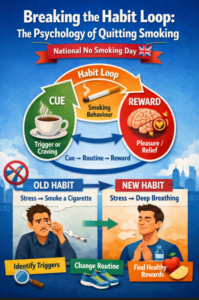
Understanding the Habit Loop
Habit Loop Theory explains how behaviours become automatic through three interconnected components:
- Cue (Trigger)
- Routine (Behaviour)
- Reward (Outcome)
This cycle repeats continuously, reinforcing the behaviour over time.
Cue: The Trigger That Starts the Habit
The cue is the signal that initiates the behaviour. In smoking, cues can be external or internal.
Common cues include:
- Feeling stressed or anxious
- Drinking tea or coffee
- Finishing a meal
- Being around friends who smoke
- Feeling bored or restless
From a psychological perspective, cues activate automatic behavioural responses stored in memory networks. Once the cue appears, the brain anticipates the reward associated with the behaviour.
For instance, a smoker may not consciously decide to smoke when feeling stressed. Instead, the brain automatically retrieves the learned response: stress → cigarette → relief.
Routine: The Behaviour Itself
The action taken due to the cue is referred to as the routine. The pattern in the situation with smoking is the light and smoke a cigarette.
The routine has been ingrained in day to day life over a long period of time. Studies in behavioural psychology have demonstrated that habits are stored in the basal ganglia which is a section of the brain that auto stores behaviours. Once a habit becomes habitual it demands less conscious effort.
That is why smokers tend to tell about smoking unconsciously. The behaviour becomes automatic and not a choice.
Reward: The Reinforcement
The reward is the benefit that reinforces the behaviour and encourages repetition.
In smoking, rewards may include:
- Temporary relaxation
- Stress reduction
- Social bonding
- A break from work
- Nicotine-induced dopamine release
Even if the reward is short-lived, it strengthens the neural association between cue and routine.
From the brain’s perspective, the cycle becomes:
Cue → Routine → Reward → Repeat
The stronger the reward, the stronger the habit loop becomes.
Why Quitting Smoking Is Psychologically Difficult
A number of smokers make several attempts before they win the battle. This is not the challenge of not being disciplined but an inability to break various psychological loops at the same time.
Quitting is difficult because of several psychological reasons:
1. Nicotine Withdrawal
Nicotine causes addiction among people and withdrawal symptoms occur when a person experiences a decrease in the nicotine levels, which lead to irritation, anxiety, restlessness, and inability to concentrate. These symptoms compel the brain to relapse into nicotine.
2. Environmental Triggers
Everyday life is full of stimuli that are related to smoking. In spite of quitting, these cues can trigger cravings.
3. Emotional Regulation
Other people smoke to relieve stress, depression or frustration. Getting rid of cigarettes and not substituting the coping mechanism may create emotional gaps.
4. Identity and Social Factors
Smoking may be incorporated into the group culture or social identity of an individual. The behaviour may be justified by social settings where smoking is widespread.
Rewiring the Habit Loop
One of the most effective psychological strategies for quitting smoking is modifying the habit loop rather than trying to eliminate it entirely.
The key principle is:
Keep the cue and reward but change the routine.
For example:
Cue: Stress
Old Routine: Smoke a cigarette
New Routine: Deep breathing or short walk
Reward: Feeling calmer
Similarly:
Cue: Tea break
Old Routine: Cigarette
New Routine: Chewing gum or talking with a friend
By replacing the routine, the brain gradually learns a new behavioural pathway.
Behavioural Change Strategies
Psychology offers several evidence-based strategies to break smoking habits.
1. Awareness of Triggers
The first step in behavioural change is identifying personal triggers. Keeping a smoking diary can help individuals track:
- When they smoke
- What they feel before smoking
- What situation triggered the urge
This awareness helps break automatic behaviour.
2. Delaying the Habit
Cravings often last only 5–10 minutes. Delaying smoking by a few minutes can weaken the habit loop.
For instance, when the urge arises, individuals can:
- Drink water
- Take a short walk
- Practice deep breathing
Often the craving fades before the cigarette is lit.
3. Replacement Behaviours
Substituting healthier behaviours can reduce cravings. Examples include:
- Chewing sugar-free gum
- Eating healthy snacks
- Practicing mindfulness
- Exercising
These alternatives provide similar psychological rewards without harmful consequences.
4. Social Support
When the environments are favourable, behavioural change is simplified. Individuals can be motivated during such hard times by friends and family, as well as support groups.
Counselling and behavioural therapy can as well assist people to come up with healthier coping mechanisms.
5. Cognitive Restructuring
Cognitive psychology emphasizes the role of thoughts in behaviour. Smokers may hold beliefs such as:
“I need a cigarette to relax.”
“Smoking helps me focus.”
Challenging these beliefs and replacing them with healthier perspectives—such as relaxation techniques or exercise—can support long-term change.
The Role of National No Smoking Day
National No Smoking Day is not a health campaign rather, it is a psychological behavioural change initiator.
Public awareness campaigns generate a moment at which each individual feels encouraged to reevaluate his or her habits. Motivation and accountability can be enhanced through social media discussions, community support and health campaigns.
From a psychological perspective, such campaigns help by:
- Increasing self-awareness about smoking behaviour
- Providing social reinforcement for quitting
- Encouraging goal-setting and commitment
When people see others attempting to quit, the behaviour becomes socially normalized.
Long-Term Habit Transformation
Quitting the habit of smoking is not a one day affair. According to behavioural psychology, change in habits comes about after constant repetition of new habits.
The brain develops new neural circuits with time. The new habit develops at some point and the previous loop is substituted by the new loop of habit.
For example:
Stress → Deep breathing → Relief
Coffee break → Short walk → Relaxation
When these patterns repeat frequently, the brain gradually rewires its reward system.
A Psychological Perspective on Hope
The most significant impact of the National No Smoking Day is that smoking can be quitted. A lot of individuals manage to give up when they learn the psychological processes of their habits.
Psychology does not view smoking as a failure in will-power, but rather a learnt behavioural loop, something that can be changed and substituted.
Whenever a smoker takes a healthier response to a trigger, he or she undermines the previous habit loop and reinforces a new one.
Even minor changes in behaviour, which are repeated regularly, may result in significant changes in health and well-being.
Conclusion
Smoking is not just a physical addiction, but it is a strong psychological habit that is developed through the cycles of cues, routines, and rewards. The Habit Loop Theory is a useful theory when it comes to the reasons why smoking is automatic and the challenges of quitting.
Individuals can also transform their patterns of behaviour over time by trigger identification, routine modification and reinforcement of healthier rewarding behaviour. National No Smoking Day brings to our minds that change is based on awareness and then maintained by regular psychological effort.
Finally, the habit loop breaking is not only about the need to stop smoking but to regain the power over behaviour, health and future.
FAQs: Habit Loop & Quitting Smoking
1. What is the Habit Loop of psychology?
The model of behaviour is the Habit Loop that defines the mechanism of forming habits by using three components: cue (trigger), routine (behaviour), and reward (outcome). This cycle strengthens behaviour and makes it an automatic one with time.
2. What is the association between the habit loop and smoking addiction?
Smoking is a cycle that is repeated quite frequently:
- Giving stimulus: Stress, coffee, social situation.
- Habit: Smoking a cigarette.
- Payoff: Relaxation or pleasure based on nicotine.
Brain turns addicted to the habit of smoking due to repeated exposure to this cycle.
3. Why is it not easy to quit smoking psychologically?
Avoiding smoking is not easy since nicotine addiction is both a chemical and a behavioural habit. Even in the case of the person, who is already not smoking, environmental cues and cravings may activate a relapse.
4. What is the National No Smoking Day?
The national no smoking day is an on-going yearly health awareness campaign in the United Kingdom that takes place on the second Wednesday of March in order to motivate smokers to quit and to enhance their health.
5. Brain What are the ways that the brain upholds smoking?
Introducing nicotine into the brain, it activates the reward systems, releasing dopamine, which make people feel pleasant or relieved. This will reinforce the cue-routine-reward loop and reinforce the habit with time.
6. Can the habit loop be changed?
Yes. According to behavioural psychology, one can change the habit by determining the cue and reward and then replacing the routine with a healthier behaviour which can be exercise, breathing exercises or chewing gum.
7. What are the usual consequences that result in smoking?
Typical triggers to smoking are:
- Stress or anxiety
- Drinking coffee or alcohol
- Social gatherings
- Boredom
- Seeing others smoke
The triggers stimulate the cravings and induce habitual behaviour.
8. How are the smoking cravings normally long?
The majority of cravings take a period of 5-10 minutes. Distraction or relaxation methods can be used to manage this short period to enable people to overcome the urge to smoke.
9. What are some of the psychological tactics that assist individuals to quit smoking?
Strategies that are evidence-based involve:
- Identifying triggers
- Replacing routines
- Cognitive behavioural therapy (CBT)
- Social support
- Mindfulness and stress reduction.
- The techniques assist in undermining the current habit loop.
10. Why do you think it is good to quit smoking?
Quitting smoking can lead to:
- Less possibility of cancer or respiratory illnesses.
- Better mood and mental wellbeing.
- Increased energy
- Money saved on non-cigarette purchase.
Reference Links
-
https://www.healthhub.sg/well-being-and-lifestyle/mental-wellness/shake-up-old-habits-to-stub-out
- The Invisible Lens: How Implicit Bias Shapes Decision-Making in Leadership and the Judiciary
This article is written for knowledge purposes, aiming to help readers understand the topic better and gain useful insights for learning and awareness.
Pingback: Beyond Willpower Behaviour Change Psychology in Healthy Diet