
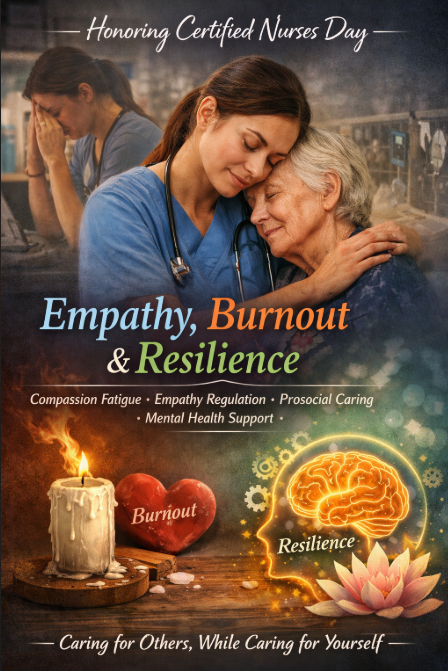
Thought-provoking: “What if the most critical qualification for nursing isn’t a certificate, but the capacity for empathy —to hold another person’s pain without breaking?
Introduction
Certified Nurses Day goes beyond professional success and is more of a validation of the deep psychological acumen, emotional intelligence, and endurance that is necessary in nursing. Certified nurses are a group of medical professionals who have proven their higher level competency, yet more importantly than technical skills they are operating within a high-stress psychological environment on a daily basis.
The reason why nursing is all about care giving is caregiving psychology – the subject that studies the ways in which people show care, respond to hardship, and remain emotionally resilient under the pressure of difficult circumstances. Nurses are always facing pain, trauma, recovery, and in some cases death; hence, their profession is also one of the most emotionally facing.
The article discusses psychological aspects of nursing, including empathy, burnout, compassion fatigue, and prosocial behaviour, and attempts to identify how nurses manage their emotional reactions to maintain personal and patient outcomes.
1. Caregiving Psychology: The Foundation of Nursing (Empathy)
Caregiving psychology is the psychology of caring and supporting other people, particularly those in a vulnerable or diseased state. Rather than serving as merely a job, caregiving in nursing reflects a professional identity grounded in attachment, empathy, and prosocial motivation.
Psychologically speaking, the motivation behind care giving is:
- Empathic concern – the skill of empathising with the patient.
- Altruism– assisting without a reward.
- Moral obligation – an internal sense of obligation.
Nurses tend to work in the context of what is referred by psychologists as a helper identity in which personal values are associated with well-being among others. Although this may be very profound, it may also lead to the susceptibility to emotional fatigue when there are no specific boundaries.
2. Empathy in Nursing: A Double-Edged Sword
Effective patient care is all about empathy. It is characterised by two significant elements:
- Cognitive empathy – the ability to interpret a patient and see his thoughts.
- Affective empathy– experiencing the emotions of a patient.
In nursing, empathy is enhanced:
- Patient satisfaction
- Treatment adherence
- Recovery outcomes
This is in line with the prosocial behaviour as actions that help increase the common good.
Nonetheless, the overuse of affective empathy may result in emotional contagion in which the nurses take up the distress of patients. This can eventually lead to mental tension.
This is the reason the contemporary psychology focuses on empathy regulation the skill of establishing equilibrium between emotional involvement and professional non-involvement.
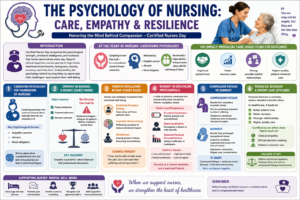
3. Empathy Regulation in High-Stress Caregiving Roles
The use of empathy is an essential skill that nurses should possess in the high-stress unit like ICUs, oncology wards, or emergency departments.
It involves:
- Emotional boundary setting- having a separation between the self and the patient.
- Cognitive restructuring – reworking painful events to minimise the effect of emotions.
- Mindfulness – being here and now without being lost in the process.
As an example, rather than internalising the suffering that a patient is about to go through, a nurse can reframe the situation inside his or her mind as:
“I am not able to take away this pain, but I can lessen their suffering and to comfort them”.
This rotation hedges against empathic distress, which is an emotional sucking instead of a satisfaction-inspiring, type of helping.
4. Burnout in Healthcare Professionals (Empathy)
It is one of the most researched issues in the field of care giving, which is described as a state of exhaustion related to intense work stress that has been ineffective in its management.
Burnout is composed of three aspects according to the studies of psychology:
- Emotional exhaustion- feeling fatigued and tired.
- Depersonalization – acquisition of a cold-hearted or disillusioned attitude towards patients.
- Less personal achievement- having a sense of ineffectiveness or inadequacy.
There is a lot of vulnerability among nurses because of:
- Long working hours
- High patient loads
- Emotional demands
- Lack of systemic support
Burnout is not a personal problem only, it is a manifestation of system problems in the healthcare setting.
5. Compassion Fatigue vs Burnout: Understanding the Difference
Fatigue and burnout are two different psychological concepts although they are commonly interchanged.
- Compassion Fatigue
- Has its origin in secondary traumatic stress.
- The consequences of the continued exposure to the suffering of others.
- The symptoms are emotional numbness, a lack of empathy, and intrusive thoughts.
- Arises as a result of prolonged occupational stress.
- Connected with workload, organisational problems and the deficit of control.
- These include fatigue and loss of concentration.
In simple terms:
- Compassion fatigue = caring too much.
- Burnout = tiredness due to overworking.
The two can coexist and this makes the burden on the psychological front heavier among the nurses.
6. Prosocial Behavior and Patient Care Outcomes (Empathy)
It is the foundation of nursing and can be described as voluntary activities aimed at doing good to others.
The social psychological research indicates that prosocial activity in healthcare results in:
- Improved patient trust
- Faster recovery rates
- Improved interaction between provider and patient.
This is largely associated with the empathy altruism hypothesis, which implies that empathic care is inherently an invigorating factor in helping behaviour.
Certified nurses have a higher chance of demonstrating better levels of:
- Clinical empathy
- Ethical decision-making
- Patient-centered care
Yet, to maintain the prosocial behaviour, there is need of psychological balancing. Unless there is adequate emotional control, aiding may result in empathic burnout.
7. The Role of Emotional Labor in Nursing (Empathy)
Nurses have a great deal of emotional work, which has been proposed by a sociologist, Arlie Hochschild.
Emotional labor involves:
- Emotional control so as to be professional.
- Being caring, calm and compassionate, even when stressed.
There are two types:
- Surface acting- acting out emotions.
- Deep acting – sincerely attempting to experience the need emotions.
The long surface acting is characterised by greater burnouts and deep acting may be more viable but still emotionally challenging.
8. Psychological Resilience in Certified Nurses
Nevertheless, it is possible to find a great number of nurses who show impressive psychological strength, stress adaptation, and recovery.
The major factors of resilience are:
- Self-efficacy– a person believes that he/she can cope with challenges.
- Skill of emotional regulation.
- Social support systems
- Meaning-making-purpose in care giving.
There is also the post-traumatic growth. According to some nurses, their personal development, growing empathy and enhanced emotional capacity have been experienced following challenging clinical experiences.
9. Coping Mechanisms and Mental Health Strategies
Nurses usually use different coping mechanisms in order to cope with psychological pressures of care giving:
- Adaptive Coping
- Relaxation and mindfulness methods.
- Peer support and supervision.
- Reflective practice
- Work-life balance
- Maladaptive Coping
- Emotional suppression
- Avoidance
- Substance use
Adaptive coping should be strongly advocated through the provision of:
- Mental health resources
- Counseling services
- Debriefing on a structured schedule.
10. The Importance of Organizational Support
Individual coping is also necessary, but the systemic change is necessary.
Psychological studies point at the role of:
- Organisational justice –fair treatment, policies.
- Perceived support – being valued by the institution.
- Work autonomy- control over task.
A low rate of burnout and increased job satisfaction among nurses are observed in hospitals that focus on these factors.
11. Reframing Nursing Through a Psychological Lens
When we study nursing in terms of psychology, we can understand that a nurse is not merely a caregiver he or she is:
- Emotional regulators
- Crisis responders
- Psychological sources of support.
Their job is constantly in contact with human suffering, and they should balance between solidarity and self-saving.
Conclusion
Certified Nurses Day is a strong reminder of the unseen psychological labour that nurses have to carry out in their daily lives. There is a complicated combination of empathy, emotional control, resilience, and prosocial motivation that should be found behind any clinical procedure.
As much as empathy is the motivation behind caregiving, it should be tempered with limits to avoid compassion fatigue. As much as performance is driven by dedication, systems should be used to avert burnout.
It is important to appreciate these psychological aspects not only to respect workers of nursing values, but also to safeguard their psychological state.
Since the health of the caregivers is eventually what defines the quality of care the caregivers offer.
And according to the caregiving psychology:
“You can not fill a cup which is empty-but, with a proper support, that cup may be filled with unparalleled medicine”.
FAQ
1. What is Certified Nurses Day?
Certified Nurses Day is held as a reminder of those nurses who have been professionally certified, which shows their high level of knowledge, clinical skills, and dedication to quality patient care.
2. What is the psychology of caregiving in nursing?
Caregiving psychology is a discipline that focuses on the manner in which nurses offer emotional and physical assistance to the patient. It deals with empathy, attachment, altruism, and prosocial motivation, which facilitate the helping behaviour within the healthcare environment.
3. What is the significance of empathy in nursing?
Empathy improves patient satisfaction, trust and outcome of recovery. It enables nurses to empathise with patients by giving them insight into the emotional and physical experiences of patients and enhances patient-centred care.
4. What is compassion fatigue among the nurses?
Compassion fatigue- is the emotional, physical, and psychological burnout that comes as a result of extended contact with suffering patients. It is regarded as a professional risk factor in nursing.
5. What is the difference between compassion fatigue and burnout?
- Compassion fatigue: A result of encountering the trauma of other people (secondary traumatic stress)
- Burnout: Workload and constant stress in the workplace.
They both can be found simultaneous though they differ in their origin.
6. What are the compassion fatigue symptoms?
Common symptoms include:
- Emotional numbness
- Aggravated and careworn.
- Sleep problems and fatigue
- Reduced empathy
- It may also impact on job performance and patient safety.
7. Why are nurses under a high risk of burn out?
Nurses face:
- Long working hours
- High emotional demands
- Patient overload
- Limited resources
- Burnout has the capacity to decrease motivation, energy and quality care.
8. What is empathy regulation in medical care?
Empathy regulation can be defined as the capacity to mediate between the emotional engagement and professionalism. It eliminates empathic distress without compromising on compassionate care.
9. What is the impact of prosocial behaviour on patient outcomes?
Prosocial behaviour (helping actions) is improved:
- Patient trust
- Treatment adherence
- Recovery rates
It is self-driven by empathy and altruism, which is the essence of nursing practise.
10. What can nurses do to make peace with compassion fatigue and burnout?
Strategies to consider are:
- Meditation and stress relieving programmes.
- Peer support (Code Lavender, etc.) programmes.
- Psychological and counselling interventions.
- Healthy work-life balance
Studies demonstrate psychological interventions to be able to decrease burnout and empathy fatigue by significant margins.
Reference
-
Study on compassion fatigue in nurses (PMC):
https://pmc.ncbi.nlm.nih.gov/articles/PMC10729325/ -
Research on compassion fatigue, burnout & coping:
https://pmc.ncbi.nlm.nih.gov/articles/PMC9835325/ -
Empathy & compassion fatigue overview (AJNER):
https://ajner.com/AbstractView.aspx?PID=2025-15-1-8 -
Psychological interventions for empathy fatigue (Frontiers):
https://www.frontiersin.org/articles/10.3389/fpubh.2022.952932 -
Burnout & compassion fatigue in nursing (Curationis):
https://curationis.org.za/index.php/curationis/article/view/1784 -
Compassion fatigue theory (OJIN Nursing World):
https://ojin.nursingworld.org - Altruistic Sacrifice: The Psychology of Moral Courage in Extreme Situations
This article is written for knowledge purposes, aiming to help readers understand the topic better and gain useful insights for learning and awareness.
Pingback: Blogs Language Development
Pingback: Psychodynamic Theory by Freud: Stages, Defense Mechanisms,
Pingback: 10 Effective Ways to Manage Anxiety and Stress Naturally
Pingback: Gentle Parenting: Emotionally Strong and Confident Children
Pingback: Attachment Styles Affect Love, Conflict, and Emotional
Pingback: Understanding Teenage Anger: Causes, Signs How to Manage It
How often do we mistake emotional exhaustion for simply being “busy” or “tired”? Recognizing these patterns early can change the way we approach our mental health. Which sign of burnout or stress do you think people tend to overlook the most?