
What Are Defense Mechanisms?
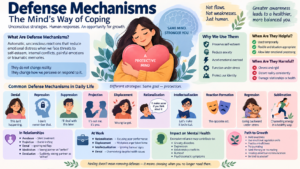
Defense mechanisms are automatic, unconscious psychological reactions that help reduce emotional distress when we encounter situations that feel threatening or overwhelming. For example, they may become activated when we experience:
- Threats to self-esteem
- Internal conflicts, such as wants versus values
- Painful emotions, including fear, anger, jealousy, or guilt
- Traumatic or deeply distressing memories
Although defense mechanisms can provide temporary emotional relief, they do not actually change reality. Instead, they change how we perceive, interpret, or respond to that reality. In this way, the mind attempts to make difficult experiences feel more manageable.
Think of defense mechanisms as mental filters—not lies, but distortions that can feel real in the moment.
Ultimately, understanding these psychological reactions can help us recognize when our mind is protecting us and when that protection may be preventing us from facing something important.
Defense Mechanisms vs Coping Strategies
| Defense Mechanisms | Coping Strategies |
|---|---|
| Unconscious | Conscious |
| Automatic | Intentional |
| Avoid emotional pain | Manage emotional pain |
| Short-term relief | Long-term adaptation |
| Can become unhealthy | Usually healthy |
Example
For example, consider how someone might respond after missing out on an important promotion:
- Defense: “I don’t care about that promotion anyway.”
- Coping: “I feel disappointed. However, I’ll use this experience to identify areas where I can improve my skills.”
The key difference is that the defense mechanism reduces emotional discomfort, whereas the coping response acknowledges the emotion and focuses on managing it constructively.
Why the Mind Uses Defense Mechanisms
Defense mechanisms serve an important psychological purpose. When we encounter emotional threats or stressful situations, they can help us temporarily manage distress and maintain a sense of stability. In particular, they may help us:
- Preserve self-esteem
- Reduce anxiety
- Avoid emotional overload
- Function under stress
- Protect our sense of identity
Especially during childhood, these responses can serve as necessary survival tools when a person has limited emotional resources or control over their environment. However, as we move into adulthood, the situation can change. Although occasional use can be protective, overuse or rigid reliance on defense mechanisms may create problems. Consequently, patterns that once helped us cope can eventually interfere with emotional awareness, relationships, and personal growth.
Defense Mechanisms in Relationships
Defense mechanisms can have a significant influence on how people communicate, interpret each other’s behavior, and respond to emotional conflict. Because relationships often involve vulnerability, rejection, insecurity, and fear of loss, defensive patterns may become especially noticeable during stressful interactions.
For example, common defense mechanisms in relationships may appear as:
- Avoidance: Withdrawing from difficult conversations or using the silent treatment to avoid emotional discomfort.
- Projection: Blaming a partner for feelings or behaviors that the person is struggling to acknowledge in themselves.
- Denial: Dismissing or ignoring clear relationship problems and red flags.
- Idealization: Viewing a partner as “perfect” while overlooking their limitations or problematic behaviors.
- Devaluation: Suddenly shifting to viewing the same partner as “all bad,” particularly after disappointment, conflict, or perceived rejection.
Although these defenses may provide temporary emotional protection, they can become harmful when they repeatedly prevent honest communication and emotional connection. For instance, avoidance may leave problems unresolved, while projection can create unnecessary blame and mistrust. Similarly, idealization and devaluation can make it difficult to maintain a balanced and realistic view of a partner.
Moreover, unconscious defensive patterns may be influenced by earlier relationship and attachment experiences. In some cases, people may repeat familiar ways of seeking safety, handling conflict, or responding to emotional closeness that developed during childhood. Therefore, becoming aware of these patterns can be an important step toward building healthier and more secure relationships.
Defense Mechanisms and Mental Health
Defense mechanisms are not mental disorders themselves. Rather, they are psychological responses that everyone may use to manage difficult emotions, anxiety, or internal conflict. However, when a person relies on certain defense mechanisms excessively or rigidly, they may interfere with emotional well-being, relationships, and everyday functioning.
For example, persistent reliance on unhelpful defensive patterns may be associated with difficulties such as:
- Anxiety disorders
- Depression
- Relationship conflicts
- Burnout
- Psychosomatic symptoms
Importantly, the presence of a defense mechanism does not mean that a person has a mental health disorder. Instead, the concern arises when defensive patterns become persistent, inflexible, or disruptive to a person’s life.
How Therapy Can Help
Therapy can help people recognize and understand defensive patterns rather than automatically reacting through them. Depending on the therapeutic approach and the individual’s needs, this may involve:
- Making defenses conscious: Identifying automatic patterns that were previously difficult to recognize.
- Replacing rigid defenses with flexible coping: Developing healthier and more adaptive ways of responding to stress and emotional discomfort.
- Processing underlying emotions safely: Exploring difficult feelings and experiences in a supportive therapeutic environment.
Ultimately, the goal is not to eliminate every defense mechanism. Instead, therapy can help a person develop greater awareness and flexibility, so that protective responses do not continually interfere with emotional health and personal relationships.
How to Become Aware of Your Defense Mechanisms
Recognizing a defense mechanism is often the first step toward changing an automatic emotional pattern. Instead of judging your reaction, try to become curious about what may be happening underneath it. When you notice yourself becoming defensive, avoiding a situation, or reacting strongly, ask yourself:
- What emotion am I avoiding right now?
- Am I reacting or responding?
- Feels what threatened—my ego, safety, or identity?
- What would happen if I allowed myself to experience this feeling?
By asking these questions consistently, you can begin to identify patterns that may otherwise operate automatically. More importantly, self-awareness allows you to create a pause between an emotional trigger and your response.
Awareness is not judgment—it’s freedom.
Healthy Alternatives to Rigid Defense Mechanisms
Although defense mechanisms can provide temporary protection, healthier coping strategies can help us address difficult emotions more directly and constructively. Depending on the situation, useful alternatives may include:
- Emotional regulation skills — learning to recognize and manage intense emotions
- Mindfulness — observing thoughts and feelings without immediately reacting to them
- Journaling — putting difficult experiences and emotions into words
- Therapy or counseling — exploring persistent emotional patterns with professional support
- Assertive communication — expressing needs and boundaries clearly and respectfully
- Self-compassion — responding to personal mistakes and emotional struggles with understanding rather than harsh self-criticism
Rather than trying to eliminate defensive responses completely, the goal is to develop greater flexibility in how we handle emotional discomfort.
When Defense Mechanisms Are Helpful—and When They Aren’t
Defense mechanisms are not automatically harmful. In fact, they can be useful when they provide temporary emotional protection and give us enough space to process a difficult experience. However, their impact depends largely on how frequently, rigidly, and appropriately they are used.
Helpful when:
- Used temporarily
- Flexible and appropriate to the situation
- Allow later emotional processing
- Help a person remain functional during temporary stress
Harmful when:
- They become chronic and rigid
- Consistently they distort or prevent acknowledgment of reality
- They interfere with emotional processing
- Damage relationships or overall well-being
The key issue, therefore, is not whether you use defense mechanisms, but whether you can eventually move beyond them when they are no longer helpful.
Conclusion: Defense Mechanisms Are Human, Not Weaknesses
Defense mechanisms are not flaws. Instead, they are psychological strategies that can develop to protect us from emotional pain, anxiety, shame, guilt, or inner conflict. Everyone uses defensive responses at times; the real concern arises when we become controlled by them without recognizing what is happening.
When we gently bring awareness to our defensive patterns, we create an opportunity to respond differently. As a result, greater awareness can support:
- Emotional clarity
- Healthier relationships
- Psychological resilience
- Personal growth
Ultimately, emotional growth does not mean never becoming defensive. It means learning to recognize when a defense is protecting you, when it is limiting you, and when you are ready to choose a healthier response.
Healing doesn’t mean removing defenses—it means choosing when you no longer need them.
FAQ Schema
1. What are defense mechanisms in psychology?
Defense mechanisms are unconscious psychological strategies used to protect a person from anxiety, emotional pain, or internal conflict by distorting or avoiding reality.
2. Are defense mechanisms good or bad?
Defense mechanisms are not inherently bad. They can be helpful in the short term, but when used excessively or rigidly, they may interfere with emotional growth and relationships.
3. What are common defense mechanisms used in daily life?
Common defense mechanisms include denial, projection, repression, rationalization, displacement, regression, intellectualization, and sublimation.
4. What is an example of denial as a defense mechanism?
Ignoring signs of stress or refusing to accept relationship problems despite clear evidence is a common example of denial in daily life.
5. How is projection used in everyday behavior?
Projection occurs when someone attributes their own unwanted feelings to others—for example, accusing someone else of anger when they themselves feel angry.
6. What is the difference between coping mechanisms and defense mechanisms?
Defense mechanisms are unconscious and automatic, while coping mechanisms are conscious and intentional strategies used to manage stress and emotions.
7. Can defense mechanisms affect relationships?
Yes. Defense mechanisms like projection, denial, and displacement can create misunderstandings, conflicts, and emotional distance in relationships.
8. Are defense mechanisms linked to mental health issues?
Excessive reliance on rigid defense mechanisms may contribute to anxiety, depression, burnout, and relationship difficulties, though they are not mental disorders themselves.
9. How can I become aware of my defense mechanisms?
Self-reflection, mindfulness, journaling, and therapy can help identify unconscious defense patterns and promote healthier emotional responses.
10. What is the healthiest defense mechanism?
Sublimation is considered the healthiest defense mechanism because it channels difficult emotions into positive and socially acceptable activities.
Reference
-
Defense mechanisms explained (Simply Psychology) — Overview of defense mechanisms from psychoanalytic theory.
👉 Defense Mechanisms in Psychology Explained (+ Examples) — Simply Psychology -
Clinical description of defense mechanisms (NCBI / StatPearls) — Definitions and clinical relevance of defense mechanisms.
👉 Defense Mechanisms — StatPearls / NCBI Bookshelf -
Broad list and examples of defense mechanisms (PositivePsychology.com) — Types and descriptions with examples.
👉 13 Types of Defense Mechanisms in Psychology (+ Examples) -
Defense mechanisms overview (Psychology Today) — Unconscious strategies to protect against distress.
👉 Defense Mechanisms — Psychology Today -
Encyclopedic summary (Britannica) — Definition and psychoanalytic background of defense mechanisms.
👉 Defense Mechanism — Encyclopedia Britannica -
Structure of Personality: Id, Ego & Superego Explained Simply
Pingback: Why Your Mind Creates Problems Even When Everything Is Fine