
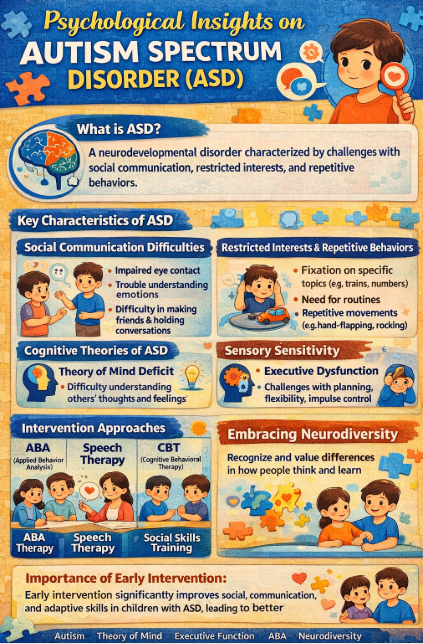
Autism Spectrum Disorder (ASD) is a lifelong neurodevelopmental condition that affects communication, behavior, and sensory processing. With the right support, individuals with autism can develop essential life skills, improve independence, and lead fulfilling lives.
Introduction
Autism Spectrum Disorder (ASD) is a lifelong neurodevelopmental condition that affects social communication, behavior, and sensory processing. While there is no “cure” for autism, a wide range of evidence-based interventions can significantly improve functioning, independence, and quality of life. The goal of treatment is not to eliminate autistic traits but to enhance adaptive functioning, communication, emotional regulation, and social participation.
Among the various therapeutic approaches, Applied Behavior Analysis (ABA) has emerged as one of the most widely researched and empirically supported interventions. Modern ASD treatment relies on a multidisciplinary framework that integrates behavioral, cognitive, developmental, and sensory-based therapies. Each individual with autism presents unique strengths and challenges, making individualized treatment planning essential.
Principles of Autism Intervention
Before exploring specific therapies, it is important to understand the foundational principles guiding autism treatment. Practitioners design effective interventions to be early, intensive, structured, and individualized. Early intervention, particularly during the critical period of neuroplasticity in early childhood, can lead to significant improvements in language, cognition, and social skills.
Another key principle is functional behavior assessment (FBA), which focuses on understanding the antecedents, behaviors, and consequences (ABC model). This enables clinicians to determine whether attention, escape, sensory stimulation, or tangible rewards reinforce a behavior. For example, a child who throws objects during a task may be attempting to escape a difficult demand, rather than simply being “non-compliant.”
Applied Behavior Analysis (ABA): Core Concepts and Techniques for ASD
Applied Behavior Analysis (ABA) is a scientific approach based on principles of learning theory and behaviorism. It focuses on modifying observable behavior through reinforcement, shaping, and systematic instruction. ABA assumes that environmental contingencies influence behavior and uses structured interventions to promote behavioral change.
Operant conditioning forms the foundation of ABA. This learning principle explains how consequences influence behavior by increasing or decreasing its likelihood of occurring. Positive reinforcement serves as a central ABA technique, as therapists provide rewarding stimuli after desirable behaviors to encourage their repetition. For example, when a child makes eye contact, therapists may offer praise or a preferred toy, which increases the likelihood that the child will repeat the behavior in the future.
ABA interventions often utilize discrete trial training (DTT), which involves breaking down complex skills into smaller, teachable units. Each trial consists of a clear instruction, a response from the child, and a consequence. For instance, teaching a child to identify colors may involve repeated structured trials with immediate feedback.
Another important technique is natural environment teaching (NET), which promotes learning in real-life contexts rather than controlled settings. This enhances generalization of skills. For example, instead of teaching “requesting” in a therapy room, the therapist may encourage the child to request a toy during playtime.
Prompting and fading are also widely used in ABA. Prompts provide assistance to help the child perform a desired behavior, while fading gradually reduces this assistance to promote independence. For example, a therapist may initially guide a child’s hand to point at an object and then slowly reduce physical assistance over time.
Behavior Reduction and Functional Communication Training for ASD
ABA focuses not only on developing new skills but also on reducing maladaptive behaviors. Therapists use techniques such as extinction, which involves withholding reinforcement for problematic behaviors, and differential reinforcement, which encourages appropriate alternative behaviors by providing reinforcement for them.
A particularly effective strategy is Functional Communication Training (FCT), which replaces problematic behaviors with appropriate communication. For example, therapists can teach a child who screams to obtain a toy to use words or gestures such as “give me” instead. As therapists consistently reinforce this functional communication behavior, the child gradually relies less on the maladaptive behavior.
Criticism and Evolution of ABA
While ABA has strong empirical support, it has also faced criticism, particularly regarding its traditional focus on compliance and normalization. Critics argue that overly rigid implementation may overlook the emotional needs and autonomy of individuals with ASD. In response, modern ABA has evolved to incorporate person-centered approaches, emphasizing consent, dignity, and the individual’s preferences.
Contemporary ABA also integrates developmental and play-based elements, making it more flexible and naturalistic. The focus has shifted from simply reducing “undesirable” behaviors to enhancing quality of life and functional independence.
Cognitive Behavioral Therapy (CBT) in Autism
Cognitive Behavioral Therapy (CBT) is particularly effective for individuals with ASD who have average or above-average cognitive abilities. It is commonly used to address comorbid conditions such as anxiety, depression, and emotional dysregulation.
CBT focuses on the relationship between thoughts, emotions, and behaviors. Individuals with ASD often experience cognitive distortions, such as catastrophic thinking or rigid belief systems. For example, a child might think, “If I make a mistake, everyone will laugh at me,” leading to avoidance behaviors.
Through CBT, individuals learn to identify these maladaptive thoughts and replace them with more balanced alternatives. Techniques such as cognitive restructuring, exposure therapy, and relaxation training are commonly used. For instance, gradual exposure to feared situations can help reduce anxiety and build coping skills.
Speech and Language Therapy
Communication deficits are a core feature of ASD, making speech and language therapy a critical component of intervention. This therapy targets both expressive language (ability to communicate) and receptive language (ability to understand).
One important focus is improving pragmatic language skills, which involve the social use of language. This includes turn-taking, maintaining conversations, and understanding nonliteral language such as sarcasm or metaphors. For example, a therapist may use role-playing exercises to teach appropriate greetings or conversational responses.
For nonverbal individuals, augmentative and alternative communication (AAC) systems, such as picture exchange systems or communication devices, are used to facilitate communication.
Occupational Therapy and Sensory Integration
Occupational therapy (OT) plays a vital role in addressing sensory processing difficulties and enhancing daily living skills. Many individuals with ASD experience sensory modulation issues, which can interfere with functioning.
Sensory integration therapy aims to help individuals process and respond to sensory stimuli more effectively. For example, a child who is hypersensitive to sound may gradually be exposed to different auditory stimuli in a controlled manner to build tolerance.
OT also focuses on fine motor skills, self-care activities, and adaptive functioning. For instance, teaching a child how to dress independently or use utensils can significantly improve autonomy.
Social Skills Training for ASD
Social skills training is essential for improving interpersonal functioning. This involves teaching specific social behaviors such as initiating conversations, understanding social cues, and maintaining friendships.
Techniques often include modeling, role-playing, and social stories. Social stories are short narratives that describe social situations and appropriate responses. For example, a social story might explain how to behave during a birthday party, helping the child anticipate and navigate the situation.
Parent-Mediated Interventions for ASD
Parents play a crucial role in the therapeutic process. Parent-mediated interventions involve training caregivers to implement therapeutic strategies in everyday settings. This ensures consistency and generalization of skills.
For example, parents may be taught to use reinforcement techniques, visual schedules, and structured routines. A parent might reinforce a child’s attempt to communicate by immediately responding and providing the desired object, thereby strengthening communication behavior.
Educational and School-Based Interventions for ASD
Educational settings provide opportunities for structured learning and social interaction. Individualized Education Plans (IEPs) are developed to address the specific needs of children with ASD.
Strategies include task analysis, visual supports, and differentiated instruction. For instance, breaking down a complex task into smaller steps can make learning more manageable. Inclusive classrooms, when properly supported, can promote peer interaction and social development.
Emerging and Complementary Therapies for ASD
In addition to established therapies, several emerging approaches are being explored. These include play therapy, music therapy, and art therapy, which focus on emotional expression and engagement. While these may not replace core interventions like ABA, they can complement them by enhancing motivation and emotional well-being.
Mindfulness-based interventions are also gaining attention, particularly for improving emotional regulation and reducing anxiety. Techniques such as breathing exercises and body awareness can help individuals manage stress more effectively.
Individualized and Multidisciplinary Approach for ASD
No single therapy is sufficient for all individuals with ASD. Effective treatment requires a multidisciplinary approach, involving psychologists, speech therapists, occupational therapists, educators, and families.
Intervention plans should be tailored to the individual’s developmental level, strengths, and needs. For example, a nonverbal child may benefit more from AAC and ABA-based communication training, while a high-functioning adolescent may require CBT for anxiety and social skills training.
Case Illustration of ASD
Consider a seven-year-old child who exhibits limited verbal communication, frequent tantrums, and sensory sensitivities. Through functional behavior assessment, it is identified that tantrums occur when the child is unable to express needs.
An intervention plan may include ABA-based Functional Communication Training to teach requesting skills, speech therapy to enhance language development, and occupational therapy to address sensory sensitivities. Over time, the child learns to use simple words or picture cards to communicate, leading to a reduction in tantrums and improved adaptive functioning.
Conclusion
The treatment of Autism Spectrum Disorder is multifaceted, requiring a comprehensive and individualized approach. Applied Behavior Analysis remains a cornerstone of intervention, offering structured and evidence-based strategies for behavior modification and skill development. However, integrating other therapies such as CBT, speech therapy, occupational therapy, and social skills training provides a more holistic framework.
Ultimately, the goal of intervention is not to “normalize” individuals with ASD but to empower them with the skills needed to navigate their environment, express themselves, and lead fulfilling lives. By adopting a person-centered and neurodiversity-affirming approach, clinicians, educators, and families can create supportive environments that foster growth, independence, and well-being.
Frequently Asked Questions (FAQs)
1. What is the best therapy for ASD?
ABA is considered the most evidence-based, but a combination of therapies works best.
2. Can ASD be cured?
No. Autism is lifelong, but therapies help improve functioning and independence.
3. At what age should therapy start for ASD?
As early as possible—ideally before age 3–5.
4. How many hours of therapy are needed for ASD?
Typically 20–40 hours per week for intensive ABA, depending on the child.
5. Is ABA harmful?
Modern ABA is child-centered, respectful, and focuses on well-being.
6. Can children with ASD go to normal school?
Yes, with proper support like IEPs and inclusive education.
7. What are early signs of ASD?
- No eye contact
- Delayed speech
- Repetitive behaviors
- Lack of social interest
8. Does speech therapy really help?
Yes, especially for improving communication and social interaction.
9. Can parents do therapy at home?
Yes, parent training is highly effective and recommended.
10. When should I seek professional help for ASD?
If you notice developmental delays or behavioral concerns, consult a professional early.
References
American Psychological Association. (n.d.). Parenting and child development.
United Nations Children’s Fund (UNICEF). (n.d.). Parenting and child development resources. https://www.unicef.org/parenting
Centers for Disease Control and Prevention. (n.d.). Child development and mental health. https://www.cdc.gov/child-development
National Institute of Mental Health. (n.d.). Autism spectrum disorder. https://www.nimh.nih.gov/health/topics/autism-spectrum-disorder
Autism in Children: Early Signs, Causes & What Parents Should Do