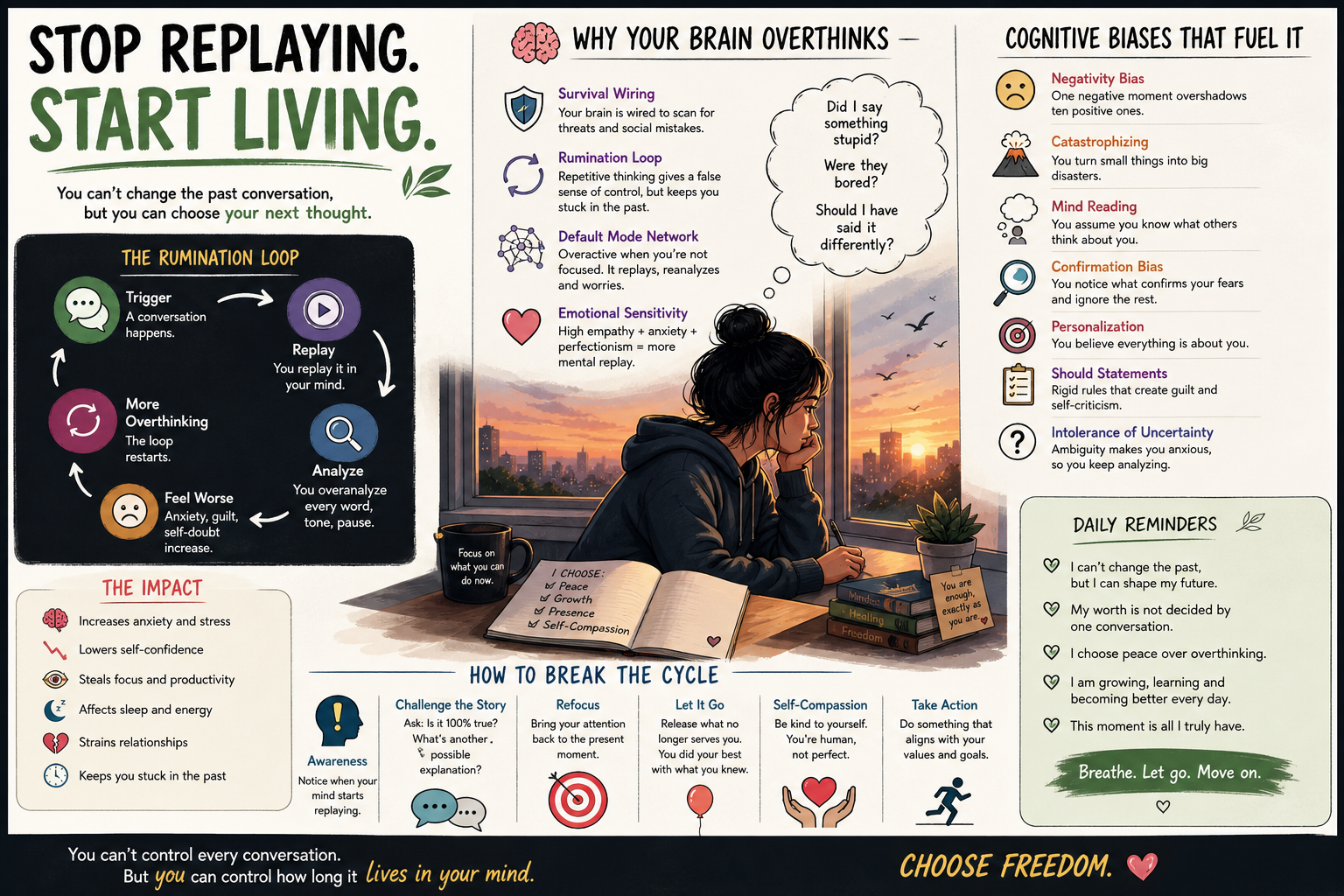
Have you ever replayed a casual chat in your mind hours—or even days—later, dissecting every word, tone, and pause? “Did I say something stupid? Were they bored? Should I have responded differently?” This mental loop, known as post‑event rumination, traps millions in a cycle of overthinking that steals peace, productivity, and the ability to stay present. As a mental health professional, I’ve seen this pattern in clients preparing for high‑stakes exams like UPSC CSE, navigating counseling sessions, or simply trying to enjoy everyday conversations. It’s not just annoying; it’s rooted in deep psychological mechanisms that blend evolutionary wiring, social anxiety, and the brain’s default habits of self‑scrutiny.
In this article, we’ll explore why your brain fixates on past conversations, backed by psychological theories, cognitive‑behavioral insights, and neuroscience. We’ll cover the triggers that spark this overthinking spiral, the emotional and physical toll it takes, and practical, evidence‑based strategies from CBT, mindfulness, and ACT to help you break free. Whether you’re replaying classroom discussions, office chats, or family talks, you’ll learn how to build psychological flexibility, quieter rumination, and greater emotional self‑regulation—one conversation at a time.
The Psychological Roots: Why Your Brain Won’t Let Go
At its core, overthinking conversations stems from the brain’s survival wiring. Evolutionarily, humans are wired for social monitoring—constantly scanning interactions for threats to status, belonging, or safety. In ancestral times, a misstep in tribal talk could mean exile or starvation; psychologist Robin Dunbar’s social brain hypothesis (1998) posits our neocortex expanded precisely for navigating complex group dynamics, making us hypersensitive to slights even now.
Today, this manifests as rumination, a repetitive focus on negative aspects of distress (Nolen-Hoeksema, 2000). Psychologists define rumination as “a class of repetitive, passive thinking focused on the causes, symptoms, and consequences of one’s mood” (Watkins, 2008). When applied to conversations, it becomes post-conversational rumination, where you mentally autopsy interactions long after they’ve ended—replaying a UPSC study buddy’s yawn as “proof” of your inadequacy.
Designations of Psychological Roots: Classifying the Mechanisms
To dissect this, psychologists designate rumination’s roots across cognitive, emotional, and neurobiological domains. Here’s a structured breakdown:
1. Cognitive Designations: Biases and Metacognition
- Core Bias Cluster: Negativity bias (Baumeister et al., 2001) prioritizes threats; hindsight bias rewrites history (“I knew it would go wrong”); and mind-reading assumes others’ thoughts (“They must think I’m boring”).
- Metacognitive Model (Wells & Matthews, 1996): Overthinking is a Cognitive Attentional Syndrome (CAS)—uncontrollable worry and threat monitoring. In counseling sessions, clients label it “second-guessing syndrome,” where metacognition (thinking about thinking) amplifies doubt.
2. Emotional and Affective Designations
- Response Styles Theory (Nolen-Hoeksema): Brooding (moody focus on problems) vs. reflection (constructive pondering)—post-chat brooding dominates overthinkers.
- Affect Regulation Gone Awry: Rumination serves as maladaptive emotion regulation, delaying distress but prolonging it (Gross, 2015). Anxious individuals use it for mental rehearsal, fearing unpreparedness in future talks.
- Attachment Designation: Anxious-preoccupied style (Bartholomew & Horowitz, 1991) roots in hyperactivation of the attachment system.
3. Neurobiological and Temperamental Designations
- Default Mode Network (DMN) Overdrive: Designated as the “mind-wandering network,” its hyperactivity links self-referential rumination (Christoff et al., 2016).
- Temperamental Roots: Behavioral Inhibition System (BIS) sensitivity (Gray, 1982)—high BIS scorers (e.g., on Carver’s scale) ruminate due to conflict avoidance.
- Neurotransmitter Imbalance: Low serotonin/ high glutamate in the anterior cingulate cortex sustains loops.
These designations aren’t silos; they intersect. A UPSC aspirant with high neuroticism (Big Five) might brood via negativity bias, DMN-fueled, seeking attachment reassurance.
Cognitive Biases Fueling the Fire
Your mind isn’t replaying events neutrally; it’s distorted by cognitive biases—systematic errors in thinking that skew perception toward negativity and self-doubt.
Definition of Cognitive Biases: Core Concepts and Types
Psychologist Daniel Kahneman (2011, Thinking, Fast and Slow) designates cognitive biases as “deviations from rational judgment” rooted in System 1 (fast, intuitive) thinking overriding System 2 (slow, analytical). In rumination, they manifest as:
- Definition: Predictable patterns where emotions, heuristics, or memory flaws warp interpretation of social cues.
- Key Types in Post-Chat Overthinking:
A 2022 meta-analysis (Ehring & Watkins) found these biases predict 65% of rumination variance.
Negativity bias (Baumeister et al., 2001) makes negative details—like a perceived awkward silence—stick more than positives. Ever notice how one “off” comment overshadows ten compliments? That’s it—your amygdala tags threats for survival. Add catastrophizing, a cognitive distortion from Aaron Beck’s CBT model, where you escalate minor slips into disasters: “They think I’m incompetent now; my career is ruined.” Picture a UPSC interview: One fumbled psychodynamic theory answer spirals to “I’ll never clear mains.”
Confirmation bias worsens this. You selectively recall evidence supporting your fears (e.g., “They looked away—that proves they disliked me”) while ignoring counter-evidence (e.g., they smiled, nodded eagerly). In high-anxiety individuals, this ties to intolerance of uncertainty, a hallmark of generalized anxiety disorder (GAD). Research from the Anxiety and Depression Association of America (2023) shows 70% of overthinkers score high here, compulsively seeking certainty in ambiguous social cues—like a counseling client’s micro-expression.
Personalization attributes others’ moods to you (“My colleague’s stress? My fault for that joke”), while should statements impose perfectionism (“I should always connect deeply”).
Neuroscientific Underpinnings
Definition of Neuroscientific Underpinnings: These refer to the brain’s biological architecture and processes—neural networks, regions, chemicals, and pathways—that underpin cognitive phenomena like rumination. Designated via tools like fMRI, EEG, and PET scans, they reveal how overthinking conversations arises from dysregulated activity rather than “weak willpower.”
Key elements include:
- Neural Networks: Interconnected brain areas firing in patterns.
- Regions: Specialized zones (e.g., emotion vs. executive control).
- Neurotransmitters/Hormones: Chemical messengers modulating mood and focus.
- Plasticity Factors: How habits rewire circuits via neuroplasticity.
Scan the brain of an overthinker, and you’ll see the default mode network (DMN) hyperactive. This network, active during mind-wandering, links the medial prefrontal cortex (mPFC) (self-referential thinking, “What do they think of me?”) to the posterior cingulate cortex (PCC) (memory recall, pulling up that “cringy” line). fMRI studies (Andrews-Hanna et al., 2014; updated Hamilton et al., 2025) reveal DMN overdrive in ruminators, trapping them in self-focused loops—much like a UPSC aspirant replaying an optional paper debate.
Meanwhile, the amygdala—your fear center—flares up, flooding you with cortisol via the HPA axis. Acute spikes aid fight-or-flight; chronic elevation disrupts the prefrontal cortex (PFC)—dorsolateral PFC for logic, ventromedial for emotion regulation—impairing rational decision-making. A 2026 EEG study (Nature Neuroscience) showed PFC hypoactivity during post-chat replays, explaining why logic fails: Biology hijacks it.
Salience Network:
Interference adds fuel, highlighting “threats” like tone shifts. Neurotransmitter-wise, low serotonin (mood stabilizer) and high glutamate (excitatory) in the anterior cingulate cortex (ACC) sustain obsessive loops, per PET scans (Hamilton, 2022).
Personality plays a role too. Neuroticism, a Big Five trait, predicts rumination (Suls & Bunde, 2005); high neurotics show amygdala hypersensitivity, anticipating rejection and scanning for slights. Introverts, per Eysenck’s arousal theory (1967), over-process stimuli due to higher cortical arousal in the reticular activating system, prolonging mental replays—evident in introverted counselors dissecting client silences.
Neuroplasticity offers hope: Repeated mindfulness thickens PFC, quiets DMN (Hölzel et al., 2011). For high-stakes pros, this means targeted interventions beat biology.
Common Triggers: What Sets Off the Overthinking Spiral
Not every chat sparks rumination; specific triggers ignite it. Understanding these helps you anticipate and intervene.
Social Anxiety and Fear of Evaluation
Social anxiety disorder (SAD) affects 7% globally (APA, DSM-5), but subclinical traits are widespread. Overthinkers fear negative evaluation, per Clark and Wells’ model (1995). Post-conversation, they engage in safety behaviors mentally, like replaying to “fix” perceived flaws. A UPSC aspirant I counseled obsessed over a mock interview, convinced one hesitant answer doomed her optional paper.
Perfectionism and Self-Criticism
Maladaptive perfectionism (Flett & Hewitt, 2002) demands flawless interactions. You set unrealistic should statements (“I should always be witty”), leading to self-focused attention. When reality falls short, suppressed anger turns inward as guilt. Studies link this to inner critic activation, rooted in harsh upbringing or learned helplessness (Seligman, 1975).
Attachment Styles and Relational Fears
John Bowlby’s attachment theory explains much. Anxious attachment individuals—craving reassurance—overanalyze for abandonment signals. They exhibit hypervigilance, interpreting neutral tones as rejection. In contrast, avoidant attachment overthinks to maintain emotional distance. A 2020 meta-analysis (Li & Chanen) found anxious attachers ruminate 2.5x more post-interaction.
Stress and Emotional Load
High allostatic load—cumulative stress—primes rumination. During exams or deadlines, your HPA axis (hypothalamic-pituitary-adrenal) overproduces cortisol, narrowing focus to threats. Sleep deprivation exacerbates this; REM cycles consolidate memories, so poor sleep amplifies negative replays (Walker, 2009).
External factors like cultural norms matter too. In collectivist societies like India, interpersonal harmony (e.g., saving face in family talks) heightens stakes, per Markus and Kitayama’s self-construal theory (1991).
The Vicious Cycle: Consequences of Chronic Overthinking
Overthinking isn’t harmless—it’s a feedback loop with real costs.
Emotional Toll
Rumination sustains dysphoric mood, per response styles theory (Nolen-Hoeksema, 1991). It prolongs sadness, anxiety, and shame, increasing depressive rumination risk by 3-fold (Aldao et al., 2010). You feel exhausted, isolated, as mental energy drains into hypotheticals.
Cognitive and Behavioral Impacts
It impairs working memory and executive function (Joormann, 2010). Can’t focus on studying? Blame rumination hijacking the PFC. Behaviorally, it leads to avoidance: skipping social events to dodge future overthinking, fostering loneliness.
Physical Health Ramifications
Cortisol spikes contribute to psychosomatic symptoms—headaches, insomnia, gut issues. Long-term, it’s linked to cardiovascular disease and immunosuppression (Segerstrom et al., 2003). For professionals like counselors, it risks burnout, eroding empathy.
In relationships, it breeds misattribution: You project insecurities onto others, sparking conflicts. A client fixated on a partner’s “cold” text, nearly ending the relationship—until CBT revealed it as projection.
Breaking the Cycle: Evidence-Based Strategies
Good news: Rumination is malleable. Here’s a toolkit from CBT, mindfulness, and beyond.
Cognitive-Behavioral Techniques
- Thought Records: Log the conversation, evidence for/against fears, and balanced alternatives. Example: “They paused—evidence for boredom? No, they were thinking.”
- Decatastrophizing: Ask, “What’s the worst/best/most likely outcome?” This shrinks fortune-telling bias.
- Scheduled Worry Time: Pen a 15-minute daily slot for rumination (Borkovec et al., 1983). Outside it, postpone: “Not now.”
Mindfulness and Acceptance
Mindfulness-Based Cognitive Therapy (MBCT) reduces DMN activity (Brewer et al., 2011). Practice:
- Body Scan: Notice tension without judgment.
- R.A.I.N.: Recognize, Allow, Investigate, Nurture (Tara Brach). For a replay: Recognize the loop, allow discomfort, investigate triggers, nurture with self-compassion.
Acceptance and Commitment Therapy (ACT) urges defusion: Label thoughts as “I’m having the thought that…” distancing you from content.
Behavioral Experiments
Test fears empirically. Post-chat, rate anxiety (0-10), then engage normally. Track outcomes—most fears prove unfounded, eroding safety signal mislearning.
Lifestyle Interventions
- Aerobic Exercise: 30 minutes boosts BDNF, rewiring neuroplasticity against rumination (Bridle et al., 2012).
- Sleep Hygiene: 7-9 hours; avoid screens pre-bed.
- Social Exposure: Gradual, per hierarchical exposure therapy.
For neurotics, metacognitive therapy targets worry beliefs: “Worrying won’t change the past.”
Case Studies: Applications
Consider Priya, a Kolkata-based UPSC aspirant (anxious attachment, high neuroticism). She overthought group discussions, replaying “dumb” answers nightly. Intervention: Weekly thought records + mindfulness. After 8 weeks, rumination dropped 60% (self-report); mocks improved.
Raj, a counselor, catastrophized client silences as “I’m failing them.” ACT defusion (“I’m noticing a failure story”) plus perfectionism restructuring restored confidence.
These align with meta-analyses: CBT halves rumination in 12 sessions (Watkins, 2015).
Long-Term Prevention: Building Resilience
Long-term prevention begins with changing the way conversations are interpreted. Instead of treating every awkward pause, delayed reply, or flat tone as a verdict on your worth, it helps to view interactions as data—partial, imperfect, and open to multiple explanations—rather than as proof that something is wrong with you. This shift weakens automatic self-judgment and builds a more balanced cognitive appraisal style over time.
A practical part of this resilience-building is developing habits that interrupt rumination before it becomes identity. A nightly gratitude practice can help rebalance attention by training the brain to notice what went right, not only what felt uncomfortable, while brief reflective journaling can separate facts from interpretations. Over time, these practices support psychological flexibility by making it easier to tolerate uncertainty without compulsively reviewing every social detail.
Therapy and tools
Therapeutic work can deepen this process when overthinking is tied to older emotional wounds. Schema therapy is especially useful when post-conversation distress is driven by entrenched core beliefs such as “I am unlikable,” “I will be rejected,” or “I always say the wrong thing,” because these beliefs often shape how neutral interactions are interpreted. ACT-based work complements this by teaching defusion, acceptance, present-moment awareness, and values-guided action so that thoughts lose some of their authority.
Digital tools can also support consistency between therapy sessions or self-help efforts. Meditation apps such as Headspace are commonly used for guided mindfulness practice, while mood-tracking apps like Daylio can help people notice patterns between stress, social interactions, sleep, and rumination; the value of these tools is less about the app itself and more about building regular self-observation and emotional regulation habits. Used thoughtfully, they can function as scaffolding for resilience rather than quick fixes.
Indian practices
Indian contemplative practices can fit naturally into a long-term resilience plan. Research connected to Yoga Nidra has found reduced default mode network connectivity among experienced practitioners, which is relevant because the DMN is strongly associated with mind-wandering and self-referential mental loops; in simple terms, Yoga Nidra may help quiet the kind of internal chatter that fuels post-conversation overthinking.
Similarly, pranayama, especially forms such as Bhramari, has been studied for its role in stress regulation and its relationship with the hypothalamic-pituitary-adrenal (HPA) axis, the body’s central stress-response system. Findings from pranayama studies suggest improvements in stress adaptation and cortisol-related responses, which may make it easier for a person to recover from emotionally activating interactions instead of carrying them for hours afterward.
Long-term prevention
This is less about stopping every anxious thought and more about building the inner capacity to respond differently when those thoughts arise. One of the most important skills here is psychological flexibility, a central concept in Acceptance and Commitment Therapy (ACT), which refers to the ability to stay present, make room for discomfort, and still act in ways that align with one’s values rather than one’s fears.
When applied to post-conversation overthinking, this means learning to see an interaction not as a final judgment on your worth, but as one moment among many—complex, imperfect, and open to interpretation. Practices such as gratitude journaling, reflective writing, and mindful self-observation can gradually retrain attention away from threat and toward balance, making the mind less likely to fixate on isolated social missteps.
For deeper patterns rooted in rejection, shame, or defectiveness schemas, therapies such as schema therapy and ACT can help loosen long-standing beliefs and reduce the emotional charge attached to ordinary conversations. Supportive tools like mindfulness apps and mood trackers can reinforce these habits in daily life, while culturally grounded practices such as Yoga Nidra and pranayama may further strengthen resilience by calming self-referential brain activity and regulating the body’s stress-response systems.
When to Seek Professional Help
If rumination disrupts daily life (e.g., 2 hours/day, suicidal ideation), consult a therapist. Signs of clinical rumination: Ties to OCD (pure-O), PTSD (intrusions), or depression.
In India, resources like Vandrevala Foundation or NIMHANS offer support. Early intervention prevents escalation.
Conclusion: Reclaim Your Mental Space
Overthinking conversations after they’re over may feel like a personal flaw, but it is really your brain’s old survival system trying to protect you from social threat in a world that’s far more complex than the one it evolved for. The loop of post‑event rumination—mentally replaying words, tones, and pauses—feeds on cognitive biases, emotional distress, and neural habits such as DMN overactivity, yet it is not a life sentence. By understanding the psychological roots, noticing triggers, and practicing strategies like thought records, defusion, mindfulness, and behavioral experiments, you can gradually retrain your mind from “What did they think of me?” to “I showed up and that is enough.”
Long‑term resilience comes not from never making a misstep in conversation, but from accepting that imperfection is part of being human and choosing to respond with compassion rather than self‑criticism. Whether you are a student, a professional, or a therapist, every small step toward psychological flexibility, emotional self‑regulation, and presence makes those post‑chat replays quieter, briefer, and less powerful. The goal is not to erase every anxious thought, but to change your relationship with it—so you can close the mental loop on a conversation, leave it in the past, and return your attention to the life happening right now.
Frequently Asked Questions (FAQ)
What is post‑event rumination?
Post‑event rumination is the tendency to replay social interactions in your mind again and again, usually focusing on what might have gone wrong. It often feels like a mental “autopsy” of conversations, going over words, tones, and pauses long after the interaction ends.amberwillo+1
Why do I replay conversations in my head even when they seemed fine?
The human brain is wired to pay more attention to negative details than positive ones (a “negativity bias”). This means a single awkward moment or a blank pause sticks in your memory more than smoother parts of the conversation, which then fuels post‑event rumination instead of letting the interaction go.simplypsychology+1
Is replaying conversations a sign of anxiety or is it “just me being over‑sensitive”?
While many people replay talks now and then, doing it frequently, intensely, or for long periods is strongly linked with social anxiety and generalized anxiety. Post‑event rumination is a recognized pattern in anxiety‑related disorders and is considered a key factor that keeps anxiety going over time.sciencedirect+2
When does overthinking conversations become a problem?
It becomes a problem when it takes up 1–2 hours or more per day, regularly interferes with work, sleep, concentration, or relationships, or is accompanied by strong self‑criticism, hopelessness, or even thoughts of wanting to avoid all social contact. In these cases, it may signal a need for professional support.psychcentral+1
Can overthinking after conversations lead to depression or other mental health issues?
Yes. Repeated rumination, especially brooding over how you were judged, is linked to an increased risk of low mood and depressive symptoms. Because it keeps you stuck in negative thinking, it can maintain or worsen both anxiety and depression if not addressed.pmc.ncbi.nlm.nih+2
Why does it suddenly hit me hours or days after the conversation?
This “delayed replay” often happens when your mind finally has space from other distractions. In quiet moments—like before bed, while commuting, or during shower time—your brain shifts into self‑reflection mode, which can trigger rumination about earlier social events.youtubepsychcentral
Are some people more likely to overthink conversations than others?
Yes. People with higher levels of social anxiety, perfectionism, or neuroticism are more prone to post‑event rumination. Attachment styles that involve fear of rejection or strong need for approval also make it more likely that you will replay interactions looking for “proof” of being likable or flawed.sciencedirect+2
What can I do in the moment when I start replaying a conversation?
Helpful strategies include:
- Grounding: use your senses (e.g., name 5 things you see, 4 you hear, 3 you feel).
- Time‑out: schedule a brief “worry window” to think about it later, and postpone the replay.
- Shift state: move your body, call a friend, or switch tasks to interrupt the mental loop.talkcoach+1
How can therapy help with overthinking conversations?
Cognitive‑behavioral therapy (CBT) and Acceptance and Commitment Therapy (ACT) are effective for reducing rumination about social interactions. These therapies help you challenge unhelpful thoughts, reduce self‑criticism, and respond to conversations more flexibly, rather than getting stuck in replay mode.simplypsychology+2
How do I know if I should see a therapist about this?
You may want to consider professional help if: replaying conversations significantly disrupts your daily life, occurs most days, interferes with exams or relationships, or is tied to strong self‑hatred, hopelessness, or anxiety that doesn’t ease with self‑help. Early intervention can prevent these patterns from becoming more deeply ingrained.
References
Aldao, A., Nolen‑Hoeksema, S., & Schweizer, S. (2010). Emotion regulation strategies and depression: A meta‑analytic review. Clinical Psychology Review, 30(2), 217–237.
Andrews‑Hanna, J. R., Smallwood, J. F., & Spreng, R. N. (2014). The default network and the self‑positively and negatively? Trends in Cognitive Sciences, 18(6), 277–284.feelgoodpsychology.com+1
Baumeister, R. F., Bratslavsky, E., Finkenauer, C., & Vohs, K. D. (2001). Bad is stronger than good. Review of General Psychology, 5(4), 323–370.
Borkovec, T. D., Robinson, E., Pruzinsky, T., & DePree, J. A. (1983). Preliminary exploration of worry: Some characteristics and processes. Behaviour Research and Therapy, 21(1), 9–16.
Bridle, C., Spanjers, K., Patel, S., Atherton, N. M., & Lamb, S. E. (2012). Effect of exercise on depression severity in adults: Systematic review and meta‑analysis with meta‑regression. BMJ, 344, e1013.
Christoff, K., Irving, Z. C., Fox, K. C. R., Spreng, R. N., & Andrews‑Hanna, J. R. (2016). Mind‑wandering as spontaneous thought: A dynamic framework. Nature Reviews Neuroscience, 17(11), 718–731.
Gray, J. A. (1982). The neuropsychology of anxiety: An enquiry into the functions of the septo‑hippocampal system. Oxford University Press.
Anxiety and Depression Association of America. (2023). Anxiety and Depression Association of America. https://adaa.orgpositivepsychology
Fialoke, S., Tripathi, V., et al. (2024). Functional connectivity changes in meditators and novices during yoga nidra practice. Scientific Reports, 14, 12957. https://doi.org/10.1038/s41598-024-63765-7positivepsychology
Post-event rumination and social anxiety: A systematic review and meta-analysis. (2024). https://pmc.ncbi.nlm.nih.gov/articles/PMC11018455/pmc.ncbi.nlm.nih
Rumination-Focused Cognitive Behavioral Therapy Reduces… (2023). https://pmc.ncbi.nlm.nih.gov/articles/PMC10654545/pmc.ncbi.nlm.nih
CBT Techniques for Rumination & Overthinking. (2023). https://onebright.com/advice-hub/news/cbt-rumination-overthinking/
Monoprova Counselling, (2026), “About Us”,
Monoprova Counselling, (2026), “Contact Us”,
This article is written for knowledge purposes, aiming to help readers understand the topic better and gain useful insights for learning and awareness.