
“If you struggle with constant overthinking, you can read my detailed guide on how to stop overthinking.”
Introduction
In a world filled with productivity hacks, self-help routines, and complex mental health strategies, we often overlook something simple: small habits. While therapy, medication, and lifestyle changes are crucial, sometimes the most powerful transformations begin with something as small as a 5-minute daily habit.
But can five minutes really make a difference?
From a psychological standpoint, the answer is yes. Small, consistent habits can rewire the brain, regulate emotions, and improve overall well-being. One such habit that has shown significant impact is daily mindful self-reflection (combined with brief journaling or awareness practice).
This article explores how a simple 5-minute habit can improve mental health, using psychological concepts such as neuroplasticity, cognitive restructuring, emotional regulation, mindfulness, and self-awareness, along with real-life examples and practical applications.
What is the 5-Minute Habit?
The habit is simple:
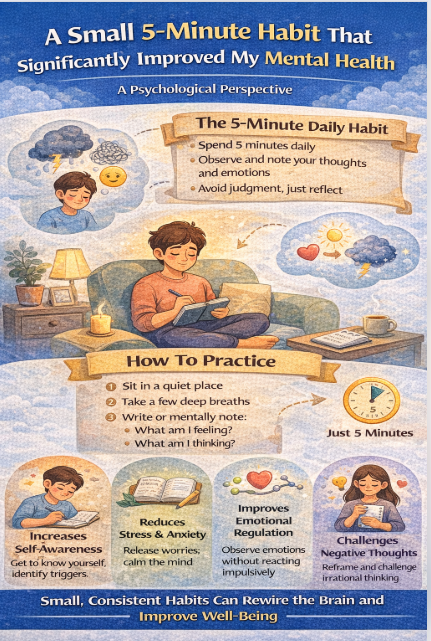
Spend 5 minutes daily observing your thoughts and emotions, and writing or mentally noting them without judgment.
This can include:
- Writing down your thoughts
- Naming your emotions
- Reflecting on your day
- Practicing mindful breathing
Why Small Habits Work: The Psychology Behind It
Neuroplasticity
The brain has the ability to change and adapt—this is known as neuroplasticity.
Every time you repeat a behavior, neural pathways are strengthened.
Example: If you practice self-reflection daily, your brain becomes better at:
- Understanding emotions
- Regulating reactions
- Reducing impulsivity
Habit Formation (Behavioral Psychology)
According to behavioral psychology, habits are formed through repetition and reinforcement.
A 5-minute habit is:
- Easy to start
- Less overwhelming
- More sustainable
The Role of Mindfulness
This habit is deeply rooted in mindfulness, which involves:
- Present-moment awareness
- Non-judgmental observation
Psychological Benefits:
- Reduces rumination
- Improves emotional regulation
- Decreases anxiety
Example: Instead of overthinking a mistake, you observe the thought:
“I made a mistake today.”
This reduces emotional intensity.
Emotional Regulation:
Emotional regulation refers to the ability to manage and respond to emotions effectively.
How the Habit Helps:
- Identifying emotions reduces their intensity
- Creates a pause between stimulus and response
Example: Instead of reacting angrily, you notice:
“I’m feeling frustrated.”
This awareness allows you to respond calmly.
Cognitive Restructuring
This habit naturally promotes cognitive restructuring, a key concept in Cognitive Behavioral Therapy (CBT).
Process:
- Identify negative thoughts
- Challenge them
- Replace with balanced thoughts
Example:
Thought: “I’m a failure.”
Reframe: “I had a bad day, but I can improve.”
Reducing Cognitive Distortions: Common distortions include:
- Overgeneralization
- Catastrophizing
- Black-and-white thinking
How the Habit Helps: By observing thoughts, you recognize distortions and reduce their impact.
The Power of Naming Emotions
Psychology calls this affect labeling.
Research Insight: Naming emotions reduces activity in the amygdala (fear center) and increases prefrontal cortex activity.
Example: Saying “I feel anxious” can actually reduce anxiety.
Self-Awareness and Metacognition:
This habit enhances metacognition—thinking about your own thinking.
Benefits:
- Better decision-making
- Improved relationships
- Increased emotional intelligence
Stress Reduction
Daily reflection reduces stress by:
- Releasing mental tension
- Organizing thoughts
- Creating clarity
Example: Writing down worries prevents mental overload.
Building Self-Compassion:
This habit encourages self-compassion, which includes:
- Self-kindness
- Acceptance
- Reduced self-criticism
Example: Instead of saying “I’m not good enough,” you say:
“I’m trying, and that’s enough.”
Real-Life Case Example
Consider “Ankit,” a working professional.
Before adopting this habit:
- Constant overthinking
- Anxiety before sleep
- Negative self-talk
After practicing 5-minute reflection daily:
- Improved emotional clarity
- Reduced anxiety
- Better sleep
The Role of Consistency
The effectiveness of this habit depends on consistency, not intensity.
Psychological Principle: Small repeated actions create long-term change.
How to Practice This Habit
Step-by-Step Guide:
- Sit in a quiet place
- Take a few deep breaths
- Ask yourself:
- What am I feeling?
- What am I thinking?
- Write or mentally note
- Avoid judgment
Time Required: Just 5 minutes
Variations of the Habit
You can customize it:
- Gratitude reflection
- Thought journaling
- Breathing awareness
- Emotion check-in
Why This Habit is Powerful
Because it:
- Requires minimal effort
- Builds self-awareness
- Improves emotional control
- Reduces stress and anxiety
Long-Term Psychological Impact
Over time, this habit leads to:
- Stronger emotional resilience
- Better coping mechanisms
- Increased confidence
- Improved mental health
Common Mistakes to Avoid
- Expecting immediate results
- Judging your thoughts
- Being inconsistent
Integrating with Therapy
This habit complements:
- Cognitive Behavioral Therapy (CBT)
- Mindfulness-Based Therapy
- Acceptance and Commitment Therapy (ACT)
Conclusion
Mental health improvement does not always require drastic changes. Sometimes, the most powerful transformations come from the smallest habits.
A simple 5-minute daily practice of mindful self-reflection can reshape how you think, feel, and respond to life. Through neuroplasticity, cognitive restructuring, emotional regulation, and self-awareness, this habit gradually builds a healthier and more resilient mind.
In a world that constantly demands more, taking just five minutes for yourself can be one of the most meaningful investments in your mental well-being.
Frequently Asked Questions (FAQs)
1. Can a 5-minute habit really improve mental health?
Yes. Small, consistent habits can rewire the brain through neuroplasticity and improve emotional regulation.
2. What is the best 5-minute mental health habit?
Mindful self-reflection—observing thoughts and emotions without judgment.
3. How does this habit reduce overthinking?
By helping you observe thoughts instead of getting stuck in them.
4. What is neuroplasticity in simple terms?
It is the brain’s ability to change and adapt through repeated behaviors.
5. Can journaling help with anxiety?
Yes. Writing thoughts reduces mental overload and improves clarity.
6. How long does it take to see results?
Some benefits can be noticed within days, but long-term change requires consistency.
7. Is this habit suitable for beginners?
Yes. It is simple, quick, and easy to start.
8. Can this replace therapy?
No, but it works well as a supportive tool.
9. What is emotional regulation?
The ability to understand and manage your emotions effectively.
10. When is the best time to practice this habit?
Morning or night—whenever you can be consistent.
Written by Baishakhi Das
Counselor | Mental Health Practitioner
B.Sc, M.Sc, PG Diploma in Counseling
Reference
American Psychological Association. (2026). Mindfulness and emotional health.
https://www.apa.org/topics/mindfulness
National Institute of Mental Health. (2026). Mental health information.
https://www.nimh.nih.gov/health
Beck Institute. (2026). Cognitive behavioral therapy techniques.
https://beckinstitute.org
Verywell Mind. (2026). Benefits of journaling for mental health.
https://www.verywellmind.com
Monoprova Counselling, (2026), “About Us”,
Monoprova Counselling, (2026), “Contact Us”,
This article is written for knowledge purposes, aiming to help readers understand the topic better and gain useful insights for learning and awareness.