
Introduction
Mental wellness is not just about the absence of mental illness—it is about emotional balance, self-awareness, resilience, and the ability to cope with daily stressors. For men, learning to Track Mental Wellness can be an important step toward understanding emotional patterns, managing stress, and building healthier coping strategies. However, mental health is often deprioritized due to social expectations, demanding schedules, and the belief that they must handle everything on their own.
Moreover, men are statistically less likely to seek therapy early, even though they may experience significant levels of stress, burnout, emotional suppression, and untreated anxiety or depression. As a result, there is growing interest in self-monitoring and digital mental wellness tools, which allow men to track their mental health privately, consistently, and at their own pace. In addition, these tools can make it easier to recognize changes in mood, stress, sleep, and daily habits before they become more difficult to manage.
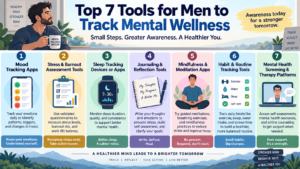
Importantly, mental wellness tools do not replace professional therapy. Instead, they support awareness, early detection, emotional regulation, and healthy habits. Therefore, this article explores the top 7 tools men can use to track their mental wellness, explaining how each tool works, why it matters psychologically, and how it can be used effectively in daily life.
Why Tracking Mental Wellness Matters for Men
Tracking mental wellness can help men become more aware of their emotional and behavioral patterns. By regularly paying attention to their mental well-being, men can:
- Recognize emotional patterns early
- Identify common stress triggers
- Monitor changes in mood and energy levels
- Reduce emotional suppression and avoidance
- Build healthier and more effective coping strategies
From a psychological perspective, self-monitoring increases emotional insight. As a result, greater awareness can become an important first step toward emotional regulation and positive behavioral change. In addition, regularly observing thoughts, emotions, and daily patterns can make it easier to recognize when something needs attention.
Furthermore, mental wellness tracking can:
- Normalize emotional experiences by making emotional awareness part of everyday life
- Reduce stigma around mental health by encouraging men to view self-care as a normal and proactive practice
- Encourage proactive self-care before stress or emotional difficulties become overwhelming
- Support therapy or counseling when needed by providing useful observations about mood, stress, habits, and emotional changes
Ultimately, tracking mental wellness is not about constantly analyzing every emotion. Instead, it is about developing enough self-awareness to recognize patterns, respond to challenges earlier, and make healthier choices.
Frequently Asked Questions (FAQ)
Top 7 Tools Men Can Use to Track Their Mental Wellness
1. What does it mean to track mental wellness (Track Mental Wellness)?
Tracking mental wellness means regularly monitoring your mood, stress levels, sleep, habits, and emotional patterns to better understand how your mental health changes over time.
2. Why is mental wellness tracking important for men (Track Mental Wellness)?
Many men suppress emotions or delay seeking help. Tracking tools increase self-awareness, help identify stress or burnout early, and provide a private way to engage with mental health.
3. Can mental wellness tools replace therapy or counseling (Track Mental Wellness)?
No. These tools support self-awareness and early intervention but do not replace professional mental health care. They work best when combined with counseling if needed.
4. Which mental wellness tool should men start with (Track Mental Wellness)?
Most men find mood trackers or sleep tracking tools easiest to begin with, as they require minimal effort and provide immediate insights into emotional and physical patterns.
5. How often should mental wellness be tracked (Track Mental Wellness)?
Consistency matters more than frequency. Tracking once daily or a few times a week is enough to notice patterns without becoming overwhelming.
6. Are mood tracking apps useful if I don’t know how to label emotions (Track Mental Wellness)?
Yes. Mood tracking apps often use emojis or simple emotion words, helping men gradually expand emotional awareness without pressure.
7. How does sleep tracking help mental health (Track Mental Wellness)?
Sleep quality directly affects mood, stress tolerance, focus, and emotional regulation. Tracking sleep helps identify habits or stressors that impact mental wellness.
8. Is journaling effective for men who don’t like talking about feelings (Track Mental Wellness)?
Yes. Journaling provides a private, judgment-free space to process thoughts and emotions, making it especially helpful for men who struggle with verbal expression.
9. Do mindfulness and meditation apps really reduce stress (Track Mental Wellness)?
Research shows that short, consistent mindfulness practices improve emotional regulation, reduce anxiety, and lower stress—especially when practiced regularly.
10. How do habit trackers support mental wellness (Track Mental Wellness)?
Habit trackers build structure and routine, which stabilize mood and energy. Small, consistent habits like exercise, hydration, or breaks support overall mental health.
11. Are online mental health screenings accurate (Track Mental Wellness)?
Screenings are helpful for awareness, not diagnosis. They indicate whether professional support may be beneficial and should not be used as a final conclusion.
12. Can these tools help with burnout prevention (Track Mental Wellness)?
Yes. Stress assessments, mood tracking, and habit monitoring help detect early warning signs of burnout, allowing timely adjustments before exhaustion becomes severe.
13. What are common mistakes men make when using mental health tools (Track Mental Wellness)?
Common mistakes include tracking obsessively, expecting instant change, ignoring emotional insights, or using tools as a substitute for seeking help.
14. How can men stay consistent with mental wellness tools (Track Mental Wellness)?
Link tools to existing routines, keep tracking simple, avoid perfectionism, and focus on self-compassion rather than streaks or scores.
15. When should a man seek professional mental health support (Track Mental Wellness)?
Professional help is important if emotional distress persists, daily functioning is affected, mood worsens over time, or feelings of hopelessness or isolation increase.
Reference
-
World Health Organization. (2022). Mental health of men and boys.
https://www.who.int/publications/i/item/9789240044149 -
American Psychological Association. (2023). Technology and mental health.
https://www.apa.org/monitor/2023/07/technology-mental-health -
National Institute of Mental Health. (2023). Caring for your mental health.
https://www.nimh.nih.gov/health/topics/caring-for-your-mental-health -
Torous, J., et al. (2021). Digital mental health and COVID-19: Using technology today to accelerate the curve on access and quality tomorrow. JMIR Mental Health, 7(3).
https://doi.org/10.2196/18848 -
Mohr, D. C., et al. (2017). The behavioral intervention technology model. Journal of Medical Internet Research, 19(6).
https://doi.org/10.2196/jmir.7787 -
Courtenay, W. H. (2000). Constructions of masculinity and their influence on men’s well-being. Social Science & Medicine, 50(10), 1385–1401.
https://doi.org/10.1016/S0277-9536(99)00390-1 -
How to Build Daily Habits for Better Mental Health