
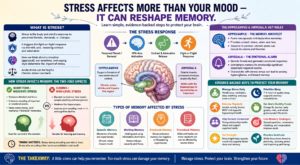
Stress affects more than your mood — it can reshape memory. Learn simple, evidence-backed steps to protect your brain.
Introduction
The human brain relies on memory as a core function; it shapes identity, guides learning, and informs our decisions. But memory is not static — it is deeply influenced by our mental state, and one of the strongest influences is stress. Understanding how stress affects memory matters because stress can alter what we remember, how well we learn, and even who we become. Physiologically, stress triggers a cascade of chemical and hormonal events—the fight-or-flight response—driven by the hypothalamic-pituitary-adrenal (HPA) axis and marked by rises in cortisol and adrenaline.
In short bursts, this response sharpens attention and can make significant events more memorable. Yet when stress becomes chronic, those same hormones can wear down brain systems that support memory, especially the hippocampus, leading to problems with encoding, consolidation, and retrieval. In this article we’ll explore the complex ways stress affects different types of memory, the brain regions involved, and practical steps to protect and restore cognitive function.
What Is Stress?
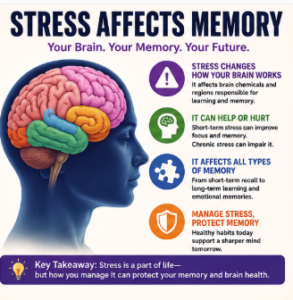
Stress is the body and mind’s response to perceived threats, demands, or changes. Biologically, it involves a cascade of chemical and hormonal events—most notably activation of the hypothalamic-pituitary-adrenal (HPA) axis and release of cortisol and adrenaline—that ready the body for action (the fight-or-flight response). Psychologically, stress is more than physiology: it’s shaped by how we perceive and interpret events.
Cognitive appraisal:
Psychologist Richard Lazarus described stress as arising from appraisal processes. First, we subconsciously evaluate whether an event is relevant or threatening (primary appraisal). Next, we assess our resources and options for coping (secondary appraisal). The same situation can produce little stress for one person and intense stress for another depending on these appraisals.
Emotional response:
Stress triggers a range of emotions—fear, anger, frustration, sadness, or overwhelm. These emotions influence attention and memory: emotionally charged stimuli are more likely to capture focus and be encoded strongly, while persistent negative emotion can bias memory toward threat-related information.
Behavioral and motivational effects:
Acute stress can sharpen motivation and increase vigilance, improving performance on short, well-defined tasks. Chronic stress often leads to avoidance behaviors, reduced motivation, impaired decision-making, and difficulty sustaining effort—factors that indirectly worsen learning and memory.
Cognitive effects:
Stress narrows attentional focus and shifts processing from flexible, deliberate thinking (prefrontal cortex functions) to quicker, habitual responses (subcortical systems). This can help survival in immediate danger but undermines complex problem solving, working memory, and the ability to form new, detailed memories when prolonged.
Individual differences and context:
Personality traits (e.g., neuroticism), prior trauma, social support, sleep quality, and coping styles determine vulnerability. People who use active coping or problem-focused strategies typically experience less harmful cognitive impact than those who ruminate or withdraw.
Developmental considerations:
Children and adolescents are especially sensitive to stress because their brains and regulatory systems are still developing. Early-life stress can shape stress-reactivity long-term and increase risk for memory and emotional difficulties later.
Clinical relevance:
When stress becomes overwhelming or prolonged it can contribute to psychiatric conditions—major depression, anxiety disorders, and PTSD—all of which include memory disturbances as core or frequent symptoms.
In short, stress is an interaction between external demands and internal meaning-making. How we appraise, feel about, and cope with a challenge determines whether stress acts as a short-lived enhancer of memory or a chronic disruptor of cognitive health.
How Stress Affects Memory: The Two-Fold Effects
Stress affects memory in complex ways depending on its intensity, duration, and timing. Below are two contrasting patterns:
- Short-term, low-to-moderate stress: Brief or moderate stress can sharpen attention and boost memory encoding for important events. This evolutionary adaptation helps us remember threats and lessons—think of vivid, long-lasting “flashbulb” memories after an accident or major life change. During these moments, adrenaline and brief cortisol spikes enhance arousal and focus, improving consolidation of emotionally salient details.
- Chronic or high-level stress: Prolonged, severe stress has the opposite effect. Persistently elevated cortisol and disrupted HPA-axis regulation impair synaptic plasticity and neurogenesis, particularly in the hippocampus, a key region for declarative (facts and events) memory. Over time this can reduce the ability to form new memories, weaken recall, and in extreme cases contribute to hippocampal atrophy and cognitive decline.
Timing matters: Stress just before or during encoding can either enhance or impair memory depending on level and context. Stress long after encoding tends to interfere with consolidation and retrieval. Individual factors—age, prior trauma, sleep, and coping style—moderate these effects, so the same stressor may affect people differently.
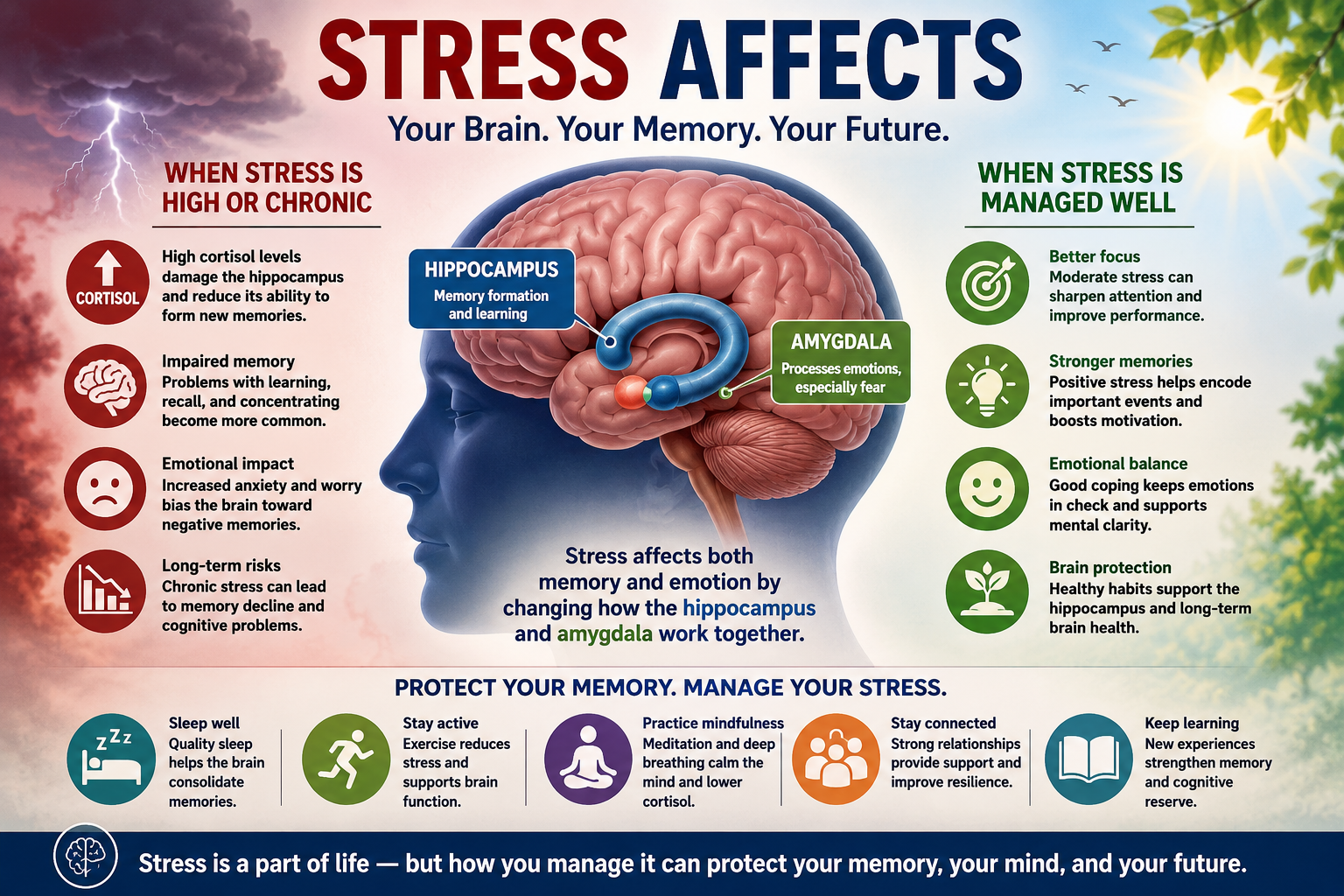
The Hippocampus and Amygdala Role.
The Hippocampus and Amygdala: How They Mediate Stress and Memory
Hippocampus
- Role: The hippocampus is essential for forming new episodic and declarative memories (facts, events) and for mapping spatial and temporal relationships. It helps convert short-term experiences into stable long-term memories and supports contextual retrieval (placing a memory in the right time and place).
- How stress affects it: Chronic stress and repeated cortisol exposure reduce hippocampal neurogenesis (birth of new neurons), impair synaptic plasticity (long-term potentiation), and can shrink hippocampal volume over time. These changes make encoding and consolidation less efficient and make it harder to retrieve detailed, context-rich memories.
- Psychological impact: Damage or functional suppression of the hippocampus shows up as difficulty learning new information, trouble remembering where or when events occurred, and increased reliance on general rather than specific memory traces (e.g., remembering that something happened but not the details).
- Resilience and recovery: The hippocampus is plastic—exercise, good sleep, stress reduction, and certain antidepressant treatments can promote neurogenesis and restore function, especially when interventions occur early.
Amygdala
- Role: The amygdala processes emotional salience and assigns emotional value to experiences, modulating attention and memory strength for emotionally charged stimuli. It communicates closely with the hippocampus to prioritize memory consolidation for events with emotional significance.
- How stress affects it: Acute stress heightens amygdala activity, which often strengthens emotional memories (why traumatic events feel indelible). Chronic stress can produce hyper-reactive amygdala responses, biasing perception toward threat and increasing emotional memory consolidation. In some cases, this leads to intrusive, vivid recollections (as in PTSD) or to distortions where emotional color overrides factual detail.
- Psychological impact: An overactive amygdala can increase fear conditioning, emotional reactivity, and the salience of negative memories, contributing to anxiety, rumination, and mood disorders. Conversely, diminished amygdala responsiveness can blunt emotional memory and affective learning.
- Interaction with hippocampus: Under stress, the amygdala can shift memory processing away from hippocampal contextual encoding toward stronger, emotion-focused traces. That trade-off helps rapid survival responses but reduces nuanced recall.
Putting it together
- Balance matters: Healthy memory requires coordinated hippocampus–amygdala interaction. Stress can tip that balance—brief activation sharpens memory for important events; chronic activation disrupts hippocampal-dependent memory while strengthening raw emotional traces.
- Clinical relevance: Patterns of hippocampal shrinkage plus amygdala hyperactivity are implicated in PTSD, depression, and stress-related cognitive decline. Targeted interventions that reduce stress, improve sleep, and increase neuroplasticity help restore healthier hippocampus–amygdala dynamics.
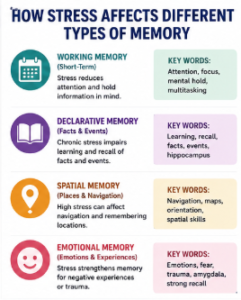
Stress and Various Forms of Memory.
Stress does not affect all types of memory equally. Effects depend on memory system, timing, and stress severity.
Working memory
- What it is: The short-term system (prefrontal cortex–dependent) that temporarily holds and manipulates information for tasks like problem solving, planning, and following conversations.
- How stress affects it: Acute stress and elevated catecholamines (adrenaline, noradrenaline) can impair prefrontal cortex function, reducing working memory capacity and cognitive flexibility. This shows up as difficulty concentrating, increased distractibility, and poorer decision-making under pressure.
- Practical sign: Struggling to follow multi-step instructions or losing your train of thought during a stressful meeting.
Long-term (declarative) memory
- What it is: Memory for facts and events (episodic and semantic) typically consolidated via hippocampal circuits.
- How stress affects it: Timing matters. Moderate stress around the moment of encoding can enhance consolidation for emotionally salient events, making them vivid and durable. Chronic or intense stress, however, disrupts hippocampal plasticity and impairs consolidation and retrieval, leading to gaps in memory and trouble learning new information.
- Practical sign: Remembering a traumatic event in vivid detail but struggling to learn or recall new material during periods of prolonged stress.
Procedural memory
- What it is: Implicit memory for skills and habits (motor skills, routines), largely supported by the basal ganglia and cerebellum.
- How stress affects it: Procedural memory is relatively resilient to stress because it relies on subcortical circuits less sensitive to HPA-axis disruption. In some cases, stress even favors reliance on habitual or procedural responses over flexible, thought-out actions.
- Practical sign: You can still ride a bike or type quickly under stress, but you may default to ingrained habits rather than deliberate strategies.
Autobiographical and emotional memory
- What it is: Personal life memories with emotional content, shaped by hippocampus–amygdala interactions.
- How stress affects it: Stress amplifies emotional salience via the amygdala, strengthening memory for emotion-laden details while sometimes degrading contextual accuracy. This can produce vivid but biased recollections.
Summary point: Overall, stress shifts brain processing from flexible, context-rich systems (prefrontal cortex and hippocampus) toward faster, emotionally driven or habitual systems (amygdala and basal ganglia). That trade-off helps immediate survival but undermines complex cognition, learning, and precise recall when stress is prolonged.
Physiological and Psychological effects of Stress-induced memory lapse.
Stress-related memory impairments are factors in a range of psychological problems:
Anxiety and Depression: Failure of memory systems in chronic stress conditions tends to increase negative recollection which contributes to anxiety and depressive moods.
Post-Traumatic Stress Disorder (PTSD): Intrusive memories and flashbacks are the characteristics of PTSD. The responses to stress which are altered lead to overactive signaling of the amygdala and impaired encoding of the hippocampal, disrupting memory integration.
Cognitive Decline in Aging: Chronic stress increases the age related memory loss and has been associated with the neurodegenerative diseases such as Alzheimer disease.
Managing stress and preserving memory.
Knowledge of the memory-stress relationship can be used to intervene:
- Mindfulness and Meditation: Stress reduction practices enhance memory in the long run by balancing cortisol and enhancing the functions of hippocampal.
- Physical Exercise: Frequent aerobic activity improves brain plasticity, neurogenesis of the hippocampus, and stress hormones.
- Adequate Sleep: Sleep plays an important role in memory consolidation. Stress has a tendency of interfering with sleep patterns; the effects on memory can be alleviated by enhancing sleep hygiene.
- Cognitive Behavioral Therapy (CBT): CBT methods assist in interrupting the negative cycles of thoughts that were developed by the stress and have a better control of emotion which indirectly enhances memory.
- Social Support: Good interpersonal relationships counteract the impacts of stress and enhance mental strength.
Conclusion
The dance stress and memory are complex, but one that points to how delicate the balance our brains pull concerning life challenges is. Although there are positive effects of stress in survival, unmanaged or perennial stress worsens mental performance and mood. The enhancement of psychological well-being and memory protection can be ensured by the creation of awareness and adaptation of effective coping strategies.
With the adoption of methods that encourage relaxation, strength, and clarity of mind, we are in a position to manage stressful situations without being overwhelmed and losing track of the beautiful tapestry that is our memories, the very nature of our existence.
FAQ Section
1. How does stress affects memory?
Stress can both improve and impair memory. Short-term stress may enhance focus, while chronic stress can damage memory functions.
2. Can stress affects on memory loss?
Yes, long-term stress can lead to memory problems by affecting brain areas like the hippocampus.
3. Does stress improve memory in some cases?
Moderate stress can improve memory by increasing alertness and helping the brain store important information.
4. What part of the brain is affected by stress?
Stress mainly affects the hippocampus (memory) and amygdala (emotions).
5. Can stress affects on damage the brain permanently?
Chronic stress may lead to long-term changes in brain structure, especially if not managed properly.
6. How does cortisol affect memory?
High levels of cortisol (stress hormone) can impair memory formation and retrieval over time.
7. Is memory loss due to stress reversible?
In many cases, yes. Reducing stress can improve memory and brain function.
8. How can I improve memory affected by stress?
You can improve memory through exercise, proper sleep, mindfulness, and stress management techniques.
9. What is the difference between acute and chronic stress?
Acute stress is short-term and can be helpful, while chronic stress is long-term and harmful to memory and health.
10. Can stress affects to mental health disorders?
Yes, prolonged stress can contribute to conditions like anxiety, depression, and PTSD.
References
- World Health Organization
👉 https://www.who.int/news-room/questions-and-answers/item/stress - American Psychological Association
👉 https://www.apa.org/topics/stress - National Institute of Mental Health
👉 https://www.nimh.nih.gov/health/topics/stress - National Library of Medicine
👉 https://www.ncbi.nlm.nih.gov/pmc/articles/PMC3181832/ - Language Development in Children: Stages, Theories (Why child not speaking clearly at age 2)
This article is written for knowledge purposes, aiming to help readers understand the topic better and gain useful insights for learning and awareness.