
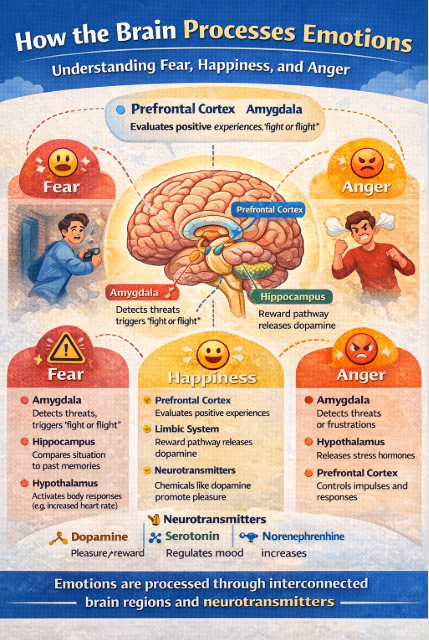
What if the secret behind your fear, joy, and anger lies in how your Brain Process emotions? Your Amygdala, Prefrontal Cortex, and Dopamine don’t just react—they shape every choice you make. Discover how your Brain Process emotions and turn that knowledge into stronger control and calm.
Introduction
Emotions are an essential part of human life. They shape our thoughts, influence our behavior, and guide our decisions. Whether it is the fear that keeps us safe, the happiness that motivates us, or the anger that signals injustice, emotions play a critical role in how we experience the world.
But have you ever wondered how the brain actually processes these emotions?
Modern neuroscience reveals that emotions are not just “feelings” but complex interactions between different brain regions, chemicals, and physiological responses. Understanding how the brain processes emotions like fear, happiness, and anger can help us improve emotional regulation, mental health, and overall well-being.
The Emotional Brain: Key Structures — Brain Process in Control
Before diving into specific emotions, it is important to understand the key brain structures involved in emotional processing.
1. Amygdala – The Emotional Alarm System
The amygdala is a small, almond-shaped structure located deep within the brain. It plays a crucial role in detecting emotional significance, especially fear and threat.
- Rapidly processes emotional stimuli
- Triggers fight-or-flight responses
- Stores emotional memories
2. Prefrontal Cortex – The Rational Controller
The prefrontal cortex (PFC) is responsible for decision-making, reasoning, and emotional regulation.
- Evaluates emotional responses
- Controls impulsive reactions
- Helps in logical thinking
3. Hippocampus – Memory and Context
The hippocampus helps link emotions with memories.
- Provides context to emotional experiences
- Helps differentiate between real and perceived threats
4. Hypothalamus – Body Response Coordinator
The hypothalamus connects the brain to the body’s hormonal system.
- Activates stress responses
- Regulates heart rate, hormones, and bodily reactions
5. Neurotransmitters – Chemical Messengers
Brain chemicals such as dopamine, serotonin, and norepinephrine influence emotional states.
- Dopamine → pleasure and reward
- Serotonin → mood regulation
- Norepinephrine → alertness and arousal
How the Brain Process Fear
Fear is one of the most primitive and survival-oriented emotions.
Step-by-Step Process of Fear:
- Stimulus Detection : You see or hear something threatening (e.g., a snake).
- Amygdala Activation: The amygdala quickly evaluates the threat.
- Fast Pathway (Low Road): The signal goes directly from the thalamus to the amygdala, allowing an immediate reaction.
- Slow Pathway (High Road): The signal is processed through the cortex for detailed analysis.
- Physical Response: The hypothalamus activates the fight-or-flight response:
- Increased heart rate
- Sweating
- Adrenaline release
Example: You are walking at night and suddenly hear footsteps behind you. Your heart starts racing before you even think about what it could be. This is your amygdala reacting instantly.
Why Fear is Important : Fear helps us survive by preparing the body to respond to danger. However, excessive fear can lead to anxiety disorders.
How the Brain Process Happiness
Happiness is a positive emotional state associated with pleasure, satisfaction, and well-being.
Key Brain Areas Involved:
- Prefrontal cortex
- Limbic system
- Reward pathway
The Role of Dopamine
Dopamine is the “feel-good” neurotransmitter that plays a central role in happiness.
Process of Happiness: Brain Flow Activated by Reward
- Reward Stimulus: You experience something pleasurable (e.g., eating your favorite food).
- Dopamine Release: The brain releases dopamine in the reward circuit.
- Activation of Reward Pathway : Areas like the nucleus accumbens become active.
- Positive Reinforcement : The brain encourages repeating the behavior.
Example: When you receive appreciation for your work, your brain releases dopamine, making you feel happy and motivated to perform well again.
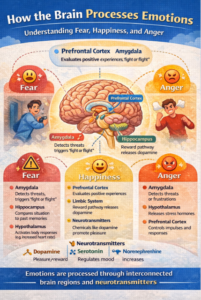
Types of Happiness
- Hedonic Happiness: Pleasure-based (e.g., entertainment, food)
- Eudaimonic Happiness: Meaning-based (e.g., purpose, growth)
Why Happiness Matters
Happiness improves mental health, boosts immunity, and enhances productivity.
How the Brain Process Anger
Anger is a powerful emotion that arises when we perceive injustice, frustration, or threat.
Brain Mechanism of Anger:
- Trigger Event: A situation causes frustration or perceived unfairness.
- Amygdala Activation: The amygdala interprets the situation as a threat.
- Reduced Prefrontal Control: The prefrontal cortex may become less active, leading to impulsive reactions.
- Physiological Arousal
- Increased heart rate
- Muscle tension
- Release of stress hormones
Example: If someone insults you publicly, your immediate reaction might be anger. You may feel a surge of energy and a desire to respond aggressively.
The Role of Hormones: Brain Process Chemicals at Work
- Testosterone → linked to aggression
- Cortisol → stress response
Why Anger Exists
Anger can be useful as it:
- Signals injustice
- Motivates action
- Helps set boundaries
However, uncontrolled anger can damage relationships and mental health.
Emotional Regulation: How the Brain Controls Emotions — Brain Process in Action
While emotions originate in the limbic system, they are regulated by the prefrontal cortex.
Techniques the Brain Uses:
- Cognitive Reappraisal: Reinterpreting a situation to change its emotional impact
- Impulse Control: Preventing immediate reactions
- Mindfulness: Observing emotions without reacting
Example: Instead of reacting angrily to criticism, you pause and think, “This might help me improve.” This is your prefrontal cortex regulating your emotional response.
Interaction Between Fear, Happiness, and Anger: How Brain Process Connects Them
These emotions are not isolated—they interact dynamically.
- Fear can turn into anger
- Happiness can reduce fear
- Anger can mask underlying fear
Example: A person afraid of rejection may express anger instead of admitting fear.
The Role of Learning and Experience: How Brain Process Shapes Emotions
The Role of Learning and Experience: Brain Process Shaped by Past Experiences
Example: If someone had a traumatic experience with dogs, their brain may trigger fear even when seeing a harmless dog.
This process is called emotional conditioning.
Emotional Disorders and Brain Function: When Brain Process Disrupts
When emotional processing is disrupted, it can lead to mental health conditions:
- Anxiety disorders → overactive amygdala
- Depression → low dopamine and serotonin
- Anger issues → poor prefrontal regulation
Practical Applications
Understanding emotional processing can help in:
- Therapy and counseling
- Stress management
- Improving relationships
- Enhancing decision-making
Case Example
Consider a student named Arjun.
- Before exams, he feels fear, activating his amygdala
- After good results, he experiences happiness due to dopamine release
- When facing criticism, he feels anger, but learns to regulate it through self-awareness
Over time, Arjun develops better emotional control by understanding his reactions.
How to Improve Emotional Control: Strengthen Brain Process
- Practice mindfulness
- Develop self-awareness
- Use relaxation techniques
- Seek professional help if needed
- Maintain a healthy lifestyle
Conclusion
The brain processes emotions like fear, happiness, and anger through a complex network of structures, chemicals, and neural pathways. The amygdala detects emotional significance, the hypothalamus triggers physical responses, and the prefrontal cortex regulates our reactions.
Understanding these processes allows us to become more emotionally intelligent and better equipped to handle life’s challenges. Emotions are not just reactions—they are powerful tools that, when understood, can enhance our well-being and guide us toward a balanced and meaningful life.
Frequently Asked Questions (FAQs)
1. How does the brain process emotions?
The brain processes emotions through structures like the amygdala, prefrontal cortex, and hippocampus, along with neurotransmitters.
2. What part of the brain controls fear?
The amygdala plays a key role in detecting threats and triggering fear responses.
3. Which chemical is responsible for happiness?
Dopamine is the primary neurotransmitter linked to pleasure and reward.
4. Why do we feel anger? Brain Process signals threat or injustice
Anger arises when we perceive threat, frustration, or injustice.
5. What is emotional regulation: Brain Process manages it
It is the ability to manage and control emotional responses using the prefrontal cortex.
6. Can emotions affect decision-making: Brain Process Connection
Yes. Emotions strongly influence how we think and make decisions.
7. What happens during the fight-or-flight response? Brain Process activates it
The hypothalamus activates physical changes like increased heart rate and adrenaline release.
8. Can emotional processing be improved?
Yes, through mindfulness, self-awareness, and therapy.
9. What causes emotional disorders? Disrupted Brain Process
Imbalance in brain activity and neurotransmitters can lead to anxiety, depression, or anger issues.
10. Why is understanding emotions important? It shows how Brain Process guides your thoughts, relationships, and decisions.
It helps improve mental health, relationships, and decision-making.
References
American Psychological Association. (n.d.). Emotions and the brain. https://www.apa.org
National Institute of Mental Health. (n.d.). Brain basics and emotional processing. https://www.nimh.nih.gov
Monoprova Counselling, (2026), “About Us”,
Monoprova Counselling, (2026), “Contact Us”,
This article is written for knowledge purposes, aiming to help readers understand the topic better and gain useful insights for learning and awareness.
Pingback: Why Your Mind Creates Problems Even When Everything Is Fine