
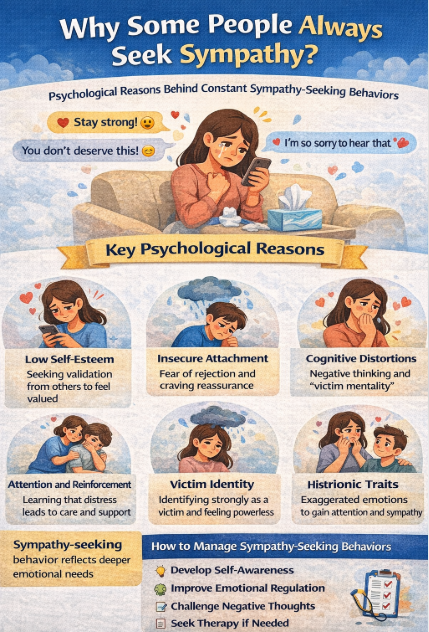
Why do some people constantly seek sympathy? Discover the psychology behind the behavior and practical ways to respond.
Introduction
Have you ever noticed someone who constantly shares their struggles, exaggerates problems, or seems to always be in distress—almost as if they are seeking sympathy? While it may appear attention-seeking or manipulative on the surface, psychology offers a deeper and more compassionate understanding of this behavior.
The need for sympathy is often rooted in unmet emotional needs, personality patterns, cognitive distortions, and past experiences. It is not always intentional or conscious. In many cases, it reflects deeper psychological processes such as low self-esteem, attachment insecurity, reinforcement learning, and maladaptive coping mechanisms.
This article explores why some individuals consistently seek sympathy, using psychological concepts, real-life examples, and clinical insights.
Understanding Sympathy-Seeking Behavior
Sympathy-seeking behavior refers to a pattern in which individuals repeatedly present themselves as victims or emotionally distressed to gain attention, care, or validation from others.
It is important to distinguish between:
- Healthy emotional expression (seeking support when needed)
- Chronic sympathy-seeking (persistent pattern of eliciting concern)
The Role of Emotional Validation
Validation is the clear recognition and acceptance of another person’s feelings, thoughts, and experiences without judgment or dismissal. It communicates: “I see you; your experience matters.” When people receive consistent validation, they learn that their inner states are understandable and tolerable. That builds emotional regulation, self-worth, and secure relating.
How lack of validation shapes sympathy-seeking
When caregivers repeatedly ignore, minimize, or punish a child’s emotions (for example, saying “Stop crying, it’s nothing”), the child learns that feelings are unsafe or unimportant. Over time this can produce several tendencies that contribute to chronic sympathy-seeking:
-
Emotional invalidation: Repeated dismissal trains a person to doubt their internal experience, so they seek external confirmation that their feelings are real and legitimate.
-
Meta-emotion problems: If caregivers model negative reactions to emotions (shame about sadness, fear of anger), the child develops confusing or hostile beliefs about their own emotions and may dramatize distress to force attention or acceptance.
-
Attachment consequences: Inconsistent or rejecting emotional responses foster anxious attachment, leading to heightened bids for reassurance and distress signals aimed at eliciting care.
-
Impaired emotion regulation: Without guidance (emotion coaching) on how to label, tolerate, and soothe feelings, people rely on others to calm them, increasing visible displays of distress.
-
Reinforcement learning: If expressions of pain reliably produce care, sympathy becomes a learned strategy to obtain safety and connection.
-
Neurobiological impact: Chronic invalidation can heighten threat-system reactivity (amygdala sensitivity) and weaken prefrontal regulatory control, making intense emotion and impulsive bids for comfort more likely.
Example: A child told that crying is weak may grow up believing their emotions are illegitimate. As an adult they might repeatedly tell friends about hardships not only to gain help but to have their inner experience acknowledged for the first time.
Clinical implications
Therapeutic approaches that target validation—such as emotion coaching, Mentalization-Based Therapy, DBT’s validation strategies, and attachment-focused work—help clients recognize and tolerate emotions internally, reducing the need to seek external sympathy. Teaching labeling of feelings, linking emotions to events, and practicing self-soothing rebuilds internal validation and emotional resilience.
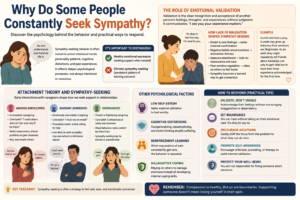
Attachment Theory and Sympathy-Seeking
Attachment theory proposes that early interactions with primary caregivers form internal working models—mental maps of whether others are available, trustworthy, and helpful. These models guide how people interpret relationships and seek support throughout life.
Insecure attachment styles and sympathy-seeking
Anxious (preoccupied) attachment
- Development: Often results from inconsistent caregiving—emotional availability that is unpredictable.
- Core belief: “Others are available sometimes, but I can’t be sure; I need to keep them close.”
- Typical behavior: High emotional expressiveness, frequent reassurance-seeking, rumination about relationships, and hypervigilance to signs of rejection.
- Relation to sympathy-seeking: Individuals may repeatedly share problems or amplify distress to elicit closeness and confirm that someone cares. Their expressions often seek comfort rather than practical solutions.
- Interpersonal effect: Can feel overwhelming to partners; may provoke caregiving but also push people away if persistent.
Avoidant (dismissive) attachment
- Development: Tends to arise when caregivers are consistently emotionally unavailable, rejecting, or discourage dependence.
- Core belief: “Others are unreliable; I must rely on myself.”
- Typical behavior: Emotional suppression, distancing, downplaying needs, and reluctance to ask for help.
- Relation to sympathy-seeking: Less likely to overtly seek sympathy; when distressed, may minimize problems or use indirect signals (irritability, sarcasm). If sympathy is solicited, it may be passive-aggressive or manipulative rather than vulnerable.
- Interpersonal effect: Can appear cold or independent; partners may feel shut out or unsure how to help.
Disorganized attachment
- Development: Associated with frightening, chaotic, or abusive caregiving where the caregiver is both a source of comfort and fear.
- Core belief: Confused expectations about safety and closeness.
- Typical behavior: Erratic, unpredictable emotional signals, sudden shifts between clinginess and withdrawal, dissociation under stress.
- Relation to sympathy-seeking: May produce inconsistent sympathy bids—intense displays at times, numbness or hostility at others. These mixed signals can lead to unstable relationships and increased need for reassurance when overwhelmed.
- Interpersonal effect: Often confusing and distressing for others; can trigger caregivers’ own anxieties.
Secure attachment (for contrast)
- Development: Consistent, sensitive caregiving that responds to emotional needs.
- Core belief: “Others are generally available; I can seek help and return to independence.”
- Typical behavior: Balanced expression of needs, effective use of social support, and better emotion regulation.
- Relation to sympathy-seeking: Seeks support when needed but does not rely on exaggerated distress to obtain reassurance.
Mechanisms linking attachment to sympathy-seeking
- Internal working models shape expectations: If someone expects rejection or conditional care, they may use intensified emotional displays to test or secure attention.
- Emotion regulation development: Secure caregiving teaches children how to soothe themselves; insecure patterns often leave people dependent on others for regulation.
- Intergenerational transmission: Parents’ own attachment styles influence how they respond to their children’s emotions, perpetuating patterns.
- Cognitive biases: Insecure attachment fosters selective attention to threat cues (e.g., perceived slights), increasing rumination and public expressions of distress.
Clinical implications
Assessment: Ask about early caregiving, current relationship patterns, and typical responses when upset to identify attachment-related drivers.
Intervention targets: Strengthen emotion regulation, repair maladaptive internal working models (through therapies like Mentalization-Based Therapy, Attachment-Based Family Therapy, or Emotionally Focused Therapy), and practice secure attachment behaviors in relationships.
Practical work: Role-play asking for support assertively, restructure beliefs about others’ availability, and build internal soothing strategies so sympathy-seeking diminishes.
Operant Conditioning and Reinforcement
From a behavioral viewpoint, sympathy-seeking develops because emotional displays are often followed by outcomes that make those displays more likely in the future.
Basic principle: If a behavior is followed by a rewarding consequence, its frequency increases. This is the core of operant conditioning.
How sympathy-seeking is learned
- Positive reinforcement: When expressions of distress (crying, dramatic complaints) reliably produce attention, comfort, or help, those responses reinforce the distress signal. Example: A child cries and a caregiver immediately attends; the child learns that showing pain brings care.
- Negative reinforcement: Sympathy-seeking can also be reinforced by the removal of an aversive stimulus. For example, exaggerating problems may lead others to cancel responsibilities or drop demands, which reduces immediate stress—so the behavior is reinforced because it helps avoid uncomfortable tasks.
- Intermittent reinforcement and persistence: If sympathy occasionally produces rewards (not every time), the behavior becomes especially persistent. Intermittent rewards—praise, concern, or help at unpredictable times—make sympathy-seeking resistant to extinction.
- Shaping and escalation: Small bids for attention can be gradually reinforced into larger displays. Caregivers who sometimes respond more to intense distress than to mild complaints inadvertently shape more dramatic expressions over time.
Examples
Child: Crying at the dinner table sometimes brings dessert or attention; crying increases.
Adult: Posting dramatic stories online receives supportive comments and messages; future posts become more emotional to maintain engagement.
Workplace: Complaining about workload leads supervisors to reassign tasks; the employee learns that dramatic complaints reduce demands.
Practical implications
- To reduce reinforcement of sympathy-seeking, respond to genuine needs with empathy but avoid consistently rewarding exaggerated displays. Provide support while encouraging problem-solving and responsibility.
- Use consistent, predictable responses rather than intermittent over-attention, which can perpetuate the pattern.
- Behavioral strategies—such as contingency management and planned ignoring for attention-seeking (when safe and appropriate)—can be combined with skills training (emotion regulation, assertive requests) to replace sympathy-seeking with healthier ways to get needs met.
Low Self-Esteem and External Validation
Individuals with low self-esteem often rely on external sources to feel valued.
They may believe:
- “I am only worthy when others care for me”
- “People will leave me unless I show vulnerability”
Example: A person constantly shares negative experiences on social media, seeking comments like “Stay strong” or “You deserve better.”
This behavior temporarily boosts self-worth but does not address underlying insecurity.
Cognitive Distortions in Sympathy-Seeking
Sympathy-seeking is often linked with cognitive distortions, which are irrational patterns of thinking.
Common Distortions:
- Catastrophizing: Exaggerating problems
Example: “This small mistake ruined my entire life.” - Personalization: Taking things personally
Example: “They didn’t call me, so they must hate me.” - Victim Mentality: Believing one is always wronged by others
These distortions amplify emotional distress, making sympathy-seeking more frequent.
The Victim Identity and Learned Helplessness
Some individuals develop a victim identity, where they see themselves as consistently powerless.
This is often linked to learned helplessness, a concept introduced by psychologist Martin Seligman.
Learned Helplessness: When repeated negative experiences lead individuals to believe they have no control over outcomes.
Example: A person who has faced repeated failures may stop trying to change their situation and instead seek sympathy for their struggles.
Personality Traits and Disorders
Certain personality traits and disorders are associated with excessive sympathy-seeking.
1. Histrionic Personality Traits
- Attention-seeking behavior
- Emotional exaggeration
- Desire to be the center of attention
2. Narcissistic Traits
- Seeking validation and admiration
- Using victimhood to gain attention
3. Dependent Personality Traits
- Strong need for support
- Difficulty functioning independently
Example: A person may frequently dramatize situations to keep others emotionally engaged with them.
Emotional Dysregulation
Sympathy-seeking can also stem from emotional dysregulation, where individuals struggle to manage their emotions effectively.
They may:
- Feel emotions intensely
- Have difficulty calming themselves
- Depend on others for emotional soothing
Example: Instead of self-soothing, a person immediately calls multiple people to share distress, seeking external regulation.
Social Media and the Culture of Sympathy
In today’s digital world, sympathy-seeking behavior is amplified by social media.
Why?
- Instant feedback (likes, comments)
- Public validation
- Comparison culture
Example: Posting emotional content and receiving supportive comments reinforces the behavior, creating a cycle of dependency on external validation.
Secondary gain: the hidden benefit of seeking sympathy
In psychology, secondary gain refers to the indirect benefits one receives from a behavior.
Example: A person may receive:
- Attention
- Care
- Avoidance of responsibilities
This reinforces sympathy-seeking unconsciously.
Interpersonal Dynamics
Sympathy-seeking affects relationships in complex ways.
Short-Term Effects:
- Increased attention
- Emotional closeness
Long-Term Effects:
- Emotional exhaustion in others
- Frustration
- Relationship strain
Example: Friends may initially be supportive, but over time, constant negativity can lead to distancing.
Real-Life Case Example
Consider “Anita,” a 28-year-old professional.
Anita frequently shares her problems with colleagues and friends. Even minor inconveniences are described as overwhelming struggles. She often says, “Nothing ever works out for me.”
Over time, people begin to feel emotionally drained. In therapy, it is discovered that Anita grew up in an environment where she only received attention when she was unwell or struggling.
Her sympathy-seeking behavior is not manipulation—it is a learned emotional survival strategy.
Is Sympathy-Seeking Always Negative?
Not necessarily.
Seeking support is a normal human need. The issue arises when it becomes:
- Excessive
- Repetitive
- Dependency-driven
How to Manage Sympathy-Seeking Behavior
1. Develop Self-Awareness: Recognize patterns of seeking validation.
2. Build Internal Validation: Practice self-acceptance instead of relying on others.
3. Challenge Cognitive Distortions: Replace irrational thoughts with balanced thinking.
4. Improve Emotional Regulation: Techniques:
- Mindfulness
- Deep breathing
- Journaling
5. Seek Therapy: Approaches like:
- Cognitive Behavioral Therapy (CBT)
- Dialectical Behavior Therapy (DBT)
can help address underlying issues.
How to Respond to Someone Who Seeks Sympathy
If you are dealing with someone who frequently seeks sympathy:
- Show empathy but set boundaries
- Avoid reinforcing exaggerated behavior
- Encourage problem-solving
- Suggest professional help if needed
Conclusion
Sympathy-seeking behavior is not simply about attention—it is deeply rooted in psychological needs, emotional experiences, and learned patterns. Concepts like attachment theory, operant conditioning, cognitive distortions, emotional dysregulation, and self-esteem provide a comprehensive understanding of why some individuals consistently seek sympathy.
Rather than labeling such individuals as “attention-seeking,” it is more helpful to view their behavior with empathy and awareness. At the same time, fostering self-awareness and emotional independence is essential for long-term well-being.
Ultimately, the goal is not to eliminate the need for support—but to balance it with self-reliance, healthy coping mechanisms, and emotional resilience.
Frequently Asked Questions (FAQs)
1. What is sympathy-seeking behavior?
It is a pattern where individuals repeatedly seek attention, care, or validation by expressing distress.
2. Is sympathy-seeking the same as attention-seeking?
Not always. It often comes from deeper emotional needs rather than intentional manipulation.
3. Why do people seek sympathy?
Due to unmet emotional needs, low self-esteem, attachment issues, or learned behavior.
4. What is emotional validation?
It is acknowledging and accepting someone’s feelings without judgment.
5. Can childhood experiences cause sympathy-seeking?
Yes. Lack of emotional validation in childhood can lead to this behavior in adulthood.
6. What is the role of cognitive distortions in this behavior?
They exaggerate problems and increase emotional distress, leading to more sympathy-seeking.
7. Does social media increase sympathy-seeking?
Yes. Likes and comments reinforce validation-seeking behavior.
8. Is sympathy-seeking a mental disorder?
Not necessarily, but it can be linked to certain personality traits or emotional issues.
9. How can someone reduce sympathy-seeking behavior?
By building self-awareness, improving emotional regulation, and seeking therapy if needed.
10. How should we deal with someone who seeks sympathy often?
Show empathy, set boundaries, and encourage independence.
References
American Psychological Association. (n.d.). Emotional validation and behavior. https://www.apa.org
National Institute of Mental Health. (n.d.). Mental health and behavior. https://www.nimh.nih.gov
Monoprova Counselling, (2026), “About Us”,
Monoprova Counselling, (2026), “Contact Us”,
This article is written for knowledge purposes, aiming to help readers understand the topic better and gain useful insights for learning and awareness.
Pingback: How to Set Healthy Boundaries in Relationships
Pingback: Emotional Abuse: 15 Subtle Signs Most People Overlook