
Introduction
Marriage was once considered a natural milestone of adulthood—something that followed education, employment, and family expectations almost automatically. However, across cultures and countries, a significant shift is occurring. Young adults today are delaying, redefining, or completely avoiding marriage.
This change is often misunderstood as selfishness, commitment issues, or moral decline. But psychology tells a much deeper story. From attachment patterns and childhood experiences to economic stress, identity exploration, trauma, and changing social values, young adults’ hesitation toward marriage is rooted in complex psychological and societal factors.
This article explores why young adults are avoiding marriage, backed by psychological theories, research insights, and real-life behavioral patterns—without blame or judgment.
Avoiding Marriage: Why Its Meaning Is Changing
For much of human history, marriage was closely connected to economic security, family formation, social status, inheritance, caregiving, and clearly defined gender roles. In many societies, marriage was not simply a personal relationship—it was an important social and economic institution.
That reality has changed.
Today, depending on the cultural and economic context:
- Individuals can build financial security independently.
- Women have greater access to education, employment, and economic autonomy.
- Living alone or remaining unmarried has become more socially acceptable in many communities.
- Emotional support can come from friendships, family, communities, and other forms of intimate partnership.
- People increasingly expect relationships to provide emotional safety, companionship, mutual respect, and personal growth, rather than simply fulfilling traditional social roles.
The Psychological Shift
The important change is not that marriage has become unnecessary for everyone. Rather, for many people, it has shifted from being an expected necessity to a personal choice. And when something becomes a choice rather than an obligation, people tend to evaluate it differently.
Instead of asking: “When should I get married?”
some young adults are asking: “Does marriage fit the life I want to build?”
This shift can make people more selective about compatibility, emotional safety, shared values, finances, lifestyle, and long-term expectations.
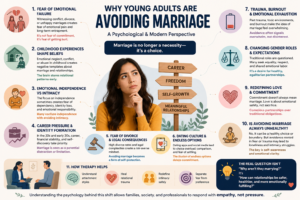
Fear of Emotional Failure Is Not the Same as Fear of Commitment
The idea that people avoid marriage because they are simply “afraid of commitment” is often too simplistic.
Some young adults genuinely want deep emotional intimacy and long-term companionship, while simultaneously fearing what could happen if the relationship becomes unhealthy.
- Their concern may not be: “I don’t want to commit.”
- It may be: “What if I commit to the wrong person and lose myself?”
This distinction matters.
Experiences That Can Influence This Fear
A person’s perception of marriage may be shaped by experiences such as:
- Witnessing chronic parental conflict
- Experiencing parental separation or divorce
- Growing up with emotionally unavailable caregivers
- Observing controlling or unequal relationships
- Seeing one partner repeatedly sacrifice their needs to maintain the marriage
- Hearing adults describe unhappy marriages as something they simply had to “adjust” to
Over time, these experiences may contribute to beliefs such as:
- “Marriage means losing my freedom.”
- “People change after marriage.”
- “Love eventually becomes responsibility.”
- “Once I am committed, it will be difficult to leave.”
- “I need to notice every possible red flag before I trust someone.”
This can create relationship hypervigilance—a tendency to closely monitor a partner or relationship for signs of danger, rejection, betrayal, or incompatibility.
What Attachment Theory Can Explain
Attachment theory provides one useful framework for understanding why some individuals experience intimacy as both desirable and threatening.
For example, someone with more avoidant attachment tendencies may value independence and feel uncomfortable with excessive emotional closeness. Someone with more anxious attachment tendencies may strongly desire intimacy while simultaneously fearing abandonment or rejection.
However, attachment style should not be used as a label for everyone who does not want marriage. A person can have a secure attachment style and consciously decide that marriage is simply not the life structure they want.
That distinction is essential: Not wanting marriage is not automatically an attachment problem.
Childhood Experiences Can Shape Adult Relationship Expectations
Our earliest relationships can influence the way we understand trust, intimacy, conflict, boundaries, and emotional safety.
A child who repeatedly observes:
- Emotional neglect
- Constant parental conflict
- Cold or emotionally disconnected relationships
- Controlling behavior
- Unequal power dynamics
- Emotional or psychological abuse
- Suppression of personal needs
may develop internal beliefs about relationships that continue into adulthood.
For example:
- “Close relationships are exhausting.”
- “Love requires sacrifice.”
- “If I become dependent on someone, I will lose myself.”
- “Conflict eventually destroys relationships.”
These beliefs do not automatically determine someone’s future. However, they can become relational schemas—mental frameworks through which later relationships are interpreted.
The Psychological Insight
People do not simply learn what relationships are from direct experience. They also learn from observing how important people around them behave. This means a young adult may consciously say: “I want a healthy marriage.”
while another part of them may still associate marriage with conflict, control, emotional exhaustion, or loss of autonomy.
This does not mean childhood experiences permanently determine adult choices. Healthy relationships, corrective experiences, self-awareness, and therapy can all help people develop new relational expectations.
Emotional Independence vs. Emotional Intimacy (Avoiding Marriage)
Modern conversations about mental health increasingly emphasize:
- Self-worth
- Boundaries
- Emotional regulation
- Self-reliance
- Personal growth
- Independence
These are valuable psychological skills.
However, they can sometimes be misunderstood as meaning: “I should never need anyone.”
That is where the difference between independence and interdependence becomes important.
Independence says:
“I can function as an individual.”
Dependence says:
“I cannot function without another person.”
Healthy interdependence says:
“I can function independently, while also allowing another person to matter deeply in my life.”
A healthy relationship does not require two people to merge their identities.
Instead, partners can maintain:
- Individual identities
- Personal boundaries
- Friendships and interests
- Financial and emotional agency
- Shared responsibilities
- Mutual emotional support
Some young adults fear that marriage will require them to surrender these aspects of themselves. Their concern may therefore be less about intimacy itself and more about identity loss.
Career Pressure, Uncertainty, and Identity Formation (Avoiding Marriage)
Young adulthood is an important period of identity development, exploration, and increasing autonomy.
Erik Erikson’s psychosocial theory famously described the developmental tension between identity and role confusion, followed by intimacy and isolation. However, these developmental processes should not be understood as rigid steps that everyone completes in exactly the same order.
Contemporary young adulthood is also taking place in a very different socioeconomic environment.
Many people face:
- Career instability
- Rising living costs
- Student or educational debt
- Housing difficulties
- Competitive employment markets
- Pressure to achieve professionally
- Social comparison through digital media
- Uncertainty about the future
As a result, marriage may be postponed until a person feels sufficiently secure in their identity, career, or finances.
Some may think:
- “I want to establish myself first.”
- “Need financial stability before starting a family.”
- “Don’t want marriage to determine my career choices.”
- “I am still figuring out who I am.”
This does not necessarily represent fear or avoidance. Sometimes it represents developmental timing and practical decision-making. The difficulty is that the feeling of being “fully established” may remain permanently out of reach in an increasingly uncertain economic environment.
Fear of Divorce and the Perceived Cost of a Wrong Decision
Marriage can represent a significant emotional, financial, social, and sometimes legal commitment. For some individuals, greater awareness of divorce and relationship breakdown has increased their perception of the risks involved. This can contribute to a risk-averse approach to romantic commitment.
A person may repeatedly ask:
- “What if we become incompatible?”
- “If the relationship changes after marriage?”
- “What if I regret my decision?”
- “If I cannot leave easily?”
- “What happens financially if the marriage ends?”
- “How can I know that this person is truly right for me?”
In some cases, this can involve cognitive processes such as catastrophizing, intolerance of uncertainty, or loss aversion. But caution is not automatically pathological.
Taking time to evaluate compatibility can be healthy. The concern arises when fear becomes so dominant that a person avoids intimacy altogether despite genuinely wanting it. For some people, therefore, avoiding marriage may function as self-protection against perceived emotional and practical risk.
Dating Culture and the Psychology of Endless Options (Avoiding Marriage)
Dating apps and social media have changed how people meet, evaluate, and communicate with potential partners. One major psychological phenomenon relevant here is choice overload. When people perceive that there are always more options available, making a final decision can become more difficult.
Digital dating can also encourage:
- Constant comparison
- Fear of settling
- Rapid judgments based on limited information
- Repeated searching for a “better” match
- Ambivalence about commitment
- Maintaining multiple possibilities simultaneously
A person may begin thinking: “What if someone better is just one swipe away?”
This can make commitment psychologically more difficult.
However, dating technology is not inherently responsible for commitment problems. The same platforms can also help people meet compatible partners whom they might never have encountered otherwise. The deeper issue is how perceived abundance of alternatives interacts with individual expectations, attachment patterns, personality, and relationship goals.
Trauma, Burnout, and Emotional Exhaustion (Avoiding Marriage)
Not everyone enters adulthood with abundant emotional capacity.
Some young adults are already carrying the effects of:
- Academic stress
- Difficult family environments
- Workplace burnout
- Previous relationship trauma
- Chronic interpersonal conflict
- Emotional exhaustion
- Repeated experiences of rejection or betrayal
When psychological resources are depleted, another major relationship commitment can feel overwhelming.
Marriage may then be perceived not as: “A source of companionship.”
but as: “Another responsibility I have to manage.”
The person may anticipate:
- More emotional labor
- Conflict more
- More expectations
- Responsibility more
- Less personal space
- Another opportunity to experience rejection or failure
From a trauma-informed perspective, avoidance can sometimes function as a protective strategy. But again, caution is important. Not every unmarried person is traumatized, and not every decision to remain single represents avoidance. The relevant question is whether the choice is consistent with the person’s values and preferences or primarily driven by unresolved fear.
Changing Gender Roles and Expectations (Avoiding Marriage)
Traditional marriage often came with relatively fixed expectations about:
- Gender roles
- Household responsibilities
- Childcare
- Financial responsibilities
- Decision-making
- Emotional labor
Those expectations are increasingly being questioned. Many young adults now want relationships based on equality, negotiation, autonomy, and shared responsibility.
Concerns may include:
- “Will I still have control over my own life?”
- “Household responsibilities actually be shared?”
- “Will marriage affect my career?”
- “I be expected to perform a traditional gender role?”
- “Will emotional labor become one person’s responsibility?”
These questions do not necessarily indicate rejection of relationships. They may indicate a demand for a different kind of relationship.
For many people, the issue is not: “I don’t want a partner.”
It is: “I don’t want a relationship structured around inequality.”
Redefining Love and Commitment (Avoiding Marriage)
The meaning of commitment is also changing.
For some young adults:
- Commitment does not necessarily require marriage.
- Love does not have to involve self-sacrifice.
- Partnership does not require losing individuality.
- Marriage is not the only marker of adulthood.
- Relationship status is not necessarily a measure of personal worth.
Increasingly, people may prioritize:
- Emotional safety
- Mutual respect
- Compatibility
- Shared values
- Personal autonomy
- Psychological well-being
- Conscious partnership
This represents a shift in relationship norms, not necessarily an improvement over previous generations in every respect. Every generation has its own strengths and vulnerabilities. The important psychological development is the growing emphasis on intentionality: choosing a relationship because it fits one’s values rather than entering it solely because society expects it.
Is Avoiding Marriage Always Unhealthy?
No.
This distinction is crucial.
Choosing not to marry can be:
- A conscious life decision
- Legitimate personal preference
- A reflection of different values
- Desire for autonomy
- A decision based on practical circumstances
- Healthy boundary following previous experiences
Being unmarried is not a psychological diagnosis. The concern arises when someone wants intimacy or partnership but repeatedly avoids it because of overwhelming fear.
For example, an individual might say: “I want a close relationship, but whenever someone becomes emotionally close to me, I find reasons to leave.”
Or: “I want love, but I cannot tolerate the vulnerability required for it.”
In such situations, the issue may be less about marriage itself and more about fear of intimacy, attachment insecurity, unresolved trauma, low trust, or difficulty tolerating vulnerability.
Therefore, the more useful question is not: “Why aren’t you married?”
but: “What does marriage mean to you, and what emotions arise when you imagine being in one?”
That question creates space for genuine self-exploration rather than social judgment.
How Therapy Can Help Clarify Marriage Anxiety (Avoiding Marriage)
Therapy should not be used to convince someone to marry. Its purpose is to help a person understand whether their relationship choices reflect their values or their fears.
Depending on the individual’s needs, therapy may explore:
- Attachment patterns
- Relationship schemas
- Fear of intimacy
- Previous relationship experiences
- Family-of-origin dynamics
- Boundaries and autonomy
- Emotional regulation
- Trust and vulnerability
- Unresolved relational trauma
- Cognitive distortions surrounding commitment
Therapy can help someone distinguish between: “I genuinely do not want marriage.” and “I want intimacy, but I am afraid of what marriage might cost me.”
Those are psychologically very different experiences.
The goal is not marriage.
The goal is clarity, autonomy, healthier relationships, and the freedom to make an informed decision without being controlled by fear or social pressure.
Conclusion (Avoiding Marriage)
Young adults’ changing attitudes toward marriage cannot be explained by a single psychological factor.
For some, the shift reflects:
- Greater autonomy
- Changing gender expectations
- Career and financial uncertainty
- Different definitions of partnership
- Greater awareness of unhealthy relationships
For others, hesitation may be connected to:
- Attachment insecurity
- Fear of intimacy
- Previous relationship trauma
- Family experiences
- Emotional exhaustion
- Fear of losing autonomy
And for many, it may simply be a conscious preference for a different way of living.
The mistake is assuming that every unmarried person needs to be “fixed”—just as it would be a mistake to assume that every person who avoids marriage is completely comfortable with that choice.
The psychologically meaningful question is not: “Why aren’t they getting married?”
It is: “What does marriage represent to them—and is their choice coming from freedom, values, and self-awareness, or from fear?”
Marriage is no longer necessarily a default destination in adulthood. For many people, it has become a deliberate choice that must compete with other equally meaningful ways of building a life.
Understanding this shift allows families, therapists, and society to move away from pressure and toward a more important conversation: How can we create relationships that offer intimacy without sacrificing autonomy, commitment without coercion, and love without losing the self?
Reference
-
Attachment Theory – American Psychological Association
👉 https://www.apa.org/monitor/julaug03/attachment -
Marriage Trends Among Young Adults – Pew Research Center
👉 https://www.pewresearch.org/social-trends/2020/08/07/are-marriage-rates-declining/ -
Erikson’s Stages of Psychosocial Development
👉 https://www.simplypsychology.org/Erik-Erikson.html -
Fear of Commitment – Psychology Today
👉 https://www.psychologytoday.com/us/basics/commitment -
Modern Dating & Choice Overload
👉 https://www.psychologytoday.com/us/basics/dating
Mental Health & Relationships – NIMH
👉 https://www.nimh.nih.gov/health/topics/mental-health
Mental health does not always announce itself loudly. Sometimes it appears as anger, exhaustion, withdrawal, overthinking, or simply losing interest in things that once mattered. Creating space to notice these changes is an important part of self-awareness and emotional well-being.