
Introduction: A Paradox of Connection
In 2025, we live in the most connected era in human history. We can message anyone instantly, join global communities, attend virtual meetings, and share our lives in real time. Yet, paradoxically, the Loneliness Epidemic has reached unprecedented levels, with millions of people reporting that they feel emotionally isolated, unseen, and disconnected—even while surrounded by others or constantly active online.
However, loneliness today is not merely about being physically alone. Rather, it is the experience of feeling alone, misunderstood, or emotionally unsupported. Consequently, this quiet epidemic can affect multiple areas of life, including mental health, physical health, productivity, relationships, and overall quality of life.
Moreover, the World Health Organization and multiple public health bodies now recognize loneliness as a serious public health concern, with effects that have been compared to major health risk factors such as smoking, obesity, and chronic stress. Importantly, loneliness is no longer confined to older adults. Instead, in 2025, it affects teenagers, working professionals, parents, couples, and even individuals with large social networks.
What Is Loneliness, Really?
To understand the Loneliness Epidemic, it is important to first recognize that loneliness is not the same as solitude. Although both involve spending time alone, they represent very different psychological experiences.
- Solitude is being alone by choice and can often feel peaceful, restorative, and personally meaningful.
- Loneliness, on the other hand, is the distressing experience of feeling emotionally disconnected, even when a person is not physically alone.
Psychologically, loneliness arises when there is a gap between the connection a person desires and the connection they actually experience. In other words, loneliness depends less on the number of people around us and more on whether our emotional and relational needs are being met.
For example, a person can:
- Be married and still feel lonely
- Have many friends and still feel lonely
- Live with family and still feel emotionally disconnected
- Be constantly online and yet experience profound loneliness
Therefore, loneliness is a subjective experience; however, its effects are very real. Even when someone appears socially connected on the outside, they may still be struggling with a deep sense of emotional isolation on the inside.
Loneliness EpidemicWhy Loneliness Has Become an Epidemic in 2025
Although technology and modern lifestyles have created more opportunities for connection, they have not necessarily created deeper emotional intimacy. As a result, several psychological and societal changes have contributed to the growing Loneliness Epidemic in 2025.
1. Digital Connection Without Emotional Intimacy
Technology has transformed how we interact; however, it has not always transformed how we connect emotionally. Although digital platforms allow us to communicate instantly, many online interactions lack the depth and emotional presence of face-to-face relationships.
In 2025:
- Conversations are often shorter
- Emojis can replace emotional nuance
- Scrolling can replace active listening
- Validation may come from likes rather than genuine presence
Furthermore, while digital platforms provide constant opportunities for social interaction, they often lack essential elements of meaningful connection, such as:
- Emotional depth
- Physical cues, including touch, tone, and eye contact
- Vulnerability
- Emotional attunement
Consequently, many people experience social saturation but emotional starvation—they are surrounded by communication yet continue to feel emotionally disconnected.
2. The Rise of Performative Living
Similarly, social media has contributed to the rise of performative living, where people feel pressure to present carefully curated versions of their lives. Instead of openly sharing both positive and difficult experiences, many individuals feel compelled to appear happy, productive, and successful.
Social media encourages people to:
- Curate idealized versions of their lives
- Hide personal struggles
- Appear happy, productive, and successful
As a result, this constant performance can create:
- Constant comparison
- Fear of vulnerability
- Shame around personal struggles
- A persistent feeling of being “behind” in life
Moreover, when everyone appears happy and successful online, people may begin to interpret their own loneliness as a personal failure rather than recognizing it as a shared human experience. Thus, social comparison can deepen the very isolation that social platforms appear to overcome.
3. Post-Pandemic Social Shifts That Never Fully Recovered
Furthermore, the COVID-19 pandemic significantly altered social behavior and patterns of interaction. Although many restrictions have ended, some of the social habits developed during that period have continued.
Even years later:
- Many people prefer isolation
- Social anxiety may remain elevated
- Trust in others may have declined
- Social skills can feel rusty
- Some community spaces have not fully recovered
For many individuals, prolonged isolation may have reinforced the perception that isolation equals safety. Consequently, reconnecting with others can feel unfamiliar, uncomfortable, or even threatening, making it harder to rebuild meaningful relationships.
4. Work Culture, Hustle, and Emotional Exhaustion
In addition, modern work culture can contribute significantly to emotional isolation. In 2025, work has become increasingly:
- Remote
- Demanding
- Performance-driven
- Potentially isolating
For example, remote work can reduce opportunities for:
- Casual conversations
- Workplace friendships
- Shared emotional experiences
At the same time, hustle culture often glorifies:
- Productivity over people
- Independence over interdependence
- Self-reliance over seeking support
As a result, many adults become emotionally exhausted, leaving them with little time or psychological energy to maintain meaningful relationships. Therefore, professional success can come at the cost of social and emotional well-being when connection is consistently deprioritized.
5. The Decline of Community and Shared Spaces
Beyond the workplace, traditional community structures have also weakened in many settings. As lifestyles become increasingly individualistic and fast-paced, opportunities for regular social interaction can become less frequent.
For example, there may be:
- Fewer neighborhood interactions
- A decline in religious and cultural gatherings
- Less time with extended family
- Fewer shared rituals and community activities
Consequently, people may begin to live parallel lives—physically close to one another yet emotionally distant. Since human beings are inherently social, the gradual loss of community can create a deep psychological void.
6. Dating Culture, Situationships, and Relationship Burnout
Meanwhile, modern dating culture has introduced another layer to the Loneliness Epidemic. Although dating apps and social platforms provide more opportunities to meet potential partners, greater choice does not necessarily lead to greater emotional security.
Modern dating in 2025 may be characterized by:
- Endless options
- Fear of commitment
- Ghosting and breadcrumbing
- Situationships without emotional security
As a result, many people experience:
- Romantic loneliness
- Emotional unavailability
- Attachment-related difficulties
- Repeated rejection
Furthermore, being in a relationship does not automatically protect someone from loneliness. A person may still feel deeply lonely because of emotional disconnection, unresolved conflicts, poor communication, or a lack of intimacy.
7. Emotional Invalidation and the “Strong Alone” Narrative
Finally, another important contributor to loneliness is the cultural belief that emotional strength means needing no one. Society often promotes messages such as:
- “Don’t need anyone”
- “Heal alone”
- “Be independent”
- “Don’t burden others”
Although independence is valuable, humans are wired for connection and emotional support. Therefore, when people repeatedly suppress their need for closeness, they may gradually become disconnected not only from others but also from their own emotional needs.
Suppressing the need for support can contribute to:
- Emotional isolation
- Shame around vulnerability
- Disconnection from self and others
Ultimately, loneliness grows where genuine emotional needs are consistently denied or ignored. Thus, addressing the Loneliness Epidemic requires not only creating more opportunities for social interaction but also creating environments where people feel safe enough to be vulnerable, supported, and genuinely understood.
Loneliness Epidemic: The Psychology of Loneliness
Loneliness is not simply an emotion; rather, it is a neurobiological and psychological state that can influence how people perceive themselves, interpret social situations, and respond to others. Therefore, understanding the psychology of loneliness is essential for understanding why prolonged disconnection can become increasingly difficult to break.
How Loneliness Affects the Brain
When loneliness becomes chronic, the brain may begin to interpret social disconnection as a potential threat. As a result, prolonged loneliness can:
- Activate threat responses
- Increase cortisol, the primary stress hormone
- Heighten sensitivity to rejection
- Impair emotional regulation
Consequently, the lonely brain may become increasingly:
- Hyper-vigilant
- Self-protective
- Distrustful
- Less open to connection
In other words, loneliness can alter the way a person perceives and responds to their social environment. This can create a vicious cycle: loneliness → withdrawal → reduced connection → greater loneliness. The more disconnected a person feels, the more difficult reaching out may become; consequently, isolation can reinforce itself over time.
Loneliness and Mental Health
Moreover, loneliness is strongly associated with several mental health difficulties, including:
- Depression
- Anxiety
- Low self-esteem
- Social anxiety
- Trauma-related responses
- Substance use
Importantly, the relationship between loneliness and mental health is not always one-directional. Loneliness can contribute to psychological distress, while existing mental health difficulties can also increase the risk of loneliness. Thus, loneliness can function as both a cause and consequence of mental health difficulties, creating a cycle that may become increasingly difficult to interrupt without appropriate support.
Physical Health Impact
Furthermore, the effects of chronic loneliness extend beyond psychological well-being. Research has linked persistent loneliness with an increased risk of several physical health problems, including:
- Heart disease
- Weakened immune functioning
- Sleep disorders
- Inflammation
- Premature mortality
Therefore, loneliness should not be dismissed as simply an unpleasant emotional experience. When loneliness becomes chronic, it can have significant psychological and biological consequences. Ultimately, the impact of loneliness demonstrates why addressing the Loneliness Epidemic requires attention not only to social relationships but also to overall mental and physical well-being.

Loneliness Epidemic: Who Is Most Affected in 2025?
Although loneliness can affect people at any stage of life, certain groups may be particularly vulnerable because of changing social roles, life transitions, relationship difficulties, or reduced opportunities for meaningful connection. Importantly, loneliness does not always depend on how many people surround us; rather, it often depends on whether we feel genuinely understood, supported, and connected.
1. Young Adults & Gen Z
Despite being highly connected through digital platforms, many young adults continue to experience significant emotional disconnection. They may report:
- Deep loneliness
- Identity confusion
- Fear of rejection
- A lack of meaningful friendships
Furthermore, digital intimacy can sometimes substitute for deeper, face-to-face relationships. As a result, young people may have frequent online interactions while their underlying emotional needs for belonging, acceptance, and genuine companionship remain unmet.
2. Working Professionals
Similarly, working professionals may become vulnerable to loneliness because of long working hours, remote work, demanding schedules, and burnout. Over time, these pressures can contribute to:
- Social withdrawal
- Reduced friendships
- Emotional numbness
Consequently, professional achievement does not always translate into emotional fulfillment. Success without meaningful connection can feel surprisingly empty, particularly when work consistently takes priority over relationships and personal well-being.
3. Parents
Parenthood can also be unexpectedly isolating. Although parents may spend much of their time caring for others, they may have limited opportunities to receive emotional support themselves. Consequently, many parents may feel:
- Isolated
- Unsupported
- Emotionally unseen
- Overwhelmed
Moreover, when parenting is experienced without a strong support network or sense of community, the emotional demands of parenthood can intensify loneliness. In other words, being constantly needed by others does not necessarily mean feeling emotionally connected.
4. Older Adults
Older adults can experience profound loneliness for several reasons, particularly as major life transitions reduce their social networks. For example, the loss of a partner, retirement, health-related challenges, and shrinking social circles can significantly reduce opportunities for meaningful interaction.
As a result, loneliness among older adults can become both persistent and deeply distressing. Importantly, this form of loneliness is often overlooked, even though social connection remains essential to psychological well-being throughout later life.
5. People in Relationships
Finally, loneliness can occur even within romantic relationships, making it one of the most painful forms of emotional disconnection. Being physically close to someone does not necessarily mean feeling emotionally close to them.
Loneliness within relationships may involve:
- Emotional neglect
- Poor communication
- Feeling unheard
- Living like roommates rather than intimate partners
Furthermore, unresolved conflict and a lack of emotional intimacy can gradually create distance between partners. Therefore, being in a relationship does not automatically protect someone from loneliness. In fact, feeling lonely while sitting beside someone you love can sometimes hurt more than being physically alone.
Why Loneliness Is Hard to Talk About
Despite how common loneliness has become, talking about it openly can still feel remarkably difficult. In many cases, loneliness carries a significant social stigma, causing people to worry about how others might perceive them.
People may fear being seen as:
- Weak
- Unlikable
- Needy
- Socially unsuccessful
As a result, instead of reaching out for support, many individuals hide their loneliness and internalize their suffering. Over time, this can lead to:
- Loneliness being hidden from others
- Emotional suffering being internalized
- Further social withdrawal and isolation
Consequently, the inability to talk openly about loneliness can reinforce the very experience people are trying to escape. In this way, silence does not simply conceal loneliness—it can also help sustain the Loneliness Epidemic.
How Technology Both Fuels and Can Heal Loneliness
Technology plays a complex role in the Loneliness Epidemic. On the one hand, digital platforms can intensify isolation; on the other hand, when used intentionally, they can create meaningful opportunities for connection and support.
How Technology Fuels Loneliness
For example, certain patterns of technology use can contribute to emotional disconnection, including:
- Passive scrolling
- Comparison culture
- Superficial interactions
- Reduced attention spans
- Less face-to-face contact
Furthermore, consuming large amounts of social content without actively engaging with others can create the illusion of connection without providing genuine emotional intimacy.
How Technology Can Help (When Used Intentionally)
However, technology is not inherently harmful. When used thoughtfully, it can also support connection through:
- Support communities
- Access to therapy and mental health resources
- Psychoeducation
- Meaningful conversations
- Shared interests and activities
Therefore, technology itself is not the enemy—how we use it matters. The goal is not necessarily to eliminate digital connection but to use technology in ways that complement, rather than replace, meaningful human relationships.
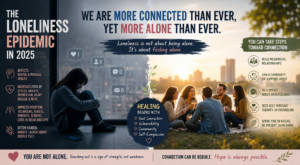
Healing the Loneliness Epidemic: What Can Help?
Although the Loneliness Epidemic is influenced by broader social and cultural factors, individuals can still take meaningful steps toward rebuilding connection. Fortunately, healing does not always require dramatic changes; often, small and consistent actions can gradually restore a sense of belonging.
1. Redefining Connection
First, it is important to redefine what meaningful connection actually means. Connection is not necessarily about the number of people in our lives; rather, it is about quality, emotional safety, and authenticity.
For example, one emotionally safe and supportive relationship may provide more psychological nourishment than a hundred surface-level interactions. Thus, building deeper relationships can be more valuable than simply increasing the size of one’s social network.
2. Practicing Vulnerability
Similarly, loneliness can decrease when people become more willing to show their authentic selves and communicate their emotional needs. This may involve:
- Sharing honestly
- Expressing emotions
- Asking for support
- Allowing themselves to be seen
Although vulnerability can initially feel uncomfortable, it creates opportunities for trust and emotional intimacy. In other words, vulnerability invites connection because it allows others to understand what lies beneath the surface.
3. Rebuilding Community
In addition to strengthening individual relationships, rebuilding a sense of community can play an important role in reducing loneliness. Small steps can include:
- Joining groups
- Volunteering
- Attending local events
- Reconnecting with old friends
Moreover, these activities create repeated opportunities for interaction, belonging, and shared experiences. Ultimately, community can help repair some of the psychological damage created by prolonged isolation.
4. Strengthening Emotional Skills
Furthermore, developing emotional and interpersonal skills can make it easier to build and maintain meaningful relationships. Helpful skills include:
- Emotional literacy
- Boundary setting
- Secure attachment behaviors
- Communication skills
Importantly, these skills are not fixed traits. They can be learned and strengthened at any age, allowing individuals to develop healthier patterns of connection over time.
5. Therapy and Counseling
For some individuals, professional support can provide an important pathway toward rebuilding connection. Therapy can offer:
- Safe emotional connection
- Validation
- Insight into relational patterns
- Opportunities to work through attachment-related wounds
Furthermore, therapy can provide a structured environment in which individuals can explore how past experiences, beliefs, and relationship patterns may influence their current experience of loneliness. For many people, therapy may become one of the first places where they feel genuinely heard and understood.
6. Reconnecting With Self
Finally, loneliness is not only about disconnection from other people; it can also involve disconnection from oneself. When individuals repeatedly ignore their emotions, needs, values, or inner experiences, they may gradually lose a sense of internal connection.
Practices such as:
- Journaling
- Mindfulness
- Self-compassion
- Inner-child-focused reflection
can help individuals become more aware of their internal experiences. As a result, rebuilding an internal sense of safety and connection can also support healthier external relationships.
What Society Needs to Address (Loneliness Epidemic)
At the same time, it is important not to place the entire responsibility for loneliness on individuals. Loneliness is not simply a personal problem; it is also a systemic and societal issue. Modern environments, work structures, technology, and community design can all influence how easily people are able to connect.
Therefore, addressing the Loneliness Epidemic requires broader solutions, including:
- Greater mental health awareness
- Community-centered urban design
- Healthier work-life balance
- Social-emotional education
- Destigmatizing vulnerability
Moreover, communities and institutions can play an important role in creating spaces where people can interact regularly, build trust, and develop a genuine sense of belonging. Ultimately, a connected society is a healthier society.
Conclusion: You Are Not Alone in Feeling Alone
The Loneliness Epidemic of 2025 is not a personal failure. Rather, it reflects the growing gap between modern lifestyles and some of our deepest human needs for belonging, emotional safety, and meaningful connection.
If you feel lonely, remember:
- You are not broken
- Not weak
- You are responding to an increasingly isolating world in a deeply human way
Therefore, healing begins with naming loneliness, acknowledging emotional needs, seeking meaningful connection, and allowing yourself to be fully human. Although rebuilding relationships can take time, meaningful connection can begin with something as simple as reaching out, having an honest conversation, or allowing someone trustworthy to see what you are really experiencing.
“Loneliness is not a sign that something is wrong with you—it is a sign that you are wired for connection.”
Ultimately, even after long periods of isolation, connection can be rebuilt. With vulnerability, support, community, and intentional effort, the experience of loneliness does not have to define the rest of a person’s life.
Reference
-
WHO – Mental Health & Social Well-Being
👉 https://www.who.int/teams/mental-health-and-substance-use
Anchor: mental health and social well-being -
Harvard Study of Adult Development
👉 https://www.adultdevelopmentstudy.org
Anchor: importance of relationships -
CDC – Social Isolation & Loneliness
👉 https://www.cdc.gov/aging/publications/features/lonely-older-adults.html
Anchor: social isolation and health -
APA – Loneliness and Mental Health
👉 https://www.apa.org/monitor/nov01/loneliness
Anchor: psychology of loneliness -
Self-Help & Emotional Well-Being: A Complete Guide to a Healthier Mind
- Contact Us