Top 7 Tools Men Can Use to Track Their Mental Wellness

Introduction

Mental wellness is not just about the absence of mental illness—it is about emotional balance, self-awareness, resilience, and the ability to cope with daily stressors. For many men, mental health is often deprioritized due to social expectations, demanding schedules, and the belief that they must handle everything on their own.

Men are statistically less likely to seek therapy early, yet they experience high levels of stress, burnout, emotional suppression, and untreated anxiety or depression. This gap has led to a growing interest in self-monitoring and digital mental wellness tools, which allow men to track their mental health privately, consistently, and at their own pace.

Mental wellness tools do not replace professional therapy—but they support awareness, early detection, emotional regulation, and healthy habits. This article explores the top 7 tools men can use to track their mental wellness, explaining how each tool works, why it matters psychologically, and how to use it effectively in daily life.

Why Tracking Mental Wellness Matters for Men

Mental wellness tracking helps men:

  • Recognize emotional patterns early

  • Identify stress triggers

  • Monitor mood and energy fluctuations

  • Reduce emotional suppression

  • Build healthier coping strategies

From a psychological perspective, self-monitoring increases emotional insight, which is the first step toward emotional regulation and behavioral change.

  • Normalizes emotional experiences

  • Reduces stigma around mental health

  • Encourages proactive self-care

  • Supports therapy or counseling when needed

Tool 1: Mood Tracking Apps

https://www.verywellmind.com/thmb/-U0xVf9OJvB7JNgmbS9BRUXCL6o%3D/1500x0/filters%3Ano_upscale%28%29%3Amax_bytes%28150000%29%3Astrip_icc%28%29/Daylio-a12eaa51dd2647e78a9305c2f070b710.jpg?utm_source=chatgpt.com

What Is a Mood Tracker?

Mood tracking apps allow users to log emotions daily using:

  • Emojis or mood scales

  • Emotion labels

  • Short notes or reflections

Over time, these apps generate patterns showing emotional highs, lows, and trends.

Why Mood Tracking Is Helpful for Men

Many men struggle to name or express emotions due to emotional conditioning. Mood trackers help by:

  • Expanding emotional vocabulary

  • Making emotions visible and measurable

  • Reducing emotional avoidance

  • Encouraging reflection without judgment

 Mood tracking asks, “How do I feel today?”

How to Use It Effectively

  • Track mood once or twice daily

  • Add brief notes about triggers

  • Review weekly or monthly patterns

  • Avoid judging “good” or “bad” emotions

Mood awareness improves emotional regulation and stress management.

Tool 2: Stress & Burnout Assessment Tools

What Are Stress Assessment Tools?

These tools use short questionnaires to measure:

  • Stress levels

  • Burnout risk

  • Emotional exhaustion

  • Work-life imbalance

They are often based on validated psychological scales.

Why This Tool Is Important

Men often normalize stress until it becomes burnout. Stress assessment tools:

  • Offer objective feedback

  • Identify early warning signs

  • Reduce denial and minimization

  • Encourage timely action

Psychologically, naming stress reduces its intensity.

How to Use It

  • Take assessments monthly or quarterly

  • Track changes over time

  • Use results to adjust workload or routines

  • Share insights with a counselor if needed

These tools are especially useful for working professionals.

Tool 3: Sleep Tracking Devices or Apps

https://oaksintcare.org/wp-content/uploads/2024/12/VitalRoleofSleep.png?utm_source=chatgpt.com

Why Sleep Is a Mental Health Indicator

Sleep is deeply linked to:

  • Mood regulation

  • Stress tolerance

  • Anxiety and depression

  • Cognitive performance

Poor sleep often worsens emotional reactivity.

How Sleep Tracking Helps Men

Sleep trackers monitor key sleep indicators, including:

  • Total sleep duration

  • Overall sleep quality

  • Night awakenings

  • Sleep consistency

This data helps men recognize how stress, screen time, caffeine, or work pressure affect sleep.

How to Use Sleep Data Wisely

  • Focus on trends, not perfection

  • Adjust bedtime routines gradually

  • Pair data with relaxation practices

  • Avoid obsessing over numbers

Better sleep improves emotional resilience.

Tool 4: Journaling & Reflection Tools

What Is Mental Health Journaling?

Journaling tools allow men to:

  • Write thoughts and emotions

  • Reflect on daily experiences

  • Process stress privately

Digital journals reduce the pressure of “writing perfectly.”

Why Journaling Works Psychologically

Journaling supports:

  • Emotional processing

  • Reduced rumination

  • Self-awareness

  • Problem-solving

For men who find talking difficult, writing becomes a safe emotional outlet.

How to Journal Effectively

  • Write for 5–10 minutes daily

  • Use prompts like:

    • “What stressed me today?”

    • “What helped me cope?”

  • Be honest, not polished

Journaling is one of the most evidence-supported self-help tools.

Tool 5: Mindfulness & Meditation Apps

https://cdn.prod.website-files.com/61258807d2d4f9553cc9d3e6/6646132ec0fbfec684c3113d_The%20Best%20Meditations%20for%20Stress%20Relief%C2%A0.webp?utm_source=chatgpt.com

What These Tools Do

Mindfulness apps guide users through:

  • Breathing exercises

  • Body scans

  • Short meditations

  • Stress-reduction practices

Sessions can be as short as 2–10 minutes.

Why Mindfulness Is Effective for Men

Mindfulness helps men:

  • Slow down impulsive reactions

  • Improve emotional control

  • Reduce anger and anxiety

  • Increase focus

It trains the brain to respond instead of react.

How to Start Without Resistance

  • Begin with short sessions

  • Focus on breathing, not “emptying the mind”

  • Practice consistency over duration

  • Use during work breaks or before sleep

Mindfulness is a skill, not a personality trait.

Tool 6: Habit & Routine Tracking Tools

What Are Habit Trackers?

Habit trackers monitor:

  • Exercise

  • Sleep routines

  • Water intake

  • Screen limits

  • Self-care habits

They visualize consistency and progress.

Why Habits Matter for Mental Wellness

Mental health improves when:

  • Daily structure is predictable

  • Self-care becomes routine

  • Small wins build confidence

For men, habits provide action-based self-care, which often feels more accessible than emotional talk.

How to Use Habit Trackers Well

  • Track only 2–3 habits at first

  • Keep goals realistic

  • Focus on consistency, not streaks

  • Review weekly progress

Healthy habits stabilize mood and energy.

Tool 7: Mental Health Screening & Therapy Platforms

https://menstherapy.online/wp-content/uploads/2025/11/MTO-Square-Logo-White-Background.png?utm_source=chatgpt.com

What These Platforms Offer

These tools provide:

  • Mental health screenings

  • Self-assessment questionnaires

  • Access to online counseling

  • Educational resources

They lower barriers to help-seeking.

Why This Matters for Men

Men often delay professional support due to:

  • Stigma

  • Time constraints

  • Privacy concerns

Digital platforms offer:

  • Confidential access

  • Flexible scheduling

  • Reduced initial resistance

Early screening prevents escalation.

How to Use Responsibly

  • Use screenings as guidance, not diagnosis

  • Seek professional help if symptoms persist

  • Combine tools with offline support when possible

Technology can bridge the gap to care.

How to Choose the Right Tools for Yourself

Not every tool suits everyone. Consider:

  • Your comfort with technology

  • Time availability

  • Emotional awareness level

  • Current stress load

Start with one or two tools, then expand gradually.

Common Mistakes to Avoid

  • Tracking obsessively

  • Expecting instant emotional change

  • Using tools instead of seeking help

  • Comparing progress with others

Tools support wellness; they do not replace human connection.

Integrating Tools into Daily Life

  • Link tracking to existing routines

  • Keep it simple and flexible

  • Review data weekly, not constantly

  • Focus on self-compassion

Consistency matters more than intensity.

When to Seek Professional Support

Tools are helpful, but consider professional help if:

  • Emotional distress persists

  • Mood worsens over time

  • Functioning is affected

  • Thoughts of hopelessness arise

Mental health care is a strength, not a failure.

Conclusion

Mental wellness tracking empowers men to understand themselves better—emotionally, mentally, and behaviorally. From mood trackers and journaling tools to sleep monitors and mindfulness apps, these tools offer accessible, private, and practical ways to support mental health.

Tracking does not mean fixing everything alone. It means paying attention, recognizing patterns, and choosing healthier responses. When combined with support, self-awareness, and compassion, mental wellness tools can play a powerful role in helping men live more balanced, resilient, and emotionally healthy lives.

Frequently Asked Questions (FAQ)

Top 7 Tools Men Can Use to Track Their Mental Wellness


1. What does it mean to track mental wellness?

Tracking mental wellness means regularly monitoring your mood, stress levels, sleep, habits, and emotional patterns to better understand how your mental health changes over time.


2. Why is mental wellness tracking important for men?

Many men suppress emotions or delay seeking help. Tracking tools increase self-awareness, help identify stress or burnout early, and provide a private way to engage with mental health.


3. Can mental wellness tools replace therapy or counseling?

No. These tools support self-awareness and early intervention but do not replace professional mental health care. They work best when combined with counseling if needed.


4. Which mental wellness tool should men start with?

Most men find mood trackers or sleep tracking tools easiest to begin with, as they require minimal effort and provide immediate insights into emotional and physical patterns.


5. How often should mental wellness be tracked?

Consistency matters more than frequency. Tracking once daily or a few times a week is enough to notice patterns without becoming overwhelming.


6. Are mood tracking apps useful if I don’t know how to label emotions?

Yes. Mood tracking apps often use emojis or simple emotion words, helping men gradually expand emotional awareness without pressure.


7. How does sleep tracking help mental health?

Sleep quality directly affects mood, stress tolerance, focus, and emotional regulation. Tracking sleep helps identify habits or stressors that impact mental wellness.


8. Is journaling effective for men who don’t like talking about feelings?

Yes. Journaling provides a private, judgment-free space to process thoughts and emotions, making it especially helpful for men who struggle with verbal expression.


9. Do mindfulness and meditation apps really reduce stress?

Research shows that short, consistent mindfulness practices improve emotional regulation, reduce anxiety, and lower stress—especially when practiced regularly.


10. How do habit trackers support mental wellness?

Habit trackers build structure and routine, which stabilize mood and energy. Small, consistent habits like exercise, hydration, or breaks support overall mental health.


11. Are online mental health screenings accurate?

Screenings are helpful for awareness, not diagnosis. They indicate whether professional support may be beneficial and should not be used as a final conclusion.


12. Can these tools help with burnout prevention?

Yes. Stress assessments, mood tracking, and habit monitoring help detect early warning signs of burnout, allowing timely adjustments before exhaustion becomes severe.


13. What are common mistakes men make when using mental health tools?

Common mistakes include tracking obsessively, expecting instant change, ignoring emotional insights, or using tools as a substitute for seeking help.


14. How can men stay consistent with mental wellness tools?

Link tools to existing routines, keep tracking simple, avoid perfectionism, and focus on self-compassion rather than streaks or scores.


15. When should a man seek professional mental health support?

Professional help is important if emotional distress persists, daily functioning is affected, mood worsens over time, or feelings of hopelessness or isolation increase.


About the Author

Baishakhi Das is a Counselor and Mental Health Practitioner with academic training in psychology and human development. She works with men experiencing stress, burnout, emotional suppression, and mental health challenges, focusing on practical, evidence-based strategies for emotional well-being.

Reference 


  1. World Health Organization. (2022). Mental health of men and boys.
    https://www.who.int/publications/i/item/9789240044149

  2. American Psychological Association. (2023). Technology and mental health.
    https://www.apa.org/monitor/2023/07/technology-mental-health

  3. National Institute of Mental Health. (2023). Caring for your mental health.
    https://www.nimh.nih.gov/health/topics/caring-for-your-mental-health

  4. Torous, J., et al. (2021). Digital mental health and COVID-19: Using technology today to accelerate the curve on access and quality tomorrow. JMIR Mental Health, 7(3).
    https://doi.org/10.2196/18848

  5. Mohr, D. C., et al. (2017). The behavioral intervention technology model. Journal of Medical Internet Research, 19(6).
    https://doi.org/10.2196/jmir.7787

  6. Courtenay, W. H. (2000). Constructions of masculinity and their influence on men’s well-being. Social Science & Medicine, 50(10), 1385–1401.
    https://doi.org/10.1016/S0277-9536(99)00390-1

  7. How to Build Daily Habits for Better Mental Health
10 Common Mental Health Challenges in Men—and How to Address Them

https://calmerry.com/wp-content/uploads/2021/05/depression-in-men.jpg?utm_source=chatgpt.com
Introduction

Mental health challenges in men are often hidden, minimized, or misunderstood. Social expectations frequently teach men to be strong, silent, and self-reliant. As a result, emotional distress is commonly suppressed rather than expressed. Many men struggle silently—until symptoms appear as anger, withdrawal, substance use, physical complaints, or burnout.

Research consistently shows that men are less likely to seek psychological help, yet they face significant mental health risks, including higher suicide rates and untreated emotional distress. Understanding the unique ways mental health challenges present in men is crucial for early support, prevention, and recovery.

This article explores 10 common mental health challenges in men and provides practical, psychologically grounded ways to address them, suitable for individuals, families, counselors, and mental health educators.

Why Men’s Mental Health Often Goes Unnoticed

Men are often conditioned to:

  • Hide vulnerability

  • Avoid emotional expression

  • View help-seeking as weakness

  • Prioritize responsibility over self-care

As a result, mental health symptoms may look different in men than in women—often showing up as irritability, aggression, risk-taking, workaholism, or emotional shutdown rather than sadness or tearfulness.

Recognizing these patterns is the first step toward change.

1. Depression in Men

How It Commonly Appears

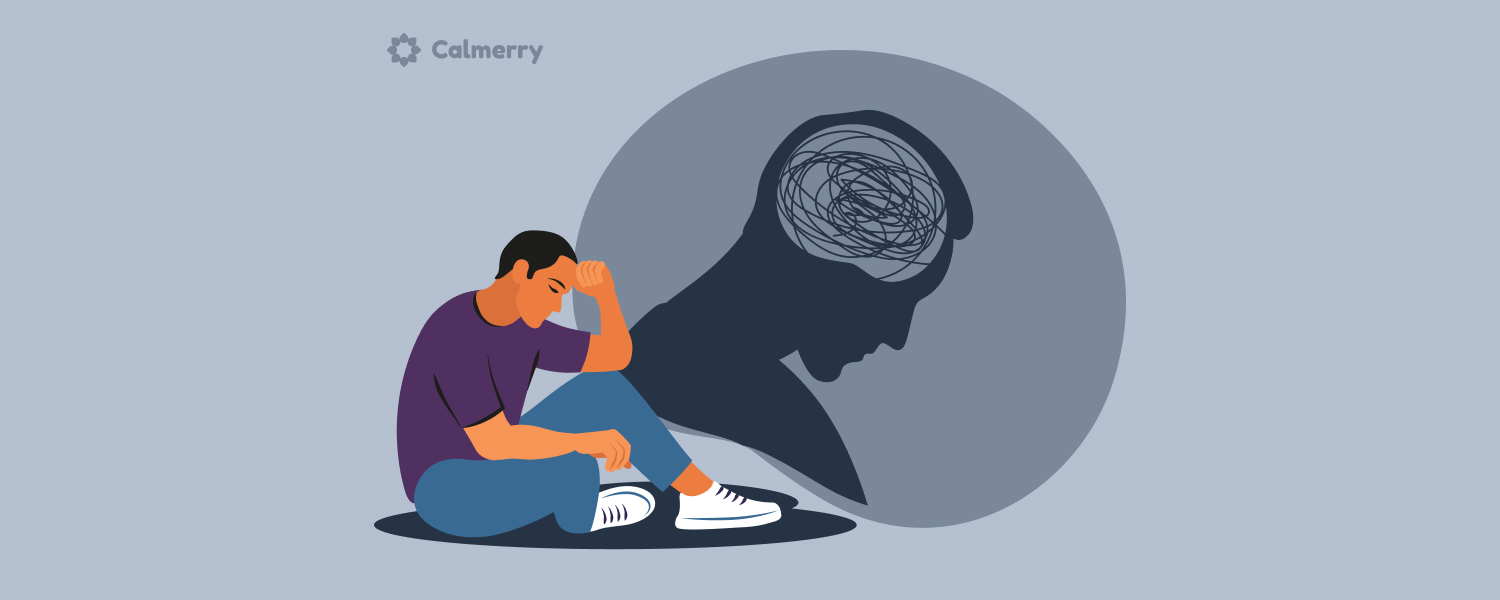
Depression in men is often underdiagnosed because it may not look like classic sadness.

Common signs include:

  • Persistent irritability or anger

  • Emotional numbness

  • Loss of interest in work or relationships

  • Fatigue and sleep disturbances

  • Withdrawal and isolation

Men may describe feeling “empty,” “tired,” or “burnt out” rather than “sad.”

How to Address It

  • Normalize emotional expression without judgment

  • Encourage routine and structure

  • Promote physical activity and sleep hygiene

  • Seek counseling or therapy early

  • Challenge beliefs that emotions equal weakness

2. Anxiety Disorders

How It Commonly Appears

Anxiety in men often manifests as:

  • Restlessness

  • Overthinking

  • Muscle tension

  • Difficulty relaxing

  • Avoidance of situations

Some men mask anxiety through overworking or controlling behavior.

How to Address It

  • Learn grounding and breathing techniques

  • Reduce caffeine and stimulants

  • Practice stress-management strategies

  • Cognitive-behavioral therapy (CBT) is highly effective

  • Normalize anxiety as a human experience

3. Anger and Emotional Dysregulation

Why It Happens

Many men were taught that anger is the only acceptable emotion, while sadness or fear were discouraged. As a result, emotional pain often gets expressed as anger.

Signs include:

  • Frequent irritability

  • Explosive reactions

  • Difficulty calming down

  • Relationship conflicts

How to Address It

  • Identify underlying emotions beneath anger

  • Learn emotional labeling skills

  • Practice pause-and-response techniques

  • Therapy focused on emotional regulation can help

  • Develop healthy outlets (exercise, journaling, conversation)

4. Stress and Work-Related Burnout

https://hbr.org/resources/images/article_assets/2022/10/A_Nov22_03_Men-mental-health_1341999505.jpg?utm_source=chatgpt.com

Why Men Are Vulnerable

Many men tie self-worth closely to:

  • Career success

  • Financial responsibility

  • Productivity

Chronic work stress can lead to:

  • Emotional exhaustion

  • Detachment

  • Reduced motivation

  • Physical health problems

How to Address It

  • Set realistic work boundaries

  • Redefine productivity beyond constant output

  • Take regular breaks and leave

  • Develop identity beyond work

  • Seek support before burnout becomes severe

5. Substance Use and Addiction

Why It’s Common

Men are more likely to use substances to:

  • Numb emotional pain

  • Manage stress

  • Avoid vulnerability

This may include alcohol, smoking, drugs, or behavioral addictions (gaming, gambling).

How to Address It

  • Address underlying emotional distress

  • Reduce shame around seeking help

  • Encourage non-judgmental conversations

  • Combine therapy with lifestyle changes

  • Seek specialized addiction support if needed

6. Loneliness and Social Isolation

How It Develops

As men age, friendships often reduce due to:

  • Work pressure

  • Family responsibilities

  • Emotional withdrawal

Loneliness in men is strongly linked to depression and poor physical health.

How to Address It

  • Rebuild social connections intentionally

  • Encourage shared activities rather than only “talk”

  • Maintain friendships outside work

  • Normalize emotional closeness among men

7. Relationship and Intimacy Difficulties

Common Challenges

Men may struggle with:

  • Emotional expression

  • Vulnerability

  • Communication

  • Fear of rejection

Unresolved emotional patterns often affect romantic relationships.

How to Address It

  • Learn emotional communication skills

  • Explore attachment patterns

  • Couples counseling when needed

  • Practice active listening

  • Address fears of intimacy gradually

8. Trauma and Unresolved Childhood Experiences

Why It’s Often Overlooked

Men may minimize past trauma, especially:

  • Childhood abuse

  • Emotional neglect

  • Bullying

  • Family violence

Unprocessed trauma can lead to anger, avoidance, or emotional shutdown.

How to Address It

  • Trauma-informed therapy

  • Safe emotional expression

  • Understanding triggers

  • Gradual processing of past experiences

  • Building emotional safety

9. Low Self-Esteem and Identity Struggles

Common Sources

  • Unrealistic masculine ideals

  • Comparison and performance pressure

  • Failure or job loss

  • Relationship breakdown

Low self-esteem in men may show as defensiveness or withdrawal.

How to Address It

  • Separate self-worth from achievement

  • Identify strengths beyond productivity

  • Practice self-compassion

  • Challenge negative self-beliefs

  • Work with a counselor if patterns persist

10. Suicide Risk and Hopelessness

https://sp-ao.shortpixel.ai/client/q_glossy%2Cret_img%2Cw_300/https%3A//mindthemen.co.uk/wp-content/uploads/2019/11/mind-the-men-asset_logo-300x300.png?utm_source=chatgpt.com

Critical Reality

Men are at higher risk of suicide, often due to:

  • Untreated depression

  • Emotional isolation

  • Reluctance to seek help

Warning signs may include:

  • Withdrawal

  • Talking about feeling like a burden

  • Risk-taking behavior

  • Sudden calm after distress

How to Address It

  • Take warning signs seriously

  • Encourage immediate professional support

  • Maintain open, non-judgmental communication

  • Crisis intervention when needed

  • Community and family support are vital


Breaking the Stigma Around Men’s Mental Health

True strength lies in:

  • Emotional awareness

  • Asking for help

  • Setting boundaries

  • Choosing healing over silence

When men are allowed to be emotionally human, mental health outcomes improve dramatically.


How Families and Society Can Support Men

  • Encourage emotional conversations

  • Avoid shaming vulnerability

  • Model healthy coping

  • Promote mental health education

  • Normalize therapy and counseling

Supportive environments save lives.

Conclusion

Men experience mental health challenges just as deeply as anyone else—often in quieter, less visible ways. Depression, anxiety, anger, burnout, addiction, and loneliness are not personal failures; they are human responses to stress, expectations, and unmet emotional needs.

Addressing men’s mental health requires awareness, compassion, early support, and cultural change. With the right tools and support, men can heal, grow, and thrive emotionally.

Mental health care is not a weakness—it is a responsibility toward oneself and those who depend on us.

Frequently Asked Questions (FAQ)

10 Common Mental Health Challenges in Men—and How to Address Them


1. Why are mental health issues in men often overlooked?

Men are often socialized to suppress emotions and appear strong or self-reliant. As a result, distress may show up as anger, withdrawal, substance use, or overworking rather than openly expressed sadness or anxiety—making it easier to miss.


2. What are the most common mental health challenges men face?

Common challenges include depression, anxiety, anger and emotional dysregulation, work-related burnout, substance use, loneliness, relationship difficulties, unresolved trauma, low self-esteem, and increased suicide risk.


3. How does depression look different in men?

Depression in men may appear as irritability, emotional numbness, fatigue, sleep problems, withdrawal, or loss of interest in work or relationships rather than visible sadness or crying.


4. Is anger a sign of poor mental health in men?

Anger can be a sign of underlying emotional distress. Many men were taught to express anger instead of sadness or fear, so unresolved pain may surface as irritability or outbursts.


5. Why do many men avoid seeking mental health support?

Common barriers include stigma, fear of being judged, beliefs that asking for help is a weakness, lack of emotional language, and limited awareness of mental health resources.


6. How does work stress affect men’s mental health?

Men often tie self-worth to productivity and financial responsibility. Chronic work stress can lead to burnout, emotional exhaustion, irritability, physical health issues, and reduced motivation.


7. Are substance use and addiction linked to men’s mental health?

Yes. Many men use substances such as alcohol or drugs to cope with stress, emotional pain, or unresolved trauma. Addressing the underlying emotional issues is essential for recovery.


8. How does loneliness impact men psychologically?

Loneliness increases the risk of depression, anxiety, substance use, and poor physical health. As men age, social connections may decrease, making isolation a significant mental health risk.


9. What role does childhood trauma play in men’s mental health?

Unresolved childhood trauma—such as abuse, neglect, or emotional invalidation—can affect emotional regulation, relationships, self-esteem, and coping strategies in adulthood.


10. Why is suicide risk higher in men?

Men are less likely to seek help and more likely to use lethal means. Untreated depression, emotional isolation, and social pressure contribute significantly to increased suicide risk.


11. How can men start improving their mental health?

Small steps help, such as:

  • Acknowledging emotions

  • Talking to someone trusted

  • Reducing harmful coping behaviors

  • Practicing stress management

  • Seeking professional support when needed


12. Is therapy effective for men?

Yes. Therapy provides a safe, confidential space to understand emotions, improve coping skills, address trauma, and build healthier relationships. Many men benefit greatly once they engage.


13. How can families and partners support men’s mental health?

Supportive listening, avoiding judgment, encouraging help-seeking, validating emotions, and reducing stigma can make a significant difference.


14. Are mental health struggles a sign of weakness?

No. Mental health challenges are human experiences, not personal failures. Seeking help reflects self-awareness, responsibility, and strength.


15. What is the most important message about men’s mental health?

Men deserve emotional support, understanding, and care just like anyone else. Breaking silence and stigma is essential for prevention, healing, and long-term well-being.


About the Author

Baishakhi Das is a Counselor and Mental Health Practitioner with formal training in psychology and human development. She works with men facing stress, emotional suppression, relationship issues, trauma, and burnout, focusing on practical coping strategies and emotional resilience.

Reference 

How to Handle Work Stress Without Burning Out

https://docsmedicalgroup.com/docsurgentcare/wp-content/uploads/sites/2/2024/05/How-To-Manage-Work-Stress-and-Avoid-Burnout-6-Tips-From-Trusted-Primary-Care-Doctor-in-Fairfield-CT.jpg?utm_source=chatgpt.com

Introduction

In today’s fast-paced, achievement-driven world, work stress has become almost unavoidable. Long working hours, constant deadlines, financial pressure, job insecurity, multitasking, and digital overload have blurred the boundary between professional and personal life.

As a result, many individuals experience mental exhaustion, emotional depletion, and physical fatigue—often without realizing they are gradually moving toward burnout.

Although closely related, stress and burnout are not the same. Stress is characterized by feeling overwhelmed while remaining engaged, whereas burnout involves prolonged emotional, mental, and physical exhaustion accompanied by a gradual loss of motivation, productivity, and sense of purpose.

The good news is that burnout is preventable. With the right awareness, mindset, and practical strategies, work stress can be managed effectively without reaching a breaking point.

This article offers a psychology-based, practical guide on how to handle work stress without burning out—suitable for working professionals, managers, caregivers, freelancers, and anyone struggling to balance work and well-being.

Understanding Work Stress

What Is Work Stress?

Work stress arises when the demands of a job exceed an individual’s capacity to manage them successfully.  It can stem from:

  • Heavy workload

  • Tight deadlines

  • Lack of control or autonomy

  • Poor work-life balance

  • Job insecurity

  • Workplace conflict

  • High expectations or perfectionism

Occasional stress is normal and can even enhance performance. However, chronic unmanaged stress gradually impacts mental health, physical health, and emotional stability.

Stress vs Burnout: Know the Difference

Understanding the difference is crucial for early intervention.

Work Stress

  • You feel pressured and overwhelmed

  • You may still care about your work

  • Energy fluctuates

  • Motivation is present but strained

Burnout

  • Emotional numbness or detachment

  • Feeling hopeless or trapped

  • Constant exhaustion

  • Reduced performance and meaning

  • Cynicism toward work

Recognizing stress early allows you to take action before burnout develops.

Early Warning Signs You Should Not Ignore

Burnout does not happen overnight. It builds gradually through warning signs such as:

Emotional Signs

  • Irritability and frustration

  • Feeling emotionally drained

  • Anxiety or low mood

  • Reduced motivation

Cognitive Signs

  • Difficulty concentrating

  • Overthinking work issues

  • Forgetfulness

  • Negative self-talk

Physical Signs

  • Headaches

  • Muscle tension

  • Sleep disturbances

  • Frequent illness

Behavioral Signs

  • Procrastination

  • Withdrawal from others

  • Increased caffeine or screen use

  • Working excessively without rest

Recognizing these signs early is the first step toward prevention.

Why Burnout Happens (Psychological Perspective)

Burnout often develops when:

  • Effort is high but rewards are low

  • There is a lack of recognition

  • Boundaries are unclear

  • Control is limited

  • Values conflict with work demands

Psychologically, burnout is linked to:

  • Chronic stress activation

  • Emotional suppression

  • Lack of recovery time

  • Identity tied only to productivity

Therefore, managing stress requires both external changes and internal mindset shifts.

1. Set Clear Boundaries Between Work and Personal Life

One of the most effective ways to prevent burnout is by creating clear boundaries.

How to Do This

  • Define work hours and stick to them

  • Avoid checking emails late at night

  • Create a separate workspace at home

  • Communicate availability clearly

Why it works:
Boundaries protect your mental energy and allow your nervous system to recover.

2. Learn to Prioritize, Not Multitask

Multitasking increases mental fatigue and reduces efficiency. Instead, prioritize tasks based on importance and urgency.

Practical Tips

  • Use a daily task list with 3 key priorities

  • Break large tasks into smaller steps

  • Focus on one task at a time

  • Accept that everything cannot be done at once

Psychological benefit:
Prioritization reduces cognitive overload and decision fatigue.

3. Redefine Productivity (Quality Over Quantity)

Many professionals equate productivity with long hours. However, productivity is about effective output, not exhaustion.

Healthy Productivity Means

  • Working with focus, not fear

  • Taking breaks to maintain efficiency

  • Allowing rest without guilt

When productivity is defined realistically, stress naturally reduces.

4. Practice Emotional Regulation at Work

Work stress often intensifies due to unprocessed emotions such as frustration, fear, or anger.

Simple Emotional Regulation Techniques

  • Pause and take 5 deep breaths

  • Label the emotion: “I feel overwhelmed”

  • Ground yourself by noticing your surroundings

  • Avoid reacting immediately during conflict

Result:
Better emotional control prevents impulsive decisions and emotional burnout.

5. Take Micro-Breaks Throughout the Day

Rest does not always mean long holidays. Short, intentional breaks are powerful.

Examples of Micro-Breaks

  • Stretching for 2 minutes

  • Stepping away from the screen

  • Drinking water mindfully

  • Brief breathing exercises

These breaks reset the nervous system and improve focus.

6. Manage Perfectionism and Unrealistic Expectations

Perfectionism is a major contributor to burnout. Constantly trying to meet unrealistic standards drains emotional energy.

Healthy Mindset Shifts

  • Progress is better than perfection

  • Mistakes are part of learning

  • Self-worth is not equal to performance

Letting go of perfectionism allows sustainable growth.

7. Improve Sleep and Physical Health

Stress and sleep are deeply connected. Poor sleep increases stress sensitivity.

Tips for Better Sleep

  • Maintain a consistent sleep schedule

  • Reduce screen exposure before bed

  • Avoid excessive caffeine

  • Practice relaxation techniques

Physical movement, even light exercise, helps regulate stress hormones.

8. Build Supportive Workplace Relationships

Social support acts as a buffer against stress.

How to Strengthen Support

  • Communicate openly with colleagues

  • Ask for help when needed

  • Share workload concerns respectfully

  • Avoid isolation

Feeling understood at work reduces emotional exhaustion.

9. Learn to Say No Without Guilt

Overcommitment is a fast track to burnout.

Assertive Communication Examples

  • “I don’t have the capacity right now.”

  • “Can we prioritize this for later?”

  • “I need to focus on existing deadlines.”

Saying no is not a failure—it is self-respect.

10. Create Meaning Beyond Work

When identity is limited only to work, stress becomes overwhelming.

Protective Factors

  • Hobbies

  • Creative activities

  • Relationships

  • Spiritual or reflective practices

Meaning outside work creates emotional balance and resilience.

11. Use Stress-Reduction Techniques Regularly

Stress management is most effective when practiced consistently, not only during crisis.

Effective Techniques

  • Mindfulness

  • Journaling

  • Progressive muscle relaxation

  • Guided breathing

Even 10 minutes a day can significantly reduce stress levels.

12. Recognize When You Need Professional Help

Sometimes, self-help is not enough—and that is okay.

Consider Professional Support If

  • Stress feels unmanageable

  • Emotional numbness persists

  • Anxiety or depression develops

  • Work impacts daily functioning

Counseling helps identify patterns, strengthen coping skills, and restore emotional balance.

Long-Term Strategies for Burnout Prevention

  • Regular self-check-ins

  • Annual leave without guilt

  • Career alignment with values

  • Ongoing skill development

  • Emotional self-awareness

Burnout prevention is a long-term lifestyle practice, not a one-time solution.

Conclusion

Work stress is a reality of modern life, but burnout does not have to be. By recognizing early warning signs, setting healthy boundaries, regulating emotions, redefining productivity, and prioritizing mental health, it is possible to manage work stress without sacrificing well-being.

Remember, rest is not a reward for exhaustion—it is a requirement for sustainability. Taking care of your mental health is not a weakness; it is the foundation of long-term success and fulfillment.

Frequently Asked Questions (FAQ)

How to Handle Work Stress Without Burning Out


1. What is work stress?

Work stress occurs when job demands exceed a person’s ability to cope. It can be caused by heavy workload, tight deadlines, lack of control, job insecurity, or poor work–life balance.


2. What is burnout and how is it different from stress?

Stress involves feeling overwhelmed but still engaged and motivated. Burnout, on the other hand, is a state of chronic emotional, mental, and physical exhaustion marked by detachment, reduced performance, and loss of meaning at work.


3. What are the early signs of burnout?

Early signs include constant fatigue, irritability, lack of motivation, difficulty concentrating, sleep problems, emotional numbness, and feeling disconnected from work or colleagues.


4. Can work stress be managed without quitting the job?

Yes. Most work stress can be managed through healthy boundaries, prioritization, emotional regulation, realistic expectations, proper rest, and supportive communication—without changing jobs.


5. Why is setting boundaries important for preventing burnout?

Boundaries protect mental and emotional energy. Without clear limits on work hours and availability, the nervous system does not get enough time to recover, increasing the risk of burnout.


6. How does perfectionism contribute to burnout?

Perfectionism creates constant pressure to perform flawlessly, leading to self-criticism, fear of failure, and emotional exhaustion. Over time, this significantly increases burnout risk.


7. Do short breaks really help with work stress?

Yes. Micro-breaks help reset the nervous system, improve focus, and reduce mental fatigue. Even 2–5 minutes of rest can lower stress levels during the workday.


8. How does poor sleep affect work stress?

Lack of sleep increases emotional reactivity, reduces concentration, and weakens stress tolerance. Poor sleep and work stress often reinforce each other, accelerating burnout.


9. Is it okay to say no at work for mental health reasons?

Yes. Saying no respectfully is a form of self-care. Overcommitting may temporarily please others but often leads to long-term stress, reduced performance, and burnout.


10. Can emotional regulation reduce workplace stress?

Absolutely. Skills like pausing, deep breathing, labeling emotions, and responding instead of reacting help manage stress, prevent conflict, and reduce emotional exhaustion.


11. How does social support at work reduce burnout?

Supportive colleagues and supervisors provide emotional validation, shared problem-solving, and a sense of belonging, all of which buffer against stress and burnout.


12. Is burnout only related to workload?

No. Burnout is also linked to lack of recognition, value conflicts, poor control over work, emotional suppression, and identity being tied solely to productivity.


13. When should someone seek professional help for work stress?

Professional support is recommended if stress becomes unmanageable, symptoms persist for weeks, emotional numbness develops, or work stress affects daily functioning and relationships.


14. Can counseling help with burnout recovery?

Yes. Counseling helps identify stress patterns, improve coping strategies, strengthen emotional regulation, rebuild boundaries, and restore balance and motivation.


15. What is the most important step in preventing burnout?

Self-awareness. Regularly checking in with your emotional, mental, and physical state allows early intervention before stress turns into burnout.

About the Author

Baishakhi Das is a Counselor and Mental Health Practitioner with academic training in psychology and human development. She works with individuals experiencing work stress, emotional exhaustion, anxiety, and burnout, focusing on practical coping strategies and emotional resilience.

Reference

Structure of Personality: Id, Ego & Superego Explained Simply

Introduction

Impulsive actions often leave us wondering why we didn’t think twice.
Guilt has a way of appearing even in complete privacy.
These experiences point to an inner conflict between what we want and what we believe we should do.

To answer these questions, Sigmund Freud proposed one of the most influential models of personality in psychology—the structural model of personality, consisting of the Id, Ego, and Superego.

Freud believed that human personality is not a single, unified system. Instead, personality is shaped through a dynamic interaction of three mental forces; together, they constantly negotiate and influence behavior.These forces operate largely outside conscious awareness and shape our thoughts, emotions, decisions, behavior, and even mental health.

This article explains the Id, Ego, and Superego in simple language, with real-life examples, clinical relevance, and everyday applications, making it useful for students, counselors, educators, and general readers.

Freud’s Structural Model of Personality: An Overview

Freud introduced the structural model in his work The Ego and the Id (1923). According to him:

  • Personality develops through inner conflict

  • Behavior is the result of interaction, not dominance of one part

  • Psychological problems arise when these parts are imbalanced

The three components are:

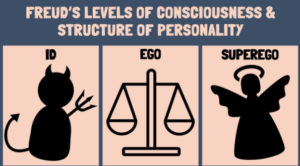
  1. Id – “I want it now”

  2. Ego – “Let’s think logically”

  3. Superego – “This is right or wrong”

They are not physical structures of the brain but theoretical constructs that help explain human behavior.

The Id: The Primitive Core of Personality

What Is the Id?

The Id is the oldest and most primitive part of personality. It is present from birth and operates entirely in the unconscious mind.

The id follows the pleasure principle, meaning:

“Seek pleasure, avoid pain, and satisfy desires immediately.”

The id does not care about:

  • Morality

  • Social rules

  • Consequences

  • Reality

Key Characteristics of the Id

  • Completely unconscious

  • Irrational and impulsive

  • Demands instant gratification

  • Driven by biological instincts

Freud believed the id contains two major instinctual drives:

  • Life instincts (Eros) – hunger, thirst, sex, survival

  • Death instincts (Thanatos) – aggression, destruction

Real-Life Examples of the Id

  • A baby crying loudly until it is fed

  • Eating junk food despite knowing it’s unhealthy

  • Sudden anger and shouting without thinking

  • Impulsive spending without planning

In adulthood, id-driven behavior may appear as:

  • Addictions

  • Aggression

  • Risk-taking

  • Poor impulse control

Id and Mental Health

When the id dominates personality:

  • The person may act recklessly

  • Difficulty delaying gratification

  • Problems with authority and rules

  • Higher risk of antisocial behavior

The id itself is not “bad”—it provides energy and motivation—but without regulation, it becomes destructive.

The Ego: The Rational Decision-Maker

What Is the Ego?

The Ego develops from the id during early childhood. It acts as the mediator between the id’s demands, the superego’s moral pressure, and external reality.

The ego follows the reality principle, which means:

“How can I satisfy this desire in a realistic and socially acceptable way?”

Functions of the Ego

  • Logical thinking

  • Problem-solving

  • Planning and decision-making

  • Delaying gratification

  • Reality testing

The ego operates at all three levels:

  • Conscious

  • Preconscious

  • Unconscious

Everyday Examples of the Ego

  • Feeling hungry (id) but waiting until lunchtime

  • Wanting to shout at your boss but choosing calm communication

  • Saving money instead of spending impulsively

The ego says:

“Not now.”
“Let’s find a better way.”
“Think about consequences.”

Ego Strength and Mental Health

A healthy ego leads to:

  • Emotional balance

  • Good coping skills

  • Problem-solving ability

  • Healthy relationships

A weak ego may result in:

  • Anxiety

  • Poor decision-making

  • Dependence on defense mechanisms

  • Emotional instability

The Superego: The Moral Judge

What Is the Superego?

The Superego represents moral values, conscience, and societal rules. It develops around the age of 4–6 years through parental guidance, cultural norms, and social expectations.

The superego strives for perfection, not pleasure or practicality.

Components of the Superego

  1. Conscience

    • Punishes wrongdoing

    • Produces guilt, shame, anxiety

  2. Ego Ideal

    • Rewards good behavior

    • Produces pride, self-worth

Examples of the Superego

  • Feeling guilty for lying

  • Feeling ashamed after hurting someone

  • Wanting to be a “good person”

  • Avoiding temptation due to moral values

The superego says:

“This is wrong.”
“You should not do this.”
“Be better.”

Superego and Psychological Problems

An overly strict superego may cause:

  • Excessive guilt

  • Low self-esteem

  • Anxiety disorders

  • Depression

  • Perfectionism

A weak superego may lead to:

  • Lack of empathy

  • Moral indifference

  • Rule-breaking behavior

Interaction Between Id, Ego, and Superego

Personality is shaped by constant conflict among these three systems.

Example: Eating Cake on a Diet

  • Id: “Eat it now!”

  • Superego: “It’s unhealthy. Don’t do it.”

  • Ego: “I’ll have a small piece today and exercise later.”
    In this way,
    healthy behavior emerges as the ego creates balance between desire and self-control.

Defense Mechanisms: Ego’s Tools for Balance

When inner conflicts create anxiety, therefore, the ego unconsciously relies on defense mechanisms to protect the individual. unconsciously to protect the individual.

Common defense mechanisms include:

  • Repression

  • Denial

  • Projection

  • Rationalization

  • Displacement

  • Regression

  • Sublimation

Example:

  • Anger at your boss → shouting at family (displacement)

Defense mechanisms are normal, but excessive use can lead to emotional problems.

Clinical Importance in Counseling & Therapy

Understanding the id–ego–superego helps counselors:

  • Identify unconscious conflicts

  • Understand resistance and defense patterns

  • Explore guilt, shame, and impulse control

  • Address childhood-based emotional struggles

In psychodynamic therapy, strengthening the ego is often a key therapeutic goal.

Criticism of the Structural Model

Despite its influence, Freud’s model is criticized for:

  • Lack of scientific testing

  • Overemphasis on unconscious processes

  • Cultural and gender bias

  • Abstract concepts difficult to measure

However, it remains foundational in personality theory and psychotherapy.

Modern Relevance of Id, Ego & Superego

Even today, Freud’s model is used to:

  • Understand emotional conflicts

  • Explain impulsive vs controlled behavior

  • Analyze moral guilt and anxiety

  • Interpret dreams and slips of speech

  • Support psychodynamic counseling

Many modern therapies have evolved but still rely on these core ideas.

Simple Summary Table

Component Key Function Operates On Example
Id Pleasure Unconscious “I want it now”
Ego Reality All levels “Let’s think”
Superego Morality Mostly unconscious “This is wrong”

Conclusion

Freud’s structural model—Id, Ego, and Superego—offers a powerful way to understand human behavior, emotional conflict, and personality development. While the id provides energy, the superego provides values, and the ego maintains balance.

Mental well-being depends not on eliminating any part, but on creating harmony among all three.

Understanding this model helps us become more self-aware, emotionally regulated, and psychologically resilient.

Frequently Asked Questions (FAQ)

Structure of Personality: Id, Ego & Superego Explained Simply


1. What is the structure of personality according to Freud?

According to Sigmund Freud, personality is made up of three interacting components: Id, Ego, and Superego. These parts work together to shape thoughts, emotions, behavior, and decision-making.


2. What is the Id in simple words?

The Id is the impulsive part of personality that wants immediate pleasure. It operates unconsciously and follows the pleasure principle, meaning it seeks instant satisfaction without considering consequences.


3. Is the Id bad or unhealthy?

No. The id is not bad; it provides basic motivation and energy for survival. Problems occur only when the id dominates behavior without control from the ego and superego.


4. What is the Ego and why is it important?

The Ego is the rational decision-maker. It follows the reality principle and balances the demands of the id, the rules of the superego, and real-life situations. A strong ego is essential for emotional stability and mental health.


5. What is the Superego?

The Superego represents moral values, conscience, and societal rules learned from parents and culture. It guides behavior by creating feelings of guilt, shame, pride, or self-approval.


6. What happens if the Superego is too strong?

An overly strong superego can lead to:

  • Excessive guilt

  • Low self-esteem

  • Anxiety or depression

  • Perfectionism

Such individuals may be very self-critical and fear making mistakes.


7. What happens if the Ego is weak?

A weak ego may struggle to manage inner conflicts, leading to:

  • Anxiety

  • Poor decision-making

  • Emotional outbursts

  • Overuse of defense mechanisms


8. How do Id, Ego, and Superego work together?

They constantly interact:

  • Id: “I want this now.”

  • Superego: “This is wrong.”

  • Ego: “Let’s find a realistic and acceptable solution.”

Healthy personality results from effective balance among the three.


9. What are defense mechanisms?

Defense mechanisms are unconscious strategies used by the ego to reduce anxiety caused by conflicts between the id and superego. Examples include repression, denial, projection, rationalization, and sublimation.


10. Are defense mechanisms normal?

Yes. Everyone uses defense mechanisms. They become problematic only when used excessively or rigidly, interfering with healthy emotional functioning.


11. How is this theory useful in counseling and therapy?

Understanding id, ego, and superego helps therapists:

  • Identify unconscious conflicts

  • Understand guilt, shame, and impulse control

  • Work with childhood experiences

  • Strengthen ego functioning

This is especially useful in psychodynamic counseling.


12. Is Freud’s structure of personality scientifically proven?

Freud’s model is largely theoretical and not easily testable through experiments. However, it remains influential for understanding personality, emotions, and therapeutic processes.


13. Is the Id–Ego–Superego theory still relevant today?

Yes. While modern psychology has evolved, this model is still used to explain emotional conflicts, moral struggles, impulsive behavior, and inner tension in both clinical and everyday contexts.


14. Can this theory be explained to students easily?

Yes. Using simple examples like hunger, anger, or temptation makes the id–ego–superego model easy to understand for school, college, and competitive exams.


15. What is the main idea of Freud’s structure of personality?

The core idea is that human behavior results from a constant inner conflict between desire (id), morality (superego), and reality (ego). Mental health depends on how well the ego manages this balance.

Written by Baishakhi Das
Qualifications: B.Sc, M.Sc, PG Diploma in Counseling
Role: Counselor / Mental Health Practitioner

Reference

Psychoanalytic Theory: Freud’s View of the Human Mind

https://www.simplypsychology.org/wp-content/uploads/Freud_Iceberg.jpeg?utm_source=chatgpt.com

Introduction

The Psychoanalytic Theory, developed by Sigmund Freud, is one of the most influential and controversial theories in the history of psychology. Freud’s ideas reshaped how humanity understands the human mind, behavior, emotions, personality, and mental illness. At a time when psychological science was still in its infancy, Freud dared to suggest that much of human behavior is driven by unconscious forces, hidden desires, unresolved childhood conflicts, and instinctual drives.

Freud proposed that the mind is not fully accessible to conscious awareness and that our thoughts, feelings, and actions are often shaped by mental processes operating outside our awareness. This radical idea challenged traditional views of rationality and free will and laid the foundation for modern psychotherapy.

Although many of Freud’s ideas have been debated, modified, or criticized, his psychoanalytic framework continues to influence clinical practice, personality theory, literature, art, and popular culture. This article explores Freud’s view of the human mind in depth—covering its structure, levels of consciousness, instinctual drives, personality development, defense mechanisms, and lasting impact.

Historical Background of Psychoanalytic Theory

Freud was born in 1856 in Austria and trained as a neurologist. While treating patients with hysteria and unexplained physical symptoms, Freud observed that many psychological problems could not be explained by organic causes alone. Working with Josef Breuer, he noticed that patients experienced relief when they talked freely about painful memories—a process later known as catharsis.

From these observations, Freud developed psychoanalysis, both as a theory of personality and a method of therapy. He believed that psychological symptoms arise from unresolved unconscious conflicts, often rooted in early childhood experiences.

https://upload.wikimedia.org/wikipedia/commons/3/36/Sigmund_Freud%2C_by_Max_Halberstadt_%28cropped%29.jpg?utm_source=chatgpt.com

Freud’s Topographical Model: Levels of Consciousness

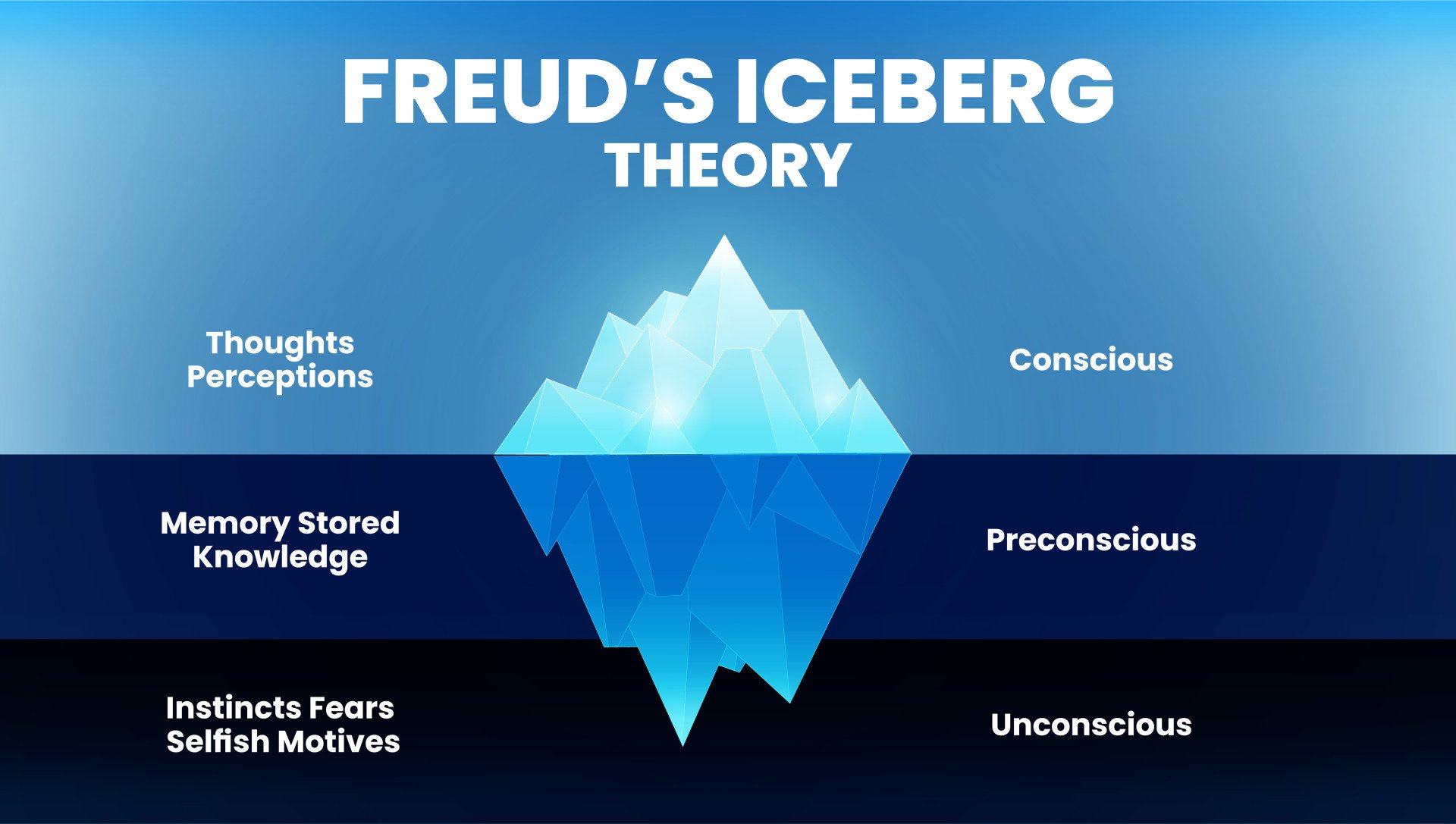
Freud divided the human mind into three levels of awareness:

1. Conscious Mind

The conscious mind includes thoughts, feelings, perceptions, and sensations that we are aware of at any given moment. For example, reading this article, feeling tired, or being aware of anxiety before an exam all belong to conscious awareness.

2. Preconscious Mind

The preconscious contains information that is not currently in awareness but can be easily brought into consciousness. Memories such as your phone number or yesterday’s lunch exist in the preconscious until needed.

3. Unconscious Mind

The unconscious is the most influential and mysterious part of the mind. It contains repressed memories, unresolved conflicts, traumatic experiences, forbidden desires, and instinctual urges. Freud believed that the unconscious mind strongly influences behavior, emotions, dreams, and slips of the tongue (Freudian slips).

The unconscious mind is symbolically represented by the iceberg model, where only a small portion (conscious) is visible above the surface, while the larger mass (unconscious) remains hidden beneath.

The Structural Model of Personality

Freud later refined his theory and introduced the structural model, which explains how personality functions through three interacting components:

1. Id

The id is the most primitive part of personality, present from birth. It operates entirely in the unconscious and follows the pleasure principle, seeking immediate gratification of instincts and desires.

Characteristics of the id:

  • Irrational and impulsive

  • Seeks pleasure and avoids pain

  • Contains sexual (libido) and aggressive instincts

Example: A child crying loudly for food without considering social rules is acting from the id.

2. Ego

The ego develops during early childhood and operates across the conscious, preconscious, and unconscious levels. It follows the reality principle, balancing the demands of the id with the constraints of reality.

Functions of the ego:

  • Logical thinking

  • Decision-making

  • Problem-solving

  • Delaying gratification

The ego acts as a mediator between instinctual urges and societal expectations.

3. Superego

The superego represents internalized moral standards and social rules, largely derived from parents and culture. It develops around the age of five.

Components of the superego:

  • Conscience: punishes behavior with guilt

  • Ego ideal: rewards behavior with pride

The superego strives for perfection and can be overly harsh, leading to feelings of shame or inferiority.

Psychic Energy and Instincts

Freud believed that human behavior is motivated by instinctual energies:

Life Instincts (Eros)

These instincts promote survival, growth, and pleasure. The energy associated with life instincts is called libido, primarily expressed through sexual and affectionate behaviors.

Death Instincts (Thanatos)

Freud later proposed death instincts, which drive aggressive, destructive, and self-destructive behaviors. These instincts may be directed outward as aggression or inward as self-harm.

Psychosexual Stages of Development

One of Freud’s most debated contributions is his theory of psychosexual development, which proposes that personality develops through a series of stages centered on erogenous zones.

1. Oral Stage (0–1 year)

Pleasure is focused on the mouth (sucking, biting).
Fixation may lead to dependency, smoking, overeating, or oral aggression.

2. Anal Stage (1–3 years)

Pleasure focuses on bowel control.
Fixation may result in:

  • Anal-retentive traits: perfectionism, rigidity

  • Anal-expulsive traits: messiness, impulsivity

3. Phallic Stage (3–6 years)

Focus on genital pleasure.
Key concepts:

  • Oedipus Complex: boys’ unconscious desire for the mother and rivalry with the father

  • Electra Complex: girls’ emotional attachment to the father

Resolution leads to identification with the same-sex parent.

4. Latency Stage (6–puberty)

Sexual urges are dormant. Energy is redirected toward learning, friendships, and skill development.

5. Genital Stage (adolescence onward)

Mature sexual interests develop. Successful navigation leads to balanced relationships and productivity.

Defense Mechanisms: Ego’s Protective Strategies

Defense mechanisms are unconscious strategies used by the ego to reduce anxiety caused by internal conflicts.

Common defense mechanisms include:

  • Repression: Blocking distressing thoughts from awareness

  • Denial: Refusing to accept reality

  • Projection: Attributing one’s own feelings to others

  • Displacement: Redirecting emotions to a safer target

  • Rationalization: Justifying unacceptable behavior

  • Regression: Reverting to earlier developmental behaviors

  • Sublimation: Channeling impulses into socially acceptable activities

Defense mechanisms are normal but become problematic when overused.

Dream Analysis: The Royal Road to the Unconscious

Freud believed that dreams provide insight into unconscious desires. He distinguished between:

  • Manifest content: the literal storyline of the dream

  • Latent content: the hidden psychological meaning

Dreams use symbols, condensation, and displacement to disguise unacceptable wishes.

Psychoanalysis as Therapy

Freud developed psychoanalysis as a therapeutic method aimed at making the unconscious conscious. Key techniques include:

  • Free association

  • Dream interpretation

  • Analysis of resistance

  • Transference analysis

The goal is insight, emotional release, and resolution of inner conflicts.

Criticism of Freud’s Theory

Despite its influence, Freud’s theory has faced criticism:

  • Overemphasis on sexuality

  • Lack of scientific testability

  • Gender bias

  • Cultural limitations

Modern psychology has moved toward evidence-based approaches, yet many core ideas remain influential.

Legacy and Modern Relevance

Freud’s work inspired later theorists such as Carl Jung, Alfred Adler, and Erik Erikson. Contemporary therapies like psychodynamic therapy continue to draw from psychoanalytic principles.

Conclusion

Freud’s psychoanalytic theory offers a profound, if complex, understanding of the human mind. By emphasizing unconscious processes, childhood experiences, and internal conflict, Freud transformed psychology from the study of behavior alone into an exploration of inner life. While not without flaws, Freud’s view of the human mind remains a cornerstone of psychological thought, reminding us that beneath conscious awareness lies a vast and powerful mental world shaping who we are.

Frequently Asked Questions (FAQ)

Psychoanalytic Theory: Freud’s View of the Human Mind


1. What is Psychoanalytic Theory?

Psychoanalytic theory is a psychological framework proposed by Sigmund Freud that explains human behavior in terms of unconscious motives, childhood experiences, and inner psychological conflicts. It emphasizes that much of our mental life operates outside conscious awareness.


2. Why is the unconscious mind important in Freud’s theory?

Freud believed the unconscious mind stores repressed memories, unresolved conflicts, and instinctual desires that strongly influence behavior, emotions, dreams, and mental health. Even though we are unaware of these contents, they shape our everyday actions.


3. What are the three levels of consciousness according to Freud?

Freud divided the mind into:

  • Conscious: thoughts and feelings we are aware of

  • Preconscious: information that can be easily recalled

  • Unconscious: hidden desires, memories, and conflicts


4. What are the id, ego, and superego?

They are the three components of personality:

  • Id: instinctual, pleasure-seeking, unconscious

  • Ego: rational, reality-oriented decision-maker

  • Superego: moral conscience and internalized social rules

Personality develops through the constant interaction of these three systems.


5. What is the pleasure principle and reality principle?

  • The pleasure principle (id) seeks immediate gratification of desires.

  • The reality principle (ego) delays gratification and considers social norms and consequences.


6. What are psychosexual stages of development?

Freud proposed that personality develops through five stages:

  1. Oral

  2. Anal

  3. Phallic

  4. Latency

  5. Genital

Unresolved conflicts at any stage may lead to fixation, affecting adult personality.


7. What is fixation in psychoanalytic theory?

Fixation occurs when an individual becomes stuck at a particular psychosexual stage due to unresolved conflict, leading to specific personality traits or behavioral patterns in adulthood.


8. What are defense mechanisms?

Defense mechanisms are unconscious strategies used by the ego to reduce anxiety caused by conflicts between the id, ego, and superego. Common examples include repression, denial, projection, displacement, regression, rationalization, and sublimation.


9. Are defense mechanisms always unhealthy?

No. Defense mechanisms are normal and necessary for psychological functioning. However, excessive or rigid use of certain defenses can contribute to emotional difficulties and mental health problems.


10. What role do dreams play in Freud’s theory?

Freud viewed dreams as the “royal road to the unconscious.” He believed dreams express hidden desires through symbols.

  • Manifest content: what we remember

  • Latent content: the hidden meaning


11. What is psychoanalysis as a therapy?

Psychoanalysis is a long-term therapeutic approach that aims to uncover unconscious conflicts through techniques such as free association, dream analysis, and transference, helping individuals gain insight and emotional healing.


12. What is transference in psychoanalysis?

Transference occurs when a client projects feelings from past relationships (often with parents) onto the therapist. Analyzing transference helps reveal unresolved emotional conflicts.


13. Why is Freud’s theory criticized?

Major criticisms include:

  • Overemphasis on sexuality

  • Lack of scientific testing

  • Gender bias

  • Cultural limitations

Despite this, Freud’s ideas remain historically and clinically influential.


14. Is Freud’s psychoanalytic theory still relevant today?

Yes. While modern psychology has evolved, psychoanalytic concepts continue to influence psychodynamic therapy, personality studies, trauma work, and understanding unconscious processes.


15. How is psychoanalytic theory useful in counseling?

It helps counselors understand:

  • Deep-rooted emotional patterns

  • Childhood trauma effects

  • Repeated relationship conflicts

  • Defense mechanisms and resistance

This insight supports long-term emotional growth and self-awareness.

Reference

How to Build Daily Habits for Better Mental Health

A practical, psychology-based guide for everyday emotional well-being

Written by Baishakhi Das

Qualifications: B.Sc, M.Sc, P.G. Diploma in Counseling
Role: Counselor / Mental Health Practitioner

Introduction: Why Daily Habits Matter More Than Motivation

Many people wait for motivation to feel better mentally. But mental health doesn’t improve through motivation alone—it improves through daily habits. Small, consistent actions shape how our brain responds to stress, emotions, and challenges.

Research in psychology shows that our brain thrives on routine and predictability. When daily habits support emotional regulation, mental clarity, and physical well-being, mental health becomes more stable and resilient over time.

This article explains how to build simple, realistic daily habits that support mental health—without overwhelming your schedule or relying on willpower alone.

Understanding Mental Health as a Daily Practice

Mental health is not just the absence of mental illness. It includes:

  • Emotional balance

  • Stress tolerance

  • Self-awareness

  • Healthy coping skills

  • Sense of purpose

Just like physical health requires daily care (eating, moving, sleeping), mental health also requires daily maintenance.

Why Habits Are More Effective Than Occasional Self-Care

Occasional self-care (like a holiday or spa day) can feel good temporarily, but habits:

  • Rewire the brain through repetition

  • Reduce emotional reactivity

  • Create a sense of control and safety

  • Prevent burnout and emotional overload

Habits work because they become automatic, requiring less mental effort over time.

1. Start with One Small Habit (Not a Full Routine)

A common mistake is trying to change everything at once.

Instead of:
❌ “I will meditate, exercise, journal, eat clean, and sleep early every day”

Try:
✅ “I will practice one small habit daily”

Examples:

  • 5 minutes of deep breathing

  • Writing one sentence about your mood

  • A 10-minute walk

Consistency matters more than intensity.

2. Morning Habits That Set the Emotional Tone

a) Begin the Day Without Rushing

Waking up in panic or rushing increases cortisol (stress hormone).

Healthy alternatives:

  • Wake up 10 minutes earlier

  • Sit quietly for a few moments

  • Take slow, deep breaths

This signals safety to your nervous system.

b) Avoid Phone Use Immediately After Waking

Checking messages or social media instantly puts your brain in reactive mode.

Instead:

  • Stretch

  • Drink water

  • Practice mindful breathing

Your brain deserves a calm start.

3. Emotional Awareness as a Daily Habit

Many people struggle mentally because they ignore or suppress emotions.

Simple Emotional Check-In (2 minutes)

Ask yourself:

    • How am I feeling at this moment?

    • What happened that affected my mood?

    • What do I need right now?

Naming emotions reduces their intensity and prevents emotional buildup.

4. Movement as Mental Medicine

You don’t need intense workouts to support mental health.

Why movement helps:

  • Releases endorphins

  • Reduces anxiety and depression

  • Improves sleep and focus

Simple daily movement habits:

  • Walking

  • Stretching

  • Yoga

  • Light home exercises

Even 10–15 minutes daily can significantly improve mood.

5. Journaling: A Powerful Daily Mental Health Tool

https://www.potawatomi.org/wp-content/uploads/Journaling-Intranet-1013x675.jpg?utm_source=chatgpt.com

Journaling helps process emotions safely.

You don’t need to write pages. Try:

  • “Today I felt ___ because ___.”

  • “One thing that stressed me today was ___.”

  • “One thing I’m grateful for is ___.”

This practice:

  • Reduces overthinking

  • Improves emotional clarity

  • Strengthens self-awareness

6. Building Healthy Thought Habits

Mental health is strongly influenced by thinking patterns.

Replace:

❌ “I’m failing at everything”
With:
✅ “I’m struggling right now, and that’s human”

This is not toxic positivity—it’s balanced thinking, a core principle of cognitive psychology.

7. Daily Digital Boundaries for Mental Peace

Excessive screen time overstimulates the brain.

Healthy digital habits:

  • No phone during meals

  • One screen-free hour before bed

  • Limiting negative news consumption

Mental silence is restorative.

8. Sleep: The Foundation of Mental Health

Sleep affects:

  • Mood regulation

  • Anxiety levels

  • Emotional control

  • Cognitive functioning

Simple sleep-supporting habits:

  • Fixed sleep and wake time

  • No screens 30 minutes before bed

  • Dim lighting at night

Good sleep is not optional—it’s essential mental care.

9. Social Connection as a Daily Habit

Mental health improves through safe human connection.

This doesn’t require long conversations:

  • A short check-in with a friend

  • A meaningful message

  • Sitting with family without distractions

Connection regulates the nervous system and reduces loneliness.

10. Self-Compassion: The Most Important Habit

Many people are kind to others but harsh toward themselves.

Practice daily self-compassion:

  • Speak to yourself kindly

  • Accept imperfections

  • Allow rest without guilt

Self-compassion reduces anxiety, shame, and emotional exhaustion.

11. When Habits Feel Hard: Be Gentle, Not Critical

Missing a habit does NOT mean failure.

Mental health habits are:

  • Flexible

  • Adaptable

  • Human

Progress is not linear.

12. When Daily Habits Are Not Enough

Habits support mental health, but they don’t replace professional care.

Seek professional help if you experience:

  • Persistent sadness

  • Panic attacks

  • Emotional numbness

  • Trauma symptoms

  • Thoughts of hopelessness

Reaching out is a sign of strength and self-awareness.

How to Create Your Personal Mental Health Habit Plan

  1. Choose one habit

  2. Attach it to an existing routine

  3. Keep it short

  4. Practice daily

  5. Review weekly

Sustainable habits create lasting mental wellness.

Final Thoughts

Better mental health is not built in one day.
It is built through small, daily choices.

You don’t need perfection.
You need patience, consistency, and compassion toward yourself.

Your mind deserves care—every single day.

📌 Disclaimer

This article is for educational purposes only and is not a substitute for professional mental health diagnosis or treatment.

Frequently Asked Questions (FAQ): Building Daily Habits for Better Mental Health

1. What are daily mental health habits?

Daily mental health habits are small, consistent actions that support emotional balance, stress management, and psychological well-being. Examples include mindful breathing, journaling, regular sleep routines, physical movement, and emotional check-ins.


2. How long does it take for mental health habits to work?

Most people begin to notice small improvements within 2–3 weeks of consistency. Lasting mental health benefits usually develop over 6–8 weeks, as the brain adapts to new routines through repetition.


3. How many habits should I start with?

Start with one habit only. Trying to build multiple habits at once often leads to overwhelm and inconsistency. Once one habit feels natural, you can slowly add another.


4. What is the easiest daily habit for better mental health?

One of the easiest and most effective habits is 2–5 minutes of slow, deep breathing. It calms the nervous system, reduces anxiety, and improves emotional regulation almost immediately.


5. Can daily habits really improve anxiety and stress?

Yes. Daily habits reduce anxiety by:

  • Regulating the nervous system

  • Lowering stress hormones

  • Creating predictability and emotional safety

Habits like movement, sleep routines, and thought awareness significantly reduce chronic stress.


6. What if I miss a day? Does that mean I failed?

No. Missing a day is normal. Mental health habits are about progress, not perfection. The key is returning to the habit without self-criticism.


7. How does journaling help mental health?

Journaling helps by:

  • Processing emotions safely

  • Reducing overthinking

  • Increasing self-awareness

  • Improving emotional clarity

Even writing for 2–3 minutes daily can be beneficial.


8. Is physical exercise necessary for mental health?

Exercise helps, but it doesn’t have to be intense. Simple activities like walking, stretching, or yoga support mental health by releasing mood-regulating chemicals in the brain.


9. How important is sleep for mental health habits?

Sleep is foundational. Poor sleep increases anxiety, irritability, and emotional instability. A consistent sleep routine is one of the most powerful daily habits for mental health improvement.


10. Can digital habits affect mental health?

Yes. Excessive screen time overstimulates the brain and increases stress. Healthy digital habits—like limiting social media or screen-free time before bed—support emotional calm and focus.


11. How can I build habits if I feel unmotivated or depressed?

When motivation is low:

  • Keep habits very small

  • Focus on consistency, not energy

  • Attach habits to existing routines

Action often comes before motivation, not after.


12. Are daily habits enough for serious mental health issues?

Daily habits are supportive but not a replacement for professional care. If symptoms are persistent or severe, therapy or counseling is strongly recommended.


13. How can self-compassion improve mental health habits?

Self-compassion reduces shame and pressure, making habits easier to maintain. Being kind to yourself increases emotional resilience and long-term consistency.


14. Can children or teenagers also build mental health habits?

Yes. Simple habits like emotional check-ins, structured routines, and mindful breaks are highly beneficial for children and adolescents when practiced consistently.


15. What is the biggest mistake people make when building mental health habits?

The biggest mistake is trying to change everything at once. Sustainable mental health improvement comes from small, realistic, daily actions.


16. When should I seek professional help instead of relying on habits?

Seek professional help if you experience:

  • Persistent sadness or anxiety

  • Panic attacks

  • Emotional numbness

  • Trauma-related symptoms

  • Thoughts of self-harm or hopelessness

Reaching out is a sign of strength.


17. How do I create my own mental health habit plan?

Start with:

  1. One habit

  2. One fixed time

  3. One clear goal

  4. Gentle consistency

Mental health improves through patience and practice.

Reference 

How to Practice Self-Care as a Busy Man

A realistic, psychology-backed guide for men who juggle work, family, responsibilities, and expectations

Introduction: Why Self-Care Is Not a Luxury for Busy Men

In today’s fast-paced world, being a “busy man” is often worn like a badge of honor. Long work hours, financial responsibilities, family roles, social expectations, and the pressure to remain emotionally strong can leave little room for rest or reflection. Many men believe self-care is time-consuming, selfish, or unmanly. In reality, self-care is a survival skill, not a spa day.

Research from organizations like World Health Organization and National Institute of Mental Health shows that chronic stress, untreated anxiety, and emotional suppression significantly increase risks for depression, cardiovascular disease, substance use, and burnout in men.

Self-care does not mean abandoning responsibilities. It means building sustainable habits that protect your mental, emotional, and physical health—so you can show up better for work, relationships, and yourself.

This article is written specifically for busy men—professionals, fathers, partners, caregivers—who think they don’t have time for self-care. You do. And you don’t need to change your entire life to practice it.

1. Understanding Self-Care Through a Male Lens

What Self-Care Really Means

Self-care is the intentional practice of behaviors that maintain and improve well-being. It includes:

  • Physical health

  • Mental clarity

  • Emotional regulation

  • Social connection

  • Meaning and purpose

For men, self-care often looks different from mainstream portrayals. It may be:

  • Taking a quiet walk instead of talking

  • Fixing something with focus

  • Exercising alone

  • Learning a new skill

  • Sitting in silence

Self-care is not one-size-fits-all.

Why Men Often Avoid Self-Care

Common psychological barriers include:

  • Gender conditioning: “Men should be strong, not vulnerable.”

  • Productivity guilt: Rest feels unproductive.

  • Emotional avoidance: Feelings are uncomfortable.

  • Time scarcity: Everything else feels more urgent.

Understanding these barriers helps you work with yourself, not against yourself.

2. The Cost of Neglecting Self-Care

When self-care is ignored, the body and mind eventually demand attention—often in unhealthy ways.

Psychological Consequences

  • Chronic irritability and anger

  • Emotional numbness

  • Anxiety and panic symptoms

  • Depression masked as fatigue or workaholism

Physical Consequences

  • High blood pressure

  • Poor sleep

  • Weakened immunity

  • Digestive issues

Relational Consequences

  • Emotional distance in relationships

  • Conflict escalation

  • Withdrawal or avoidance

Self-care is preventive mental health.

3. Micro Self-Care: Small Habits That Fit Busy Schedules

https://www.uhhospitals.org/-/media/images/blog/2024/02/man-practices-breathing-1472399571-blog-mainarticleimage.jpg?h=450&hash=93760D0A2E7BD633BF3DD6B6296ECECC&la=en&w=720&utm_source=chatgpt.com
You don’t need hours. You need minutes, practiced consistently.

1. Two-Minute Breathing Reset

  • Inhale for 4 seconds

  • Hold for 4

  • Exhale for 6

  • Repeat for 2 minutes

This activates the parasympathetic nervous system, reducing stress hormones.

2. Mental Check-In (Once a Day)

Ask yourself:

  • What am I feeling right now?

  • What do I need most today?

Naming emotions reduces their intensity.

3. Body Awareness Break

Stand up every 90 minutes:

  • Roll shoulders

  • Stretch neck

  • Relax jaw

Stress is stored in the body—movement releases it.

4. Physical Self-Care Without Extreme Fitness

Redefining Exercise

You don’t need:

  • A perfect body

  • Daily gym sessions

  • Extreme discipline

You need consistent movement.

Effective options for busy men:

  • 20-minute brisk walks

  • Home bodyweight workouts

  • Climbing stairs

  • Stretching before bed

Sleep: The Most Ignored Self-Care Tool

Men often sacrifice sleep for work or screens.

Healthy sleep basics:

  • Fixed sleep and wake time

  • No screens 30 minutes before bed

  • Dark, cool room

  • Reduce caffeine after afternoon

Sleep deprivation worsens anxiety, irritability, and decision-making.

5. Emotional Self-Care: The Skill Men Are Rarely Taught

https://dayoneapp.com/wp-content/uploads/2023/06/emotinoal-journaling.jpg?utm_source=chatgpt.com
Emotional Suppression vs Regulation

Many men suppress emotions because they were never taught how to process them.

Suppression leads to:

  • Anger outbursts

  • Emotional shutdown

  • Psychosomatic symptoms

Regulation means:

  • Recognizing feelings

  • Allowing them without judgment

  • Expressing them safely

Simple Emotional Practices

  • Journaling: Write freely for 5 minutes

  • Label emotions: “I feel overwhelmed, not weak”

  • Music processing: Let music help release emotions

Emotional self-care is not weakness—it’s emotional intelligence.

6. Mental Self-Care: Protecting Your Cognitive Energy

Reduce Mental Overload

Your brain is not designed for constant stimulation.

Mental self-care strategies:

  • Single-task instead of multitask

  • Schedule “no-thinking” breaks

  • Limit doom-scrolling

Cognitive Boundaries

Learn to say:

  • “Not today.”

  • “I’ll think about this later.”

  • “This can wait.”

Boundaries protect mental health as much as physical safety.

7. Self-Care at Work: Thriving Without Burning Out

https://workplace.msu.edu/wp-content/uploads/2021/04/workday-break.jpg?utm_source=chatgpt.com
Workplace Self-Care Is Essential

Ignoring stress at work spills into home life.

Practical steps:

  • Take full lunch breaks

  • Step away from your desk

  • Clarify unrealistic expectations

  • Use vacation time

Redefining Success

Success is not:

  • Constant availability

  • Chronic exhaustion

True success includes sustainability.

8. Relationship Self-Care: You Can’t Pour From an Empty Cup

Communicating Needs

Men are often expected to “just handle it.”

Try:

  • “I’m overwhelmed and need quiet time.”

  • “I’m not okay today.”

  • “I need support, not solutions.”

Healthy Solitude vs Isolation

Solitude restores energy.
Isolation drains it.

Choose intentional alone time, not emotional withdrawal.

9. Digital Self-Care in a Hyperconnected World

Technology Fatigue

Constant notifications keep your nervous system activated.

Digital self-care ideas:

  • No phone during meals

  • One screen-free hour daily

  • Remove non-essential apps

Mental space is a form of self-respect.

10. Self-Care for Fathers and Family Men

https://www.bigdaddykreativ.ca/wp-content/uploads/2017/07/father-and-young-son-outdoors-on-sunny-day-sittin-2025-02-10-13-20-21-utc.jpg?utm_source=chatgpt.com

Being strong for your family includes caring for yourself.

Children learn emotional regulation by observing you.

Model:

  • Healthy stress management

  • Emotional expression

  • Rest without guilt

Self-care makes you a better role model, not a selfish one.

11. Spiritual and Purpose-Based Self-Care

Self-care is not only about stress reduction; it’s about meaning.

Purpose-based practices:

  • Prayer or meditation

  • Nature connection

  • Gratitude reflection

  • Service without overgiving

Meaning buffers stress and builds resilience.

12. When Self-Care Is Not Enough: Seeking Professional Help

Self-care is not a replacement for therapy.

Consider professional support if you experience:

  • Persistent sadness or anger

  • Panic attacks

  • Emotional numbness

  • Substance dependence

  • Thoughts of hopelessness

Organizations like American Psychiatric Association emphasize that early intervention prevents long-term mental health issues.

Asking for help is an act of responsibility.

13. Creating a Sustainable Self-Care Plan

Step 1: Identify One Area

Physical, emotional, mental, relational, or spiritual.

Step 2: Choose One Small Habit

Example:

  • 5-minute walk

  • One boundary at work

  • One honest conversation

Step 3: Schedule It

What gets scheduled gets done.

Step 4: Review Weekly

Adjust, don’t abandon.

Consistency beats intensity.

Common Myths About Men and Self-Care

Myth Reality
Self-care is selfish It improves relationships
Men don’t need emotional care Men experience emotions deeply
I don’t have time You can’t afford not to
Therapy is weakness It’s skill-building

Final Thoughts: Redefining Strength Through Self-Care

Strength is not endurance without rest.
Strength is self-awareness, adaptability, and sustainability.

As a busy man, you carry many roles. Self-care ensures those roles don’t consume you.

You don’t need perfection.
You need permission—to pause, to feel, to care for yourself.

Because a well-cared-for man is not only more productive—
he is more present, grounded, and alive.

Frequently Asked Questions (FAQ): Self-Care for Busy Men

1. What does self-care really mean for men?

Self-care for men means maintaining physical, mental, emotional, and social well-being in a practical and sustainable way. It’s not about luxury or indulgence—it’s about managing stress, regulating emotions, staying healthy, and preventing burnout so you can function effectively in daily life.


2. Why do many busy men struggle with self-care?

Many men grow up with beliefs such as:

  • “I must always be strong”

  • “Rest is laziness”

  • “Others’ needs come first”

Busy schedules, work pressure, financial responsibilities, and emotional suppression make self-care feel unnecessary or impossible—until stress shows up as anger, exhaustion, or health issues.


3. Is self-care selfish for men with family responsibilities?

No. Self-care is protective, not selfish. When men neglect themselves, stress spills into relationships through irritability, withdrawal, or emotional unavailability. Caring for yourself helps you be a better partner, father, and provider.


4. How much time does self-care require each day?

Self-care does not require hours. Even:

  • 5 minutes of deep breathing

  • 10 minutes of walking

  • 5 minutes of journaling

can significantly reduce stress if practiced consistently. Micro self-care is ideal for busy men.


5. What are simple self-care habits for men with hectic work schedules?

Some realistic habits include:

  • Taking short movement breaks at work

  • Eating at least one mindful meal daily

  • Setting a fixed sleep time

  • Reducing screen use before bed

  • Saying no to one unnecessary commitment

Small habits done daily are more effective than occasional big efforts.


6. How does self-care help with anger and irritability in men?

Unexpressed stress and emotions often turn into anger. Self-care helps by:

  • Calming the nervous system

  • Improving emotional awareness

  • Reducing physical tension

Practices like exercise, breathing, and emotional check-ins reduce emotional overload and impulsive reactions.


7. Is exercise necessary for self-care, or are there alternatives?

Exercise helps, but self-care is broader than fitness. Alternatives include:

  • Stretching

  • Walking

  • Adequate sleep

  • Healthy eating

  • Mental breaks

The goal is movement and regulation, not physical perfection.


8. How can men practice emotional self-care if they find it difficult to talk?

Emotional self-care doesn’t always require talking. Men can:

  • Write privately in a journal

  • Use music to process emotions

  • Spend time alone mindfully

  • Name emotions internally

Emotional processing can be quiet and private—it doesn’t have to be verbal.


9. What role does sleep play in self-care for men?

Sleep is one of the most powerful self-care tools. Poor sleep increases:

  • Anxiety

  • Irritability

  • Poor concentration

  • Health risks

Improving sleep quality often improves mood, energy, and emotional control without any other changes.


10. How can men practice self-care without feeling guilty?

Guilt comes from outdated beliefs that rest equals weakness. Reframe self-care as:

  • Maintenance, not indulgence

  • Responsibility, not escape

  • Strength-building, not avoidance

When self-care is seen as essential, guilt naturally reduces.


11. Can self-care improve work performance?

Yes. Self-care improves:

  • Focus and decision-making

  • Emotional regulation under pressure

  • Productivity and creativity

  • Long-term career sustainability

Burnout reduces performance; self-care protects it.


12. How does self-care affect relationships?

Men who practice self-care:

  • Communicate more clearly

  • Are less reactive

  • Feel more emotionally available

  • Experience fewer conflicts

Healthy relationships require emotionally regulated individuals.


13. Is digital detox part of self-care for busy men?

Absolutely. Constant notifications keep the brain in a stress state. Digital self-care includes:

  • Limiting social media

  • No-phone time before bed

  • Screen-free meals

Mental silence is a powerful form of rest.


14. When should a man seek professional mental health support?

Self-care is helpful, but professional support is needed if you experience:

  • Persistent sadness or anger

  • Panic attacks

  • Emotional numbness

  • Substance dependence

  • Thoughts of hopelessness

Seeking help is a sign of self-awareness and responsibility—not weakness.


15. How can a man build a long-term self-care routine?

Start simple:

  1. Choose one area (sleep, stress, emotions)

  2. Pick one small habit

  3. Schedule it

  4. Review weekly

Self-care should be sustainable, flexible, and realistic, not perfection-driven.


16. Can fathers practice self-care without neglecting their children?

Yes. In fact, children benefit when fathers model:

  • Healthy stress management

  • Emotional expression

  • Balanced routines

Self-care teaches children emotional intelligence by example.


17. What is the biggest myth about self-care for men?

The biggest myth is:
“Strong men don’t need self-care.”

In reality, strong men understand their limits, protect their health, and seek balance.

Written by Baishakhi Das

Qualifications: B.Sc, M.Sc, PG Diploma in Counseling

Role: Counselor / Mental Health Practitioner

Reference

How to Support a Man Who Is Struggling Mentally

Introduction: Supporting Men Requires Understanding, Not Fixing

When a man struggles mentally, the signs are often subtle, indirect, or misunderstood. He may not say, “I’m depressed” or “I’m anxious.” Instead, he may become irritable, withdrawn, emotionally distant, overworked, or physically unwell. Many well-meaning partners, family members, and friends feel confused—wanting to help but unsure how to support without pushing, judging, or making things worse.

Men are less likely to seek mental health support, yet they face higher risks of untreated depression, substance use, and suicide. According to the World Health Organization, men worldwide underutilize mental health services despite significant emotional burden.

This article is a comprehensive, trauma-informed guide on how to support a man who is struggling mentally—whether he is your partner, husband, brother, father, friend, or colleague—without becoming his therapist or losing yourself in the process.

Understanding How Men Experience Mental Health Struggles

Men Often Show Distress Differently

Men’s mental health struggles often look like:

  • Anger or irritability

  • Emotional numbness

  • Silence or withdrawal

  • Overworking

  • Risk-taking behaviors

  • Substance use

  • Physical complaints

These behaviors are frequently mistaken for lack of care, laziness, or attitude problems, when they are actually coping mechanisms for emotional pain.

Why Men Struggle to Ask for Help

1. Masculinity Conditioning

Many men grow up hearing:

  • “Don’t cry.”

  • “Be strong.”

  • “Handle it yourself.”

Over time, vulnerability becomes associated with weakness and shame.

2. Fear of Burdening Others

Men often believe their problems will:

  • Worry loved ones

  • Make them appear incompetent

  • Reduce respect

Silence feels safer than emotional exposure.

3. Limited Emotional Vocabulary

Many men were never taught to identify or express emotions, making it genuinely difficult to articulate what they’re experiencing.

The Most Important Rule: You Cannot Fix Him

Support is not about:

  • Forcing him to talk

  • Giving constant advice

  • Monitoring his emotions

Support is about safety, presence, and consistency.

Healing happens when a man feels:

  • Accepted

  • Not judged

  • Not rushed

  • Not controlled

Step 1: Recognize the Warning Signs Early

You may notice:

  • Personality changes

  • Increased anger or withdrawal

  • Loss of interest in things he once enjoyed

  • Sleep or appetite changes

  • Emotional numbness

  • Increased alcohol or substance use

Early recognition prevents crises.

Step 2: Create Emotional Safety Before Conversation

Before talking:

  • Regulate your own emotions

  • Let go of the need to “fix”

  • Be prepared to listen more than speak

Men open up when they feel safe—not cornered.

Step 3: How to Start the Conversation

Use Observation, Not Accusation

❌ “You’re always angry.”
✅ “I’ve noticed you seem more stressed lately, and I care about you.”

Lead With Care

“I’m not trying to push you. I just want to understand what you’re going through.”

This reduces defensiveness.

Step 4: How to Listen Without Making It Worse

1. Don’t Rush to Solve

Many men shut down when conversations turn into problem-solving sessions.

Instead of:
❌ “Just relax.”
Try:
✅ “That sounds really heavy.”

2. Validate Before Responding

Validation means:

  • Acknowledging feelings

  • Not minimizing

  • Not comparing

“It makes sense that you feel overwhelmed.”

3. Allow Silence

Silence often means processing—not resistance.

Step 5: Respect His Pace

Some men:

  • Open up slowly

  • Share in fragments

  • Need breaks from emotional talk

Pushing too hard can trigger shutdown.

Step 6: Support Without Becoming the Therapist

Healthy support includes:

  • Listening

  • Encouraging rest

  • Normalizing help

Unhealthy support includes:

  • Emotional rescuing

  • Constant checking

  • Neglecting your own needs

You are a supporter—not a mental health professional.

Step 7: Encourage Professional Help Gently

Many men fear therapy.

Reframe Therapy As:

  • Stress management

  • Skill-building

  • Mental fitness

Instead of:
❌ “You need therapy.”
Try:
✅ “Would you be open to talking to someone who helps people manage stress and pressure?”

The American Psychiatric Association emphasizes that therapy is effective for everyday stress, not only severe mental illness.

Step 8: When He Refuses Help

You cannot force change—but you can:

  • Keep communication open

  • Normalize mental health care

  • Set boundaries if behavior affects you

Support does not mean tolerating harm.

Step 9: Supporting Men With Trauma Histories

Men with childhood trauma may:

  • Struggle with trust

  • React defensively

  • Avoid vulnerability

Trauma-informed support includes:

  • Patience

  • Predictability

  • Non-judgment

  • Encouraging professional help

Step 10: Watch for Crisis Signs

Seek immediate professional help if you notice:

  • Talk of hopelessness or escape

  • Severe withdrawal

  • Heavy substance use

  • Reckless behavior

  • Self-harm thoughts

According to the National Institute of Mental Health, early intervention significantly improves outcomes.

Step 11: How Culture Affects Men’s Mental Health

In many cultures:

  • Men are expected to suppress emotions

  • Mental health is stigmatized

  • Help-seeking is discouraged

Breaking these patterns within families and relationships saves lives.

Step 12: Supporting Without Losing Yourself

Supporting someone mentally struggling can be exhausting.

You are allowed to:

  • Set emotional boundaries

  • Seek your own support

  • Take breaks

Two regulated nervous systems heal better than one overwhelmed one.

Step 13: What Real Progress Looks Like

Progress may be:

  • Less anger

  • Small emotional disclosures

  • Willingness to rest

  • Considering support

Healing is not linear.

Common Mistakes to Avoid

  • Minimizing feelings

  • Comparing struggles

  • Using ultimatums too early

  • Taking behavior personally

  • Expecting quick change

How Friends, Families & Colleagues Can Help

  • Check in without pressure

  • Normalize conversations

  • Avoid jokes about emotional weakness

  • Encourage balance and rest

Support does not require closeness—only care.

Conclusion: Support Is Presence, Not Perfection

Supporting a man who is struggling mentally is not about having the right words—it’s about creating safety, consistency, and dignity.

The most powerful messages you can offer are:

  • “You’re not weak.”

  • “You’re not a burden.”

  • “You don’t have to do this alone.”

When men feel emotionally safe, healing becomes possible.

Frequently Asked Questions (FAQ)

1. How can I tell if a man is struggling mentally?

Men often show mental distress through anger, withdrawal, emotional numbness, overworking, substance use, or physical complaints rather than sadness. Sudden personality changes, isolation, or irritability are important warning signs.


2. What is the best way to support a man emotionally?

The most effective support is listening without judgment, validating feelings, and creating emotional safety. Avoid trying to fix or control the situation. Consistent presence matters more than advice.


3. Should I push him to talk about his feelings?

No. Pressuring a man to open up can increase emotional shutdown. Let him know you’re available, respect his pace, and keep the door open for conversation without forcing it.


4. Is anger a sign of mental health problems in men?

Yes. In men, anger and irritability are often masked symptoms of depression, anxiety, or chronic stress rather than personality flaws.


5. How do I help without becoming his therapist?

You can support by listening, encouraging rest, and normalizing help—but you should not take responsibility for his healing. Professional help is important, and your own boundaries matter.


6. How can I encourage therapy without offending him?

Reframe therapy as skill-building or stress management, not weakness.
For example: “Would you be open to talking to someone who helps people handle pressure better?”
The American Psychiatric Association confirms therapy helps with everyday stress—not only severe illness.


7. What if he refuses professional help?

You cannot force someone to seek help. You can:

  • Normalize mental health care

  • Share resources gently

  • Maintain boundaries if behavior affects you
    Support does not mean tolerating harm.


8. When should I be seriously concerned and seek urgent help?

Immediate professional support is needed if you notice:

  • Talk of hopelessness or wanting to disappear

  • Severe withdrawal

  • Heavy substance use

  • Reckless behavior

  • Self-harm or suicidal thoughts

According to the National Institute of Mental Health, early intervention saves lives.


9. Can childhood trauma affect how men cope mentally?

Yes. Men with emotional neglect or abuse histories may struggle with trust, vulnerability, and emotional expression. Trauma-informed support and therapy are often essential.


10. How can I protect my own mental health while supporting him?

Set emotional boundaries, take breaks, seek your own support, and remember: you are a supporter, not a savior. Two regulated people heal better than one overwhelmed one.


11. Does cultural background affect men’s mental health struggles?

Yes. In many cultures, men are discouraged from expressing emotions or seeking help. Breaking these patterns within families and relationships creates long-term change.


12. What does real progress look like?

Progress is often slow and non-linear. Signs include:

  • Reduced anger

  • Small emotional sharing

  • Better rest

  • Openness to support
    Small changes matter.

Written by Baishakhi Das

Qualifications: B.Sc, M.Sc, PG Diploma in Counseling

Role: Counselor / Mental Health Practitioner

Reference

American Psychiatric Association. (2022). Diagnostic and Statistical Manual of Mental Disorders (5th ed., text rev.; DSM-5-TR).
American Psychiatric Publishing.
🔗 https://www.psychiatry.org/psychiatrists/practice/dsm

World Health Organization. (2022). Mental health of men and boys.
🔗 https://www.who.int/news-room/fact-sheets/detail/mental-health-of-men-and-boys

National Institute of Mental Health. (2023). Men and mental health.
🔗 https://www.nimh.nih.gov/health/topics/men-and-mental-health

Beck, J. S. (2011). Cognitive behavior therapy: Basics and beyond (2nd ed.).
Guilford Press.
🔗 https://www.guilford.com/books/Cognitive-Behavior-Therapy/Judith-S-Beck/9781609185046

Courtenay, W. H. (2000). Constructions of masculinity and their influence on men’s well-being.
Social Science & Medicine, 50(10), 1385–1401.
🔗 https://doi.org/10.1016/S0277-9536(99)00390-1

Signs of Depression in Men: What to Look For (and What to Do Next)

How to Talk to Your Partner About Men’s Mental Health

Introduction: Why This Conversation Matters More Than Ever

Talking about mental health is difficult for many couples—but when it comes to men’s mental health, the silence is often deeper and more dangerous. Across cultures, men are taught to be strong, self-reliant, and emotionally controlled. While these traits may be valued socially, they often prevent men from expressing emotional pain, stress, trauma, or vulnerability within intimate relationships.

As a result, many partners sense that something is wrong—irritability, withdrawal, overworking, emotional distance—but don’t know how to start the conversation without triggering defensiveness or shutdown.

According to the World Health Organization, men are less likely to seek mental health support yet face higher risks of suicide, substance use, and untreated psychological distress. Partners often become the first—and sometimes only—point of emotional contact.

This article is a comprehensive guide on how to talk to your partner about men’s mental health with empathy, safety, and effectiveness, without blame, pressure, or fear.

Understanding Men’s Mental Health in Relationships

Men Often Show Distress Differently

Many men do not express distress through tears or verbal sadness. Instead, mental health struggles may appear as:

  • Anger or irritability

  • Emotional numbness

  • Avoidance or silence

  • Overworking

  • Substance use

  • Reduced intimacy

These behaviors are often misunderstood as lack of care or emotional unavailability, when they are actually coping mechanisms.

Why Men Struggle to Talk About Their Mental Health

1. Masculinity Conditioning

Men are frequently taught:

  • “Don’t cry”

  • “Handle it yourself”

  • “Be strong for others”

Over time, emotional suppression becomes habitual, making emotional conversations feel unsafe or unfamiliar.

2. Fear of Judgment or Failure

Men often fear that opening up will make them appear:

  • Weak

  • Inadequate

  • Less masculine

  • A burden

This fear is especially strong in romantic relationships, where men may feel pressure to be emotionally stable providers.

3. Lack of Emotional Language

Many men were never taught how to identify or name emotions. When asked “How are you feeling?”, the honest answer may be “I don’t know.”

Why Partners Hesitate to Start the Conversation

Partners often fear:

  • Making things worse

  • Triggering anger or shutdown

  • Being blamed

  • Overstepping boundaries

Silence, however, often allows mental health struggles to deepen.

Preparing Yourself Before the Conversation

Before you talk to your partner, it’s important to regulate yourself first.

Ask Yourself:

  • Am I calm or emotionally charged?

  • Am I trying to help or to fix/control?

  • Can I listen without interrupting or correcting?

Your emotional state sets the tone.

Choose the Right Time and Environment

Avoid starting this conversation:

  • During arguments

  • When your partner is exhausted

  • In public or rushed settings

Choose:

  • A calm, private space

  • A time without distractions

  • A moment of relative emotional safety

How to Start the Conversation (What to Say)

Use Observation, Not Accusation

Instead of:
❌ “You’re always angry lately.”

Say:
✅ “I’ve noticed you’ve seemed more stressed and distant recently, and I care about you.”

Express Care, Not Concern as Criticism

Men may hear concern as judgment. Balance it with reassurance.

Example:

“I’m not trying to change you or push you. I just want to understand what you’re going through.”

Normalize Struggle

Let your partner know that stress and emotional difficulty are human, not failures.

“A lot of people struggle silently. You don’t have to handle everything alone.”

How to Listen When He Opens Up

1. Don’t Rush to Fix

Many partners instinctively offer solutions. While well-intentioned, this can shut men down.

Instead of:
❌ “You should just relax more.”

Try:
✅ “That sounds really heavy. I can see why you’d feel that way.”

2. Validate Feelings, Even If You Don’t Agree

Validation does not mean agreement—it means acknowledgment.

“I may not fully understand it, but I believe that this feels real and difficult for you.”

3. Allow Silence

Men often need time to process emotions. Silence doesn’t mean failure—it often means thinking.

What Not to Say

Avoid:

  • “Others have it worse.”

  • “Just think positive.”

  • “You’re overreacting.”

  • “Why don’t you just talk?”

These statements unintentionally minimize emotional experience.

When He Doesn’t Want to Talk

Sometimes your partner may say:

  • “I’m fine.”

  • “I don’t want to talk about it.”

Respect this boundary while keeping the door open.

Example:

“That’s okay. I’m here whenever you want to talk—now or later.”

Consistency builds trust.

Talking About Therapy Without Triggering Defensiveness

Many men associate therapy with weakness or failure.

Reframe Therapy As:

  • Skill-building

  • Stress management

  • Mental fitness

Instead of:
❌ “You need therapy.”

Try:
✅ “Would you be open to talking to someone who helps people manage stress and pressure?”

The American Psychiatric Association emphasizes that therapy is effective for everyday stress, not just severe mental illness.

Supporting Without Becoming the Therapist

Partners can support—but should not replace—professional help.

Healthy support includes:

  • Listening

  • Encouragement

  • Emotional safety

Unhealthy support includes:

  • Constant monitoring

  • Emotional rescuing

  • Self-neglect

When Mental Health Affects the Relationship

Mental health struggles may impact:

  • Communication

  • Intimacy

  • Conflict patterns

Address both compassionately:

“I know you’re struggling—and I also want us to feel connected. Can we work on this together?”

Signs That Professional Help Is Needed

Encourage professional help if you notice:

  • Persistent anger or numbness

  • Increased substance use

  • Withdrawal from daily life

  • Sleep loss

  • Hopelessness or talk of escape

According to the National Institute of Mental Health, early intervention significantly improves outcomes.

If Your Partner Has Childhood Trauma

Men with histories of emotional neglect or abuse may:

  • Struggle with trust

  • Avoid vulnerability

  • Become defensive

Patience, consistency, and trauma-informed therapy are crucial.

Cultural Factors & Men’s Mental Health

In many cultures, including South Asian contexts:

  • Men are expected to suppress emotions

  • Mental health is stigmatized

  • Seeking help is discouraged

Breaking this pattern within relationships creates generational change.

Taking Care of Yourself as a Partner

Supporting someone with mental health struggles can be emotionally taxing.

You are allowed to:

  • Set boundaries

  • Seek your own support

  • Take breaks

A healthy relationship requires two regulated nervous systems, not one rescuer.

Building a Safe Emotional Culture in the Relationship

You can foster openness by:

  • Modeling emotional expression

  • Appreciating vulnerability

  • Avoiding ridicule or dismissal

  • Celebrating emotional honesty

Safety is built over time, not in one conversation.

What Progress Actually Looks Like

Progress may be:

  • Small emotional disclosures

  • Less defensiveness

  • Willingness to consider support

  • Improved communication

Healing is not linear.

Conclusion: Love Speaks Through Safety

Talking to your partner about men’s mental health is not about forcing vulnerability—it’s about creating safety where vulnerability can emerge naturally.

The most powerful messages you can offer are:

  • “You’re not weak.”

  • “You’re not alone.”

  • “I’m here—with you.”

When men feel emotionally safe, they don’t just open up—they begin to heal.

Frequently Asked Questions (FAQ)

1. Why is it so hard for men to talk about their mental health with their partner?

Many men are raised to believe that expressing emotional pain equals weakness. Social conditioning around masculinity teaches men to suppress vulnerability, making emotional conversations feel unsafe, unfamiliar, or threatening—even with a loving partner.


2. How can I bring up my partner’s mental health without upsetting him?

Start with care, not criticism. Use observations instead of accusations and choose a calm moment. For example:
“I’ve noticed you seem more stressed lately, and I care about how you’re feeling.”
This reduces defensiveness and creates emotional safety.


3. What if my partner shuts down or says “I’m fine”?

Respect the boundary without withdrawing support. Let him know the door is open:
“That’s okay. I’m here whenever you want to talk.”
Consistency and patience often matter more than one deep conversation.


4. Should I push my partner to open up if he avoids talking?

No. Pressure can increase emotional shutdown. Men often open up gradually when they feel safe and unjudged. Gentle check-ins and emotional availability are more effective than pushing.


5. How can I listen without turning into a therapist?

Focus on listening and validating, not fixing. You don’t need solutions—presence matters more. Reflect what you hear and avoid interrupting or giving advice unless asked.


6. Is it normal if my partner shows stress as anger or withdrawal?

Yes. Men often express distress through irritability, silence, overworking, or emotional distance rather than sadness. These behaviors are common coping responses, not intentional rejection.


7. How do I suggest therapy without making him feel weak?

Reframe therapy as support or skill-building, not failure.
Instead of “You need therapy,” try:
“Would you be open to talking to someone who helps people manage stress and pressure?”
The American Psychiatric Association notes that therapy is effective for everyday stress, not only severe mental illness.


8. What if my partner refuses professional help completely?

You can’t force change—but you can:

  • Model healthy emotional behavior

  • Normalize mental health support

  • Share resources gently

  • Set boundaries if the relationship is affected

Sometimes seeing emotional safety over time reduces resistance.


9. How can mental health struggles affect intimacy and communication?

Stress, depression, or anxiety can reduce emotional and physical intimacy, increase misunderstandings, and trigger conflict. Addressing mental health compassionately often improves connection and trust.


10. When should I be seriously concerned about my partner’s mental health?

Seek professional help urgently if you notice:

  • Persistent anger or numbness

  • Heavy substance use

  • Withdrawal from daily life

  • Sleep loss for weeks

  • Expressions of hopelessness or wanting to escape

According to the National Institute of Mental Health, early intervention significantly improves recovery outcomes.


11. Can my partner’s childhood experiences affect how he handles emotions now?

Yes. Men who experienced emotional neglect, criticism, or trauma may struggle with vulnerability and trust. These patterns are protective responses, not personal failures, and often benefit from trauma-informed support.


12. How do I support my partner without neglecting my own mental health?

Supporting someone does not mean sacrificing yourself. Set emotional boundaries, seek your own support if needed, and remember that you are a partner—not a therapist.


13. What if my partner’s mental health struggles start hurting the relationship?

It’s okay to express both compassion and needs:
“I understand you’re struggling, and I also want us to work on how this affects us.”
Healthy relationships balance empathy with mutual responsibility.


14. Can talking openly about mental health actually strengthen a relationship?

Yes. Couples who communicate openly about emotional struggles often develop deeper trust, emotional safety, and resilience. Vulnerability—when met with respect—strengthens connection.


15. What is the most important thing I can offer my partner?

Emotional safety.
Knowing he won’t be judged, rushed, or dismissed makes it easier for him to open up over time.

Written by Baishakhi Das

Qualifications: B.Sc, M.Sc, PG Diploma in Counseling

Role: Counselor / Mental Health Practitioner

Reference

American Psychiatric Association. (2022). Diagnostic and Statistical Manual of Mental Disorders (5th ed., text rev.; DSM-5-TR).
American Psychiatric Publishing.
🔗 https://www.psychiatry.org/psychiatrists/practice/dsm

World Health Organization. (2022). Mental health of men and boys.
🔗 https://www.who.int/news-room/fact-sheets/detail/mental-health-of-men-and-boys

National Institute of Mental Health. (2023). Men and mental health.
🔗 https://www.nimh.nih.gov/health/topics/men-and-mental-health

Beck, J. S. (2011). Cognitive behavior therapy: Basics and beyond (2nd ed.).
Guilford Press.
🔗 https://www.guilford.com/books/Cognitive-Behavior-Therapy/Judith-S-Beck/9781609185046

Courtenay, W. H. (2000). Constructions of masculinity and their influence on men’s well-being.
Social Science & Medicine, 50(10), 1385–1401.
🔗 https://doi.org/10.1016/S0277-9536(99)00390-1

Signs of Depression in Men: What to Look For (and What to Do Next)

Mental Health Warning Signs Every Man Should Know

Introduction: The Signs Men Are Taught to Ignore

Mental health problems in men often go unnoticed—not because they don’t exist, but because they don’t look the way society expects them to. Men are frequently taught to stay strong, push through pain, and keep emotions under control. As a result, many men dismiss early warning signs of mental distress until their lives, relationships, or physical health are seriously affected.

Globally, men are less likely to seek psychological help, yet they face higher risks of suicide, substance dependence, untreated depression, and chronic stress-related illness. According to the World Health Organization, men are significantly underrepresented in mental health services despite carrying a heavy burden of psychological distress.

This article outlines the most important mental health warning signs every man should know, why these signs are often misunderstood, and when professional support becomes essential.

Why Men’s Mental Health Warning Signs Look Different

Men do experience depression, anxiety, trauma, and burnout—but their symptoms are often externalized rather than internalized.

Instead of crying or openly expressing sadness, men may show distress through:

  • Anger or irritability

  • Emotional shutdown

  • Overworking

  • Risk-taking behavior

  • Physical complaints

Because these signs don’t match common stereotypes of mental illness, many men—and those around them—fail to recognize them as serious warning signals.

1. Persistent Irritability and Anger

What It Looks Like

  • Short temper

  • Frequent arguments

  • Road rage

  • Explosive reactions to small issues

Why It Matters

In men, anger is often a masked form of depression or anxiety. Chronic irritability is not just a personality trait—it can signal emotional overload and poor stress regulation.

Unaddressed anger increases the risk of:

  • Relationship breakdown

  • Workplace conflict

  • Hypertension and heart disease

2. Emotional Numbness or Detachment

What It Looks Like

  • Feeling “empty” or disconnected

  • Inability to feel joy or sadness

  • Indifference toward relationships

  • Lack of emotional response

Why It Matters

Emotional numbness is a common trauma and depression response. Many men mistake numbness for strength or control, but it often indicates emotional shutdown due to prolonged stress.

This state reduces empathy, intimacy, and life satisfaction.

3. Withdrawal From Family and Friends

What It Looks Like

  • Avoiding social interaction

  • Spending excessive time alone

  • Reduced communication

  • Canceling plans repeatedly

Why It Matters

Social withdrawal is one of the strongest predictors of worsening mental health. Human connection acts as a buffer against stress, and isolation intensifies emotional pain.

4. Changes in Sleep Patterns

What It Looks Like

  • Difficulty falling or staying asleep

  • Early morning waking

  • Excessive sleeping

  • Night-time restlessness

Why It Matters

Sleep disturbances are both a cause and symptom of mental health problems. Chronic sleep deprivation impairs emotional regulation, increases irritability, and worsens anxiety and depression.

According to the National Institute of Mental Health, persistent sleep problems significantly increase the risk of mood and anxiety disorders.

5. Increased Use of Alcohol, Nicotine, or Substances

What It Looks Like

  • Drinking to relax or sleep

  • Increased smoking or vaping

  • Using substances to “switch off”

Why It Matters

Many men self-medicate emotional pain through substances rather than seeking help. While this may provide temporary relief, it worsens mental health over time and increases dependence risk.

Substance use is often a coping mechanism—not the core problem.

6. Physical Complaints Without Clear Medical Cause

What It Looks Like

  • Headaches

  • Body pain

  • Digestive issues

  • Chronic fatigue

Why It Matters

Men are more likely to seek medical help for physical symptoms than emotional distress. However, chronic stress and anxiety often manifest physically through the nervous system.

When medical tests show no clear cause, mental health should be assessed.

7. Loss of Interest or Motivation

What It Looks Like

  • Disinterest in hobbies

  • Reduced work motivation

  • Feeling “stuck”

  • Lack of drive

Why It Matters

This is a core symptom of depression. Men often interpret it as laziness or burnout, ignoring the emotional roots.

Loss of motivation often reflects emotional exhaustion, hopelessness, or internal pressure.

8. Overworking and Inability to Rest

What It Looks Like

  • Excessive work hours

  • Difficulty relaxing

  • Feeling guilty when resting

  • Using work to avoid emotions

Why It Matters

Overworking can be a socially acceptable way to avoid emotional distress. While productivity may increase temporarily, it often leads to burnout, health problems, and emotional collapse.

9. Risk-Taking and Reckless Behavior

What It Looks Like

  • Dangerous driving

  • Gambling

  • Unsafe sexual behavior

  • Financial impulsivity

Why It Matters

Risk-taking can be an unconscious attempt to feel something when emotionally numb or overwhelmed. It is a serious warning sign, especially when it appears suddenly or escalates.

10. Difficulty Expressing or Identifying Emotions

What It Looks Like

  • Saying “I don’t know how I feel”

  • Limited emotional vocabulary

  • Avoiding emotional conversations

Why It Matters

Many men were never taught emotional literacy. Difficulty naming emotions increases stress, miscommunication, and emotional buildup.

Therapy helps men develop emotional awareness without forcing vulnerability.

11. Persistent Anxiety or Overthinking

What It Looks Like

  • Constant worry

  • Restlessness

  • Racing thoughts

  • Muscle tension

Why It Matters

Anxiety in men often goes undiagnosed because it may appear as irritability, perfectionism, or control issues rather than fear.

Chronic anxiety exhausts the nervous system and increases burnout risk.

12. Feelings of Worthlessness or Failure

What It Looks Like

  • Harsh self-criticism

  • Feeling like a burden

  • Comparing self to others

  • Shame around income or success

Why It Matters

Men often tie self-worth to achievement and financial stability. When these areas are threatened, mental health deteriorates rapidly.

These thoughts are major risk factors for depression and suicide.

13. Thoughts of Escape, Death, or Disappearance

What It Looks Like

  • “I want everything to stop”

  • Fantasizing about disappearing

  • Passive death wishes

Why It Matters

These thoughts are serious warning signs that require immediate professional attention.

The American Psychiatric Association emphasizes that suicidal thoughts may not always involve active planning but still signal high psychological distress.

Why Men Delay Seeking Help

Men often delay support due to:

  • Fear of appearing weak

  • Shame

  • Belief they should handle it alone

  • Lack of emotional language

  • Stigma around therapy

Unfortunately, delaying care often makes recovery harder and longer.

When to Seek Professional Help

A man should seek professional support if:

  • Symptoms persist longer than two weeks

  • Relationships or work are affected

  • Substance use increases

  • Emotional numbness or anger escalates

  • There are thoughts of self-harm

Early intervention saves lives and prevents long-term damage.

How Therapy Helps Men

Modern therapy is:

  • Structured

  • Skill-based

  • Goal-oriented

Approaches like Cognitive Behavioral Therapy (CBT) help men:

  • Understand stress patterns

  • Regulate emotions

  • Reduce anger and anxiety

  • Improve relationships

Therapy is not about weakness—it is about learning tools for resilience.

How Families and Society Can Help

  • Stop shaming emotional expression

  • Encourage open conversations

  • Normalize mental health care

  • Model healthy coping behaviors

Changing how we talk about men’s mental health changes outcomes for future generations.

Conclusion: Awareness Is the First Step

Mental health warning signs in men are often loud in behavior but silent in emotion. Anger, withdrawal, overwork, and physical symptoms are not character flaws—they are signals of distress.

Recognizing these signs early allows men to:

  • Seek timely support

  • Protect relationships

  • Prevent burnout and illness

  • Build healthier emotional lives

Mental health is not a weakness.
Ignoring warning signs is.

Frequently Asked Questions (FAQ)

1. Why are mental health warning signs often missed in men?

Men are often taught to suppress emotions and stay “strong,” which causes distress to appear as anger, withdrawal, or physical symptoms instead of sadness. Because these signs don’t match common mental health stereotypes, they are frequently overlooked.


2. Are anger and irritability signs of mental health problems in men?

Yes. Persistent anger, frustration, or irritability in men is often a masked form of depression, anxiety, or chronic stress. These reactions signal emotional overload rather than a personality issue.


3. Can physical symptoms be related to mental health issues?

Absolutely. Headaches, body pain, digestive problems, fatigue, and sleep disturbances can be physical expressions of psychological stress. Men often seek medical help for these symptoms without realizing mental health is involved.


4. How do men experience depression differently from women?

Men may experience depression as:

  • Emotional numbness

  • Irritability or anger

  • Loss of motivation

  • Overworking or risk-taking

  • Substance use

Unlike women, men may not openly express sadness or cry.


5. When should a man seek professional mental health support?

A man should seek help if symptoms:

  • Last more than two weeks

  • Affect work or relationships

  • Include increased substance use

  • Cause emotional numbness or anger outbursts

  • Involve thoughts of self-harm or escape

Early help prevents long-term consequences.


6. Is emotional numbness a serious warning sign?

Yes. Emotional numbness often indicates prolonged stress, trauma, or depression. While it may feel like control, it actually reflects emotional shutdown and reduced nervous system regulation.


7. Do sleep problems indicate mental health issues?

Yes. Chronic insomnia, frequent waking, or excessive sleep are strongly linked to anxiety, depression, and burnout. According to the National Institute of Mental Health, sleep disturbance is one of the most common early indicators of mental health disorders.


8. Why do men often turn to alcohol or substances instead of therapy?

Many men use substances to self-medicate emotional pain because seeking emotional support feels unsafe or stigmatized. Unfortunately, this worsens mental health over time and increases dependence risk.


9. Can workaholism be a sign of poor mental health?

Yes. Overworking is often a socially accepted way to avoid emotional distress. When rest feels uncomfortable or guilt-inducing, it may indicate burnout, anxiety, or emotional avoidance.


10. Are mood changes always linked to mental illness?

Not always, but persistent or worsening mood changes—such as irritability, withdrawal, or hopelessness—should never be ignored. These are warning signals that emotional needs are not being met.


11. What role does childhood experience play in men’s mental health?

Men who experienced emotional neglect, harsh discipline, or abuse may struggle with emotional awareness and regulation in adulthood. These early experiences can increase vulnerability to stress, anger, and burnout.


12. Can therapy help men who struggle to talk about feelings?

Yes. Therapy does not require men to be “emotional.” Structured approaches like Cognitive Behavioral Therapy (CBT) focus on thoughts, behaviors, and coping skills, making therapy accessible even for emotionally reserved men.


13. Are suicidal thoughts always obvious in men?

No. Men may experience passive thoughts such as wanting to disappear or feeling life is meaningless, without openly expressing suicidal intent. According to the World Health Organization, these subtle signs still indicate high risk and need immediate attention.


14. How can families support men showing warning signs?

Families can help by:

  • Avoiding judgment or shaming

  • Encouraging conversation without pressure

  • Normalizing mental health care

  • Supporting professional help

Supportive environments significantly improve outcomes.


15. What is the most important step in protecting men’s mental health?

Awareness and early action. Recognizing warning signs early and responding with support—rather than silence—prevents long-term mental and physical harm.

Reference

American Psychiatric Association. (2022). Diagnostic and Statistical Manual of Mental Disorders (5th ed., text rev.; DSM-5-TR).
American Psychiatric Publishing.
🔗 https://www.psychiatry.org/psychiatrists/practice/dsm

World Health Organization. (2022). Mental health of men and boys.
🔗 https://www.who.int/news-room/fact-sheets/detail/mental-health-of-men-and-boys

National Institute of Mental Health. (2023). Men and mental health.
🔗 https://www.nimh.nih.gov/health/topics/men-and-mental-health

Beck, J. S. (2011). Cognitive behavior therapy: Basics and beyond (2nd ed.).
Guilford Press.
🔗 https://www.guilford.com/books/Cognitive-Behavior-Therapy/Judith-S-Beck/9781609185046

Courtenay, W. H. (2000). Constructions of masculinity and their influence on men’s well-being.
Social Science & Medicine, 50(10), 1385–1401.
🔗 https://doi.org/10.1016/S0277-9536(99)00390-1

Maslach, C., & Leiter, M. P. (2016). Understanding the burnout experience: Recent research and its implications for psychiatry.
World Psychiatry, 15(2), 103–111.
🔗 https://doi.org/10.1002/wps.20311

Signs of Depression in Men: What to Look For (and What to Do Next)