
Decision making: why your choices feel logical — until psychology proves otherwise.
Introduction
Every day, we make thousands of decisions—some small, like choosing what to eat for breakfast, and others more complex, like career choices or relationships. While we often believe these decisions are rational, the truth is that human psychology plays a powerful and often invisible role in shaping our choices. Our thoughts, emotions, biases, past experiences, and social influences constantly guide how we perceive options and make decisions.
Understanding how psychology influences decision-making is not only fascinating but also essential. It helps us become more self-aware, improve our judgment, and avoid common cognitive errors that can negatively impact our lives.
The Role of Cognitive Processes in Decision-Making
At the core of decision-making are cognitive processes such as perception, attention, memory, and reasoning. These processes help us interpret information and evaluate different options.
For example, when choosing between two job offers, your brain analyzes factors like salary, location, work culture, and growth opportunities. However, your perception of these factors may not always be objective. If one company has a more appealing brand image, you might unconsciously favor it—even if the other job is better suited for you.
Example: A person may choose a well-known brand over a lesser-known one, assuming higher quality, even when both products are identical. This is influenced by perception and prior knowledge, not actual product differences.
Emotional Influence on Decision making
Emotions play a critical role in decision-making. While we like to think of ourselves as logical beings, emotions often override rational thinking.
Positive emotions can lead to optimistic decisions, while negative emotions can result in avoidance or impulsive choices.
Example: Imagine going shopping after a stressful day. You may end up buying things you don’t need as a way to cope with your emotions. This is known as emotional decision making.
Similarly, fear can prevent someone from taking risks, such as applying for a new job, even when they are qualified.
Cognitive Biases: The Hidden Influencers
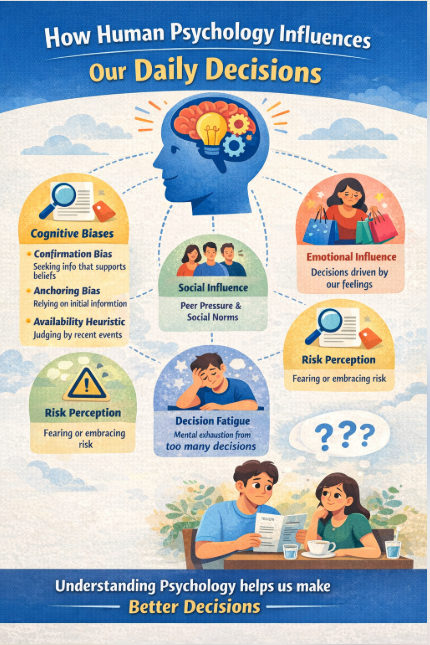
Cognitive biases are systematic errors in thinking that affect our decisions. These biases simplify complex information but can lead to poor judgment.
Common Cognitive Biases:
- Confirmation Bias: We tend to seek information that supports our existing beliefs and ignore contradictory evidence. Example: Believing a diet works because you only notice success stories.
- Anchoring Bias: We rely heavily on the first piece of information we receive. Example: If a product is initially priced at ₹5000 and discounted to ₹2500, it feels like a great deal—even if it’s not worth ₹2500.
- Availability Heuristic: We judge the likelihood of events based on how easily examples come to mind. Example: After hearing about a plane crash, people may fear flying more, even though it is statistically safer than driving.
These biases show that our decisions are often shortcuts rather than carefully reasoned conclusions.
The Role of Past Experiences
Our past experiences shape our beliefs, attitudes, and expectations, which in turn influence our decisions.
Example: If someone had a negative experience in a relationship, they might hesitate to trust future partners. Similarly, a student who performed well in exams may feel more confident when facing new challenges.
This process is linked to learning and memory, where the brain uses past information to guide future behavior.
Social Influence and Decision Making
Humans are social beings, and our decisions are heavily influenced by others. Social norms, peer pressure, and cultural expectations play a major role.
Types of Social Influence:
- Conformity: Changing behavior to match group norms
- Compliance: Agreeing to requests from others
- Obedience: Following authority figures
Example: A person might choose a particular career path because it is valued by their family or society, even if it does not align with their personal interests. Social media has amplified this effect. People often make decisions based on trends, influencers, or societal validation rather than personal preferences.
Heuristics: Mental Shortcuts
Heuristics are quick decision-making strategies that simplify complex problems. While they save time, they can also lead to errors.
Example: Choosing a restaurant based on its crowd size. A busy restaurant is assumed to have better food, which is not always true. Heuristics are useful in everyday life, but relying on them too much can result in biased decisions.
The Impact of Motivation and Needs in decision making
Our needs and motivations strongly influence our choices. According to psychological theories, humans are driven by basic needs such as safety, belonging, and self-esteem.
Example: A person who values financial security may choose a stable job over a passion-driven career. On the other hand, someone motivated by personal growth may take risks to pursue their dreams. Motivation directs attention and prioritizes certain options over others.
Decision Fatigue: When the Mind Gets Tired
Making too many decisions can lead to decision fatigue, reducing the quality of our choices.
Example: After a long day of work, you may find it harder to make healthy choices, such as cooking a nutritious meal. Instead, you might opt for fast food because it requires less effort. This shows that decision-making is not just about logic but also about mental energy.
The Role of Personality in decision making
Individual differences in personality also affect decision-making. Traits such as openness, conscientiousness, and neuroticism influence how people approach choices.
Example:
- A highly conscientious person may carefully analyze options before deciding.
- A more impulsive person may make quick decisions without much thought.
Understanding personality can help explain why different people make different choices in similar situations.
Risk Perception and Decision Making
People perceive risk differently, which affects their decisions.
Example: Some individuals are risk-averse and avoid uncertainty, while others are risk-seeking and embrace challenges. This explains why one person invests in safe savings plans, while another invests in stocks or startups.
Risk perception is influenced by emotions, past experiences, and cultural factors.
The Influence of Habits
Many of our daily decisions are not conscious at all—they are habits.
Habits are automatic behaviors formed through repetition. They reduce the need for active decision-making.
Example: Choosing the same brand of toothpaste every time or taking the same route to work. While habits save time, they can also prevent us from exploring better alternatives.
Technology and Decision Making
In today’s digital age, technology significantly influences our decisions.
Algorithms on social media and shopping platforms suggest products, content, and even opinions based on our behavior.
Example: You may end up buying a product simply because it was recommended to you multiple times online. This creates a sense of familiarity and trust. Technology can both help and manipulate decision-making processes.
Improving Decision Making Through Psychological Awareness
Understanding psychological influences can help us make better decisions.
Strategies to Improve decision making:
- Increase Self-Awareness; Reflect on your thoughts and emotions before making decisions.
- Question Your Biases: Ask yourself if your decision is based on facts or assumptions.
- Take Time: Avoid making important decisions when emotionally overwhelmed.
- Seek Multiple Perspectives: Consider different viewpoints to reduce bias.
- Limit Choices: Too many options can lead to confusion and poor decisions.
Real-Life Case Study
Consider a student choosing a career path. Their decision may be influenced by:
- Parental expectations (social influence)
- Fear of failure (emotional factor)
- Past academic performance (experience)
- Perceived job stability (risk perception)
- Popular career trends (availability heuristic)
This example shows that decision making is not a single process but a combination of multiple psychological factors.
Conclusion
Human psychology plays a profound role in shaping our daily decisions. From cognitive processes and emotions to biases and social influences, our choices are influenced by a complex interplay of internal and external factors.
While we cannot eliminate these influences entirely, becoming aware of them allows us to make more informed and balanced decisions. By understanding how our mind works, we can improve not only our decision making skills but also our overall quality of life.
In a world full of choices, the key to better decisions lies not just in information—but in understanding the psychology behind how we choose.
Frequently Asked Questions (FAQs)
1. What is decision making in psychology?
Decision-making is the process of choosing between options based on thoughts, emotions, and experiences.
2. How do emotions affect decision making?
Emotions can lead to impulsive or biased decisions, often overriding logical thinking.
3. What are cognitive biases?
Cognitive biases are mental shortcuts that can lead to errors in judgment.
4. What is an example of decision fatigue?
Choosing unhealthy food after a long day due to mental exhaustion.
5. How do past experiences influence decision making?
They shape beliefs and expectations, guiding future choices.
6. What is the role of social influence in decision making?
People often make choices based on peer pressure, norms, or societal expectations.
7. What are heuristics in decision making?
Heuristics are quick mental shortcuts used to make decisions.
8. Can decision making be improved?
Yes, through awareness, critical thinking, and reducing biases.
9. What is risk perception in decision making?
It is how individuals interpret and respond to risk in decision making.
10. Why is understanding decision making important?
It helps improve judgment, reduce mistakes, and make better life choices.
References
American Psychological Association. (n.d.). Decision-making and problem solving. https://www.apa.org
Verywell Mind. (n.d.). Decision-making psychology. https://www.verywellmind.com
Monoprova Counselling, (2026), “About Us”,
Monoprova Counselling, (2026), “Contact Us”,
This article is written for knowledge purposes, aiming to help readers understand the topic better and gain useful insights for learning and awareness.
Pingback: The Right Way to Talk to Kids About Sex psychological Guide
Pingback: Five-Factor Model: Traits Explained With Daily Examples