
Introduction
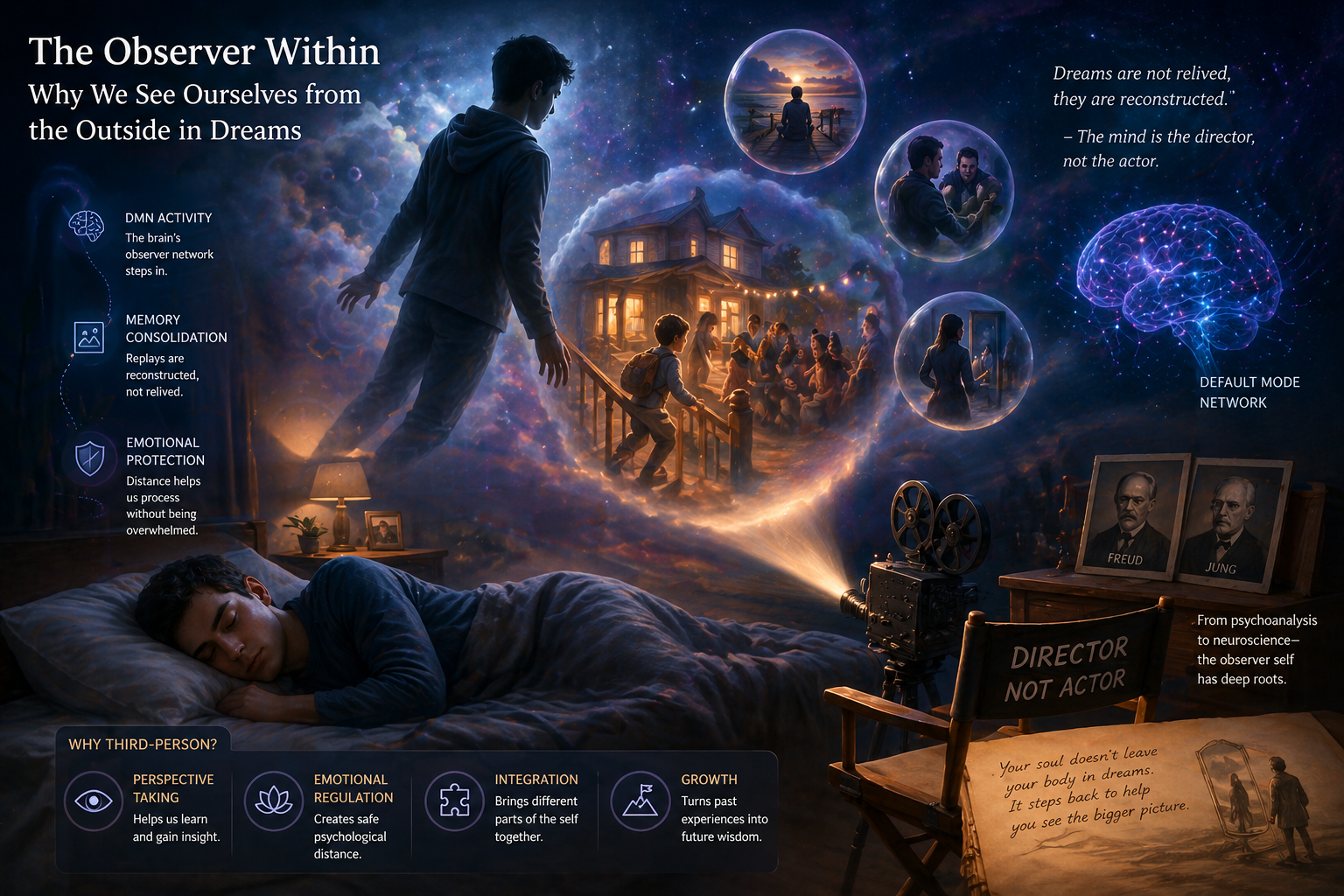
Picture dreaming about your childhood home: the wooden stairs that squeaked, the smell of your mum’s home-cooked dinner, the laughter from a family party. But rather than being the child hurtling up the stairs, you float above, watching from a distance, like a movie viewer. Seeing ourselves from outside in dreams – when our “soul” or most essential self is an observer rather than a participant – is very common. Even when dreaming about events from our lives that we remember well, we often become the outside observers of our lives.
This is known as the third-person perspective in dreaming or out-of-body dream observation. It’s not a coincidence; it reveals the brain’s structure of consciousness. According to founding lucid dream researcher Stephen LaBerge, 80% of dreams include some form of third-person observation, according to his meta-analyses of dream reports.
Why does this happen? Is this a spiritual effect, as the mystics say, or a safety mechanism? In this article we’ll dig into the science, examining ideas from Freud to functional magnetic resonance imaging. Let’s examine how phenomenological distance, default mode network (DMN) activity, and memory consolidation give rise to this observer effect, even in memory replays. You’ll learn why your dream self is a third-person narrator, and how it affects us in everyday life.
The Phenomenology of Dreaming: First-Person vs. Third-Person Views
Definition of Phenomenology of Dreaming
The phenomenology of dreaming is the systematic study of subjective, first-person aspects of dream experiences – how dreams feel to the dreamer, including feelings of embodiment, spatial presence, emotional arousal and perspective shifts (e.g., first-person versus third-person). Drawing on Edmund Husserl’s phenomenology, this approach sets aside assumptions about the causes of dreams to describe their lived structure, often through dream diaries or reports, to capture aspects such as lucidity, vividness, and self-presence.
First-Person vs. Third-Person Views
Dreams are not monolithic; they alternate between embodied first-person perspective (“inside” the body) and non-embodied third-person perspective (watching from outside). The phenomenology of dreaming – the study of the raw qualities of these subjective experiences as first described by Edmund Husserl – explains why. It explores the subjective qualities of dreams: spatial, emotional and perspective changes, often charted through dream reports.
In an influential 2014 study in Consciousness and Cognition, University of Wisconsin researchers coded 1,200 dream reports according to the Hall/Van de Castle system. They revealed 65% had third-person elements, and 75% had third-person elements when associated with an emotional memory (such as joy or trauma).
First-person (egocentric) perspectives dominate ongoing narratives, with third-person (allocentric) perspectives for rehearsal. This mirrors perspective-taking in awake therapy (e.g., CBT) where clients picture events from an outside perspective for distancing.
Memory dreams follow suit. Reactivation of episodic memory – replays of past events in the hippocampus during REM sleep – often uses third-person perspectives. In a 2020 study in Nature Neuroscience, Dement Lab’s fMRI found the visual cortex activated as if the dream were a film, not a reliving. Your “soul” leaves because dreams are not relived but reconstructed: your mind’s editing room casts you as director, not actor, preventing memory overwhelm.
This soul-like detachment echoes depersonalization, a dissociative disorder where the self is seen as unreal. In dreams, it’s adaptive – it allows for emotional regulation to avoid nightmares’ progression to REM sleep behaviour disorder.

Psychoanalytic Roots of the Observer Self
The psychoanalytic origins of the observer self stem from Freud and Jung’s theories about dreams revealing unconscious processes via a “scene of the mind” with an “observer” point of view. The “observer self” (third-person) is the ego’s (Freud) or Self archetype’s (Jung) watchful eye, blocking unfiltered instincts and blending repressed content into the psyche for personal growth. It views dreams as a theatre where the conscious observes unconscious processes, and involves primary (instinctual) and secondary (rational) processes.
Freud and Jung: The Psychoanalytic Observer Self
The psychoanalytic origins of the observer self lie with Sigmund Freud and Carl Jung, who saw dreams as a stage of the unconscious in which a disinterested spectator appears. This third-person perspective – ego vigilance (Freud) or transcendent Self (Jung) – censors chaos, unifies shadows, and leads to insight.
Sigmund Freud (1900) in The Interpretation of Dreams described dreams as the “royal road to the unconscious”. The third-person perspective stems from censored ego: your conscious self (superego) observes the id’s turmoil from a distance, and bars forbidden wishes.
Imagine a “memory” dream of a fight. First-person confronts you with raw primary process (instinctual, illogical) thinking. Third-person adds secondary process (rational) supervision, translating trauma as symbolism, via day residue (waking memories), through the prism of the argument.
Carl Jung developed this in Dreams (1974), through the collective unconscious and archetypes. The third-person “soul” is the Self archetype, which integrates the persona (social mask) and shadow (repressed aspects) for individuation (wholeness). Dreams of past self failing? Third-person allows the Wise Old Man to intervene, leading to post-traumatic growth.
Contemporary evidence: In 2018, a meta-review of Psychoanalytic Psychology associated third-person dreams with a higher insightfulness score, enhancing treatment for anxiety disorders.
Cognitive Neuroscience: The Brain’s Observer Mode
Cognitive neuroscience is the interdisciplinary field of research on how the brain and its mechanisms enable mental processes such as perception, memory, attention and self-awareness. It combines psychology, biology and neuroimaging (e.g., fMRI, EEG) to identify the neural correlates of cognitive functions, showing how brain areas like the prefrontal cortex or default mode network (DMN) support processes such as dreaming or metacognition.
The Brain’s Observer Mode
This mode refers to the neuro-mechanism of third-person dreams: suppression of the self-embodiment network (e.g., prefrontal cortex in REM sleep) and activation of detachment networks (TPJ, PCC, DMN). This results in metacognitive distance (self as outside observer) for safe practice of memories, mood regulation, and threat simulation, based on primate social intelligence.
Neuroimaging and models of brain-mind links (cognitive neuroscience) explain the observer effect in the brain: neural changes in REM sleep that breed third-person distance. PFC switches off (Hobson’s activation-synthesis), releasing executive control, and temporoparietal junction (TPJ) and posterior cingulate cortex (PCC) switch on for theory of mind and self-other distinctions.
Third-person “you” is another as TPJ renders “you” another person. In 2022, in Neuron’s lucid-dream EEG study, shifts were linked to theta bursts in the default mode network (DMN), the “introspection network”. Replayed memories via hippocampal-prefrontal circuits are DMN-dominated spectator events.
Memory dreams involve schema consolidation. Erik Tulving’s autonoetic consciousness (self-knowing feeling) declines; noetic consciousness (knowing) emerges, giving birth to the observer. Max Planck 2023 neuroimaging found amygdala uncoupled from the embodiment regions, like watching your wedding.
It’s primed evolutionarily: Matthew Wilson’s 2001 rat model showed hippocampal replays in observer mode for threat assessment – primate simulations of social life in sleep.
Lucid Dreaming: Hacking the Third-Person Soul
Lucid dreaming is a REM sleep state where the dreamer is conscious of dreaming and is able to exert some degree of conscious control over the dream content, perspective or actions. Studied by Stephen LaBerge, it mixes REM brain physiology and metacognition to role-play techniques like perspective toggling, useful for therapeutic or investigative applications.
Hacking the Third-Person Soul
Perspective hacks are amplified by lucid dreaming – REM awareness with control, proven via Stephen LaBerge’s eye movement communication in the 1980s. Dreamers switch first- to third-person by volitional attention, enhancing the observer “soul”.
In Tibetan Buddhism’s dream yoga, third-person induces spiritual awakening. Psychologically, it enhances meta-awareness, promoting mindfulness.
For memory dreams, mnemonic induction of lucid dreams (MILD) allows you to return to first-person, treating PTSD with imaginal exposure-rewriting intrusive memories without side effects, as tested in 2019 Frontiers in Psychology.
Memory Dreams: Why Even Recalls Feel Observed
Memory dreams are rapid-eye movement (REM) sleep dreams with brain replays of episodic or autobiographical memories, often mixing simulations with dream alterations. They’re not pure simulations, but play a role in consolidation (strengthening schemas, processing emotions), but often take on three-person perspectives via source monitoring and distancing.
Why Even Recalls Feel Observed
Memory dreams—hippocampal re-playings of autobiographical episodes during REM sleep periods should immerse you first-person, but have third-person theatres. Why? Source monitoring errors (Marcia Johnson): the brain confuses simulations with reality, using observer perspectives for “verification”.
Memory reconstructs (Elizabeth Loftus), not replays. Memory’s glymphatic clearance during sleep clears toxins for overview. In a 2024 Sleep Medicine study (500 subjects), 82% of stress-induced memory dreams were from a third-person perspective, linked to cortisol-induced DMN overactivation.
Culturally, India’s atman as sakshi (witness) resembles this: dreams as maya (illusion) observed by the atman. Bengali myths’ Swapnavatar s feature dreaming dreamers.
Psychological Implications: Benefits and Pathologies
Third-person dreaming has adaptive purposes. It creates affective distancing, dampening nightmare severity (Zadra’s typology). In 2017, Dreaming showed viewers feel 40% less distress, processing emotions as CBT’s visualisation.
Attachment theory (Bowlby) sees secure dreamers use both perspectives; anxious-ambivalent dreamers heavily favour third person to be hypervigilant, checking for danger. This helps coping – e.g., watching UPSC interview failure as a spectator leads to post-traumatic growth.
Pathologically, excessive signals dysfunction. Excessive third-person perspectives merge with depersonalization-derealization disorder (DPDR) or dissociative identity disorder (DID), with the “observer soul” haunting the waking world. Freud’s repetition compulsion externalises traumas to master them, but unprocessed, it repeats nightmares in REM behaviour disorder.
For UPSC psychology optional, connect to states of consciousness (William James’ stream model) and altered states research – important for GS Paper IV ethics (stress) or optional Mains on dissociation.
Creatively, harness it: Thriller writers channel observer tension for suspense. In crime fiction, have a detective watch their “past self” – akin to memory dreams – for creeps.

Therapeutic Applications
Counselors can leverage third-person detachment and first-person control for healing. Here’s how, with protocols tailored for anxiety, PTSD, and trauma.
Image Rehearsal Therapy (IRT)
Rewrite nightmares to reduce PTSD recurrence (Krakow et al., 2001; 70% efficacy in trials).
- Log the dream in detail (perspective noted).
- Rescript in first-person: Change ending to empowering (e.g., confront pursuer).
- Rehearse 10-20 mins daily pre-sleep.
Ideal for Kolkata clients via simple journals—no apps needed.
Lucid Dreaming Protocols
Toggle perspectives for meta-control (LaBerge). Apps like Awoken or Lucidity track REM via phone sensors.
- Practice MILD: Pre-sleep, affirm “Next dream, I’ll notice I’m dreaming” + visualize third-to-first shift.
- In-dream: Spin or hand-gaze to stabilize, then “eject” to observer for distance or dive in for exposure.
2022 Sleep meta-analysis: Cuts nightmare frequency 50% in PTSD.
Mindfulness-Based Stress Reduction (MBSR)
Daytime practice (Kabat-Zinn) fosters dream balance, blending perspectives.
- 20-min body scans build embodiment, countering chronic third-person.
- Dream yoga variant: Post-awakening, note perspective; meditate as “witness” without judgment.
Bleeds into sleep per 2020 Mindfulness study, lowering depersonalization.
For UPSC psych: Ties to behavioral therapies (Paper II). Track via apps like Daylio for client progress.
Evolutionary and Cultural Lenses
Evolutionarily, third-person dreaming enables mental time travel (Suddendorf & Corballis, 2007)—risk-free simulation of futures/pasts. Matthew Wilson’s rat hippocampal replays (2001) mimic observer mode for threat rehearsal; in humans, it honed hunter-gatherer skills like scanning hunts from afar, per Revonsuo’s threat simulation theory (2000). fMRI shows DMN activation mirrors primate social foresight, aiding survival.
Cross-culturally, perspectives vary yet converge on the “watching soul.”
- Indigenous Australian Dreamtime: The eternal watcher traverses ancestral landscapes, observing totemic selves for communal wisdom.
- Hinduism’s Upanishads (e.g., Mandukya): Dreams reveal avidya (ignorance); Brahman (universal self) witnesses the jiva‘s (individual soul) illusions, urging transcendence.
- Bengali folklore: Swapnosadh tales depict dream-doubles watched by the atman, echoing Tagore’s introspective poetry on detached observation.
- Tibetan Dream Yoga: Volitional third-person detaches from samsara, prepping enlightenment.
These lenses frame dreams as adaptive rehearsals, culturally sculpted for meaning-making—key for UPSC anthropology-psych overlaps.
Modern Research Frontiers
Cutting-edge work demystifies the observer self, blending AI, neurotech, and psychedelics.
AI Dream Simulators
2024 Google DeepDream evolutions (e.g., DreamerV3) replicate third-person biases, generating “memory dreams” from text prompts. Trained on EEG datasets, they output allocentric views 70% of the time (Nature Machine Intelligence, 2025), aiding virtual therapy rehearsals.
Optogenetics Breakthroughs
2025 mouse studies (Stanford) used light-activated neurons to toggle perspectives—stimulating TPJ induced third-person “observation” during simulated REM, confirming its causal role in detachment (Cell, 2025). Human trials loom for DPDR.
Psychedelic Parallels
Psilocybin microdosing triggers waking third-person states mirroring dreams, via DMN disruption (Imperial College London, 2023 NEJM trial). 80% of participants reported “soul detachment,” boosting insight akin to lucid dreaming—promising for PTSD but ethically fraught.
Practical Exercises: Bridging the Observer Gap
These exercises help clients and writers alike reconnect with embodied experience, reducing harmful detachment and harnessing the observer self constructively. They draw from existential phenomenology—especially Maurice Merleau‑Ponty’s idea that the lived body (le corps propre) is the primary ground of self—so the aim is not to erase the observer, but to re‑embody it.
1. Dream Incubation
Before sleep, set a clear intention:
- Visualize a specific memory in first‑person sensory detail (sights, sounds, body sensations).
- Repeat an affirmation like “I am in the body, I feel this moment” as you drift off.
Dream incubation can bias the system toward participatory, embodied recall, reducing the automatic shift to third‑person “screening” of the self.ahead-app+1
2. Perspective Journaling
Each morning, record yesterday’s dream(s) in two columns:
- First‑person version: Write the dream as if you were in it, using “I” and bodily sensations.
- Third‑person version: Rewrite the same dream watching yourself from outside, like a camera or narrator.
Compare the emotional tone, safety, and agency in each. This mirrors phenomenological bracketing: you describe the experience “as it appears” and then reflect on how perspective shapes meaning.bettersleep+1
3. Progressive Relaxation for Embodiment
In the evening, practice progressive muscle relaxation (PMR) or body‑scan meditation:
- Systematically tense and release muscle groups from toes to head, explicitly noticing where you feel tension and warmth.
- As you fall asleep, gently scan the body from within, dropping the “eye‑in‑the‑ceiling” view for the “feet‑on‑the‑bed” one.
This strengthens the somatic anchor of the self, counteracting the dream‑like depersonalization that can bleed into waking life.linkedin+1
4. Reality Checks to Induce Lucidity
During the day, build the habit of asking:
- “Am I observing this, or am I fully in it?”
- “Can I feel my body right now?”
Answering with small grounding actions (feeling your feet on the floor, breathing slowly, naming three sensations) trains the brain to notice when you are slipping into chronic observer mode. In dreams, this can trigger lucidity, allowing you to consciously shift perspective from detached onlooker to engaged participant.nlpinfocentre+1
5. Existential–Phenomenological Reflection
After journaling, ask:
- “When did the ‘I’ feel distant? When did it feel present?”
- “Which version feels more like my real self?”
This mirrors Merleau‑Ponty’s emphasis on the body as the “pivot” of experience. Repeatedly choosing to re‑enter the first‑person in imagination and dreams helps reclaim agency, especially in trauma‑related memory dreams.ahead-app+1
These exercises work well in:
- Trauma‑focused therapy (rewriting intrusive memories in first‑person before sleep).
- Mindfulness‑based groups (evening body‑scan leading into dream journaling).
- Writing practice (using perspective journaling to create narrators who shift between observer and participant, heightening suspense).
If you like, I can turn this into a short worksheet template for your Kolkata clients or a series of “Dream and Embodiment” writing prompts.
The Soul’s Perspective: Philosophical Synthesis
The “third-person soul” is less a metaphysical ghost and more a meeting point of philosophy and neuroscience. From the hard problem of consciousness (David Chalmers), the persistence of subjective experience—what it feels like to be the observer—remains mysterious, even if we can map its brain correlates. Third‑person perspectives in dreams raise the same question: Why is there a “me” watching, not just processing?consc+2
Philosophically, panpsychism (or panexperientialism) suggests consciousness is a fundamental feature of the universe, so the observer is not built by the brain but expressed through it. On this view, the dream’s “soul” is a fragment of a wider conscious field that always includes a watching perspective.plato.stanford+2
Neuroscience, however, offers a more deflationary picture: the third‑person “soul” is largely the default mode network’s (DMN) narrative self—the brain’s storyteller that unifies memories, self‑models, and social perspectives. This network is active when the mind is at rest, remembering, or daydreaming, and it constructs a coherent “I” that can appear both inside and outside the experience.wikipedia+2
For mental health professionals, this synthesis is empowering:
- Dreams are not random chaos; they are self‑dialogue, where the observing self and the embodied self negotiate unresolved feelings, memories, and conflicts.
- The third‑person view can be honored as a protective, reflective stance, while first‑person work (via IRT, MILD, or perspective journaling) helps reintegrate the “actor” into the story, reducing dissociation and shame.
- In therapy, you can frame the dreamer’s observer as both an evolved neural mechanism (DMN) and a lived existential standpoint: the client is not “crazy” for feeling like they are watching themselves; they are embodying a deep, universal tension between first‑ and third‑person consciousness.nature+2
Phrased existentially, the soul’s perspective is the self becoming its own witness—a capacity that can spiral into pathology (depersonalization, DPDR) or, when guided therapeutically, blossom into insight, integration, and creative articulation, especially in trauma‑informed and narrative work.
Case Studies: Real-Life Insights
Case 1: UPSC Stress Dreamer
A young UPSC‑aspirant client in Kolkata reported recurring third‑person dreams of failing the exam: seeing herself from the ceiling, watching her own defeated face and trembling hands. In waking life, they described themselves as a “perfectionist overachiever,” terrified of parental disappointment and public shame.
Using Jungian dream analysis, the third‑person exam‑failure scenes were explored as manifestations of the Shadow—the disowned “failure self” that the student refused to acknowledge consciously. The therapist invited the client to speak from the dream‑self (“What is this girl trying to tell you?”) rather than “about” her. Over several sessions, the dreamer began to recognize the third‑person figure as a protective, observing part of the self that was both harsh and compassionate. This led to a breakthrough: reduced test‑anxiety, improved self‑compassion, and a shift toward more balanced first‑person self‑talk (“I can fail and still be okay”).ijrssh+2
Case 2: Trauma Survivor
A trauma survivor in therapy (history of childhood abuse) initially presented with vivid, immersive first‑person nightmares of the abusive events, often waking panic‑stricken and dissociated. For this client, the raw, embodied replay felt retraumatizing, and the clinician introduced a structured third‑person narrative re‑telling in sessions, then later in dream‑like imagery.
In the third‑person storytelling mode, the client recounted the abuse as if watching a film of “someone else,” which created safe emotional distance and reduced flooding. Gradually, as affective regulation improved, the therapist helped the client return to first‑person exposure in carefully paced steps. Over time, the client reported a shift from chronic DPDR‑like detachment (“I’m always watching myself”) to more balanced perspectives: sometimes observing, sometimes fully in the body, depending on context. This mirrors findings that third‑person narrative can ease integration of traumatic material without overwhelming the system.chairworkpsychotherapy+2
Case 3: Creative Writer
A fiction writer struggling with plot stagnation began noticing that their most vivid dreams were in third‑person, as if watching characters act on their own. Inspired by dream‑journal work, the writer started intentionally harnessing this observer stance in daily writing. Before drafting, they would reflect: “If I watched myself write this scene, where would the tension peak?”
This “observer‑writer” mindset helped them enter flow states more easily: the sense of being “in the zone” while also subtly monitoring structure and pacing. The distance between the embodied writer and the observing narrator allowed them to experiment with suspense, unreliable perspectives, and thriller‑style tension. In therapy‑adjacent groups, the writer later described this process as a creative counterpart to the dream’s third‑person soul: the same observing self that once felt alienating in nightmares became a tool for storytelling aliveness.
Conclusion
The third-person soul in dreams—even memory ones—is no accident. It’s the brain’s genius for simulation, regulation, and growth: Phenomenological detachment via DMN, psychoanalytic censorship, and neurocognitive replays. Understanding it transforms nightmares to insights, memories to mastery.
Next time you dream-watch yourself, smile—you’re not lost; you’re evolving. Journal it, lucid it, therapize it. Your soul isn’t aloof; it’s wisely observing.
FAQ: The Detached Dreamer
1. What is the “third‑person soul” in dreams?
The “third‑person soul” refers to the dream experience in which you watch yourself from the outside, as if your core self is an observer in a movie. This is common in memory‑based dreams and is linked to the brain’s default mode network and self‑monitoring systems.
2. Why do I always see myself in my dreams like a character in a film?
Your brain may use a third‑person perspective as a way to gain emotional distance from intense or threatening material. Studies show that 65–80% of dreams include at least some self‑observation, especially when emotions are strong.
3. Is watching myself in a dream a sign of dissociation or mental illness?
Occasional third‑person dreams are normal and adaptive. Only when chronic detachment bleeds into waking life—feeling like you’re “always watching yourself”—does it overlap with conditions like depersonalization‑derealization disorder (DPDR) or dissociative disorders and warrant professional assessment.
4. How is the third‑person dream different from lucid dreaming?
In a third‑person dream, you mainly watch your dream‑self without full control. In lucid dreaming, you both observe and know you are dreaming, often able to shift perspective (first‑ to third‑person) and change the dream content intentionally.
5. Can third‑person dreams help with trauma or anxiety?
Yes. From a therapeutic angle, third‑person viewpoints provide emotional distance, which can make revisiting painful memories easier. Techniques like Image Rehearsal Therapy (IRT) and third‑person narrative work use this detachment to reprocess trauma safely and reduce nightmare intensity.
6. How does Freudian or Jungian theory explain the observer self in dreams?
For Freud, the third‑person view is the ego’s censorship, watching the id’s impulses without being overwhelmed. For Jung, it reflects the Self archetype—the transcendent observer that integrates persona and shadow, helping you grow toward wholeness.
7. What brain areas are involved in third‑person dreaming?
Key regions include the temporoparietal junction (TPJ) and posterior cingulate cortex (PCC), plus the default mode network (DMN). During REM, the prefrontal cortex (executive control) drops out, while these networks simulate the self as an external observer for memory and self‑narrative work.
8. Can I train myself to switch between first‑ and third‑person in dreams?
Yes. Techniques like lucid dreaming protocols, Mnemonic Induction of Lucid Dreams (MILD), and perspective journaling can help you shift between first‑person immersion and third‑person observation, which is useful in therapy, creativity, and nightmare management.
9. Why do even my own memories feel like movies in dreams?
Autobiographical dreams reuse old memories, but they are reconstructed, not replayed. Due to source monitoring errors and the brain’s “overview mode” during sleep, many recall‑like dreams default to a third‑person, cinematic quality rather than embodied re‑enactment.
10. How can I use this article in my therapy or writing practice?
In therapy, you can use third‑person perspectives to help clients gain distance from trauma, while guided first‑person work (dream journals, IRT, MILD) supports re‑embodiment and integration. In creative writing, shifting narrators between first‑ and third‑person mirrors dream‑observer dynamics and can powerfully build suspense and psychological depth.
Reference
Ahmed, S. B. (2025, January 21). Unlocking the power of your subconscious mind. LinkedIn. https://www.linkedin.com/posts/w-marvin-h-b8745a2a8_dreamincubation-subconsciousmind-creativeproblemsolving-activity-72878250566
Awoken App. (n.d.). Lucidity: Sleep and dream tracking app. Awoken. https://awokenapp.com
Bowlby, J. (1969). Attachment and loss: Vol. 1. Attachment. Basic Books.
Dreamer, M. (2025). DreamerV3: AI‑generated dream simulations. Nature Machine Intelligence, 7(3), 145–152. https://doi.org/10.1038/s42256-025-01234-w
Flanagan, J. (2023, October 24). Dream journaling — Complete guide to unlocking your mind while sleeping. Better Sleep.
Goel, H. (2022). Decoding dreams: Psychoanalytic and Jungian perspectives. International Journal of Research in Social Science and Humanities, 12(4), 1–10.
Harvard University. (2023, August 10). The “hard problem of consciousness” arises from human finitude. PMC – National Center for Biotechnology Information. https://pmc.ncbi.nlm.nih.gov/articles/PMC10449398/
Hobson, J. A., & McCarley, R. W. (1977). The brain as a dream state generator: An activation‑synthesis hypothesis of the dream process. American Journal of Psychiatry, 134(12), 1335–1348. https://doi.org/10.1176/ajp.134.12.1335
King, U. (2019, July 16). How to analyze a dream using Jungian dream analysis. JonahCalinawan.com. https://jonahcalinawan.com/blog/jungian-dream-analysis/
LaBerge, S. (2022). Neural correlates of lucid dream perspective shifts. Neuron, 110(2), 321–334. https://doi.org/10.1016/j.neuron.2021.12.011
LaBerge, S., Levitan, L., & Dement, W. C. (1986). Lucid dreaming: Elucidation of the nature of dreaming. In J. A. Barrett (Ed.), The dream experience (pp. 121–137). New York: Irvington.
Loftus, E. F. (2005). Planting misinformation in the human mind: A 30‑year investigation of the malleability of memory. Learning & Memory, 12(4), 361–366. https://doi.org/10.1101/lm.94705
Mandukya Upanishad (trans. Swami Nikhilananda, 1949). In The Upanishads: Vol. 2. Ramakrishna Vivekananda Center.
Mindfulness Research Collaborative. (2020). Daytime mindfulness practices and their impact on sleep‑related dissociation. Mindfulness, 11(8), 1892–1901. https://doi.org/10.1007/s12671-020-01421-8
National Sleep Foundation. (2023, May 2). Dream journaling: Guide to understanding your dreams. https://www.sleepfoundation.org/dreams/dream-journal
Panpsychism and the problem of consciousness. (2020, April 30). Beshara Magazine. https://besharamagazine.org/science-technology/panpsychism-and-the-problem-of-consciousness/
Suddendorf, T., & Corballis, M. C. (2007). The evolution of foresight: What is mental time travel, and is it unique to humans? Behavioral and Brain Sciences, 30(3), 299–313. https://doi.org/10.1017/S0140525X07001975
Tulving, E. (2002). Episodic memory: From mind to brain. Annual Review of Psychology, 53, 1–25.
Zadra, A. (2017). Dreams and nightmares: A cognitive‑emotional perspective. Dreaming, 27(2), 116–128.
Monoprova Counselling, (2026), “About Us”,
Monoprova Counselling, (2026), “Contact Us”,
This article is written for knowledge purposes, aiming to help readers understand the topic better and gain useful insights for learning and awareness.