
Can a machine truly understand your emotions?
Introduction
The mental health landscape is rapidly evolving with the integration of Artificial Intelligence (AI) into therapeutic practices. AI-based tools such as chatbots, mental health apps, and virtual therapists are increasingly being used to provide psychological support. While these innovations promise accessibility and scalability, they raise critical questions about the essence of therapy itself.
Therapy, traditionally, is a deeply human process grounded in empathy, relational dynamics, and nuanced psychological understanding. Concepts like therapeutic alliance, transference, and emotional attunement form the backbone of effective psychotherapy.
This article explores the key differences between AI therapy and human therapy using psychological frameworks, helping you understand their roles, strengths, and limitations.
What is AI Therapy?
AI therapy refers to the use of machine learning algorithms, natural language processing (NLP), and data-driven systems to simulate therapeutic interactions. Examples include AI chatbots like Woebot or Wysa that provide Cognitive Behavioral Therapy (CBT)-based interventions.
Key Features
- Algorithm-based responses
- Pattern recognition in user input
- Structured interventions (often CBT-based)
- 24/7 accessibility
AI therapy primarily operates through rule-based systems or predictive models, lacking true consciousness or subjective emotional experience.
What is Human Therapy?
Human therapy involves trained mental health professionals such as psychologists, counselors, or psychiatrists who engage clients in a therapeutic relationship.
Key Features
- Emotional empathy and attunement
- Use of diverse therapeutic modalities (CBT, Psychodynamic Therapy, Humanistic Therapy)
- Ability to interpret non-verbal cues
- Personalized and adaptive interventions
Human therapy is rooted in the biopsychosocial model, acknowledging that mental health is influenced by biological, psychological, and social factors.
Core Differences Between AI and Human Therapy
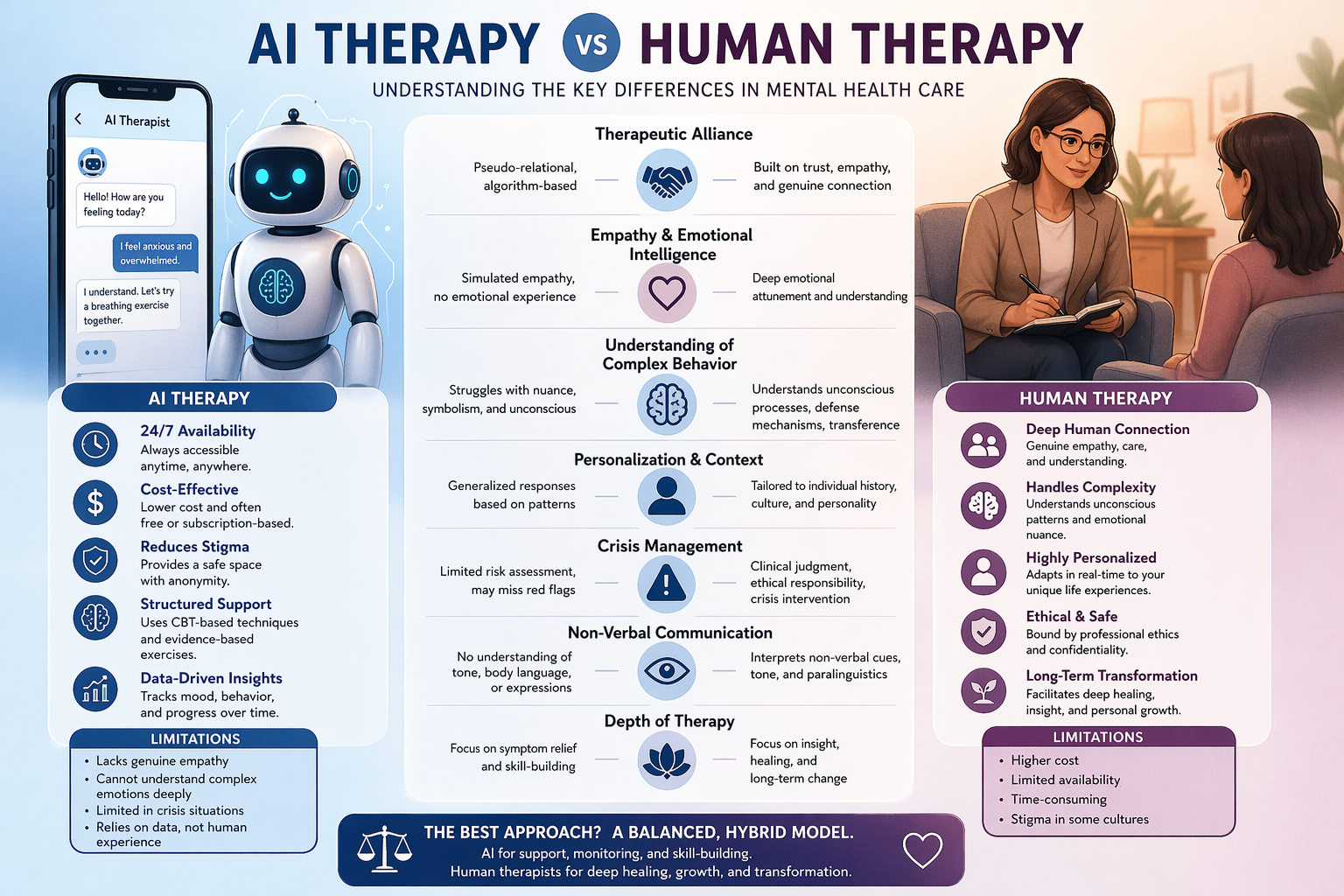
1. Therapeutic Alliance
The therapeutic alliance refers to the collaborative and emotional bond between therapist and client. Research shows it is one of the strongest predictors of therapy outcomes.
- AI Therapy:
AI can simulate supportive language but lacks genuine emotional reciprocity. The alliance is pseudo-relational. - Human Therapy:
A human therapist builds trust, rapport, and emotional safety through empathic understanding and unconditional positive regard (Carl Rogers).
Key Insight: AI can mimic connection, but cannot truly experience it.
2. Empathy and Emotional Intelligence
Empathy involves both cognitive empathy (understanding another’s perspective) and affective empathy (feeling another’s emotions).
- AI Therapy:
Limited to programmed responses; lacks affective resonance. It recognizes patterns but does not feel. - Human Therapy:
Therapists use emotional attunement, mirroring, and validation to deeply connect with clients.
Psychological Term: Affective attunement—a human therapist’s ability to match emotional states.
3. Understanding of Complex Human Behavior
Human behavior is influenced by unconscious processes, defense mechanisms, and early life experiences.
- AI Therapy:
Struggles with ambiguity, symbolism, and unconscious dynamics. - Human Therapy:
Can interpret defense mechanisms (e.g., repression, projection) and explore psychodynamic conflicts.
Example: A human therapist can identify transference, where a client projects feelings onto the therapist—AI cannot meaningfully process this.
4. Personalization and Contextual Sensitivity
- AI Therapy:
Offers generalized responses based on datasets. Personalization is limited to input-output patterns. - Human Therapy:
Adapts in real-time, considering cultural context, life history, and individual personality structures.
Psychological Concept: Idiographic approach—understanding the individual uniquely.
5. Ethical Judgment and Crisis Management
- AI Therapy:
Lacks moral reasoning and may fail in high-risk situations like suicidal ideation. - Human Therapy:
Uses clinical judgment, ethical frameworks, and crisis intervention strategies.
Important: In cases of suicidal ideation, human intervention is critical.
6. Non-Verbal Communication
- AI Therapy:
Limited to text or voice input; cannot interpret body language, tone shifts, or micro-expressions. - Human Therapy:
Observes non-verbal cues, which account for a large portion of communication.
Psychological Term: Paralinguistics—tone, pitch, and pace of speech.
7. Accessibility vs Depth
- AI Therapy:
Highly accessible, affordable, and stigma-free. Useful for mild anxiety, stress, or psychoeducation. - Human Therapy:
Offers depth, insight, and long-term personality change.
Balance: AI is good for support, human therapy is essential for transformation.
Limitations of AI Therapy
- Lack of genuine empathy
- No understanding of unconscious processes
- Risk of misinterpretation
- Ethical concerns (data privacy, misdiagnosis)
Advantages of Human Therapy
- Deep emotional connection
- Ability to handle complex disorders
- Flexible and adaptive
- Ethical responsibility
- Long-term personality restructuring
Human therapy facilitates insight-oriented change, not just symptom relief.
Can AI Replace Human Therapists?
The short answer: No.
AI lacks consciousness, subjectivity, and emotional depth, which are essential for therapeutic healing. However, it can serve as a supportive tool alongside human therapists.
Future Model: Hybrid Therapy
- AI for monitoring, reminders, and basic CBT exercises
- Human therapists for deep emotional and psychological work
Psychological Perspective: Why Humans Still Matter
From a humanistic psychology perspective, healing occurs through authentic relationships. Carl Rogers emphasized:
- Empathy
- Congruence
- Unconditional positive regard
These cannot be authentically replicated by AI.
From a psychodynamic perspective, therapy involves exploring unconscious material—something AI cannot access or interpret meaningfully.
Real-Life Example
Imagine a client dealing with childhood trauma:
- AI Response:
“I’m sorry you feel this way. Try deep breathing.” - Human Therapist Response:
“I notice a pattern in how these experiences affect your current relationships. Let’s explore that together.”
The difference lies in depth, interpretation, and emotional resonance.
Conclusion
AI therapy is a powerful tool that increases accessibility and provides immediate support. However, it cannot replace the depth, empathy, and relational healing offered by human therapists.
Mental health is not just about solving problems—it is about being seen, understood, and held in a safe psychological space. That space, at least for now, remains deeply human.
FAQ
1. What is the difference between AI therapy and human therapy?
AI therapy uses algorithms and machine learning to provide structured support, while human therapy involves emotional connection, empathy, and personalized psychological intervention.
2. Is AI therapy effective for mental health?
AI therapy can be effective for mild to moderate issues like stress, anxiety, and habit-building, especially using Cognitive Behavioral Therapy (CBT) techniques.
3. Can AI replace human therapists?
No, AI cannot replace human therapists because it lacks emotional intelligence, empathy, and the ability to understand unconscious psychological processes.
4. What is the therapeutic alliance in psychotherapy?
The therapeutic alliance is the emotional bond and collaborative relationship between therapist and client, which significantly influences therapy outcomes.
5. Is AI therapy safe for severe mental health issues?
AI therapy is not recommended for severe conditions such as depression with suicidal ideation, trauma, or personality disorders. Human intervention is essential.
6. What are the advantages of AI therapy?
AI therapy offers 24/7 availability, affordability, anonymity, and immediate responses, making it accessible for many users.
7. What are the limitations of AI therapy?
AI lacks empathy, cannot interpret non-verbal cues, struggles with complex emotional issues, and may misinterpret user input.
8. Why is human therapy more effective for deep psychological issues?
Human therapists use empathy, clinical judgment, and psychological theories to address root causes, unconscious conflicts, and emotional patterns.
9. What is Cognitive Behavioral Therapy (CBT) in AI therapy?
CBT in AI therapy involves structured techniques like thought restructuring, behavioral activation, and coping strategies delivered via chatbots or apps.
10. What is the future of AI in mental health care?
The future lies in a hybrid model where AI supports monitoring and basic interventions, while human therapists provide deep emotional and psychological healing.
References (APA Style with Links)
- Rogers, C. R. (1957). The necessary and sufficient conditions of therapeutic personality change. Journal of Consulting Psychology.
https://doi.org/10.1037/h0045357 - Beck, A. T. (1976). Cognitive Therapy and the Emotional Disorders. New York: International Universities Press.
https://books.google.com/books/about/Cognitive_Therapy_and_the_Emotional_Di.html - Norcross, J. C., & Lambert, M. J. (2018). Psychotherapy relationships that work (3rd ed.). Oxford University Press.
https://global.oup.com/academic/product/psychotherapy-relationships-that-work-9780190843960 - Fitzpatrick, K. K., Darcy, A., & Vierhile, M. (2017). Delivering Cognitive Behavioral Therapy to young adults with symptoms of depression and anxiety using a fully automated conversational agent (Woebot). JMIR Mental Health.
https://mental.jmir.org/2017/2/e19/ - American Psychological Association. (2020). Understanding psychotherapy and how it works.
https://www.apa.org/topics/psychotherapy -
Monoprova Counselling, (2026), “About Us”,
-
Monoprova Counselling, (2026), “Contact Us”,
This article is written for knowledge purposes, aiming to help readers understand the topic better and gain useful insights for learning and awareness.
Pingback: AI Productivity Hacks for 2025: Work Faster & Smarter
I appreciate how this article combines psychological understanding with practical, everyday examples. A valuable read for anyone interested in mental health.