
Introduction: Indian Mothers Struggle
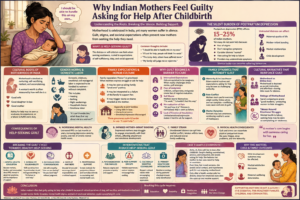
Becoming a mother is often described as one of life’s most beautiful transitions. However, for many Indian women, this transformative period can also bring physical exhaustion, emotional turbulence, fear, and a profound sense of guilt. In fact, Indian Mothers Struggle with the pressure to appear strong and capable, particularly when they consider asking for help after childbirth. Instead of feeling comfortable expressing their needs, they may worry that seeking support means they are unable to fulfil the expectations placed upon them as mothers.
Moreover, this guilt is not simply an internal emotional response. Rather, it is shaped by deeply rooted cultural beliefs, gendered expectations, family dynamics, and gaps in maternal mental health awareness and support. In India, where motherhood is often idealized and women are expected to shoulder responsibilities selflessly, asking for emotional, physical, or psychological support can trigger feelings of inadequacy, shame, or fear of judgment. Consequently, many mothers may continue struggling silently even when they genuinely need assistance.
This article explores why Indian mothers feel guilty asking for help after childbirth, examining the cultural narratives, family pressures, gender norms, and psychological mechanisms that contribute to this guilt. Furthermore, it considers how delayed help-seeking can affect maternal mental health, mother–infant relationships, and overall family wellbeing. Finally, the article highlights evidence-informed approaches that can help challenge these expectations, normalize vulnerability, and create healthier pathways toward support and recovery.
Indian Mothers Struggle: Understanding Postpartum Help-Seeking Guilt
After childbirth, mothers may need support in many forms — from assistance with household responsibilities and childcare to emotional reassurance and professional mental health care. Ideally, asking for help should be recognized as a normal and healthy part of postpartum recovery. However, for many Indian mothers, the reality can be very different. Instead of feeling comfortable expressing their needs, they may experience guilt, fear, or self-blame when they consider seeking support. Consequently, a simple request for assistance can become an emotionally difficult decision, particularly when mothers have internalized the belief that they should be able to manage everything on their own.
Indian Mothers Struggle: What Is Help-Seeking Guilt?
Help-seeking guilt refers to the emotional distress, discomfort, or self-criticism a person may experience when asking for or accepting assistance. In many cases, this guilt develops from internalized expectations surrounding self-sufficiency, responsibility, duty, and social approval. As a result, individuals may feel that needing support reflects a personal weakness rather than a normal human need.
In the postpartum period, these feelings can become particularly intense. Mothers are often expected to adapt quickly to the demands of caring for a newborn while simultaneously managing household responsibilities and their own physical and emotional recovery. Consequently, when they struggle or need assistance, they may interpret their needs as a failure to meet the expectations of motherhood.
For example, postpartum help-seeking guilt may appear through thoughts such as:
- “I should be able to handle this on my own.”
- “If I ask for help, people will think I’m weak.”
- “This is my duty; others have suffered more.”
- “My family will judge me or reject me.”
These thoughts can gradually reinforce self-blame and emotional suppression. Therefore, recognizing help-seeking guilt is an important first step toward understanding why some mothers delay asking for the support they genuinely need.
Indian Mothers Struggle: Cultural Roots of Motherhood in India
In the Indian cultural imagination, motherhood is often deeply idealized. Mothers may be expected to be nurturing, self-sacrificing, resilient, and emotionally strong, even when they are physically or psychologically overwhelmed. Moreover, these expectations are shaped by longstanding cultural narratives and social traditions that often portray motherhood as a profound responsibility and a form of unconditional care. From historical and religious representations of the mother as a “giver of life” to contemporary expectations surrounding maternal devotion, these ideals can strongly influence how women understand their roles after childbirth.
The “Good Mother” Ideal
Within many Indian families and communities, a woman’s sense of social worth may become closely connected to how well she fulfils multiple family roles, including being a:
- Good wife
- Well daughter-in-law
- Good mother
These roles can carry significant moral and social expectations. Consequently, when a woman feels unable to meet them perfectly, she may fear criticism, gossip, disappointment, or a loss of respect. In such an environment, asking for help may therefore be interpreted not as a healthy form of support-seeking, but as a sign of weakness, incompetence, or failure to fulfil her responsibilities.
Furthermore, this “good mother” ideal can make ordinary postpartum struggles feel like personal shortcomings. A mother who is exhausted, emotionally overwhelmed, or in need of assistance may begin to question her own adequacy rather than recognizing that recovery and caregiving often require support. As a result, cultural expectations can contribute to the guilt and self-blame that discourage mothers from openly expressing their needs.
Indian Mothers Struggle: Gender Norms and Domestic Labor
In India, domestic labor and childcare are disproportionately performed by women. Furthermore, even when families have access to paid domestic help or support from relatives, the emotional and managerial responsibility for childcare often continues to fall largely on the mother. She may remain responsible not only for completing tasks but also for anticipating the baby’s needs, organizing routines, monitoring the household, and managing the emotional wellbeing of family members.
This structural expectation can place mothers under pressure to manage multiple responsibilities simultaneously, including:
- feeding,
- bathing,
- night awakenings,
- household chores,
- and emotional labor,
often without openly expressing exhaustion or asking for assistance. Consequently, when a mother does seek help, she may experience guilt because she has internalized the belief that managing these responsibilities is part of being a “good” mother.
A classic question many mothers may silently wrestle with is: “If I can’t handle this, what does that say about me as a woman?”
This question reflects more than individual insecurity. Rather, it highlights how broader gender norms can shape a woman’s sense of identity and self-worth. When caregiving competence becomes closely associated with being a successful woman or mother, needing support may feel like a personal failure rather than a normal part of postpartum recovery. As a result, mothers may continue carrying an overwhelming workload even when practical, emotional, or psychological support could significantly improve their wellbeing.
Indian Mothers Struggle: Family Expectations & Honor Culture
Many Indian families may function within an honor-based framework, where family reputation and social standing can carry significant importance—not only for the individual mother but also for the household as a whole. Consequently, a mother’s emotional struggles may sometimes be viewed through the lens of how they could affect the family’s image, rather than simply being recognized as a genuine need for support.
When a new mother expresses that she is struggling or asks for help, several reactions may follow:
- It may be perceived as airing family “problems” publicly.
- May be it interpreted as a failure of the family to support her adequately.
- It may trigger blame, criticism, or shame directed toward the mother.
Furthermore, these pressures can become particularly pronounced in extended or joint-family settings, where:
- mothers may live with in-laws,
- hierarchical family structures may emphasize deference to elders,
- and open emotional expression may be discouraged.
As a result, a new mother may hesitate to communicate her exhaustion, emotional distress, or need for practical assistance. Instead of saying, “I need help,” she may remain silent to avoid being perceived as incapable, disrespectful, or ungrateful. Over time, however, this silence can reinforce self-blame and make it increasingly difficult to seek appropriate support.
Ultimately, asking for help is not a failure of motherhood. Rather, it is a legitimate expression of need during a major physical, emotional, and social transition. Creating family environments where mothers can ask for support without fear of judgment is therefore an important step toward protecting maternal mental health.
Indian Mothers Struggle: The Silent Burden of Postpartum Depression
Postpartum depression (PPD) is an important maternal mental health concern that can emerge during the period following childbirth. It is estimated to affect roughly 15–25% of Indian mothers, although prevalence rates can vary depending on the region, socio-economic context, and screening methods used.¹ ² Therefore, postpartum depression should not be dismissed as simply a normal consequence of becoming a mother.
Yet, despite the availability of effective support and treatment, many women do not seek help. In particular, help-seeking may be delayed when mothers:
- fear stigma or negative judgment,
- do not recognize their own symptoms as signs of a mental health concern,
- assume that emotional distress is simply a “normal” part of motherhood,
- or interpret asking for help as a personal failure.
Moreover, symptoms may sometimes be underestimated or normalized by family members and, in some cases, even by healthcare providers when emotional wellbeing is not directly explored. As a result, a mother may continue struggling without receiving the assessment or support she needs.
This silence can allow treatable emotional distress to become more persistent and disruptive. Consequently, untreated or inadequately addressed postpartum depression can affect multiple areas of a mother’s life, including:
- Maternal quality of life: Persistent sadness, anxiety, exhaustion, or loss of interest can interfere with daily functioning and overall wellbeing.
- Mother–infant bonding: Emotional distress may make it more difficult for some mothers to engage consistently and comfortably with their infants.
- Marital and family relationships: Ongoing psychological distress can contribute to communication difficulties, emotional distance, and family tension.
- Child development: Maternal mental health can influence the emotional and relational environment in which a child develops.
Ultimately, recognizing postpartum depression early and making help-seeking feel safe and acceptable can reduce the burden on mothers and support healthier outcomes for the entire family.
Why Guilt Becomes a Barrier to Care
Understanding why postpartum mothers experience help-seeking guilt requires looking at the psychological mechanisms that can turn a genuine need for support into feelings of shame, self-doubt, or inadequacy. Moreover, these mechanisms often interact with cultural expectations, family pressures, and maternal mental health stigma, making it harder for mothers to seek timely care.
1. Internalized Expectations
From childhood, many girls are socialized to become caregivers, peacemakers, and nurturers. Consequently, when the realities of postpartum life—such as fatigue, anxiety, emotional overwhelm, or sadness—conflict with these internalized expectations, guilt may emerge. A mother may therefore interpret normal difficulties in postpartum adjustment as evidence that she is not fulfilling the expected role of a “good mother.”
2. Fear of Judgment
Mothers may avoid asking for help because they anticipate criticism, comparison, or rejection. For example:
- family members may criticize them,
- friends or relatives may compare them with other mothers,
- community gossip may follow.
As a result, fear of negative evaluation can become a powerful barrier to postpartum help-seeking. Instead of expressing their needs openly, mothers may suppress their concerns to avoid being judged as weak, incapable, or inadequate.
3. Self-Blame
Even when physical exhaustion or postpartum mental health symptoms are present, mothers may turn their distress inward and blame themselves. They may think:
- “I’m weak.”
- “Shouldn’t i feel this way.”
- “Other mothers manage better.”
These self-critical thoughts can reinforce maternal guilt, low self-worth, and emotional distress. Furthermore, the more a mother blames herself, the less likely she may be to recognize that her difficulties deserve understanding and professional support. Thus, self-blame can contribute to delayed help-seeking and prolonged suffering.
4. Normalization of Pain
When families or communities repeatedly normalize postpartum distress by saying, “It’s just how it is,” mothers may begin to believe that emotional suffering is something they simply have to endure. Consequently, seeking help may feel unnecessary, selfish, or even ungrateful. This normalization can make it difficult to distinguish between expected postpartum challenges and symptoms that require additional emotional or psychological support.
5. Lack of Emotional Vocabulary
In families where emotions are rarely discussed openly, mothers may struggle to identify and communicate what they are experiencing. For instance, a mother may know that she feels overwhelmed, disconnected, or emotionally exhausted without having the words to explain why. Without an adequate emotional vocabulary, expressing distress and asking for support can become significantly more difficult.
Therefore, improving emotional awareness and creating safe spaces for mothers to talk about their experiences can play an important role in reducing postpartum help-seeking guilt. Ultimately, when mothers are encouraged to name their emotions, communicate their needs, and seek support without fear of judgment, help-seeking can become a healthy part of postpartum care rather than a source of guilt.
Family Dynamics That Intensify Guilt
Family relationships can significantly influence postpartum help-seeking, maternal guilt, and emotional wellbeing. In particular, power dynamics, role expectations, and limited communication can make it difficult for new mothers to express their needs openly.
A. Hierarchy and In-Law Power
Within many families, elders—especially mothers-in-law—may have considerable influence over household routines, childcare practices, and expectations surrounding motherhood. Consequently, a new mother who asks for help or expresses disagreement may sometimes be perceived as challenging established authority or family traditions. This can make her hesitant to communicate her physical exhaustion, emotional distress, or need for additional support.
B. Role Conflict
Mothers may simultaneously be expected to:
- care for everyone,
- adapt quickly to motherhood,
- follow advice from elders,
- and avoid complaining.
However, these expectations can conflict with the mother’s actual physical and emotional needs. As a result, she may experience role conflict, confusion, and guilt when she is unable to satisfy every expectation at once. Over time, this pressure can contribute to emotional suppression and delayed postpartum help-seeking.
C. Marital Dynamics
Partners also play an important role in maternal mental health and postpartum recovery. Some partners may have limited awareness of postpartum depression, maternal emotional distress, or the importance of practical support, and may therefore assume that asking for help should be unnecessary. Consequently, a lack of understanding or shared responsibility can reinforce the mother’s sense of inadequacy and make her less likely to seek support.
Cultural Narratives That Reinforce Guilt
Beyond individual family dynamics, broader cultural narratives can also shape how mothers understand their responsibilities and emotional needs. These narratives may reinforce the idea that a “good mother” should be selfless, resilient, and capable of managing motherhood without significant support.
1. Motherhood as Divine Duty
In many spiritual and cultural traditions, motherhood may be portrayed as:
- sacred,
- instinctive,
- effortless.
While these beliefs can provide meaning and value to motherhood, they may also leave limited space for acknowledging exhaustion, ambivalence, emotional distress, or the need for help. Consequently, mothers may feel that struggling contradicts the idealized image of motherhood.
2. Ratings of Motherhood
In everyday conversations, mothers may hear statements such as:
- “She’s such a good mother!”
- “She manages everything so gracefully!”
Although such comments may appear positive, they can sometimes create implicit standards against which other mothers compare themselves. As a result, social comparison may increase pressure to appear competent, composed, and emotionally strong, while discouraging mothers from acknowledging vulnerability or asking for support.
3. Taboos Around Emotional Struggle
Mental health concerns can remain taboo in some Indian communities, particularly when emotional difficulties are misunderstood or associated with weakness, failure, or family shame. Therefore, seeking psychological support may sometimes be perceived as complaining, being unable to cope, or failing to fulfil maternal responsibilities. This stigma can reinforce postpartum guilt, emotional suppression, and delayed help-seeking.
Ultimately, these cultural narratives do not affect every Indian mother in the same way. However, when they combine with family pressure, gender expectations, and limited emotional support, they can create a powerful environment in which mothers feel guilty for asking for help—even when that help is genuinely necessary.
Consequences of Help-Seeking Guilt
When mothers feel guilty about asking for support, they may delay seeking the practical, emotional, or professional care they need. Consequently, postpartum help-seeking guilt can have consequences that extend beyond the mother’s immediate emotional experience and affect her mental health, relationships, physical wellbeing, and family functioning.
A. Worsening Mental Health
When postpartum depression (PPD) and other postpartum mental health concerns remain unaddressed, symptoms may become more persistent or severe. Furthermore, delaying professional support can increase the emotional burden associated with ongoing distress. This may contribute to:
- increased depression severity,
- heightened anxiety,
- emotional exhaustion,
- and a greater risk of longer-term mental health difficulties.
Therefore, recognizing symptoms early and making help-seeking easier can be an important part of protecting maternal mental health.
Breaking the Guilt Cycle: Towards Healthy Help-Seeking
Breaking the cycle of postpartum help-seeking guilt requires more than encouraging individual mothers to “be stronger.” Instead, families, healthcare providers, and communities need to create an environment in which asking for support is understood as a normal and healthy part of postpartum recovery.
1. Mental Health Education
Mothers, families, and communities need accessible education about:
- postpartum depression,
- normal versus concerning postpartum symptoms,
- and the importance of practical, emotional, and professional support.
Furthermore, better awareness can help families recognize that maternal distress is not necessarily a sign of weakness or poor parenting. When people understand the signs of postpartum mental health difficulties, they may be more likely to respond with empathy rather than judgment.
2. Normalize Vulnerability
- Changing the narrative from: “A good mother should manage everything.”
- to: “It’s human to need help.”
can gradually shift emotional norms around motherhood. Consequently, vulnerability can become understood as a normal part of being human rather than evidence of maternal inadequacy.
3. Encourage Open Conversations
Family members should regularly ask questions such as:
- “How are you feeling?”
- “Do you need help?”
However, these questions should be asked without judgment, criticism, or pressure. When mothers feel emotionally safe, they may be more willing to describe exhaustion, anxiety, sadness, or other concerns before these difficulties become overwhelming.
4. Involve Partners
Partners should be educated about maternal mental health, postpartum depression, emotional recovery, and the importance of shared caregiving responsibilities. Moreover, practical involvement—such as sharing childcare, household tasks, and night-time responsibilities—can reduce the burden placed on mothers and communicate that they do not have to manage everything alone.
5. Professional Support
Healthcare providers should consider routine screening for postpartum psychological distress and make appropriate referrals to counseling or other mental health services when needed. Importantly, discussing mental health proactively can reduce the sense that a mother must first “prove” that she is struggling before she deserves support.
Interventions That Reduce Help-Seeking Guilt
Alongside broader cultural change, targeted interventions can also help reduce maternal guilt, mental health stigma, and barriers to postpartum help-seeking.
A. Psychoeducation for Families
Teaching families about postpartum mental health can reduce stigma, correct misconceptions, and promote empathy. As a result, family members may become better equipped to recognize when a mother needs emotional or practical support rather than interpreting her distress as weakness or failure.
B. Peer Support Groups
Connecting mothers with others who have experienced similar challenges can:
- validate their experiences,
- reduce isolation,
- normalize emotional difficulties,
- and encourage help-seeking.
Furthermore, peer support can help mothers recognize that struggling after childbirth does not mean they are alone or failing at motherhood.
C. Culturally Sensitive Counseling
Counseling that respects cultural values, family structures, and individual beliefs while encouraging healthy emotional expression can make psychological support more acceptable. Therefore, culturally sensitive counseling can address both the mother’s emotional needs and the social context contributing to her help-seeking guilt.
D. Primary Healthcare Integration
Routine mental health screening during postnatal checkups can support early identification of postpartum depression and other emotional difficulties. Moreover, integrating mental health discussions into routine maternal healthcare can reduce the perception that seeking psychological support is unusual or shameful.
Case Example (Composite)
Anita, 26, lives with her in-laws after childbirth. Despite feeling overwhelmed, anxious, and exhausted, she avoids asking for help because she believes her mother-in-law views needing assistance as a sign of weakness. Over time, her mood worsens, she withdraws from social contact, and she experiences guilt because she is not enjoying motherhood in the way she expected. Only after a health worker asks her directly about her emotional wellbeing does she feel able to open up and receive appropriate support.
This composite case illustrates how cultural expectations, family dynamics, internalized gender norms, and postpartum help-seeking guilt can intersect to delay care. It also demonstrates the importance of proactive, non-judgmental screening, particularly when a mother may not feel able to initiate the conversation herself.
Why This Matters: Child and Family Outcomes
When mothers delay help-seeking, the consequences may extend beyond their individual wellbeing. For example:
- Child development and emotional wellbeing may be affected by the broader caregiving environment.
- Marital satisfaction and family relationships may become strained.
- Maternal wellbeing may deteriorate when distress remains unaddressed.
Conversely, when mothers receive timely emotional, practical, and professional support, families are better positioned to respond to the challenges of the postpartum period. Supporting maternal wellbeing is therefore not only an individual concern—it can contribute to healthier family functioning and more supportive environments for children.
Impaired Mother–Infant Bonding
Postpartum depression and significant emotional distress may make it difficult for some mothers to engage emotionally with their infants. As a result, persistent distress can affect opportunities for responsive interaction and may create additional concerns around the mother–infant relationship and attachment.
Importantly, this does not mean that a mother experiencing postpartum depression is a “bad mother.” Rather, emotional difficulties can interfere with caregiving experiences, which is why timely support can benefit both the mother and the developing relationship with her child.
Family Strain
When emotional distress remains unaddressed, its effects may extend into other family relationships. For example, ongoing stress can contribute to:
- marital conflict,
- tension with in-laws,
- communication difficulties,
- and reduced overall family wellbeing.
Moreover, when a mother feels unsupported while simultaneously carrying significant caregiving responsibilities, resentment, emotional withdrawal, or interpersonal tension may gradually increase. Thus, supporting the mother is also an important part of supporting the wider family system.
Physical Health Consequences
Guilt, chronic stress, and emotional distress can also make postpartum physical recovery more difficult. In particular, persistent psychological strain may contribute to or intensify experiences such as fatigue, sleep difficulties, and perceived physical discomfort.
Consequently, the effects of help-seeking guilt should not be viewed as purely psychological. Rather, maternal mental health and physical wellbeing are closely interconnected during the postpartum period. Encouraging mothers to seek appropriate support can therefore help address both emotional needs and the broader demands of postpartum recovery.
Conclusion
Indian mothers may feel guilty asking for help after childbirth because they are often navigating cultural narratives surrounding duty, self-sacrifice, resilience, and idealized motherhood. At the same time, gender norms, family dynamics, mental health stigma, and limited emotional validation can reinforce a cycle in which mothers suppress their needs, blame themselves, and delay seeking support.
Breaking this cycle requires more than telling mothers to ask for help. It requires a broader shift in how families and communities understand maternal vulnerability and postpartum mental health. Key steps include:
- Education about postpartum mental health,
- Empathy toward mothers’ emotional and physical needs,
- Healthcare integration and timely screening,
- Cultural narrative change that challenges the expectation of self-sacrificing motherhood.
Ultimately, supporting mothers is not a luxury—it is an essential component of healthier families, healthier children, and healthier communities. Asking for help should be recognized not as a failure of motherhood, but as a responsible and healthy step toward recovery and wellbeing.
References
-
World Health Organization. (2022). Perinatal / Maternal Mental Health. https://www.who.int/teams/mental-health-and-substance-use/promotion-prevention/maternal-mental-health.
-
Upadhyay, R. P., et al. (2017). Postpartum depression in India: a systematic review and meta-analysis. Journal of Affective Disorders, 218, 39–46. https://pmc.ncbi.nlm.nih.gov/articles/PMC5689195/
-
Fisher, J., et al. (2012). Prevalence and determinants of common perinatal mental disorders in women in low- and lower-middle-income countries. Bulletin of the World Health Organization, 90(2), 139–149. https://pmc.ncbi.nlm.nih.gov/articles/PMC3302553/
-
Patel, V., et al. (2018). The burden of mental disorders in India and globally. Lancet Psychiatry, 5(2), 148–161. https://pubmed.ncbi.nlm.nih.gov/30314863/
-
Stewart, D. E., & Vigod, S. (2016). Postpartum depression. New England Journal of Medicine, 375, 2177–2186. https://www.nejm.org/doi/full/10.1056/NEJMcp1607649
-
Husain, N., et al. (2024). Culturally adapted CBT for postnatal depression in South Asian women. The Lancet. https://www.thelancet.com/journals/lancet/article/PIIS0140-6736(24)01612-X/fulltext
- Hormonal Changes After Pregnancy & Their Impact on Mental Health